The Best Meditation Cushions

A meditation cushion does one simple thing: it lifts your hips above your knees so your spine can stack up without effort. That sounds minor until you've sat cross-legged on a hard floor for twenty minutes and felt your lower back start to round and ache. Yoga Journal puts the target at three to five inches of hip elevation above the knees. Get that right and your legs stop going numb, your shoulders drop, and you stop counting the minutes. Get it wrong and you'll blame meditation for a furniture problem.
Here's the honest part: no cushion fixes tight hips, and none of them fits everybody. Height is personal. A five-inch zafu that's perfect for a tall person with loose hip flexors will feel low and cramped to someone whose knees ride high off the floor, and too tall for a shorter sitter whose legs then dangle. Buckwheat hulls give you some adjustability through the zipper, but you're still guessing at first. Expect to add or remove fill a few times before it clicks, and expect a break-in stretch where nothing feels quite right.
Buckwheat is what we'd point most people toward. It conforms to your sit bones, stays firm for years, and its weight keeps the cushion from sliding around under you. Kapok is lighter for travel but softens sooner. All five cushions here use buckwheat hulls, which narrows the decision to height, cover, and build quality. We think that the Hugger Mugger Zafu is the best meditation cushion for most people, and that the Florensi Meditation Cushion is the one to buy if you want more height and a softer cover for less money.
Everything we recommend

The traditional shape, done well, with fill you can tune
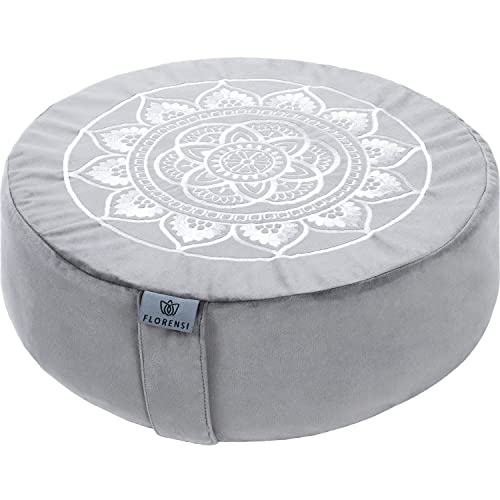
More height and a softer cover, if canvas feels harsh

A firmer, wider sit for people who use the floor a lot

Buckwheat and a handle for less, with less consistency
At a glance
| Product | Cushion Height | Cover Material | Price | |
|---|---|---|---|---|
| Hugger Mugger Zafu Meditation Cushion - OliveTop pick | 5 in | Durable Fabric | $76 |
| Bean Products Round Zafu Meditation CushionAlso great | 6 in | Cotton Duck Canvas | $70.95 |
| Gaiam Zafu Meditation CushionBudget pick | 0.01 in | — | $39.99 |
| Florensi Meditation Cushion Grey Velvet Buckwheat RoundRunner-up | — | Velvet | $44.99On sale |
How we picked
Fill material. We prioritized buckwheat hulls over foam or synthetic fill, since spec sheets and durability reporting both show hulls keeping their loft for years while foam compresses within months. Every cushion here is buckwheat-filled.
Height and hip lift. Yoga Journal specifies that a zafu should lift your hips three to five inches above your knees, with tighter hip flexors needing six to eight inches. We compared listed heights against that range and flagged cushions that skew tall or short.
Washable covers. Verywell Mind's analysis of verified retail reviews found a removable, machine-washable cover is the most commonly cited purchase criterion. We favored cushions with a separate outer cover, and gave extra credit to two-layer designs with an inner liner.
Build and stitching. We read owner feedback for patterns around seam failure, zipper problems, and fill leakage. Cushions with repeated complaints about construction dropped below those with consistent reports of durability past the one-year mark.
Fill adjustability. Because the right height is personal, we looked for a usable zipper that lets you pour hulls out and back in. Cushions with awkward or sealed access lost ground here.
Top pick
The traditional shape, done well, with fill you can tune
Hugger Mugger Zafu Meditation Cushion - Olive
A classic tuffet-shaped zafu with organic buckwheat hulls, a heavy woven cotton cover, and a hidden zipper for adding or removing fill. Owners who've sat on borrowed cushions for years consistently say this one finally puts their sit bones in the right place.
$76fromAmazonThe zipper is the whole reason this wins. Every buckwheat zafu ships overstuffed, and every body needs a different amount. Hugger Mugger's hidden zipper lets you pour hulls out until the height matches your hips, then add some back if you overshoot. Owners describe doing exactly this on day one — unzipping over a storage bin so the hulls don't scatter — and landing on a fit they've kept for years. It's a small feature that turns a guess into an adjustment.
The build reads as sturdy the moment it arrives. The cover is a woven cotton that owners compare to canvas, thick enough that it doesn't pill or thin out at the seams where your weight concentrates. It's sewn in the USA, and repeat buyers who've used cushions at group sits describe this one as noticeably more solid than the ones sitting in the corner of a studio. That matters more than it sounds: a cover that frays is the thing that ends a cushion's life, not the fill.
Owners report it working across postures — Burmese, quarter lotus, and seiza — rather than being tuned for one. That flexibility comes from the tuffet shape, which is wider at the seat than a flat round pillow and gives your thighs somewhere to fall. People who sit for longer stretches, forty-five minutes and up, are the ones most likely to say it beat the cushions they used before.
The handle earns its keep if you sit anywhere but one room. It's stitched into the side seam, and a fully filled buckwheat cushion is heavy enough that carrying it by the body gets awkward. If you take your cushion to a class, a friend's living room, or just from bedroom to porch, you'll use the handle every time.
Flaws but not dealbreakers
It's heavy. The listed weight is well above what a kapok cushion runs, and that's the tradeoff for a base that doesn't slide across a hardwood floor. If you're flying to a retreat, this isn't the cushion to pack.
The listing dimensions are confusing — the length figure doesn't match the round shape people receive, so don't try to plan your space around the spec line. Measure against a cushion you already own instead. Color options are also limited compared to the big retail brands.
Buckwheat hulls make a faint rustling sound when you shift your weight. Most people stop noticing after a week. If you're sensitive to small sounds in a quiet room, it's worth knowing going in.
Runner-upOn sale
More height and a softer cover, if canvas feels harsh
Florensi Meditation Cushion Grey Velvet Buckwheat Round
A taller buckwheat zafu with a velvet cover and a removable outer layer for washing. The extra height suits people whose knees ride high off the floor, and the soft cover is easier on bare legs than heavy cotton duck.
$44.99fromAmazonList priceIf your knees sit well above the floor when you cross your legs, height is your problem and this fixes it. This cushion runs taller than the standard five- to six-inch zafu, which tips the pelvis further forward and lets tight hips settle. Owners who couldn't get comfortable in lotus on a shorter cushion describe this one as the difference between sitting for five minutes and sitting for thirty.
The velvet cover is the other reason to pick it. Heavy cotton duck is durable but scratchy against bare skin, and if you meditate in shorts or after a shower, that texture registers. Velvet doesn't. The outer cover comes off for washing, which is the single most practical feature on any cushion you sit on daily — Verywell Mind's analysis of retail reviews found washability is what buyers cite most often.
It holds up. Owners who've had this cushion for a year or two report it still holding its shape, with no visible sagging at the center where weight concentrates. That's consistent with what Wirecutter found in long-term durability work on buckwheat cushions generally: hulls keep their loft where foam compresses within a couple of months.
This is also the cushion most people in this lineup actually own, and that volume shows up as unusually consistent feedback across postures. Practitioners who sit in Burmese posture for traditional Chan and Zen practice report it works fine, which isn't a given for cushions designed with a Western retail buyer in mind.
Flaws but not dealbreakers
The height that helps tight hips hurts shorter sitters. Owners around five foot two report their legs can't settle because the cushion lifts them too far, leaving their knees unsupported and their thighs tired. If you're on the shorter side, the Hugger Mugger is the safer buy.
There's a foam layer under the buckwheat rather than hulls all the way through. It's a small amount and owners don't complain about it compressing, but it's not the pure-hull construction a traditionalist wants.
Velvet holds dust and pet hair more than canvas does. You'll be running a lint roller over it more often than you'd expect.
Also great
A firmer, wider sit for people who use the floor a lot
Bean Products Round Zafu Meditation Cushion
A 14-inch round zafu in heavy cotton duck, handmade in Chicago with Midwest-grown organic buckwheat. It sits firmer than the others here, and the inner liner plus outer cover makes cleaning genuinely easy.
$70.95fromAmazonFirmness is the point here. The 10-ounce cotton duck cover doesn't give much, and packed buckwheat under it makes a seat that holds you upright rather than letting you sink and slouch. Owners who specifically wanted firm support — people who slouch and know it, or who sit for long stretches — are the ones happiest with it. If you like a cushion you can sink into, this isn't it.
The two-layer construction is better than what most cushions offer. There's an inner liner holding the hulls and a separate outer cover, so washing doesn't mean wrestling loose buckwheat. That matters over years of use, and it's the setup Zen centers tend to use for cushions that get sat on by many different people.
It's made in Chicago from hulls grown in the Midwest, triple-screened and heat-sanitized. That last part is worth noting given that buckwheat is an agricultural product and hull cleanliness varies by supplier. It also comes in a larger 18-inch oval if the round shape feels tight under a wider seated stance.
Owners keep finding uses beyond meditation. Floor sitting with a laptop, playing on the ground with grandkids, getting up and down more easily with sore hips — the height and firmness that work for a seated practice also work for anyone who'd rather be on the floor than in a chair.
Flaws but not dealbreakers
At 14 inches it's narrower than the Gaiam or Florensi, which some owners like for fitting into a small space but which can feel tight if you sit in a wide Burmese posture. The 18-inch oval exists for that reason, but it's a different purchase.
The cotton duck is stiff and scratchy at first. It softens with use, but the first few weeks against bare legs aren't pleasant.
Feedback on this one is a bit more mixed than on the top picks — a small share of owners report build issues, which suggests some variability from unit to unit.
Budget pick
Buckwheat and a handle for less, with less consistency
Gaiam Zafu Meditation Cushion
Gaiam's zafu covers the fundamentals: adjustable buckwheat fill, a removable cover, and a carry handle, at the lowest cost here. It's a reasonable first cushion if you're not sure floor practice will stick.
$39.99fromAmazonIf you're not yet sure meditation will become a habit, this is the low-commitment way in. You get real buckwheat hulls rather than foam, a cover that comes off to wash, and a handle, which is most of what actually matters. Owners describe it as having a satisfying weight and a firmness that doesn't feel cheap, and it's easy to find in stores if you'd rather sit on one before buying.
It's wider than the Bean Products cushion at 15 inches, which gives a wide-legged Burmese stance more room. Several owners mention using it for kundalini practice and for getting on and off the floor with a knee injury — the extra surface makes it easier to push up from.
The color range is the widest here, which sounds trivial until you realize this thing lives in a corner of your bedroom or living room permanently. Owners who care about their space looking calm rather than cluttered mention this more than you'd expect.
Flaws but not dealbreakers
Quality control is the real issue. A meaningful minority of owners report build problems, and at least one describes finding insects in the buckwheat fill. Hull cleanliness varies by supplier, and Gaiam doesn't publish the sourcing detail that Bean Products does. Inspect yours when it arrives.
The stitching and cover aren't at the level of the Hugger Mugger or Bean Products. It'll hold up to a few sessions a week for a while, but if you're sitting daily for years, expect to replace it sooner.
Adjusting the fill is fussier here — the zipper access isn't as clean, and removing hulls without scattering them takes patience.
Who this is for
Buy a zafu if you're sitting on the floor regularly and your back or knees are telling you about it. That includes people starting a home practice, longtime Zen and Vipassana practitioners replacing a worn cushion, yoga students moving into seated breathwork, and anyone who'd rather be on the floor than in a chair. If you have knee or hip trouble, the cushion is genuinely load-bearing — the hip lift is what keeps your knees from carrying weight they shouldn't. Pair it with a zabuton mat if you can; Lion's Roar describes that combination as the standard setup at Zen retreat centers, and it spreads pressure across your ankles and knees.
Skip it if you meditate in a chair, or if you're only sitting for five minutes at a stretch — a folded blanket handles that fine. This guide covers round and tuffet-shaped zafus filled with buckwheat hulls. It doesn't cover crescent cushions, wedge seats, kneeling benches, or zabuton mats, all of which solve related problems and deserve their own comparison. If your hips are tight enough that no amount of cushion height gets your knees toward the floor, a crescent shape or a bench may serve you better than anything here.
How we picked
We built the shortlist around five things. Fill: buckwheat hulls only, because spec sheets and durability reporting agree that hulls hold their shape for years while foam flattens within a couple of months. Height: cushions that land in the three-to-five-inch hip-lift range Yoga Journal specifies, with a note where a cushion runs tall enough to suit tight hips or too tall for a shorter sitter. Cover: removable and washable, ideally with a separate inner liner so cleaning doesn't mean chasing loose hulls across the floor. Build: owner feedback read for repeated seam, zipper, and fill-leak complaints. Adjustability: a zipper you can actually use, since the right height is something you dial in rather than guess.
The competition
This is what our research surfaced among widely available buckwheat zafus, not a survey of everything on the market. Several specialist brands — the ones that supply Zen centers directly — sell mostly through their own storefronts and aren't represented here.
Care and setup
Start by unzipping the cushion over a large storage bin or a bathtub and pouring out hulls until the height feels right — do this before your first real sit, and keep the extra hulls in a sealed bag so you can add them back. To clean, pull off the outer cover and machine wash it cold, then air dry; never wash the inner liner with the hulls inside, since damp buckwheat molds and won't dry out. If the fill starts to smell musty, spread the hulls on a sheet pan in the sun for a few hours. Buckwheat compresses slowly over years rather than failing suddenly, so top it up with fresh hulls when the cushion sits noticeably lower than it used to. Store it away from damp basements and out of reach of pets who find rustling fascinating.
Questions we get
What is a zafu, and do I need one to meditate?
A zafu is a firm round cushion that lifts your hips above your knees so your spine stacks naturally instead of rounding. You don't strictly need one — a folded blanket works for short sits. But if you're sitting longer than about fifteen minutes, the difference is real: research cited by Tricycle Magazine points to meaningfully less lumbar compression on a properly sized cushion versus sitting flat on a mat.
Should I choose buckwheat hull fill or kapok?
Buckwheat for almost everyone. It conforms to your sit bones, stays firm for years, and its weight keeps the cushion planted on a hardwood floor. Kapok is lighter — a kapok cushion runs one to two pounds against three to five for buckwheat — which makes it easier to carry to a retreat, but it softens noticeably within a year or so of daily use. Every cushion in this guide is buckwheat-filled.
What height cushion do I need?
Yoga Journal's guidance is that your hips should sit three to five inches above your knees. If your hip flexors are tight and your knees ride high when you cross your legs, you'll likely need six to eight inches. Standard zafus run five to six inches tall, so start there and adjust the fill through the zipper — that's exactly what the zipper is for.
How do I clean a meditation cushion?
Take the outer cover off and machine wash it in cold water, then air dry. Don't wash the inner liner with buckwheat hulls inside — wet hulls mold and are nearly impossible to dry properly. If the fill itself smells stale, empty it onto a tray and leave it in the sun for a few hours before returning it to the liner.
Do I need a zabuton mat too?
Not required, but it helps a lot if you sit longer than half an hour. A zabuton is a flat floor mat, usually 28 to 36 inches square and two to three inches thick, that cushions your knees and ankles where they meet the floor. Lion's Roar describes the zafu-plus-zabuton pairing as the standard setup at Zen retreat centers, and it's the single easiest way to extend how long you can comfortably sit.
How long does a buckwheat zafu last?
Years, if the cover holds up. Buckwheat hulls compress gradually rather than collapsing, so what usually fails first is stitching or a zipper, not the fill. When the cushion sits noticeably lower than it used to, buy a bag of replacement hulls and top it up rather than replacing the whole thing.
Why you should trust us
For this guide:
- We compared manufacturer specifications for every cushion here against sizing guidance from Yoga Journal and DharmaCrafts, focusing on seat height and diameter.
- We read published reporting from Wirecutter, Verywell Mind, Tricycle Magazine and Lion's Roar on fill durability, cover washability and zafu-zabuton pairing.
- We read owner feedback across all five listings for recurring themes around fit by body height, cover texture, stitching quality and fill cleanliness.
- We read owner reviews on every listing, weighted toward the critical ones, because that is where the recurring failures show up.
- We have a systematic way of automatically fetching the latest prices, so the numbers on this page stay current.
- This is a research-focused guide, so the team may not own every product listed — though we often do own the top winners, which gives us extra context for the recommendations.
- We don't accept free products, and the retailer commission never changes which product we recommend.
Sources
How to Choose a Meditation Cushion — Yoga Journal, Yoga Journal
Best Meditation Cushions — Wirecutter (NYT), Wirecutter
Best Meditation Cushions — Verywell Mind, Verywell Mind
Best Meditation Cushions — Healthline, Healthline
How to Sit — Posture and Equipment Guide — Lion's Roar, Lion's Roar
Meditation Cushion Buyer's Guide — DharmaCrafts, DharmaCrafts
Meditation Gear Guide — Mindful Magazine, Mindful Magazine
Meditation Cushions and Posture — Tricycle: The Buddhist Review, Tricycle Magazine
Meditation Equipment and Posture Science — Yoga International, Yoga International
GREENGUARD Gold Certification — UL Solutions, UL Solutions
Global Meditation Market Report — Grand View Research, Grand View Research
Amazon product listings and owner reviews for all 4 products
Manufacturer specification pages for each product
Some passages in this guide may be paraphrased with AI help. Prices are refreshed automatically.
More like this.
Continue exploring lifestyle reviews and recommendations.

The Best Mindfulness and Meditation Books
Learning to meditate from a book sounds backwards, but it's how most people actually start. You don't need a teacher or a retreat to begin. You need…

The Best Heated Car Seat Cushions
A cold car seat in January is its own kind of misery. Your factory seat heaters, if you have them, take a few minutes to do anything useful - and plenty…

The Best Lumbar Support Cushions
Your chair's backrest is flat. Your lower back isn't. A lumbar cushion fills that hollow just above your beltline so your spine keeps its natural inward…

The Best Journal Notebooks for Daily Writing
A journal notebook only earns its place if you actually reach for it. That sounds obvious, but it's where most notebooks fail. The paper feathers your…

The Best Historical Fiction Books
Historical fiction has one job: to put you somewhere you've never been and make it feel ordinary. The cold of a French farmhouse in winter, the noise of a…

The Best Robotic and Cordless Electric Lawn Mowers
Mowing is the one chore you can't skip, and for most of us it eats a Saturday morning every week from April through October. Electric mowers change that…