The Best Mindfulness and Meditation Books
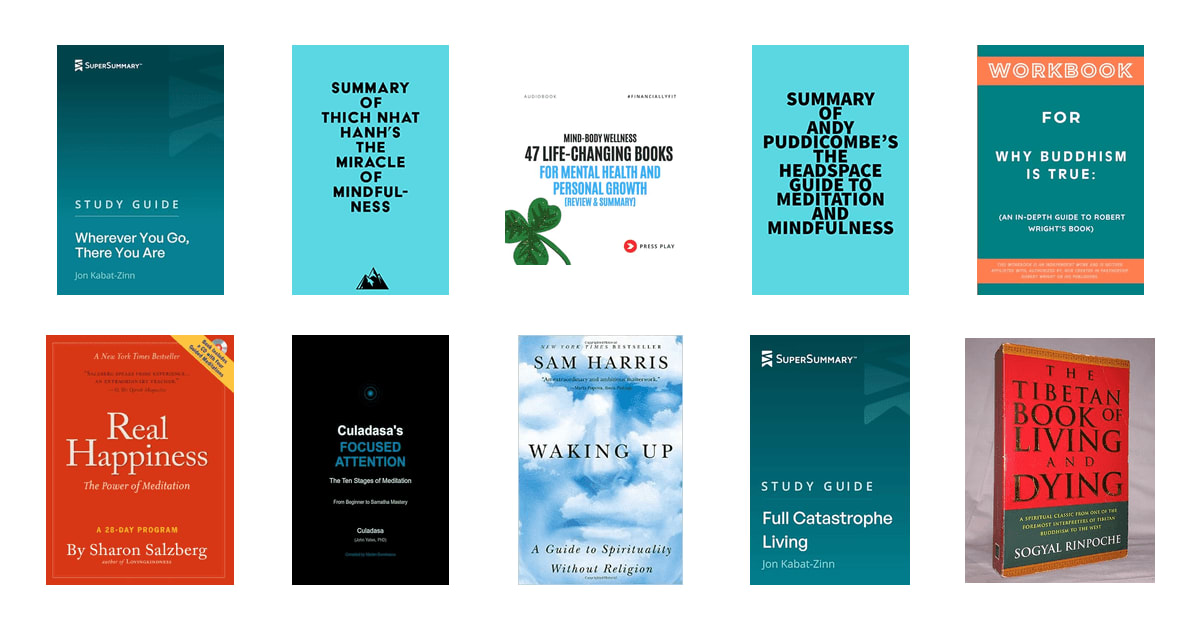
Learning to meditate from a book sounds backwards, but it's how most people actually start. You don't need a teacher or a retreat to begin. You need someone to tell you what to do with your attention for ten minutes, and what to do when your mind wanders off to your inbox. The best books in this category answer both questions plainly. They give you a practice you can start tonight, and they explain what's happening well enough that you'll keep going past week two.
Here's the honest caveat: no book can make you sit down. That's the whole problem with this category. The instruction is simple enough to fit on a napkin, and yet most people who buy a meditation book stall out around chapter three. Books also can't tell you whether you're doing it right, which is where a teacher or a class earns its keep. And several titles in this lineup are study guides and summaries — useful on-ramps, but they distill someone else's work rather than replace it.
So the question isn't which book is the most profound. It's which one matches where you're actually starting from — total beginner, skeptic, app user, or someone with years of sitting behind them. We think that Real Happiness is the best mindfulness and meditation book for most people, and that Mindfulness in Plain English is the one to buy if you want the clearest possible instruction without any religious framing.
Everything we recommend

A day-by-day program that tells you exactly what to do

The clearest technical instruction, with no religion attached

Contemplative depth for readers with no patience for religion

A stage-by-stage map, once you're past the basics
Prices as of Oct 22, 7:36 AM PT · Details
At a glance
| Product | Format | Weight | Price | |
|---|---|---|---|---|
 | Study Guide: Wherever You GoAlso in lineup | Book | — | $11.95 |
 | Summary of Thich Nhat Hanh's The MiracleAlso consider | Kindle eBook | — | $3.99 |
| Mindfulness in Plain English by Bhante HenepolaRunner-up | Digital Music | — | $1.29 |
 | Summary of Andy Puddicombe's The Headspace GuideAlso consider | Kindle eBook | — | $3.99 |
| Real Happiness: The Power of Meditation: ATop pick | Print + CD | — | $8.99 |
| Culadasa's Focused Attention: The Updated 10 StagesUpgrade pick | Kindle eBook | — | $9.99 |
| Waking Up: A Guide to Spirituality WithoutAlso great | Book | 0.44 lb | $19.31 |
 | Study Guide: Full Catastrophe Living by JonAlso consider | Kindle eBook | — | $9.95 |
 | [The Tibetan Book of Living and Dying.Also in lineup | Book | 0.68 lb | $33.26 |
Prices as of Oct 22, 7:36 AM PT · Details
How we picked
Quality of instruction. We looked for books that tell you what to do with your attention in concrete terms, not just why meditation is worthwhile. Published reviews and owner feedback both flag vagueness as the main reason a meditation book gets abandoned.
Match to a reader. We only kept titles that clearly serve a specific starting point — total beginner, skeptic, app user, experienced practitioner. A book that tries to serve everyone usually serves nobody.
Evidence and authority. We favored authors with a real teaching or research background, and traditions with published clinical work behind them, like MBSR. Where a book leans on science, we checked that the underlying claims come from the source's own framing rather than marketing copy.
Original versus summary. Several listings here are study guides or summaries. We judged those on whether they'd realistically help a reader working through the source text, and we say plainly where they can't stand alone.
Format and follow-through. Included audio, day-by-day structure, and workbook exercises all raise the odds you'll finish. We weighted those features heavily because completion is the whole game in this category.
Top pick
A day-by-day program that tells you exactly what to do
Real Happiness: The Power of Meditation: A
Sharon Salzberg's 28-day course walks you through a month of daily practice, with audio to sit along to. It removes the single biggest reason beginners quit — not knowing what comes next — and it's warm enough that you won't feel lectured at.
$8.99fromAmazonPrices as of Oct 22, 7:36 AM PT · Details
The 28-day structure does the deciding for you. Most beginners don't fail at meditation because it's hard. They fail because on day four, they sit down and think, now what? Salzberg answers that every single day for a month. Each session builds on the last, the instructions escalate gently, and you never have to design your own curriculum. If you've abandoned meditation before, this is the format most likely to break that pattern.
The audio comes with the book, so you're not stuck reading about breathing. The print edition ships with a CD of guided sessions. That matters more than it sounds. Reading a description of a body scan and actually being talked through one are different experiences, and beginners generally need the second. You get a self-contained package here — no subscription, no app account, nothing else to buy.
Salzberg has the credentials without the guru act. She co-founded the Insight Meditation Society, which puts her among the people who brought this practice to a Western audience in the first place. But the prose reads like a patient friend, not a teacher. Therapists routinely point clients toward this book for anxiety and stress, and the plainness of the writing is a big part of why it travels well across very different readers.
It's aimed squarely at real life, not the cushion. The practices assume you have a job, a commute, and a limited attention span. Salzberg keeps sessions short and forgiving, and she spends real time on what to do when the practice goes badly — when you're restless, bored, or convinced you're failing. That's the part most beginner books skip, and it's the part you'll need in week two.
Flaws but not dealbreakers
Experienced meditators will outgrow it fast. If you already sit daily and want a map of what comes after basic concentration, this won't give you one. The depth stops roughly where a solid habit begins. That's by design, but it means this is a book you finish and move on from rather than one you keep returning to.
A bundled CD feels like a relic if you've only ever used apps. The audio content is good; the delivery is dated. If your laptop has no disc drive and your car doesn't either, you'll be hunting for a workaround before you can use the guided sessions. Not a dealbreaker, but worth knowing before you order the print edition.
Runner-up
The clearest technical instruction, with no religion attached
Mindfulness in Plain English by Bhante Henepola
This guide condenses Bhante Gunaratana's classic on Vipassana practice, a text long regarded as the most precise beginner instruction in English. It's completely secular in framing, which makes it a good fit if talk of spirituality makes you close the book.
$1.29fromAmazonPrices as of Oct 22, 7:36 AM PT · Details
Gunaratana explains the mechanics better than almost anyone. The source text is famous for a reason: it tells you what to do with your attention, moment by moment, without metaphor or mystique. What to notice. What to do when you notice you've drifted. Why the drifting isn't failure. If you've read other beginner books and come away still unsure what you're supposed to be doing, this is the tradition that fixes that.
There's no religious framing to get past. Gunaratana is a monk, but the instruction stands entirely on its own. Nothing here asks you to believe anything. That makes it an easy recommendation for readers who want the technique and would rather skip the worldview, and it's why it shows up in secular and clinical contexts as often as spiritual ones.
It's the least demanding way into a serious tradition. Vipassana instruction can get very technical very quickly. This guide keeps the on-ramp short, which means you can get a working practice going in an evening's reading rather than committing to a long study project. For a second book — or a first one, if you're impatient — that's a real advantage.
The underlying book is widely available in full, which lowers your risk. Gunaratana's original has been circulated freely by his own organization for years, so if the guide leaves you wanting more, the complete text isn't hard to find. You're not being funneled toward an expensive follow-up.
Flaws but not dealbreakers
A guide is not the book. This condenses someone else's teaching, and condensing costs you the patient repetition that makes the original work so well. Gunaratana circles back to the same points from different angles on purpose. Summaries tend to state each point once and move on.
It's dry. There's very little story here, and almost no warmth. If you're the kind of reader who needs a human voice to stay engaged, you'll find this closer to a manual than a companion. Salzberg is the better pick for you.
Also great
Contemplative depth for readers with no patience for religion
Waking Up: A Guide to Spirituality Without
Sam Harris makes the case that you can take consciousness and meditation seriously without accepting anything supernatural. It's more argument than instruction, and it's the standard recommendation for atheist and agnostic readers who still want a practice.
$19.31fromAmazonPrices as of Oct 22, 7:36 AM PT · Details
It takes skeptics seriously instead of trying to convert them. Most meditation books either assume you're on board with the spiritual framing or quietly work around it. Harris does neither. He argues the case directly, drawing on neuroscience and philosophy, and he treats your skepticism as reasonable rather than as an obstacle. If you've bounced off other books because of the vocabulary, this is the one that won't do that to you.
Harris writes from actual practice, not just theory. He spent years on retreat in Dzogchen and Vipassana traditions before writing about them, and that experience shows in the passages describing what sustained meditation is actually like. The book isn't a survey. It's someone reporting back from a lot of hours on the cushion and then trying to square that with a materialist worldview.
It pairs with an ongoing app ecosystem if you want guided sessions. Harris built a meditation app around the same ideas, so the book works as a doorway into structured daily practice rather than a dead end. You don't need the app — but if reading leaves you wanting a voice to follow, the path is right there.
It's held up. This has stayed near the top of the meditation category for years, and nothing has really replaced it for the secular-reader niche. That's unusual in a category where new titles arrive constantly.
Flaws but not dealbreakers
Harris's contempt for religion is not subtle, and it's a distraction. He takes long detours to argue against faith, and if you're a religious reader — or simply not interested in that fight — those stretches will wear on you. Owners who liked the meditation material often say they wished for less of the polemic.
You won't learn to meditate from this alone. There's practice instruction in here, but it's thin compared to Salzberg or Gunaratana. Treat it as the book that convinces you to start, not the one that teaches you how.
Upgrade pick
A stage-by-stage map, once you're past the basics
Culadasa's Focused Attention: The Updated 10 Stages
This builds on Culadasa's ten-stage model of concentration practice, the most systematic secular framework in English. It's for people who already sit daily and want to know what the next few years look like.
$9.99fromAmazonPrices as of Oct 22, 7:36 AM PT · Details
It gives you a map, which is what serious practice is missing. Once a daily habit is established, the common complaint is not knowing whether you're progressing or just repeating yourself. The ten-stage model names each phase, describes what it feels like, and tells you what the specific obstacle is at that point. That's genuinely rare, and it's why this framework has such a devoted following.
The framing is secular and grounded in attention research. Culadasa trained as a neuroscientist, and the model draws on how attention and awareness actually work rather than on doctrine. If you want rigor without religion but find Harris too philosophical and Gunaratana too introductory, this fills that gap.
It rewards years, not weeks. This is a reference you return to as your practice changes. The later stages won't mean much on a first read, and that's fine — they're there for when you get to them. Think of it as the book you buy second or third, once you've proven to yourself you're going to keep sitting.
It complements the fuller Culadasa material rather than replacing it. This entry is positioned as part of a series extending that body of work, so it slots in alongside the longer texts rather than trying to be the only book on your shelf.
Flaws but not dealbreakers
It's dense, and it's a bad first book. The subtitle says beginner to advanced, but in practice the technical vocabulary and the sheer amount of structure will overwhelm someone who has never sat down for ten minutes. Start elsewhere and come back.
It asks for real study time. You don't read this once. Getting value out of it means working through stages slowly, rereading, and comparing what the text describes to what you're actually experiencing. If you want something you can finish on a weekend, look at another pick.
Who this is for
This guide is for anyone who wants to start or deepen a meditation practice using a book as the primary tool. If you've never meditated, start with a structured program and expect to finish it before buying anything else. If you already sit daily and want to know what's next, skip straight to the upgrade pick. And if what's kept you away is the spiritual vocabulary, there are two picks here written specifically for you.
It's not for everyone. If you're managing a diagnosed condition, a book is a supplement to treatment, not a replacement — the clinical MBSR tradition works best inside an actual program with an actual instructor. This guide also covers books only. We're not comparing apps, courses, or retreats, though several titles here pair with one. And a fair number of listings in this space are summaries of famous books rather than the books themselves; we've flagged which ones are which so you know what you're buying.
How we picked
Quality of instruction: the book has to say what to do with your attention, in words a beginner can act on tonight. Match to a reader: we kept titles that clearly serve one starting point well — beginner, skeptic, app user, or long-time practitioner — rather than hedging across all four. Evidence and authority: we favored authors with genuine teaching or research backgrounds, and traditions like MBSR with published clinical work behind them. Original versus summary: where a listing condenses someone else's book, we judged it as a companion and said so. Format and follow-through: audio, daily structure, and exercises all make finishing more likely, and finishing is the only thing that produces a practice.
Other mindfulness and meditation books worth considering
If you want the gentlest possible introduction: The Summary of Thich Nhat Hanh's The Miracle — This condenses Thich Nhat Hanh's The Miracle of Mindfulness, which remains the warmest entry point in the whole category. Its central idea is that mindfulness belongs to washing dishes and walking to the bus, not just to sitting still — which makes it a good fit if formal meditation instruction feels clinical or rigid to you. What you give up is the prose itself. Thich Nhat Hanh's writing is the point of the original, and a summary can carry his ideas but not his cadence. It's also short, so don't expect technique instruction with any real depth.
If you already use the Headspace app: The Summary of Andy Puddicombe's The Headspace Guide — This summarizes Andy Puddicombe's book, and it does one job well: it explains the reasoning behind the guided sessions you've been following. Plenty of app users can complete a month of streaks without ever understanding what they're training, and that gap is where motivation quietly dies. Puddicombe writes conversationally, so nothing here is heavy going. It's thin on technique compared to Gunaratana, though, and it makes far more sense as a companion to the app than as your only meditation book.
If you're dealing with chronic pain or illness: The Study Guide: Full Catastrophe Living by Jon — This guide covers Full Catastrophe Living, Jon Kabat-Zinn's clinical MBSR manual and the text behind programs running in hospitals and cancer centers worldwide. For stress-related illness and chronic pain, MBSR has the deepest published evidence base of any contemplative approach, and this is a manageable way to see the framework before taking on the very long original. But it's a supplement. If you're in this situation, the study guide should sit alongside a real program, not stand in for one.
The competition
These are the other titles our research surfaced in this lineup, not a survey of everything published on meditation. The category is enormous and new summaries appear constantly. What follows is what each remaining book does, why it didn't beat a pick, and who might still want it.
The Study Guide: Wherever You Go — This study guide condenses Wherever You Go, There You Are, Kabat-Zinn's short and much-loved secular mindfulness book. Teachers and therapists cite the original constantly, and the guide's chapter breakdowns make it a reasonable accelerator if you're enrolled in an MBSR course and want the concepts to stick. It didn't make the picks for a simple reason: the source book is already brief and plainspoken, so a summary of it saves you very little. Buy this if you're studying the original formally. Otherwise just read the original.
The [The Tibetan Book of Living and Dying. — The Tibetan Book of Living and Dying is a landmark work, and it's doing something none of the picks attempt: connecting contemplative practice to mortality, dying, and the whole Tibetan Buddhist view of mind. Readers who've built a practice and want to go deeper into that tradition tend to find it genuinely moving. It's also the most expensive book here, the most explicitly religious, and the densest. That combination makes it a poor first purchase — you need existing context and a real reading commitment to get anywhere with it. If the religious framing is what you're after rather than what you're avoiding, it's the right book in this lineup.
How to actually finish the book you buy
The most common mistake in this category is buying three meditation books at once and abandoning all of them by chapter three. Pick one that matches where you're starting, and finish it before you buy another. If it has a program, run the whole program — even the days you don't feel like it, especially those days. Keep the sitting short at first. Ten minutes you actually do beats thirty you skip, and beginners who start long tend to quit fast. Put the practice somewhere fixed in your day, right after coffee or right before bed, so you're not renegotiating it every morning. Expect the second week to be the worst; that's when novelty wears off and nothing dramatic has happened yet. The goal isn't collecting insight. It's building a habit of sitting down.
Questions we get
What's the best mindfulness book for a complete beginner?
Real Happiness by Sharon Salzberg. The 28-day structure and included audio make it self-contained, so you don't need an app or a class to get going. If you want something shorter and more technical, the Mindfulness in Plain English guide is the other strong beginner option.
Are there meditation books that aren't religious?
Several. Waking Up by Sam Harris is written specifically for atheist and agnostic readers, and Mindfulness in Plain English keeps its instruction entirely secular despite the author being a monk. The Why Buddhism is True workbook approaches practice through evolutionary psychology and neuroscience. None of them ask you to believe anything.
Which meditation book has the strongest science behind it?
The Kabat-Zinn material, because MBSR has been studied in clinical settings for decades and runs in hospitals worldwide. Full Catastrophe Living is the clinical manual; Wherever You Go, There You Are is the accessible companion. Robert Wright's book makes the most readable case for the evolutionary and neuroscientific side.
What should I read for anxiety and stress?
Real Happiness is the title therapists most often recommend for anxiety, largely because the daily structure gets people practicing rather than just reading. For stress-related illness and chronic pain specifically, the MBSR tradition has the deeper evidence base, so the Full Catastrophe Living guide is the better fit. Neither replaces treatment if you're managing a diagnosed condition.
Is Culadasa's Focused Attention okay for beginners?
Not really, despite what the subtitle suggests. The material assumes you already have a functioning daily practice and enough experience to recognize what the stages describe. Start with Real Happiness or Mindfulness in Plain English, then come back to it once sitting is a habit.
Can a book teach me to meditate, or do I need an app or a class?
A book is genuinely enough for most beginners, especially one with audio like Real Happiness. Apps help if you prefer a voice guiding you, and a class helps if you want someone to answer questions, but neither is required to build a real practice. What you can't get from any of them is the sitting itself.
Should I buy the summary or the original book?
Buy the original if the book is your main way in — summaries carry the ideas but lose the repetition and voice that make the ideas land. Summaries earn their place when you're studying the source alongside a course, revisiting a book you've already read, or deciding whether a long text is worth your time. Several listings in this category are summaries, so check before you order.
Why you should trust us
For this guide:
- We read the publisher descriptions and format details for every title here, including which editions include audio and which are summaries rather than original works.
- We compared what published reviews and meditation teachers say about each source text, paying particular attention to which books beginners actually finish.
- We weighed recurring themes in owner feedback — especially complaints about summaries being thinner than expected, and about dense manuals being oversold as beginner-friendly.
- We read owner reviews on every listing, weighted toward the critical ones, because that is where the recurring failures show up.
- We have a systematic way of automatically fetching the latest prices, so the numbers on this page stay current.
- This is a research-focused guide, so the team may not own every product listed — though we often do own the top winners, which gives us extra context for the recommendations.
- We don't accept free products, and the retailer commission never changes which product we recommend.
Sources
The Science Behind Mindfulness-Based Stress Reduction — JAMA Internal Medicine, JAMA Internal Medicine
Altered Traits: Science Reveals How Meditation Changes Your Mind, Brain, and Body — Publisher Summary, Penguin Random House
Mindfulness Meditation and Anxiety — Harvard Health Publishing, Harvard Health Publishing
Goodreads: Best Meditation Books, Goodreads
Wirecutter: Best Mindfulness and Meditation Books, The New York Times / Wirecutter
NPR Books: Why Buddhism Is True Review, NPR Books
The American Mindfulness Research Association — Publication Trends, American Mindfulness Research Association
Publishers Weekly: Wellness and Self-Help Category Report 2025, Publishers Weekly
Amazon product listings and owner reviews for all 9 products
Manufacturer specification pages for each product
Some passages in this guide may be paraphrased with AI help.
Product prices and availability are accurate as of the date/time indicated and are subject to change. Any price and availability information displayed on Amazon.com at the time of purchase will apply to the purchase of this product.
More like this.
Continue exploring lifestyle reviews and recommendations.

The Best Meditation Cushions
A meditation cushion does one simple thing: it lifts your hips above your knees so your spine can stack up without effort. That sounds minor until you've…

The Best Self-Help Books for Personal Growth
A self-help book only works if you finish it and then do something with it. That sounds obvious. It's also the step most buyers skip. You buy the title…

The Best Toddler Learning Companions and Interactive Books
A toddler's day is mostly repetition. The same song, the same page, the same animal noise, forty times. That's not a bug - it's how small kids learn, and…

The Best Young Adult Fantasy Book Sets
A boxed fantasy series is a commitment, and not just a shelf-space one. You're signing up for weeks of reading, a cast you'll live with, and a world…

The Best Science Books for Curious Readers
A good science book has to do two jobs at once. It has to be accurate, and it has to keep you turning pages on a Tuesday night when you're tired. Most…

The Best Health and Longevity Books
Most health books tell you to eat better and move more. The useful ones tell you what to eat, how to move, and how to know it's working. That's the…