The Best Metal Lathes for Hobbyist Machinists
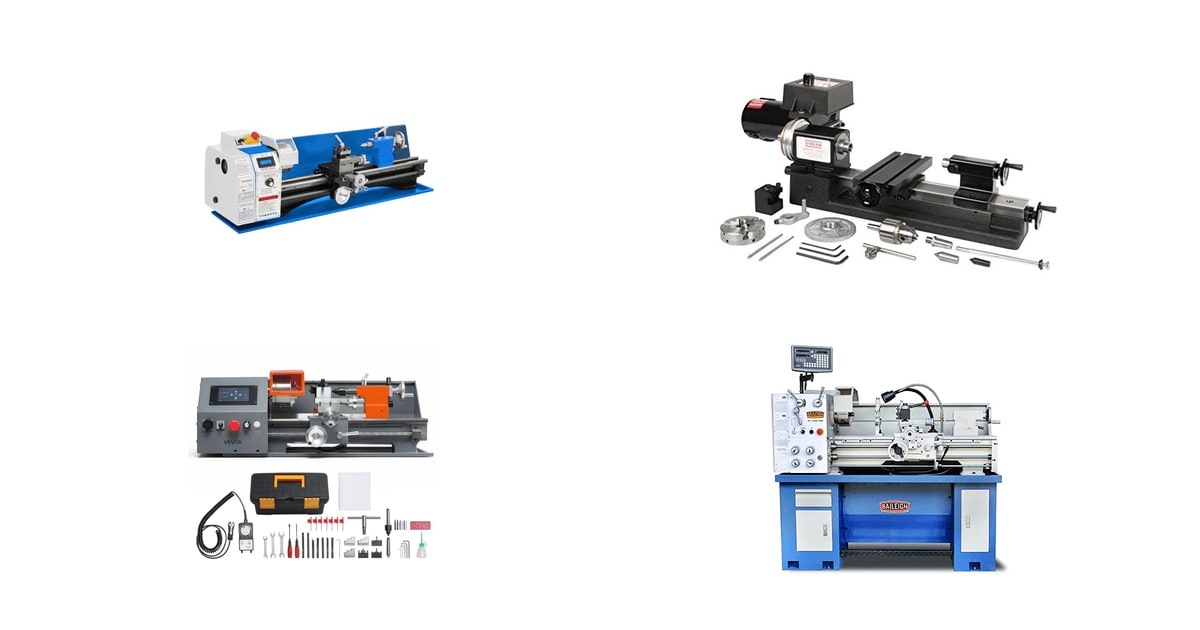
A metal lathe is the machine that lets you make a part instead of ordering one. You chuck up a piece of steel or brass, and a few minutes later it's a bushing, a shaft, or a replacement pin that nobody sells anymore. For most hobbyists the appeal is repair work and small builds: model engines, RC parts, a stuck fastener turned down to fit. The machine doesn't have to be big. It does have to be rigid, and it has to hold a size.
Here's the part nobody puts on the box. No hobby lathe arrives ready to cut. You'll level it, scrub off the shipping grease, and buy tooling — a quick-change tool post, cutters, a live center, probably a four-jaw chuck. Swing numbers are optimistic too. A lathe rated for a 10-inch swing gives you closer to 7 or 8 inches of usable diameter once the tool, the compound and the chuck jaws are all in the way. Budget for the extras before you fall for a spec sheet.
Capacity is where people get burned. Surveys on hobby machining forums keep turning up the same regret: the first lathe was too small, and distance between centers is the spec buyers wish they'd doubled. Bed length can't be upgraded later, so buy longer than your current project list suggests. We think that the JET BDB-929 is the best metal lathe for most people, and that the Festisoul 9-inch benchtop lathe is the one to buy if you want stepless variable speed in a machine two people can lift.
Everything we recommend
Heavy, well-supported, and set up for real threading work
Stepless speed and a digital display, in a lighter machine

More swing, more length and a built-in DRO, if you have 220 volts

Tiny capacity, but the accuracy small-parts work demands
At a glance
| Product | Swing Capacity | Motor Power | Price | |
|---|---|---|---|---|
| 9"x30" Benchtop Metal LatheRunner-up | 9x30 in | 1100W | $1,239 |
| Sherline 8 Inch Lathe Package A 4000AAlso great | 8 in | 90V DC | $860 |
 | VEVOR Metal Lathe 8"x16" 1100W Benchtop CNCAlso in lineup | 8x16 in | 1100W | $1,679.99 |
| Baileigh Industrial - PL-1236E-DRO-1.0; 220V 1Phase LatheUpgrade pick | 12x36 in | 220V 1Ph | $11,064.99 |
| JET 9" x 29" Belt Drive BenchTop pick | 9x29 in | 3/4 HP | $3,999.99 |
How we picked
Capacity that lasts. We compared swing over bed and distance between centers against the projects hobbyists describe on machining forums. Because owners overwhelmingly report their first lathe was too short, we weighted bed length heavily — it's the one spec you can't upgrade.
Rigidity and mass. We read manufacturer specs on weight, bed construction and carriage fit, since mass is what stops chatter and gives a clean finish. Anything too light to hold a cut in steel got flagged as a non-ferrous machine, not a general-purpose one.
Threading and feed. We looked for power longitudinal feed and a quick-change gearbox covering both inch and metric threads. Change-gear-only machines still work, but published guides and owner feedback agree that swapping gears by hand means you'll thread less often.
Power and speed range. We compared motor ratings and usable RPM spans, paying attention to how low each machine goes. Low-end torque is what lets you rough heavy cuts and thread up to a shoulder; a high top speed only helps on small-diameter finishing.
Parts and support. We favored brands with US distribution, published parts diagrams and a real support line. Community consensus is that a lathe you can't get a replacement gear for becomes a very heavy shelf.
Top pick
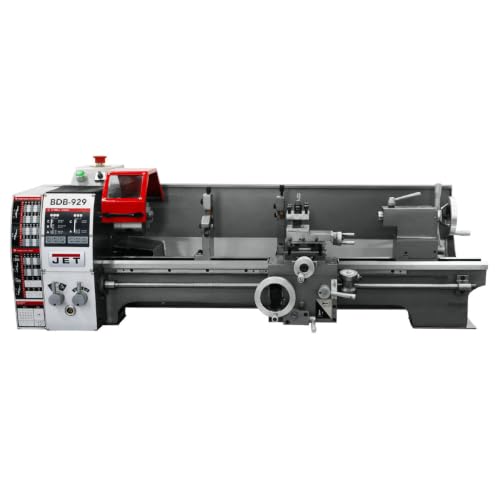
Heavy, well-supported, and set up for real threading work
JET 9" x 29" Belt Drive Bench
The BDB-929 is a 287-pound belt-drive bench lathe with a quick-change gearbox that cuts both inch and metric threads. It runs off a standard 115-volt outlet, gives you 29 inches between centers, and comes from a brand whose parts and dealers you can actually reach.
$3,999.99fromAmazonFor most home shops, this is the right amount of lathe. Nine inches of swing and 29 inches between centers covers the work hobbyists actually do — bushings, arbors, small shafts, motorcycle and lawn-equipment repairs. It's long enough that you're not fighting the tailstock on every job. And at 287 pounds it has the mass to damp the chatter that makes lighter benchtop machines miserable on steel.
The quick-change gearbox is the feature that earns its keep. Cutting threads without one means swapping change gears by hand, which is greasy, fiddly work you'll end up doing less often than you should. Here you just move levers. Inch and metric threads are both on the chart, and power longitudinal feed handles the tedium of long turning passes. Reverse threading is there too, which matters when you cut up to a shoulder.
Belt drive is the trade-off. You change speed by moving a belt on stepped pulleys instead of turning a dial, so it's a lid, a glove and about thirty seconds. Gear-head lathes hold torque much better at low RPM, which is what you want for heavy roughing in alloy steel. But those machines weigh hundreds of pounds more and usually want 220-volt power. For aluminum, brass, mild steel and the occasional harder job, belt drive is fine.
Support is the quiet reason to buy this one. JET sells through the major tool retailers, so a belt, a gear or a chuck is a phone call rather than a shipping container from overseas. The listing also covers the small things that make daily use pleasant: backlash adjustment throughout the carriage, a full-length splash guard, a reversing switch, and an emergency stop right where your hand already is.
Flaws but not dealbreakers
Three-quarters of a horsepower is modest. You can cut steel with it, but you'll take lighter passes and more of them than someone running a 1.5 HP machine. Deep roughing cuts in tough alloy will bog it down, and pushing anyway is how you snap a tool.
Then there's the bulk. At 287 pounds and just over four feet long, this isn't going on a folding workbench. You want something solid and bolted down, and you want a second person on moving day. There's no digital readout either, so you're counting dial graduations until you add one.
Runner-up
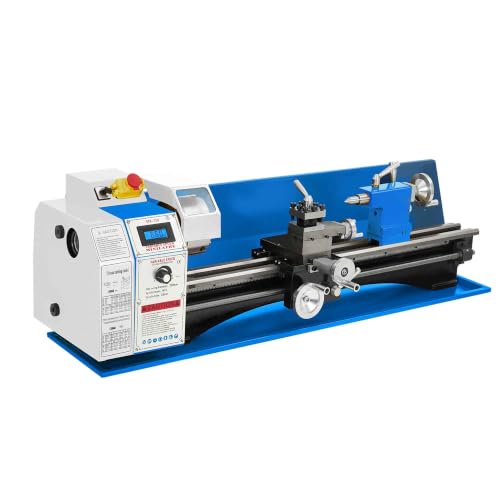
Stepless speed and a digital display, in a lighter machine
9"x30" Benchtop Metal Lathe
This 188-pound benchtop lathe runs an 1,100-watt motor with stepless speed control across two ranges, and it shows real spindle RPM on a digital display. It ships with a 3-jaw chuck, a 4-way tool post, cutters and change gears, so you can make chips the day it lands.
$1,239fromAmazonVariable speed changes how a lathe feels to use. Instead of stopping to move a belt, you turn a knob and watch the RPM on the display. The low range runs from a crawl up to 1,250 RPM for roughing and threading. The high range goes to 2,500 for small-diameter finishing in aluminum. If you're learning, that instant feedback is genuinely useful — you can dial in a speed and watch the chip change.
The motor is the other reason to look here. At 1,100 watts it has real grunt compared to the small mini lathes, and it delivers it without the belt-swap ritual. Forward and reverse sit on a switch. There's an emergency stop, a brake handle and an automatic power-off cover over the chuck, which is a sensible set of safeguards on a first machine.
It's also the easiest of our picks to live with. Under 190 pounds means two people can set it on a sturdy bench without renting equipment. The included tool box covers cutters, change gears, outside jaws, wrenches, an oiler and mounting hardware — the accessories that quietly add up when you buy them one at a time.
Think of it as the JET's lighter, more modern sibling. You give up mass and a lever-operated threading gearbox. You get speed control, a readout and a lathe you can actually move by yourself and a friend. For aluminum, brass and light steel work, that trade lands in this machine's favor more often than spec-sheet shoppers expect.
Flaws but not dealbreakers
The naming is misleading, and it matters. The listing calls this a 9-by-30 machine, but the stated swing over the bed is 7.09 inches and the distance between centers is 13.78 inches. That's a big gap. Measure your longest planned part before you order, because 14 inches of capacity rules out a lot of shaft work.
Lighter also means less rigid. Under 190 pounds is easy to move and easier to make chatter, so heavy passes in steel are off the menu. And a stepless dial is not a threading gearbox — check the change-gear chart against the threads you actually need before you commit.
Upgrade pick
More swing, more length and a built-in DRO, if you have 220 volts
Baileigh Industrial - PL-1236E-DRO-1.0; 220V 1Phase Lathe
The PL-1236E gives you a 12-inch swing and 36 inches between centers, with variable speed from 70 to 1,400 RPM and a digital readout built in. It's the lathe to buy when your projects have outgrown a 9-inch benchtop machine and you've got the floor space to spare.
$11,064.99fromAmazonThis is the capacity most hobbyists eventually wish they'd bought. Twelve inches of swing puts brake rotors, flywheels and larger flanges on the table — call it eight or nine inches of genuinely usable diameter once tooling clearance is accounted for. Thirty-six inches between centers handles long shafts and barrel work. You can't add bed length later, and this is the pick that takes that seriously.
The integrated DRO is not a nice-to-have. Reading position off a screen instead of counting handwheel graduations removes the most common source of scrapped parts, especially when you back out of a cut and re-enter it. Retrofit kits exist for other lathes, but they cost real money and take a weekend of drilling and squaring. Here it arrives already aligned and wired.
Speed tops out at 1,400 RPM, which sounds low until you think about what a 12-inch lathe is for. Bigger diameters want slower spindle speeds, because surface speed at the cutting edge climbs fast as the part grows. Down at 70 RPM you get the torque for heavy roughing and for threading up to a shoulder without panic. A quick-change tool post comes standard.
Baileigh aims this one at small fabrication shops, schools and serious garages, and it shows in the details rather than the marketing. The gear system covers tapping, turning and polishing. A machine built to survive a room full of students is a decent proxy for surviving whatever a weekend hobbyist throws at it.
Flaws but not dealbreakers
It runs on 220-volt single-phase power. If your garage has nothing but 120-volt outlets, add an electrician's visit to the cost and the timeline. That's the single biggest reason people cross this one off the list.
It's also a floor machine in spirit, not a benchtop. A 12-by-36 lathe with a DRO takes serious space and serious support, and getting one down a basement stairwell is a project of its own. If your work is small parts a few inches long, you're paying for capacity you'll never reach.
Also great
Tiny capacity, but the accuracy small-parts work demands
Sherline 8 Inch Lathe Package A 4000A
The Sherline 4000A is an 8-inch American-made lathe that weighs 27 pounds and runs a DC motor with electronic speed control. It's built for watch, clock and model engine work, where half a thousandth of an inch matters far more than how much steel you can hog off.
$860fromAmazonMost of this guide is about capacity. This pick isn't. Sherline builds small precision lathes in San Marcos, California, and the company's technical documentation puts accuracy for the line in the half-thousandth range under normal hobby conditions. If you're a model engineer boring a cylinder or a clockmaker turning an arbor, that's the number that decides the purchase.
It's the only machine here you can pick up and carry. Twenty-seven pounds fits on an apartment table, a closet shelf or the corner of a desk. No 220-volt circuit, no engine hoist, no reinforced bench. If you live somewhere a 300-pound lathe simply isn't happening, this is an honest answer rather than a sad compromise.
The accessory catalog is the real asset. Sherline backs the lathe with a deep line of dedicated attachments — milling columns, indexing, collets, steady rests — built by the same company to the same standard. That matters, because import machines often leave you adapting parts that were never meant to fit together. This package also ships with a faceplate, lathe dog, two dead centers, a tool post and a sharpened high-speed steel cutter.
The DC motor with electronic speed control gives you smooth, stepless adjustment right down to very low RPM, which is exactly what fine work in brass wants. The laser-engraved aluminum handwheels are large for the machine's size too. Small, deliberate infeeds are easier to read and easier to repeat when the dial isn't the size of a bottle cap.
Flaws but not dealbreakers
The capacity is genuinely small. An 8-inch bed and a light structure means this is a parts-under-a-couple-of-inches machine. Try to turn a real driveshaft on it and you'll be disappointed in yourself, not the lathe.
It also costs far more than its size suggests, because you're paying for American manufacturing and tight tolerances rather than pounds of cast iron. And the base package is a starting point. Collets, chucks and the milling column are all separate purchases, and the ecosystem is deep enough to get expensive fast.
Who this is for
This guide is for someone setting up a home shop: a beginner learning turning and facing, a maker fabricating RC or model parts, a gunsmith doing barrel work, or a woodturner curious about metal. If you're repairing your own equipment and tired of waiting for a part that costs more to ship than to make, a lathe pays for itself in ways that are hard to quantify but easy to feel. We stuck to benchtop and light floor machines that fit a garage and, in most cases, a normal wall outlet.
This isn't the guide if you're outfitting a production shop or need CNC as your primary workflow. It also isn't the guide if you're shopping used — a clean South Bend or Atlas can be a terrific buy, but condition varies so wildly that no article can recommend one sight unseen. And if you only ever need to face off a bolt or two a year, skip the lathe. A file and a drill press will get you there for a fraction of the space and money.
How we picked
We built the shortlist from manufacturer specifications, published buying guides and recurring themes in hobby machining communities, then ranked on five things. Capacity: swing over bed and, more importantly, distance between centers, because bed length is the upgrade you can never make. Rigidity: weight and cast iron construction, since mass is what kills chatter and produces a clean surface finish. Threading: a quick-change gearbox covering inch and metric threads beats hand-swapping change gears every time. Power: motor rating matters less than how much torque survives at low RPM, which is where heavy roughing and threading actually happen. Support: US parts availability, published diagrams and a phone number you can call when a gear strips.
The competition
This is what our research surfaced in the hobby lathe category, not a census of the market. Several of the most-recommended machines in this space — Grizzly's bench and gear-head lathes, Precision Matthews, the HiTorque mini lathes from Little Machine Shop — sell direct from their manufacturers and don't show up here at all. If you're shopping seriously, price those out too.
The VEVOR Metal Lathe 8"x16" 1100W Benchtop CNC ($1,679.99) — The VEVOR 8x16 is the most interesting machine here and the hardest one to recommend broadly. Touchscreen control, a gearless drive that picks its own ratio, a quick-change tool post and speeds to 2,500 RPM add up to a lot of feature in a 156-pound package. But owner feedback on VEVOR's 8x16 platform points the same direction: the aluminum gearbox components don't like sustained aggressive cuts, which effectively makes this an aluminum and brass machine. If you mostly turn non-ferrous parts and want to dip a toe into programmed motion, it's worth a look. If you're cutting steel, buy mass instead.
Setup and first cuts
Plan a setup day before you plan a project. These machines ship coated in heavy preservative grease that has to come off with mineral spirits — every surface, including underneath the carriage, which is where people always miss it. Then level the bed with a machinist's level before you trust it to turn anything straight. A twisted bed cuts a taper you'll chase for weeks and blame on your technique. Check tailstock alignment and chuck runout next. After that, upkeep is simple and constant: oil the ways before each session, wipe bare cast iron down when you're done, and keep chips off the leadscrew. Rust is the real enemy in an unheated garage, and a light film of way oil is a lot cheaper than a new bed.
Questions we get
What size metal lathe do I need for a home garage shop?
For most home shops, something in the 9-to-10-inch swing range with 20 or more inches between centers is the sweet spot. It's big enough for real repair work and small builds, and it still fits on a heavy bench. If you're choosing between two, take the longer bed. Distance between centers is the spec owners most often regret skimping on.
Can a mini lathe cut steel, or is it only good for aluminum and brass?
A mini lathe can cut mild steel, but it wants light passes, sharp tools and patience. The limit is rigidity, not the motor — a light machine flexes and chatters when you push it. Hardened or tough alloy steel is realistically out of reach. If steel is your main material, buy the heaviest machine your bench and budget allow.
What's the difference between a gear head lathe and a belt drive lathe?
A belt drive lathe changes speed by moving a belt across stepped pulleys, and a gear head lathe does it with a geared transmission and a lever. Gear heads hold far more torque at low RPM, which is what you need for heavy roughing cuts and interrupted cuts in alloy steel. They're also heavier, louder and usually want 220-volt power. Belt drive is quieter, lighter and perfectly adequate for aluminum, brass and mild steel.
What does "swing over bed" mean, and how much do I actually need?
Swing over bed is the largest diameter that will physically rotate over the ways, measured as twice the center height. It's routinely optimistic. Once you account for tool clearance, compound rest clearance and chuck jaws sticking out, a 10-inch swing gives you roughly 7 to 8 inches of usable diameter. Assume you'll actually use about three-quarters of the number on the box.
Can I cut threads on a hobby lathe, and what does that take?
Yes, and most lathes in this guide are set up for it. You need a leadscrew driven off the spindle, either through a quick-change gearbox or a set of change gears you swap by hand. A gearbox is a lever pull; change gears are a greasy fifteen minutes. Check the thread chart against the pitches you actually need, and confirm whether metric threading requires an extra gear set.
Do I need a digital readout, and is it worth adding one?
You don't need one, but almost everyone who adds one stops wanting to work without it. A DRO shows carriage and cross-slide position on a screen instead of making you track handwheel graduations and backlash in your head, which is where most scrapped parts come from. Buying a lathe with a DRO already integrated saves you a weekend of drilling and squaring brackets. Retrofit kits work fine, but they aren't cheap and they aren't quick.
Why you should trust us
For this guide:
- We read manufacturer specification sheets and full listing details for every lathe here, then compared swing, distance between centers, spindle speed range, motor rating and threading capability side by side.
- We drew on published buying guides and long-running hobby machining forum threads to understand where owners run into trouble months after purchase, particularly around capacity, spindle bore and rigidity.
- We weighted recurring owner feedback themes over individual opinions, and treated any spec we couldn't confirm in a manufacturer document as unverified.
- We read owner reviews on every listing, weighted toward the critical ones, because that is where the recurring failures show up.
- We have a systematic way of automatically fetching the latest prices, so the numbers on this page stay current.
- This is a research-focused guide, so the team may not own every product listed — though we often do own the top winners, which gives us extra context for the recommendations.
- We don't accept free products, and the retailer commission never changes which product we recommend.
Sources
Mini Lathe Comparison and Buyer's Guide — Little Machine Shop, Little Machine Shop
Grizzly G0602 10x22 Bench Lathe Full Specifications, Grizzly Industrial
Precision Matthews PM-1022V Lathe — Full Specs and Quality Process, Precision Matthews
Grizzly G4003G 12x36 Gear Head Lathe Specifications, Grizzly Industrial
Sherline Products Lathe Technical Documentation, Sherline Products
Baileigh PL-1022VS Bench Lathe Product Specifications, Baileigh Industrial
JET BD-920N 9x20 Bench Lathe Official Specifications, JET Tools
Hobby Machinist Forum — Lathe Buying Advice and Community Reviews, Hobby Machinist Forum
Practical Machinist Forum — Home Shop Lathe Recommendations, Practical Machinist
This Old Tony YouTube — Buying Your First Metal Lathe (Guide), This Old Tony (YouTube — 1M+ subscriber machining channel)
Home Shop Machinist Magazine — Lathe Selection and Setup, Home Shop Machinist
Amazon product listings and owner reviews for all 5 products
Manufacturer specification pages for each product
Some passages in this guide may be paraphrased with AI help. Prices are refreshed automatically.
More like this.
Continue exploring home reviews and recommendations.

The Best Metal Detectors for Finding Gold
Gold hides in ground that fights you. The dirt in most active goldfields is loaded with iron, and that iron talks back to a detector all day long - …

The Best Metal Detector Pinpointers for Gold Prospecting
A pinpointer is the small probe you pull out after your main detector says there's something down there. Without one, you widen the hole, sift the pile,…

The Best Meat Grinders And Sausage Stuffers
Grinding your own meat is one of the few kitchen upgrades where the difference shows up on the first bite. You pick the cut, you pick the fat ratio, and…

The Best Fermentation Kits
Fermenting cabbage at home sounds complicated until you do it once. Then you realize the hard part isn't the bacteria - it's keeping your vegetables under…

The Best Cookbook Stands
A cookbook stand does one job: it holds your book open, at an angle you can read, somewhere the sauce can't reach it. That sounds trivial until you're…

The Best Animated Christmas Yard Decorations
A yard decoration works about forty nights a year, and it works hard. It sits out in wind, rain and road salt. It plugs into an outdoor outlet and stays…