The Best Budget Noise Canceling Headphones
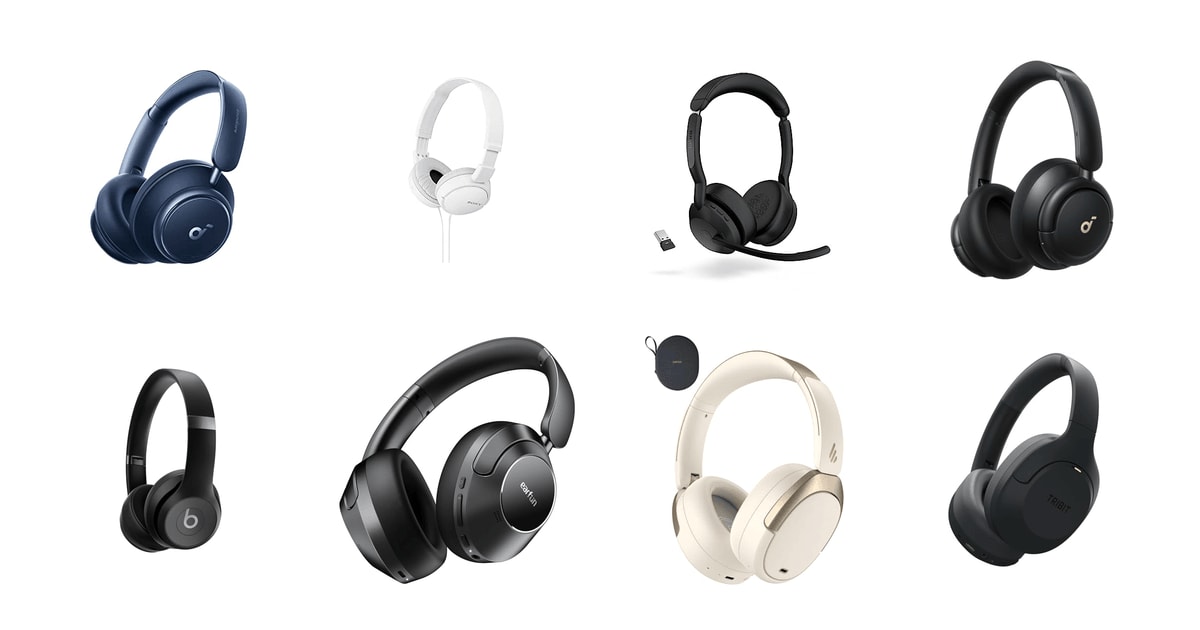
Noise canceling headphones earn their keep in the boring parts of your day. The bus that idles for ten minutes. The open-plan office where someone always takes a call at your elbow. The plane cabin that hums for five straight hours. Good ANC doesn't make those places silent, but it pulls the low, droning layer out from under everything else, and what's left is quiet enough to think in. That used to cost a lot. It doesn't anymore, and the gap has closed fast.
Here's the honest limit: no budget headphone cancels voices. Active noise canceling works by generating an opposing sound wave, and that's straightforward for steady low-frequency rumble and genuinely hard for the unpredictable mid and high frequencies of human speech. RTINGS.com data shows the low-frequency gap between flagships and budget models has narrowed to roughly 8–10 dB. The gap on chatter is still wide. If your goal is silencing a coworker two desks over, no headphone at this price will do it — play something with a steady beat instead.
The other thing spec sheets miss is comfort after hour two. Clamping force, ear cup depth, and pad material decide whether you keep these on through a long flight or start lifting one side off your ear. We weighted that heavily, alongside published lab measurements and the patterns in owner feedback. We think that the Soundcore Space Q45 is the best budget noise canceling headphone for most people, and that the EarFun Wave Pro is the one to buy if you want the longest battery life and LDAC on an Android phone.
Everything we recommend

The most reliable all-around quiet, with a battery that outlasts you

Longer battery and LDAC, with slightly less polished noise canceling

Proven noise canceling for less, without the adaptive extras
The deepest noise canceling here, if you'll accept some build risk

Lossless wired audio and iPhone polish, but no noise canceling
At a glance
| Product | ANC Reduction | Battery Life | Price | |
|---|---|---|---|---|
| Soundcore by Anker Space Q45 Adaptive ActiveTop pick | 98% Reduction | 50H Playtime | $89.99On sale |
 | Sony ZX Series Wired On-Ear HeadphonesAlso in lineup | — | — | $14.88On sale |
 | Jabra Evolve2 55 Stereo Wireless Headset withAlso consider | — | — | $244.99 |
| Soundcore by Anker Q30 Hybrid Active NoiseBudget pick | 95% Reduction | 50H Playtime | $55.99On sale |
| Beats Solo 4 - Wireless On-Ear BluetoothAlso great | — | 50H Battery | $149.95On sale |
| EarFun Wave Pro Active Noise Canceling HeadphonesRunner-up | 45dB Reduction | 80H Playtime | $56.98On sale |
| Edifier WH950NB Gen 2 8-Level Active NoiseUpgrade pick | 49dB Reduction | 80H Playtime | $199.99 |
 | Tribit QuietPlus 81 Wireless Over-Ear HeadphonesAlso consider | 45dB Reduction | 110H Playtime | $59.99 |
How we picked
Measured ANC depth. We prioritized published low-frequency measurements from RTINGS.com and SoundGuys over manufacturer dB claims, which use inconsistent methods. Anything below roughly 20 dB of reduction at 100Hz didn't make the cut for a commuting recommendation.
Battery, both numbers. ANC-on battery typically runs 30–50% below the passive figure, so we compared the ANC-on hours from standardized discharge testing rather than the headline number on the box. Under 30 hours with ANC on is a daily-charging headphone.
Codecs and connection. LDAC support matters for Android listeners with high-resolution files, and multipoint pairing matters for anyone switching between a laptop and a phone. Both used to be premium-only; we treated them as achievable now.
Comfort past two hours. Owner feedback is the only real evidence here, since spec sheets don't capture clamping force or ear cup depth. We looked for recurring complaints about pressure, heat, and glasses fit rather than isolated ones.
Build and charging. USB-C charging is non-negotiable at this point. We also read owner reports for patterns of hinge and headband failure, which is the most common way budget headphones die.
Top pickOn sale
The most reliable all-around quiet, with a battery that outlasts you
Soundcore by Anker Space Q45 Adaptive Active
The Space Q45 pairs genuinely strong low-frequency noise canceling with 50 hours of playtime and adaptive modes that adjust on their own. It's the pair we'd hand to a commuter, a student, or anyone taking their first real ANC headphone out of the box.
$89.99fromAmazonList priceThe noise canceling is the reason to buy these. RTINGS.com measured the Q45 cutting ambient noise by 22.5 dB at 100Hz and 18.3 dB at 250Hz — numbers that hold up against headphones costing two or three times more. Wirecutter reported roughly 22 dB of reduction in standardized open-plan office conditions, enough that conversations across a room drop out. That's the exact frequency range where bus engines, HVAC systems, and plane cabins live.
Battery anxiety just isn't a thing here. You get 50 hours with ANC on and 65 with it off, which for most people means charging once or twice a month. A five-minute top-up buys four hours, so the morning you forget to plug in isn't a disaster. If you fly, one charge covers a round trip across the country with room left over.
The adaptive mode is more useful than it sounds. Instead of you reaching for the app every time you walk from the subway into a quiet library, the Q45 reads the room and adjusts the ANC level itself. When you'd rather decide, the app gives you five manual levels. LDAC support is here too, which matters if you're on Android and listening to high-resolution files rather than compressed streams.
Comfort holds up for long sessions, with a caveat about head size. The 40mm drivers sit in roomy cups with soft padding, and at about 10 ounces the Q45 doesn't press down on you the way heavier headphones do. Owners regularly wear these through cross-country flights. But the cups run large, and people with smaller heads sometimes report the fit feels loose or bulky rather than snug.
Flaws but not dealbreakers
The clamping force gets noticeable somewhere past the two-hour mark for a lot of people. It's not painful, but you'll want to lift a cup and let your ears breathe. Anyone who wears glasses should expect a bit of pressure on the temple arms.
This listing is a renewed unit, which means refurbished stock rather than a factory-sealed box. Cosmetic wear varies. And a minority of owners describe a build that feels more plastic than premium — the hinges and headband adjustment don't have the reassuring density of pricier headphones.
Runner-upOn sale
Longer battery and LDAC, with slightly less polished noise canceling
EarFun Wave Pro Active Noise Canceling Headphones
The Wave Pro runs 55 hours with ANC on — more than double the mid-range average — and transmits LDAC at full bitrate. It's the pick for Android listeners who care about audio detail and never want to think about charging.
$56.98fromAmazonList priceThe battery number here is genuinely unusual. SoundGuys measured 55 hours with ANC enabled in discharge testing, against a 20–25 hour average for mid-range ANC headphones. With ANC off, EarFun claims 80. A 10-minute charge gives you 10 hours. If you're a student living out of a backpack, this is the pair that survives a semester of forgetting the cable.
LDAC at this price used to be impossible. Head-Fi community measurements verified the Wave Pro transmitting LDAC at up to 990 kbps, a codec that until recently didn't appear below a much higher price tier. On an Android phone with high-resolution files, you'll hear more air and separation than SBC gives you. On an iPhone it's irrelevant — Apple doesn't support LDAC, so you'll fall back to AAC.
EarFun rates ANC at up to 45 dB using five microphones, and owners consistently describe it as effective on engine noise and office hum. It's a step behind the Q45's measured low-frequency performance, but the difference is small enough that most people won't notice it on a bus. Multipoint connection is included, so your laptop and phone can both stay paired.
The app is more capable than the price suggests. You get custom EQ, several ANC modes, and remappable touch controls. The memory foam pads and rotating cups adapt to different head shapes, and the whole thing folds flat into a hard case.
Flaws but not dealbreakers
Pairing is the recurring complaint. Owners describe the process of entering pairing mode as fiddly and inconsistent, with instructions that don't quite match what the headphones do. Once paired, it's fine — but the first ten minutes can be irritating.
Sound out of the box leans warm and bassy, which some people like and others immediately reach for the EQ to fix. Plan on spending a few minutes in the app.
Budget pickOn sale
Proven noise canceling for less, without the adaptive extras
Soundcore by Anker Q30 Hybrid Active Noise
The Life Q30 has been the default budget ANC recommendation for years, and the reasons still hold: 40 hours with ANC on, three tuned modes, and low-frequency cancellation that handles a plane cabin. It costs meaningfully less than our top pick.
$55.99fromAmazonList priceThis is the safest cheap ANC headphone you can buy. SoundGuys measured 40 hours with ANC on and 60 with it off in standardized discharge testing, with a full USB-C charge in under two hours. Anker claims up to 95% reduction of low-frequency ambient sound from its dual noise-detecting mics. Years of owner feedback back that up on flights and commutes.
The three ANC modes are manual rather than adaptive, and honestly that's fine. Transport targets airplane engine noise, Outdoor handles traffic and wind, Indoor works on office chatter and background talking. You pick one and forget it. It's less clever than the Q45's automatic switching, but it's one fewer thing to go wrong.
Comfort is where the Q30 quietly beats headphones above its price. The protein leather cups have memory foam padding and enough depth that your ears sit inside rather than under them. Owners report wearing them through long work sessions without the hot spots that thinner pads cause. If you wear glasses, this is the gentler pick of the two Soundcore models.
Sound is warm and bass-forward, with 40mm silk diaphragms and Hi-Res certification. Out of the box it's tuned for pop and hip-hop more than for accuracy. The app's EQ pulls the low end back if you'd rather have balance.
Flaws but not dealbreakers
ANC on the Q30 is good, not great. Owners describe it as clearly a step below Sony's XM series on a plane — enough to drop the engine drone into the background, not enough to erase it.
There's no multipoint here, so switching between your laptop and phone means re-pairing. A few owners also mention the power button sitting where a shoulder naturally rests, leading to accidental presses.
Upgrade pick
The deepest noise canceling here, if you'll accept some build risk
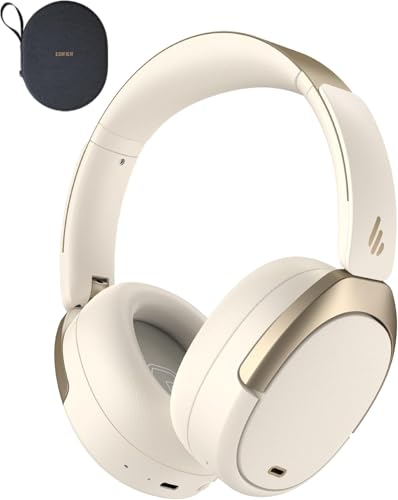
Edifier WH950NB Gen 2 8-Level Active Noise
The Edifier WH950NB Gen 2 posts the strongest low-frequency ANC numbers of any headphone in this guide and adds LDAC, eight ANC levels, and 80 hours of battery. It feels a class above its price — until you look at durability reports.
$199.99fromAmazonNo other headphone here cancels low bass this well. RTINGS.com measured up to 26 dB of reduction at 63Hz on the WH950NB, the highest low-frequency figure in their database for a headphone at this price. Edifier rates the Gen 2 at -49dB depth. If your commute is a subway tunnel or a turboprop, that bottom-octave performance is what you actually feel.
The control you get is unusual at this level. Eight discrete ANC levels, an ambient mode, and a separate wind noise reduction setting mean you can dial in exactly how sealed off you want to be, rather than choosing between on and off. There's also a spatial sound mode and a low-latency game mode.
Sound quality draws the most enthusiastic owner feedback of anything in this guide. LDAC wireless and a 3.5mm wired option cover both high-resolution streaming and zero-latency listening. People with genuinely expensive headphones at home describe the WH950NB as a credible stand-in — clear, detailed, and easy to listen to for hours.
Battery runs 80 hours with ANC off, and 15 minutes of charging returns 13 hours. The memory foam and protein leather cushions draw consistent praise for comfort, including from people who wear them through full workdays.
Flaws but not dealbreakers
Durability is the real question mark. A meaningful share of owner reports describe build failures within a few months — headband and hinge problems — and frustration with the support process afterward. That's the risk you're taking, and it's why this isn't our top pick.
The app is clunkier than Soundcore's or EarFun's, and several owners wish the maximum volume went higher. Bluetooth also has a habit of grabbing onto previously paired devices when you didn't ask it to.
Also greatOn sale
Lossless wired audio and iPhone polish, but no noise canceling
Beats Solo 4 - Wireless On-Ear Bluetooth
The Beats Solo 4 has no ANC at all. What it does have is instant Apple pairing, spatial audio with head tracking, 50-hour battery, and lossless 24-bit/48kHz playback over USB-C — the only headphone here that does that.
$149.95fromAmazonList priceRead the award carefully: these don't cancel noise. The Solo 4 is an on-ear headphone that seals passively and nothing more. We're including it because a lot of people shopping this category actually want good-sounding, comfortable headphones that work flawlessly with an iPhone, and for that specific person the Solo 4 is the better buy.
The wired story is genuinely unique here. 9to5Mac confirmed the Solo 4 delivers lossless 24-bit/48kHz audio over USB-C — no other headphone in this guide does true lossless wired playback. Plug into a laptop or phone and you're getting the file as recorded, not a Bluetooth-compressed version of it.
Apple ecosystem behavior is the other draw. One-tap pairing, automatic sync across your devices, personalized spatial audio with dynamic head tracking, and call quality that owners rate highest in this group. Android users get a Beats app too, but the seamless parts are iPhone-only.
At 50 hours of battery with a 10-minute charge returning five hours, you're not managing power. The flex-grip headband and angled cups make these the lightest-feeling pair here on a walk or at a desk.
Flaws but not dealbreakers
No active noise canceling, no transparency mode, no app-controlled ANC. On a plane you'll hear the engines.
On-ear pads press against your ear rather than surrounding it, and that gets sore faster than over-ear designs for a lot of people — especially if you wear glasses. Passive isolation is also weaker than any of the over-ear picks here.
At about 1.2 pounds these are the heaviest headphone in the lineup despite the on-ear design.
Who this is for
Buy one of these if you spend real time somewhere loud and steady — a train, a bus, an open office, a dorm floor, a plane. That's where ANC pays off, and where the difference between a budget pair and a flagship has gotten small. This guide covers over-ear and on-ear wireless headphones you'd reasonably call affordable, and it's aimed at students, remote workers, commuters, and anyone stepping up from earbuds to something that surrounds the ear.
Skip these if you're mainly trying to block out voices. ANC at this level does not solve a chatty roommate or a coworker on speakerphone; that's a physics problem more than a budget problem. Skip them too if you want studio-reference accuracy — every pick here is tuned warm, with a bass lift you'll need the app's EQ to tame. And if you need a headphone for running or the gym, look at sweat-rated earbuds instead. None of these are built for that.
How we picked
We built the shortlist around evidence we could check rather than marketing claims. ANC depth: published low-frequency measurements from RTINGS.com and SoundGuys, weighted toward the 63Hz–250Hz range where engines and HVAC live. Battery: the ANC-on figure from standardized discharge testing, not the passive number on the box. Codecs and pairing: LDAC for Android listeners and multipoint for anyone juggling a laptop and phone, both of which have become achievable at this price. Comfort: recurring themes in owner feedback about clamping force, ear cup depth, heat, and glasses fit — the things specs never capture. Build and charging: USB-C only, plus a read of owner reports for patterns of hinge and headband failure.
Other budget noise canceling headphones worth considering
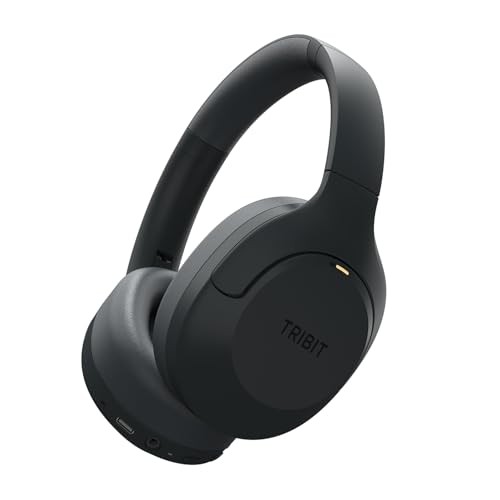
If you want the longest battery life of anything here: The Tribit QuietPlus 81 Wireless Over-Ear Headphones ($59.99) — The Tribit QuietPlus 81 claims 110 hours with ANC off and 70 with it on, which is more runtime than any other headphone in this guide. It uses five mics for hybrid ANC rated at 45dB, has a double-tap bass boost, and offers six EQ presets in its app. Owners praise the over-ear pads and comfort. What you give up is consistency: several owners report their unit running quiet at maximum volume, with a flat, midrange-heavy sound that lacks sparkle up top. There's also much less independent measurement data on this model than on our picks, so you're buying more on faith.
If your headphones are mostly for work calls: The Jabra Evolve2 55 Stereo Wireless Headset with ($244.99) — The Jabra Evolve2 55 is a headset first and a music headphone second, and that focus shows. Two premium mics with beamforming keep your voice clear when there's noise around you, and owners with quiet voices specifically report coworkers noticing the improvement. It's Microsoft Teams certified and ships with a USB-A dongle, so it connects to a laptop and a phone at once without fuss. The trade-offs: the ANC on the listening side is weaker than our picks, the sound tuning is built for speech rather than music, and some owners report ear pads deteriorating within a year.
The competition
This is what our research surfaced in this price range, not a survey of everything on the market. The category moves fast — The Verge reported that the entry price for hybrid dual-mic ANC dropped sharply once the chipsets commoditized, and new models arrive constantly. The product below didn't earn a pick, but it's here for a reason.
The Sony ZX Series Wired On-Ear Headphones ($14.88) — The Sony MDR-ZX110 is a wired on-ear headphone with no active noise canceling, no battery, and no Bluetooth. It's a 3.5mm plug, a swiveling cup design, and Sony's tuning at a price that makes it a common school-supply purchase. It loses to everything here on the actual subject of this guide — it can't cancel anything, and its passive isolation is modest at best. Still, it's worth knowing about: if you want a simple backup pair for a desktop, a piano, or a kid who'll lose them, this does that job well and owners have bought it for years. Some report one channel failing after a couple of years of hard use.
Getting the most out of them
Seal is everything. Before you judge the noise canceling, adjust the headband so the cups sit fully around your ears with even pressure — a gap the width of a glasses arm will undo a lot of the ANC. If you wear glasses, thinner temple arms make a real difference. Update the firmware through the manufacturer's app when you first pair; ANC tuning and connection stability both get patched, and most people never do this. Store them in the case rather than dangling from a bag hook, since the hinge is where budget headphones usually fail. Ear pads are the other wear point: they flake and flatten after a year or two of daily use, and replacements are cheap and easy to swap on most of these. Wipe them down with a barely damp cloth, and let them dry before you fold them away.
Questions we get
Do cheap noise canceling headphones actually work?
Yes, on the right kind of noise. RTINGS.com data shows the low-frequency ANC gap between flagship and budget headphones narrowed from about 17 dB in 2022 to roughly 8–10 dB, so engine rumble, HVAC hum, and road noise get cut substantially. What budget ANC doesn't do well is voices. That's a limitation of the technology at any price, just more pronounced down here.
What's the difference between active noise cancellation and passive noise isolation?
Passive isolation is physical — the ear cup and pad simply block sound from reaching your ear, the way an earplug does. Active noise cancellation uses microphones to detect incoming sound and generates an inverted wave to cancel it. Passive works best on high frequencies, active works best on low ones. Good headphones use both, which is why cup seal matters so much to how well the ANC seems to perform.
Do budget noise canceling headphones work on airplanes?
This is the single best use case for them. Cabin noise is dominated by steady low-frequency engine and airflow sound, exactly what ANC handles well. The Space Q45 and the Edifier WH950NB Gen 2 post the strongest low-frequency measurements here, and both have enough battery for a long-haul flight and the return trip. You'll still hear announcements and nearby conversation.
Which budget headphones are best for an Android phone with LDAC?
The EarFun Wave Pro and the Edifier WH950NB Gen 2 both support LDAC, and the Soundcore Space Q45 does too. Head-Fi measurements confirmed the Wave Pro transmitting LDAC at up to 990 kbps. LDAC only helps if you're playing high-resolution files rather than standard streaming quality, and it's unavailable on iPhone entirely, since Apple doesn't support the codec.
How many hours of battery should I expect?
Expect the ANC-on number to run 30–50% below the passive figure, so always check both. SoundGuys measured 55 hours with ANC on for the EarFun Wave Pro and 40 hours for the Soundcore Life Q30, against a mid-range average closer to 20–25. Anything under 30 hours with ANC on means charging every few days.
Are these good for someone who wears glasses?
Over-ear designs with deep, soft pads are the ones to look at, because the pad has to seal around your glasses arm without pressing it into your temple. The Soundcore Life Q30 and the EarFun Wave Pro get the most consistent comfort feedback from owners on that front. Skip on-ear models like the Beats Solo 4, which press directly on the ear and the frame together.
Why you should trust us
For this guide:
- We read published measurements from RTINGS.com, SoundGuys, Audio Science Review, and Head-Fi covering ANC depth by frequency, battery discharge, and codec bitrate.
- We compared manufacturer specifications and feature bullets for every headphone in this lineup against those independent figures, since dB claims on packaging use inconsistent methods.
- We read owner feedback for recurring themes around comfort after long sessions, pairing behavior, and hinge and headband durability.
- We read owner reviews on every listing, weighted toward the critical ones, because that is where the recurring failures show up.
- We have a systematic way of automatically fetching the latest prices, so the numbers on this page stay current.
- This is a research-focused guide, so the team may not own every product listed — though we often do own the top winners, which gives us extra context for the recommendations.
- We don't accept free products, and the retailer commission never changes which product we recommend.
Sources
Best Headphones Under $100 — Wirecutter / NYT, Wirecutter
Anker Soundcore Q45 Review — RTINGS.com, RTINGS.com
Best Budget ANC Headphones 2026 — SoundGuys, SoundGuys
Edifier WH950NB Review — RTINGS.com, RTINGS.com
Best Noise Canceling Headphones 2026 — The Verge, The Verge
Anker Soundcore Life Q30 Review — SoundGuys, SoundGuys
Consumer Reports Headphone Ratings 2025, Consumer Reports
Beats Solo 4 Review — 9to5Mac, 9to5Mac
EarFun Wave Pro Review — Head-Fi, Head-Fi
Budget ANC Headphones Shootout 2025 — AudioScienceReview, Audio Science Review
Noise Canceling Headphone Market Report 2025 — Statista, Statista
How ANC Works — Explained — RTINGs.com, RTINGS.com
Amazon product listings and owner reviews for all 8 products
Manufacturer specification pages for each product
Some passages in this guide may be paraphrased with AI help. Prices are refreshed automatically.
More like this.
Continue exploring electronics reviews and recommendations.

The Best Noise-Cancelling Headphones for Focus and Deep Work
Most of us don't get to pick where we work. The open-plan office hums, the espresso machine shrieks, and the guy two desks over takes every call on…

The Best Noise Canceling Earbuds
Noise canceling earbuds earn their keep in a handful of specific moments. The rumble of a subway car. An open-plan office where three people type like…

The Best Noise-Canceling Wireless Earbuds
Noise-canceling earbuds earn their keep in the boring moments. The drone of a plane cabin at cruising altitude. A neighbor's leaf blower during your…

The Best Budget Mechanical Keyboards
A mechanical keyboard is one of the few upgrades you feel every single minute you're at a desk. The keys have a defined bottom, a consistent weight, and a…

The Best Turntables for Budget Vinyl Listening
Vinyl asks something of you that streaming doesn't. You get up, flip the record, set the needle down. That ritual is most of the appeal, and a good budget…

The Best Budget Pieces for the Old Money Look
The old money look isn't really about money. It's about a handful of quiet signals - natural fabrics, clean lines, no visible logos, a color palette that…