The Best Pole Saws
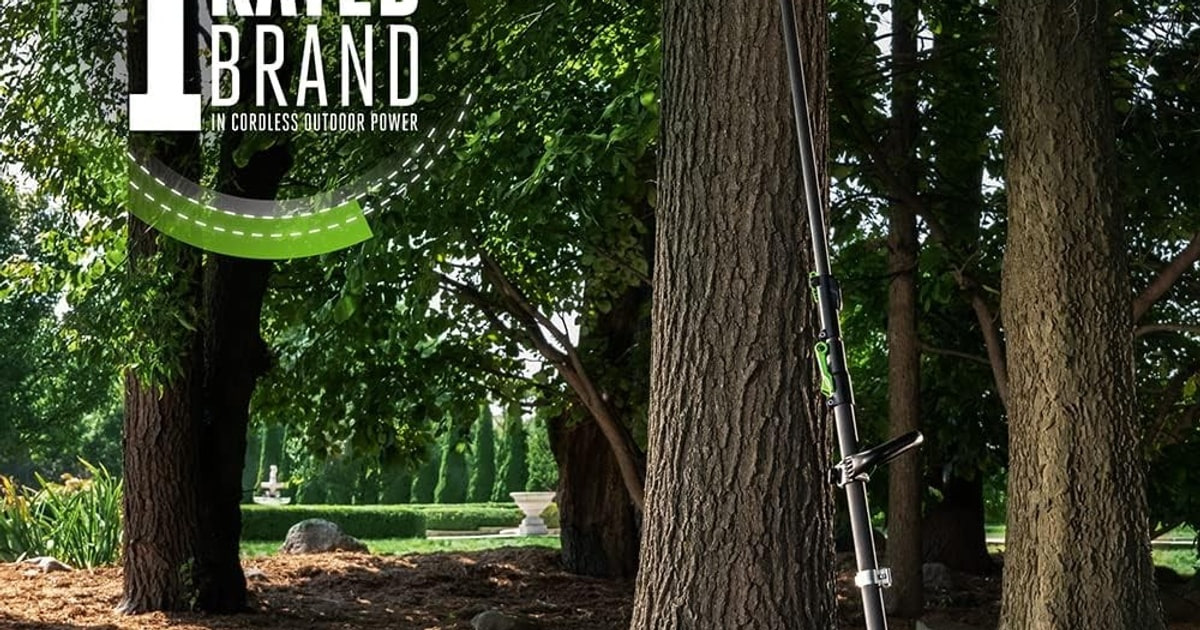
Pruning overhead branches used to mean a ladder, a chainsaw, and a bad idea. A pole saw fixes that. You keep both feet on the ground, extend the shaft, and take down the limb that's been scraping your roof. What matters most isn't raw power. It's whether you can hold the tool steady above your head for half an hour, and whether it actually reaches the branch you're aiming at. Reach and weight decide that. Bar length and voltage come second.
Here's the honest part: none of these are pleasant to use for long. A pole saw hangs several pounds off the end of a long lever, so your shoulders and lower back do the work your hands think they're doing. Chain oil drips down the shaft and onto you. Published reach numbers assume you're holding the pole nearly straight up, which isn't how most cuts happen. And every one of these bogs down in thick hardwood at full extension. Plan on short sessions.
So buy for your trees, not for the spec sheet. If you're clearing deadwood from a few mature shade trees once or twice a season, a cordless model at 40 volts or higher does everything you need, and it starts every time you pull the trigger. Gas still wins for people billing hours in somebody else's yard. We think that the EGO Power+ PS1001 is the best pole saw for most people, and that the DeWalt DCPS620B bundle is the one to buy if you already own DeWalt 20V MAX batteries.
Everything we recommend

The lightest long reach, plus a light that shows your cut

The longest cordless reach, if you already own 20V MAX packs
Light, simple, and never needs a charge, if you'll drag a cord

Gas power and a 12-inch bar for all-day work, at a weight cost
At a glance
| Product | Bar Length | Max Reach | Price | |
|---|---|---|---|---|
| EGO Power+ Pole Saw for Tree TrimmingTop pick | 10-Inch | 13 ft | $339On sale |
| Dewalt DCPS620BDCB240C-BNDL 20V MAX XR Brushless Lithium-IonRunner-up | 8 in. | 15 ft | $299.99 |
 | Milwaukee 49-16-2720 M18 FUEL QUIK-LOK 10 in.Also in lineup | 10 in. | — | $149.50On sale |
 | Greenworks 40V 8-Inch Cordless PolesawAlso consider | 8-Inch | 11ft max | $139.99On sale |
 | RYOBI 40V HP Brushless 12 in. TopAlso in lineup | 12 in. | — | $273.98 |
 | Worx WG323 20V Power Share 10" CordlessAlso consider | 10 inches | 12 ft | $169.99On sale |
| Sun Joe SWJ803E 10 inch 8.0 AmpBudget pick | 10-Inch | 15 ft | $114.99 |
| Husqvarna 525P4S Gas Powered Pole SawUpgrade pick | 12-Inch | 13 feet | $569.99 |
How we picked
Total overhead reach. We compared manufacturer reach figures rather than bar or pole length alone, since a short shaft with a long bar still leaves you under the branch. Anything under about 10 feet of total reach didn't clear the bar for real shade-tree work.
Weight in your hands. We pulled listed tool weights and weighted them heavily, because overhead fatigue is the complaint that shows up most consistently in owner feedback across every brand. Under 10 pounds was the target for cordless and corded models.
Chain care built in. We looked for an automatic oiler and tool-free chain tensioning on every spec sheet. A dry or loose chain is the fastest way to wreck a bar, and manual-only systems mean the maintenance simply won't happen.
Battery ecosystem fit. We checked which battery platform each cordless model uses, since reusing packs you already own removes a large accessory cost. That made bare tools and bundles worth judging on different terms.
Safety hardware. We confirmed each listing includes the basics for ground-based cutting, such as low-kickback bar and chain, branch hooks, and guards. Published reviews and safety guidance were the reference point here, not our own use.
Top pickOn sale
The lightest long reach, plus a light that shows your cut
EGO Power+ Pole Saw for Tree Trimming
The PS1001 pairs a 56-volt brushless motor with a telescoping carbon fiber shaft that reaches 13 feet. It's easier to hold overhead than the aluminum poles it competes with, and an LED shines down the cut line, which sounds like a gimmick until you're squinting up into a shaded canopy.
$339fromAmazonList priceThe carbon fiber shaft is the real reason to buy this one. Carbon fiber is stiffer for its weight than aluminum, so the tip wanders less when you're lining up a cut at full extension. That matters more than it sounds. Less flex means fewer glancing hits on bark and less vibration coming back down the pole into your wrists. EGO backs the shaft with a limited lifetime warranty, which tells you what they think of it.
The LED cut line indicator solves a problem you'll actually have. Most overhead pruning happens under the canopy, looking up into shade with bright sky behind the branch. That's the worst possible lighting. EGO says this is the first pole saw to build in a cut line light, and the point isn't brightness. It's that you can see where the chain will land before you commit, which is how you avoid a torn, angled cut on a limb you meant to finish clean.
The 56-volt platform keeps the chain moving. EGO rates chain speed at up to 20 meters per second from a brushless motor, with a 10-inch bar running a narrow quarter-inch pitch chain. Narrow chain on a fast motor is the right recipe for pruning, where you want a quick clean kerf rather than brute torque. EGO rates the included 2.5Ah battery at up to 100 cuts, enough for an afternoon of seasonal work without swapping packs.
Tool-free tensioning and a shoulder strap hook make long sessions bearable. Chains stretch as they warm up, and a saggy chain is how bars get ruined. Being able to snug it up by hand, standing under the tree, means you'll actually do it. The quick-adjust handle lets you move your grip as the pole extends, and the strap hook takes some of the 9.4 pounds off your arms. Small things, but they decide whether the tool gets used.
Flaws but not dealbreakers
It's the most expensive cordless option here, and the long reach costs extra. Thirteen feet is the standard configuration. Getting to 17 feet means buying the EP1000 extension pole separately, so the reach figure that sells the tool isn't the reach that comes in the box. Budget for the extension if you have tall oaks.
The 10-inch bar and fine-pitch chain are built for pruning, not felling. This is a limb saw. Push it into thick trunk wood and the narrow chain will heat up and slow down long before the motor gives out. If you routinely cut anything close to bar length, look at a gas unit or a proper chainsaw.
You're buying into a battery system. The value here climbs steeply if you already own EGO 56V mowers or blowers, and it looks thin if this is your only EGO tool. One battery also means one afternoon; a second pack is another purchase.
EGO covers the telescoping carbon fiber shaft with a limited lifetime warranty.
Runner-up
The longest cordless reach, if you already own 20V MAX packs
Dewalt DCPS620BDCB240C-BNDL 20V MAX XR Brushless Lithium-Ion
This bundle puts a brushless DeWalt pole saw, a 4Ah battery, and a charger in one box, with an extension pole that takes you to 15 feet. That's more reach than anything else here on batteries, and the tree hook gives you something to grab a stuck limb with.
$299.99fromAmazonFifteen feet of reach is the headline, and it's the longest cordless figure in this guide. The extension pole goes on without tools, so you can run the saw short for shoulder-height work and long for the crown. Standing further back from a falling limb is a genuine safety benefit, not just a convenience. If your problem branches sit above a fence or a driveway, that extra span is what keeps you off a ladder.
The bundle removes the hidden cost of a bare tool. A 4Ah battery and a charger come in the box, so the tool is ready to run the day it arrives. A 4Ah pack also roughly doubles the runtime you'd get from a 2Ah pack under the same load, which means fewer pauses mid-job. And every other DeWalt 20V MAX tool you own runs on that same battery.
The bucking strip and tree hook are the details that separate this from cheaper poles. The metal bucking strip bites into the limb so the bar doesn't skate sideways when you start a cut overhead. The hook lets you pull down a branch that hangs up in the canopy instead of shaking the whole tree. Auto oiling handles chain lubrication on its own, so you're not stopping every few minutes with an oil can.
A brushless motor is the right choice at this voltage. DeWalt's XR motor puts more of the pack's energy into chain speed instead of heat, which partly offsets the lower nominal voltage. It also means fewer wear parts inside the head. For softwood limbs and medium hardwood, the difference between this and a higher-voltage saw is a slower cut, not a failed one.
Flaws but not dealbreakers
The 8-inch bar sets a real ceiling. Eight inches of bar comfortably handles limbs up to roughly six inches thick. Past that you're making two cuts from opposite sides at the top of a 15-foot pole, which is awkward and slow. If your regular work involves thick hardwood, this is the wrong tool.
Twenty volts nominal is the lowest power class among the cordless picks. In seasoned oak or maple, you'll feel the chain slow under load in a way you won't with a 40- or 56-volt saw. Ease off, let the chain do the work, and it gets through. Push it and you'll stall it.
Fully extended, it's a handful. Fifteen feet of pole with a saw head on the end is a long lever, and the strain lands on your forearms. That's physics, not a design flaw, but plan on resting more often than the reach spec makes you expect.
Budget pick
Light, simple, and never needs a charge, if you'll drag a cord
Sun Joe SWJ803E 10 inch 8.0 Amp
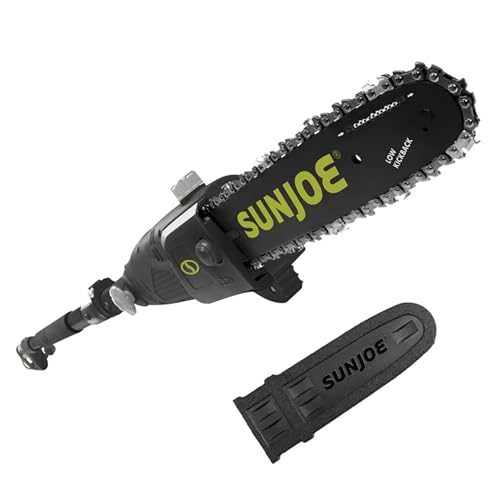
The Sun Joe SWJ803E plugs into any outdoor outlet and runs as long as you do. It weighs under eight pounds, telescopes to about 15 feet of overhead reach, and its head pivots up to 30 degrees so you can square up on a branch instead of hacking at it sideways.
$114.99fromAmazonRuntime stops being something you think about. There's no pack to charge, no pack to age out, and no second battery to buy in three years. Plug it in and prune until you're done. For someone who trims a couple of ornamentals near the house once a season, that's genuinely the right trade, because a battery that sits dead in the garage for eleven months is its own kind of problem.
The multi-angle head is unusual at this level. Most budget poles fix the bar at one angle, which forces you to reposition your whole body to meet the branch squarely. This one adjusts from 0 to 30 degrees. A square cut heals better and binds the bar less, and being able to set the angle from the ground means fewer awkward stances under the tree.
At 7.9 pounds it's the lightest full pole saw here. Weight is the complaint that turns up most often in pole saw feedback, and this one keeps the number down. The pole itself telescopes from 5.8 to 8.8 feet, which puts the head around 15 feet up for most people. Sun Joe rates the 8-amp motor for branches up to about 9.5 inches on the 10-inch bar.
It's the easiest one to hand to somebody else. No fuel mixing, no charger, no ecosystem decision. If you're buying a first pole saw and you're not sure how much you'll use it, this is the low-commitment way to find out.
Flaws but not dealbreakers
The cord decides where you can work. You're tethered to an outdoor outlet, and a long extension cord snaking through a yard while you're looking up is a trip hazard you have to actively manage. Anything past the back fence line is probably out of range.
An 8-amp motor doesn't hold torque like a 40- or 56-volt battery saw. In dense, dry hardwood it slows down noticeably and you'll be feeding the cut gently. It's fine for green limbs and deadwood. It's not fine for a storm cleanup of thick oak.
Build quality reflects the price. Budget poles are the ones owners most often report loosening up over time at the joints and tensioner, so check the pole clamps and chain tension before each session rather than assuming they held.
Sun Joe warrants this pole saw for two years from the date of purchase.
Upgrade pick
Gas power and a 12-inch bar for all-day work, at a weight cost
Husqvarna 525P4S Gas Powered Pole Saw
The Husqvarna 525P4S is the one to buy if you prune for a living or manage acreage. Its 25.4cc two-stroke engine and 12-inch bar cut wood that stalls battery saws, and it doesn't fade over a long day. You pay for that in weight, noise, and maintenance.
$569.99fromAmazonSustained power is the whole argument. A 25.4cc, 1.36 horsepower two-stroke doesn't taper the way a battery does as the pack drains. Refuel and keep going. If you're moving through a property all day, or cutting dense oak and maple that make cordless saws slow to a crawl, this is the category that still wins outright.
A 12-inch bar with 13 feet of reach covers the full range of pruning work. That's the longest bar in this guide paired with reach that matches the cordless picks. Longer bar means bigger limbs in a single pass, and fewer two-sided cuts overhead. For commercial removal work, one pass instead of two adds up over a day.
It starts without a fight. The air purge system clears air out of the carburetor and fuel lines, which is what makes a cold two-stroke hard to start on a chilly morning. Husqvarna designed the starting system around crews that need the tool running on the first or second pull, every day, not a homeowner who fires it up twice a year.
The dealer network is part of what you're buying. Carburetor adjustment, bar replacement, and chain spec work are things a certified Husqvarna technician handles routinely. Cordless tools mostly get replaced when they fail. A gas pole saw gets serviced, and having somewhere local to take it is worth real money over years of use.
Flaws but not dealbreakers
At more than 16 pounds, it's by far the heaviest tool here. Every extra pound at the end of an extended pole multiplies into your shoulders. Fatigue arrives much faster than it does with the cordless picks, and that's a safety issue as much as a comfort one when you're working under a limb.
Two-stroke maintenance is a standing commitment. You'll mix fuel at 50 to 1, clean the air filter, change the plug, and keep the carburetor in tune. Skip any of it and starting gets harder. If you don't already own gas outdoor equipment, this is a new chore, not a feature.
It's loud and it smells. Gas pole saws are firmly in ear protection territory, and the exhaust makes early-morning suburban use a bad neighbor move. Unless you're on acreage or a job site, the cordless picks fit the setting better.
Who this is for
This guide is for someone standing in their yard looking up at a branch they can't reach. If you're clearing deadwood, thinning a crown, or cutting back limbs from a roof or a driveway, and those limbs run up to roughly eight inches thick, a pole saw is the right tool and one of these will do it. If you've got existing batteries from EGO, DeWalt, Greenworks, or WORX, start there, because the pack you already own quietly changes the math on every option below.
Skip this category if you're felling trees, bucking firewood, or working from a bucket or a climbing line. Those are chainsaw jobs, and a pole saw does them badly and unsafely. We're also not covering hedge trimmers, manual pole pruners with a rope-pull blade, or attachment heads for multi-tool systems beyond the one noted here. And the rule that overrides everything else: both feet on the ground, always. Never run a pole saw from a ladder.
How we picked
We built this guide from manufacturer specifications, published reviews, and the themes that recur in owner feedback, and we weighed five things. Total reach: the figure that decides whether you need a ladder, measured from the ground to the bar rather than by pole or bar length alone. Weight: anything over about 10 pounds becomes punishing overhead, and fatigue is the most common regret owners report. Chain care: automatic oiling and tool-free tensioning, because maintenance you have to stop and do is maintenance you'll skip. Battery fit: which platform the tool runs on, since existing packs remove a significant accessory cost. Safety hardware: low-kickback bar and chain, branch hooks, and guards, treated as a floor rather than a bonus.
Other pole saws worth considering
If you want the simplest complete kit: The Greenworks 40V 8-Inch Cordless Polesaw ($139.99) — The Greenworks PS40B210 comes with a 40V battery, a charger, and the saw in one box, and at 7.8 pounds it's among the lightest cordless options here. The three-piece aluminum shaft extends to about nine feet for roughly 11 feet of maximum reach, and you get an automatic oiler and easy chain adjustment, which is more than the price tier usually delivers. What you give up is bar length and runtime: the 8-inch bar caps you around six-inch limbs, and the 2Ah battery won't go as long as the 4Ah packs bundled with the DeWalt. For a first pole saw on a small suburban lot, that's a fair trade.
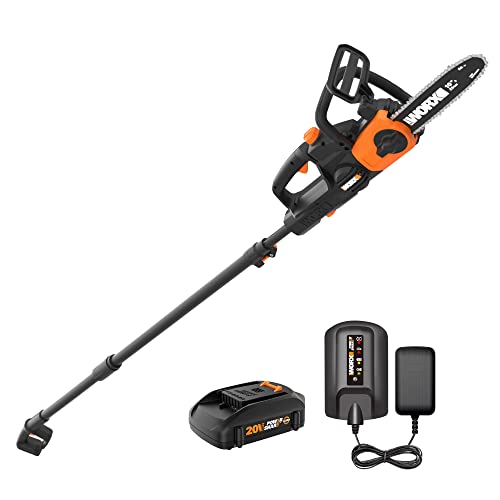
If you want long reach on a budget platform: The Worx WG323 20V Power Share 10" Cordless ($169.99) — The Worx WG323 gets you up to 12 feet with a battery and charger in the box, and the same 20V pack runs more than 75 tools across the WORX Power Share line. Auto-tensioning and automatic chain lubrication with a visible oil level indicator are real conveniences, and the 10-inch bar handles more than the 8-inch bars on the DeWalt and Greenworks. The catches are weight and torque. At just over 10 pounds it sits right at the edge of comfortable overhead use, the 20V platform is the least powerful here in dense hardwood, and bar oil isn't included, which is an odd thing to leave out.
The competition
This is what our research surfaced, not a census of everything sold. Plenty of capable pole saws sit outside this lineup, and brands shuffle their models constantly. The one below is worth understanding because it's a different kind of purchase than the rest, and it makes sense for a narrow group of buyers.
The Milwaukee 49-16-2720 M18 FUEL QUIK-LOK 10 in. ($149.50) — The Milwaukee M18 FUEL QUIK-LOK 10-inch attachment isn't a complete tool. It's a saw head that clicks onto an M18 FUEL powerhead you buy separately, which is why it didn't win against the picks: for anyone starting from scratch, the total cost of a powerhead plus attachment is steep for one job. The engineering is excellent. It has an automatic oiler with a translucent reservoir so you can see the level at a glance, a tool-free chain tensioner you can reach easily, a branch hook for leverage, and a padded grip, and it weighs just over six pounds because the motor lives in the powerhead. If you're a contractor already running M18 FUEL and swapping between a hedge trimmer, an edger, and a string trimmer head, buying one more head instead of one more whole tool is the smart move. For everyone else, buy a saw with a motor attached.
Care and maintenance
Fill the oil reservoir before every session and glance at the level every 10 to 15 minutes of steady cutting, because a dry chain wears fast, grabs, and raises your kickback risk. Check chain tension when the saw is cool, then again once it's warmed up, since chains stretch as they heat. Most pole saw chains take a standard round file, usually 3/16-inch on smaller bars, filed at the angle the manufacturer specifies, generally somewhere between 25 and 35 degrees. Keep every cutter the same length or the saw will pull to one side. When the cutters hit the wear marks, replace the chain rather than fighting it. On the gas Husqvarna, add air filter cleaning and a fresh spark plug to the routine, and mix fuel at 50 to 1 every time.
Questions we get
Are battery pole saws as powerful as gas ones?
For residential pruning, yes. Cordless saws at 40 volts and up handle limbs in the six-to-ten-inch range without drama, and they start instantly and run quietly. Gas keeps its edge for all-day commercial cutting and for the thickest dense hardwood, where a battery would need swapping and a two-stroke just keeps going.
How high can a pole saw reach without a ladder?
Most extend to somewhere between 10 and 15 feet of overhead reach from ground level. The DeWalt goes to 15 feet, the EGO reaches 13 and stretches to 17 with its optional extension pole, and the Sun Joe is rated at about 15 feet overhead. Whatever the number, keep both feet on the ground. Never run a pole saw from a ladder or any raised platform.
What bar length do I need?
For limbs up to about six inches, an 8-inch bar is plenty, which covers the DeWalt and the Greenworks. Step up to a 10-inch bar for branches in the six-to-nine-inch range. The 12-inch bar on the Husqvarna is commercial territory. Longer bars add weight right at the tip of an extended pole, so don't buy more bar than your trees need.
Can I use a pole saw to fell a small tree?
You can, but you shouldn't. Pole saws are built for limbing and overhead branch removal from a standing tree, not for felling. A regular chainsaw is safer and much faster for that job. If you do use a pole saw at ground level, confirm the chain brake and kickback guard are working and wear full protective gear including chainsaw chaps.
What safety gear do I actually need?
Eye protection or a face shield, hearing protection, cut-resistant gloves, chainsaw-rated chaps or pants, and boots with grip. Gas models are loud enough that ear protection isn't optional. Clear a drop zone under the branch first and keep everyone well clear before you start the cut. The safety features on the tool supplement your gear, they don't replace it.
Do I need to oil the chain myself?
Not on most of these. The EGO, DeWalt, Milwaukee, Greenworks, and Worx models all lubricate automatically, so your job is filling the reservoir before you start and watching the level as you go. If a model doesn't have an automatic oiler, plan on applying bar and chain oil by hand every five to ten minutes of cutting. Running a chain dry wears it out quickly and voids most warranties.
Why you should trust us
For this guide:
- We read the manufacturer specification sheets and listing details for every pole saw here, comparing total reach, bar length, weight, and chain maintenance features side by side.
- We reviewed published coverage of these tools and recurring themes in owner feedback, particularly complaints about overhead fatigue and chain tensioning.
- We did not cut anything ourselves, so every claim here traces back to published specifications, other people's reviews, or reported owner experience.
- We read owner reviews on every listing, weighted toward the critical ones, because that is where the recurring failures show up.
- We have a systematic way of automatically fetching the latest prices, so the numbers on this page stay current.
- This is a research-focused guide, so the team may not own every product listed — though we often do own the top winners, which gives us extra context for the recommendations.
- We don't accept free products, and the retailer commission never changes which product we recommend.
Sources
Best Pole Saws, Tested and Reviewed, Popular Mechanics
The Best Pole Saws of 2026, The Spruce
Best Pole Saws, Bob Vila
Best Pole Saws, Expert-Tested, Family Handyman
Best Pole Saws, Good Housekeeping
Amazon product listings and owner reviews for all 8 products
Manufacturer specification pages for each product
Some passages in this guide may be paraphrased with AI help. Prices are refreshed automatically.
More like this.
Continue exploring lifestyle reviews and recommendations.

The Best Wet Tile Saws
Cutting tile is the part of a tile job that decides how the finished wall looks. Every outlet, every doorway, every corner needs a cut piece, and a…

The Best Miter Saws for Woodworking and Home Shops
A miter saw is the tool that decides whether your trim looks sharp or looks like it was cut with a butter knife. It crosscuts boards to length and slices…

The Best Contractor and Jobsite Table Saws
A jobsite table saw is the tool you drag out of the truck when a door needs trimming or a sheet of plywood needs breaking down. It lives outside, gets…

The Best Hiking Poles
Hiking poles change how a trail feels. On a steep descent, they take a real bite out of what your knees absorb - research published in Clinical…

The Best Sci-Fi Books About Artificial Intelligence
Machines that think used to be a thought experiment. Now you talk to one before breakfast, and the questions novelists spent seventy years turning over - …

The Best Cooling Tents and Hot-Weather Camping Gear
Heat is the one camping problem you can't sleep through. A tent sitting in afternoon sun turns into an oven fast - Wirecutter's summer tent research found…