The Best Miter Saws for Woodworking and Home Shops
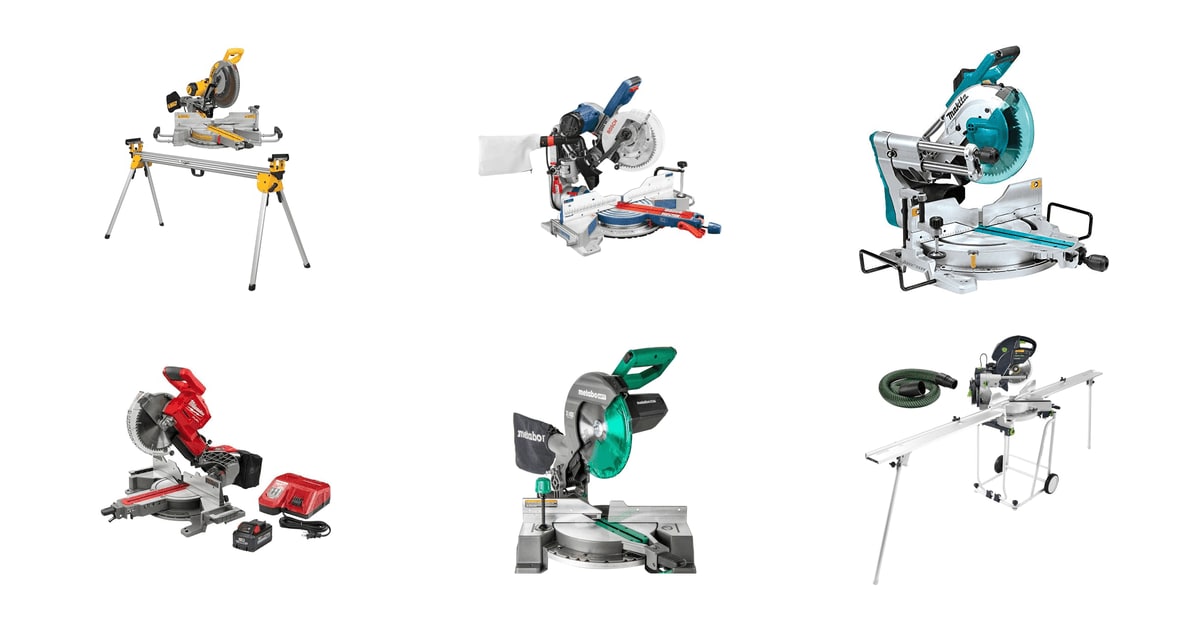
A miter saw is the tool that decides whether your trim looks sharp or looks like it was cut with a butter knife. It crosscuts boards to length and slices angles for door casing, baseboard, picture frames and deck rails. Most of what you'll ask it to do is boring and repetitive, which is exactly the point — you want the same clean 45 all afternoon without fiddling. The differences between saws come down to how much material they swallow, how square they stay, and how much sawdust ends up on your floor instead of in a bag.
Here's the part nobody puts on the box: no miter saw collects dust well on its own. Even the best of them fling fine powder past the shroud, and the small cloth bags that come in the carton are close to useless. You'll want a shop vacuum hooked to the port, and you'll still sweep. Weight is the other honest caveat. A 12-inch slider is a genuinely heavy machine, and the ones with the smoothest glide are usually the heaviest of the bunch. Plan a permanent spot for it if you can.
We looked at what published reviews, manufacturer specifications and owner feedback say about accuracy, capacity, dust handling and how much bench depth each saw eats. Small shops care about that last one more than they expect to. Cordless models have gotten good enough that a cord is now a preference rather than a requirement for most home projects. We think that the DEWALT DWS780 is the best miter saw for most people, and that the Bosch CM10GD is the one to buy if your saw has to live against a wall in a tight garage.
Everything we recommend

The saw everything else gets compared to

Nearly as capable, and it sits flat against the wall

The best cut quality here, with a 60-degree miter range

Light, accurate, and enough saw for most home projects
The dust collection is in a different league entirely
At a glance
| Product | Blade Size | Bevel Type | Price | |
|---|---|---|---|---|
| DEWALT DWS780 12-Inch Double Bevel Sliding CompoundTop pick | 12" | Double Bevel | $798On sale |
| BOSCH 15.0 Amp CM10GD 10 In. Dual-BevelRunner-up | 10" | Dual-Bevel | $629 |
| Makita LS1019L 10" Dual-Bevel Sliding Compound MiterAlso great | 10" | Dual-Bevel | $739 |
| Metabo HPT 10-Inch Single Bevel Compound MiterBudget pick | 10" | Single Bevel | $169On sale |
| Festool 579556 KAPEX KS 120 REB MiterUpgrade pick | — | — | $2,699 |
 | Makita LS1219L 12" Dual-Bevel Sliding Compound MiterAlso consider | 12" | Dual-Bevel | $980.78 |
How we picked
Cut accuracy. We compared published measurements of detent repeatability and fence flatness, prioritizing saws that published reviews and owner feedback both describe as square out of the box. A saw that drifts a fraction of a degree between settings is useless for crown.
Real capacity. We read manufacturer specifications for horizontal crosscut, vertical baseboard and nested crown capacity, and looked for saws that clear a 2x12 in one pass. Crown capacity nested against the fence mattered more to us than blade diameter alone.
Space in the shop. We favored designs that work flush to a wall, since most home shops put the saw against one. Front-mounted glide arms and compact two-rail systems reclaim bench depth that rear-rail sliders eat.
Dust handling. We compared published capture-rate figures against owner reports of how much dust escapes in practice. Anything under about half is normal for the category, so we noted which saws beat it and which need a shop vacuum to be usable indoors.
Cut-line guidance. We weighted shadow-line indicators above lasers because published testing shows they position more accurately and can't drift as the tool heats up. Saws with no indicator at all had to be excellent elsewhere.
Top pickOn sale
The saw everything else gets compared to
DEWALT DWS780 12-Inch Double Bevel Sliding Compound
A 12-inch dual-bevel slider with a shadow-line cut indicator instead of a laser, bundled here with DEWALT's universal rolling stand. It crosscuts a 2x16 flat and handles crown up to 6-5/8 inches nested, which covers essentially every job a home shop throws at it.
$798fromAmazonList priceThe cut-line system alone justifies the pick. Instead of a laser, DEWALT's XPS setup shines an LED past the blade so the blade itself casts a shadow on your pencil mark. There's nothing to calibrate, and it can't drift as the tool warms up. Popular Mechanics estimated that shadow-line indicators cut blade-positioning error by around 40% versus traditional lasers. In practice that means you line up the shadow to the waste side of your line and cut.
Capacity is where the 12-inch blade earns its keep. The 15-amp motor spins at 3,800 rpm, and the saw handles 16 inches of horizontal cut and 6-3/4 inches vertically. That's a 2x16 crosscut in one pass and tall baseboard standing against the fence. If you're building bookcases from wide boards or cutting deck framing, this is the difference between one clean pass and flipping stock halfway through.
Repeatability matters more than raw power for trim work, and this is where the DWS780 has built its reputation. This Old House reported that its positive bevel detents held within ±0.1° of their stated angles across repeated settings. Detents that wander are how you end up with a crown joint that shows a hairline gap from across the room. These hold.
The bundle includes DEWALT's DWX723 stand, which is worth having. It's aluminum, about 29 pounds, and the beam extends to support up to 16 feet of material and 500 pounds. The mounting brackets are universal, so if you ever change saws the stand stays. For anyone cutting long trim in a garage without a dedicated bench, a stand like this does more for your accuracy than any saw feature.
Flaws but not dealbreakers
DEWALT says the dust system captures over 75% of what the blade throws, which is honest for the category and still means a real mess. Hook it to a shop vacuum and expect to sweep anyway. The bundled bag is not a serious dust solution.
This is a rear-rail slider, so it needs clearance behind it to travel. If your bench is against a wall, you'll lose several inches of usable depth, and that's the single biggest reason to look at the Bosch Glide saws instead. The saw and stand together are also a two-trip carry.
DEWALT does not state a warranty term in this listing.
Runner-up
Nearly as capable, and it sits flat against the wall
BOSCH 15.0 Amp CM10GD 10 In. Dual-Bevel
Bosch's 10-inch Glide saw swaps sliding rails for articulated hinge arms, so it needs no room behind it. You give up a little capacity versus a 12-inch saw and get back as much as 10 inches of bench depth, which is a trade most small-shop woodworkers should take.
$629fromAmazonIf your shop is small, this is the saw to buy. The Axial-Glide arms fold rather than slide backward, so the saw's front-to-back footprint shrinks by up to 10 inches compared with rail sliders of similar capacity. Push it right up against the wall. In a one-car garage where the bench is 24 inches deep, that reclaimed space is the difference between a workable station and a saw you have to pull out every time.
Capacity holds up well for a 10-inch saw. You get 12 inches of horizontal cut, 5-1/2 inches of vertical baseboard against the fence, and 6 inches of crown nested at 45 spring. That covers standard door casing, baseboard and most crown you'd hang in a house. The 15-amp motor runs at 4,800 rpm, which is quicker than the 12-inch saws here and leaves a cleaner edge in hardwood.
The controls are all up front — bevel lock lever and range selector both — so you're not reaching around a hot motor to change a setting. Owners, including flooring installers running it daily on quarter round and stair nosing, consistently call out the glide action as smoother and less prone to slop than rail systems. The tall 4-1/4-inch sliding fences help when you're standing crown up.
Cut quality is the other reason it lands here rather than lower. Owner feedback skews strongly positive on precision straight out of the box, and the arm mechanism doesn't accumulate the sawdust grit that eventually makes rails feel notchy. For furniture and trim work where you're cutting the same angle dozens of times, that consistency is worth more than an extra inch of capacity.
Flaws but not dealbreakers
There's no laser or shadow-line indicator, which is the most common complaint from owners. You cut to the blade and your pencil line, the old way. If you've gotten used to a projected cut line, you'll notice its absence on day one.
It also has no soft start, so the head jumps a little when you pull the trigger. Not a dealbreaker, but it's startling the first few times and you'll want a firm grip. At 64 pounds it's heavier than the 10-inch blade suggests, and it's the most expensive 10-inch option here.
Also great
The best cut quality here, with a 60-degree miter range
Makita LS1019L 10" Dual-Bevel Sliding Compound Miter
Makita's 10-inch slider uses a linear ball bearing glide and a two-rail design that lets it sit flush to a wall. It miters a full 60 degrees left and right, so hexagon and octagon frames don't need a jig, and it cuts crown up to 6-5/8 inches nested.
$739fromAmazonFurniture builders keep landing on this saw, and the reason is the glide. Makita runs the head on linear ball bearings rather than plain bushings, and the two-rail design means a single smooth stroke instead of the double-slide some sliders need. Deflection is low, which shows up as square edges on wide hardwood rather than a faint radius across the cut. Owners upgrading from older sliders describe it as noticeably quieter, too.
The 60-degree miter range is a real capability, not a spec-sheet flourish. Most saws stop around 52. Going to 60 in both directions means you can cut the 30-degree segments a hexagonal frame needs, or the parts of an octagonal planter, without building a sled or clamping an auxiliary fence. If you build anything with more than four sides, this saves you an afternoon of setup.
It handles crown up to 6-5/8 inches nested — the same as a 12-inch saw — because the direct-drive gearbox and guard were redesigned to free up vertical room. Vertical capacity is 5-1/4 inches. At about 58 pounds it's also the lightest full slider here, and the two-rail layout lets it work flush against a wall like the Bosch Glide saws.
The laser is genuinely useful on this one, though it's still a laser and lasers can drift with heat. Dust collection is among the better performers in the 10-inch class, which matters if the saw lives indoors. It won't match the Festool, but connected to a vacuum it keeps the immediate area workable.
Flaws but not dealbreakers
A few owners report saws arriving with the blade carriage not quite parallel to the rails, which shows up as a slight arc on wide crosscuts. Check it against a known-square reference before you trust it on a project, and return it right away if it's off — the misalignment is hard to dial out yourself.
There's no way to lock the miter table at a non-detented angle on some units, which is frustrating if you're chasing an odd angle off an out-of-square wall. And the 10-inch blade caps you below what a 12-inch saw crosscuts, so wide framing stock means two passes.
Budget pickOn sale
Light, accurate, and enough saw for most home projects
Metabo HPT 10-Inch Single Bevel Compound Miter
A 10-inch single-bevel compound saw that weighs 24 pounds and includes a shadow-line cut indicator, a 40-tooth blade and a clamp. It doesn't slide and it doesn't bevel both ways, but it cuts clean and it's easy to carry up basement stairs.
$169fromAmazonList priceMost home projects are crosscuts and simple miters on boards under six inches wide, and this saw does those well. The 15-amp motor spins to 5,000 rpm, the miter range runs 0–52° in both directions, and the bevel goes 0–45° to the left. Picture frames, shelf stock, 2x4s, deck balusters, quarter round — all straightforward. Owners repeatedly note it arrives square and needs little adjustment.
At 24 pounds, this is the only saw here you can carry with one hand. That's not a small thing. If your workshop is a corner of the basement or a spot on the driveway you set up and break down, a 60-pound slider becomes a reason not to start the project. This one comes off the shelf and goes back with no ceremony.
The Xact Cut shadow line is unusual at this price. It works like the DEWALT system — light past the blade, shadow on your mark — so there's no laser to calibrate or watch drift. Combined with the included 40-tooth carbide blade and the vice clamp, you can make accurate cuts the day it arrives without buying anything else.
Metabo HPT covers it with a five-year warranty, which is longer than most saws in any price class. For someone building their first shop, that's a reasonable hedge on a tool they're still learning to use.
Flaws but not dealbreakers
Single bevel means crown molding and compound cuts require flipping the workpiece and thinking carefully about which end is up. It's doable — carpenters did it that way for decades — but it's slower and it's where mistakes happen.
No slide, so your crosscut width is limited to roughly what a 10-inch blade reaches in a chop. Owners note it's best on boards around six inches or narrower. Some units have shipped without the dust bag, and there's no way to lock the miter at custom, non-detent angles.
The C10FCG2 comes with a five-year Metabo HPT warranty.
Upgrade pick
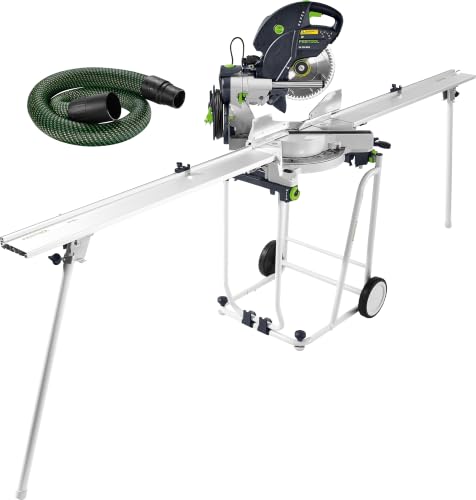
The dust collection is in a different league entirely
Festool 579556 KAPEX KS 120 REB Miter
Festool's Kapex KS 120 REB starter set includes the saw, the UG stand, extension wings and a 36mm extraction hose. Paired with a Festool CT extractor it captures roughly 91% of dust at the source — a number no other miter saw here approaches.
$2,699fromAmazonDust is the reason to buy this saw. Fine Woodworking's shop testing put the Kapex at approximately 91% capture at source with a Festool CT extractor, against 30–55% for typical miter saws. If your shop is an attached garage, a basement, or anywhere the air you breathe circulates back into your house, that gap is the whole argument. It's also why finish carpenters bring one into occupied homes.
The precision matches the reputation. Machined bevel detents, tight tolerances and a genuinely quiet motor make it the saw people build a miter station around rather than a saw they set on a bench. For trim, molding and fine finish carpentry — the work where a gap of a few thousandths is visible — this is the reference point.
This particular listing is the starter set, not just the tool. You get the UG stand and extension wings, which turn it into a full cutting station with real support for long stock, plus the 36mm hose to connect an extractor. Long-material support does as much for accuracy as anything inside the saw. Buying the stand separately later costs more and takes longer.
It's also portable in a way the weight doesn't suggest. The UG stand is designed to fold and move, so the whole station breaks down for a job site and sets back up without tools. That's unusual for something this precise.
Flaws but not dealbreakers
It's far and away the most expensive setup here, and the extractor that unlocks the dust performance is a separate purchase. Buy just the saw and you've paid a premium for a capture rate you're not getting.
Long-term durability is the recurring concern. Some heavy users report Kapex saws needing service after a few years of daily production work, and at least one experienced woodworker has moved to a Makita slider after going through two of them. For a home shop cutting a few hundred board feet a year, that's much less likely to be your story than it is a trim contractor's.
Who this is for
Buy one of these if you're building furniture, hanging trim, framing a deck or setting up a garage shop and you're tired of crosscutting with a circular saw and a speed square. A miter saw is usually the second or third stationary tool people buy, and it pays for itself the first time you cut 40 pieces of baseboard to the same length. If you only cut a board or two a year, a good handsaw and a miter box will serve you fine and take up no room.
This guide covers corded and cordless miter saws for home shops and light professional trim work, from single-bevel choppers up through premium sliders. We're not covering radial arm saws, table saws or track saws, and we're not covering the industrial saws built for production shops. One safety note worth taking seriously: Family Handyman reports that miter saws account for roughly 14% of serious workshop injuries from stationary tools, with kickback and unclamped workpieces the two leading causes. Use the clamp that came with your saw.
How we picked
Cut accuracy: We looked for detents that repeat and fences that stay flat, since a saw that wanders a fraction of a degree can't cut crown. Real capacity: We compared published crosscut, baseboard and nested-crown figures rather than judging by blade diameter, and favored saws that clear a 2x12 in one pass. Space in the shop: Designs that sit flush to a wall got extra credit, because most home benches are against one and rear-rail sliders quietly steal a foot of depth. Dust handling: We compared published capture rates against owner reports of what actually escapes, since anything you cut indoors ends up in the air you breathe. Cut-line guidance: Shadow-line indicators beat lasers in published comparisons and can't drift as the motor warms, so we weighted them accordingly.
Other miter saws for woodworking and home shops worth considering
If you want the biggest capacity in the smallest footprint: The Makita LS1219L 12" Dual-Bevel Sliding Compound Miter ($980.78) — Makita's LS1219L is the 12-inch version of our Also great pick, and it's the capacity champion here — 8 inches of crown vertically nested, 6-3/4 inches of baseboard, and 15-inch crosscuts at 90 degrees. Like its 10-inch sibling it uses the two-rail system, so it still works flush against a wall despite the larger blade. Dual dust ports help. What you give up is portability: at roughly 82 pounds this is a saw you mount once and leave alone, and owners are split on the base being perfectly planar out of the box. If you have a dedicated miter station and cut wide stock often, it's the most capable saw in this lineup short of the Festool.
The competition
This is what our research turned up in the lineup we could confirm, not a survey of every miter saw sold. Plenty of good saws from Ryobi, Skil, Craftsman and others aren't here simply because they weren't part of this comparison. Every product in this guide appears above as a pick or an also-consider, so there's nothing left in this section to warn you off — treat the flaws listed under each pick as the honest case against it.
Setup and maintenance
Check your saw for square before you trust it. Put a reliable square against the fence and the blade, and cut a scrap wide enough to flip and butt against itself — any gap is double your error. Most saws have adjustment screws for the 90-degree and 45-degree stops, and dialing them in once at the start saves you a project full of tight joints. After that, keep the rails or glide arms clean; sawdust packed into a slide is what makes a smooth saw feel notchy after a year. Blow out the motor vents periodically. And upgrade the blade when the factory one dulls — a good 60- or 80-tooth crosscut blade improves finish cuts more than almost any other change you can make.
Questions we get
Should I get a 10-inch or a 12-inch miter saw?
Get a 12-inch if you regularly cut wide stock like 2x12s or tall baseboard standing up. Get a 10-inch if space and weight matter more, since it'll be lighter, spin faster and often leave a slightly cleaner edge. Blades cost less too. Note that some 10-inch sliders, including the Makita LS1019L, match a 12-inch saw's nested crown capacity.
What's the difference between a compound and a sliding compound miter saw?
A compound saw pivots for miters and tilts for bevels, but the head only drops straight down, so your maximum crosscut width is whatever the blade reaches. A sliding compound saw adds rails so the head travels forward and back, roughly doubling the width you can cut. Sliders cost more, weigh more and usually need clearance behind them unless they use a glide or two-rail design.
Do I need a dual-bevel saw for crown molding?
No, but it makes the job faster and less error-prone. With a single-bevel saw you flip the workpiece to cut the opposite hand of an angle, which works fine but is where miscuts happen. If you're hanging crown through a whole house, dual bevel is worth it. For occasional picture frames and baseboard, single bevel is plenty.
Can a cordless miter saw replace a corded one in a home shop?
For most home shop work, yes. Cordless sliders on the current battery platforms handle crosscuts and miters in dimensional lumber and hardwood without noticeable bogging, and a large-capacity pack covers a day of intermittent cutting. The real costs are money and batteries — you're paying a premium and you need packs on hand. If your bench has an outlet, corded is still the better deal.
How much does dust collection actually matter?
A lot if the saw lives indoors. Most miter saws capture somewhere between 30 and 55 percent of what they throw, meaning fine dust settles across your whole shop and hangs in the air. Connecting a shop vacuum to the dust port instead of using the cloth bag is the single biggest improvement you can make. Only the Festool Kapex approaches the roughly 91 percent range, and only with a matched extractor.
Does a better blade really make a difference?
Yes, and it's one of the simplest upgrades you can make. Factory blades are usually general-purpose with a modest tooth count, fine for framing and mediocre for finish work. A high-tooth-count crosscut blade dramatically reduces tearout in plywood and hardwood. Putting a good blade on an average saw beats leaving the stock blade on an expensive one.
Why you should trust us
For this guide:
- We compared manufacturer specifications for every saw in this guide, focusing on crosscut, bevel and nested crown capacity rather than blade diameter alone.
- We read published reviews from outlets including Fine Woodworking, Popular Mechanics, This Old House and Bob Vila for figures on dust capture, detent repeatability and cut-line accuracy.
- We reviewed owner feedback across these listings for recurring themes — alignment issues out of the box, dust escaping the shroud, and how each saw holds up after a year of use.
- We read owner reviews on every listing, weighted toward the critical ones, because that is where the recurring failures show up.
- We have a systematic way of automatically fetching the latest prices, so the numbers on this page stay current.
- This is a research-focused guide, so the team may not own every product listed — though we often do own the top winners, which gives us extra context for the recommendations.
- We don't accept free products, and the retailer commission never changes which product we recommend.
Sources
Best Miter Saws of 2026 — Popular Mechanics, Popular Mechanics
Best Miter Saw — This Old House Reviews, This Old House
Best Miter Saws — Family Handyman, Family Handyman
Best Miter Saw — Bob Vila, Bob Vila
Miter Saw Tool Guide & Reviews — Fine Woodworking, Fine Woodworking
Best Miter Saws Tested — Wood Magazine, Wood Magazine
DEWALT DWS780 Official Product Specifications, DEWALT
Bosch GCM12SD Axial-Glide Miter Saw — Official Specs, Bosch Tools
Milwaukee 2739-21HD M18 FUEL Miter Saw — Official Specs, Milwaukee Tool
Festool Kapex KS 120 REB — Official Specs & Dust Extraction Data, Festool
Makita LS1019L Official Specifications, Makita
Miter Saw Safety Education — U.S. Consumer Product Safety Commission, U.S. Consumer Product Safety Commission
Amazon product listings and owner reviews for all 6 products
Manufacturer specification pages for each product
Some passages in this guide may be paraphrased with AI help. Prices are refreshed automatically.
More like this.
Continue exploring home reviews and recommendations.

The Best Wet/Dry Shop Vacuums
A shop vacuum is the tool you drag out when a regular vacuum would die trying. Broken tile, wet sawdust, a burst supply line under the sink, the gravel…

The Best Random Orbital Sanders for Woodworking
Sanding is the part of woodworking nobody brags about. It's also the part that decides whether your finish looks like furniture or looks like a school…

The Best Benchtop Drill Presses for Woodworking
A handheld drill wanders. Even with a steady hand you'll drift a couple of degrees, and that shows up later as a shelf that rocks or a dowel joint that…

The Best Wet Tile Saws
Cutting tile is the part of a tile job that decides how the finished wall looks. Every outlet, every doorway, every corner needs a cut piece, and a…

The Best Pole Saws
Pruning overhead branches used to mean a ladder, a chainsaw, and a bad idea. A pole saw fixes that. You keep both feet on the ground, extend the shaft,…

The Best Cordless String Trimmers
A string trimmer has one job, and you notice immediately when it does that job badly. The line runs out halfway down the fence. The head bogs down in wet…