The Best Portable Car Refrigerators
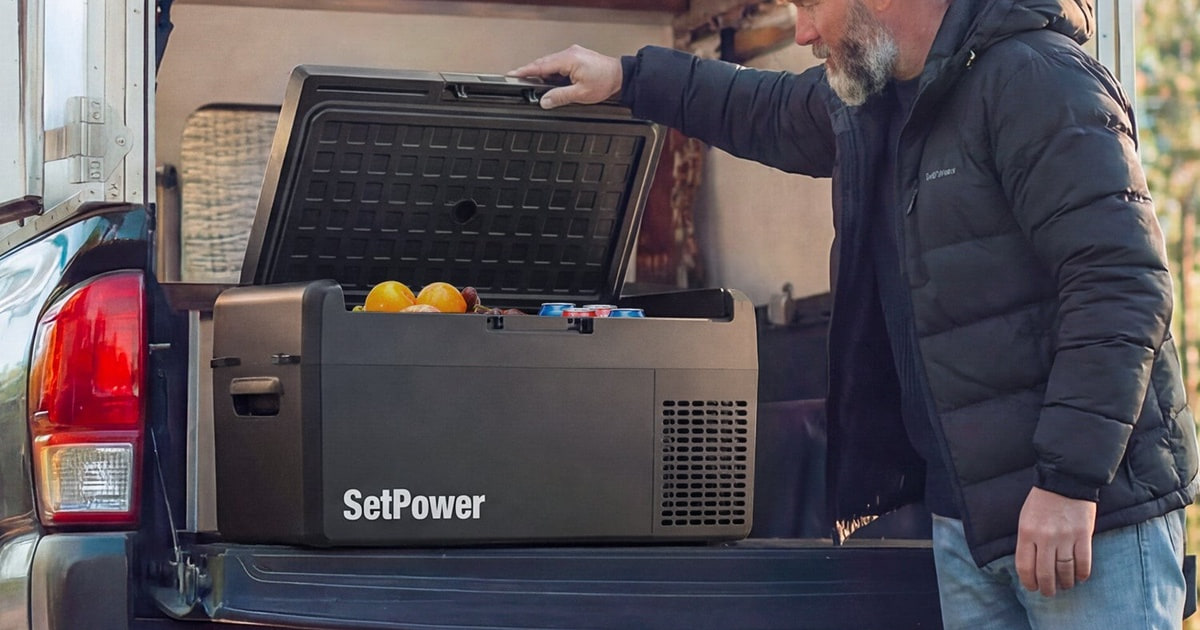
A 12V compressor fridge changes how you travel. There's no ice to buy, no meltwater sloshing around your sandwiches, no soggy cardboard at the bottom of the cooler. You set a temperature and the box holds it, whether you're crossing Nevada in July or parked in the shade at a campsite. Milk stays drinkable on day four. Leftovers stay safe. And if the unit freezes, you can carry frozen meat for a week and thaw it as you go.
But they all share one problem: power. A compressor fridge pulls roughly 35 to 60 watts whenever it's running, and in the heat it runs a lot. Leave one plugged into your starter battery overnight and you can wake up to a car that won't turn over. Battery-protection cutoffs help, though they protect the battery by shutting the fridge off — which means warm food. None of these units solves that for you. Plan on an auxiliary battery, a power station, or solar.
They're heavier and louder than the marketing suggests, too. A 60-liter box packed with groceries is a two-person lift, and even a quiet compressor cycles on and off a few feet from your head all night. So we read the spec sheets closely, compared published reviews, and looked at what owners say after a season of use. We think that the BougeRV CR28 30QT is the best portable car refrigerator for most people, and that the Setpower DT55 is the one to buy if you need a fridge and a freezer running at once.
Everything we recommend
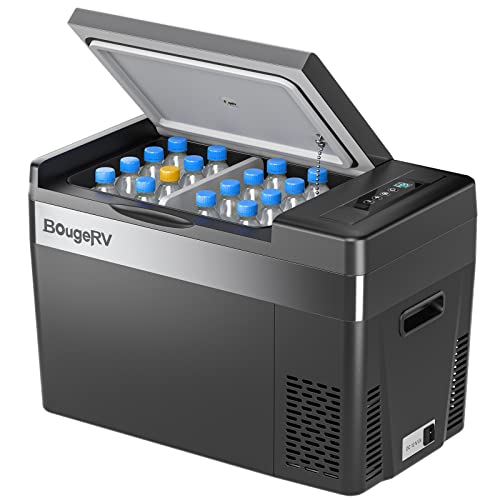
Real freezing power and quiet running for most trips

Two zones and phone control on a tight power budget

The coldest, toughest box here if you skip the smart features
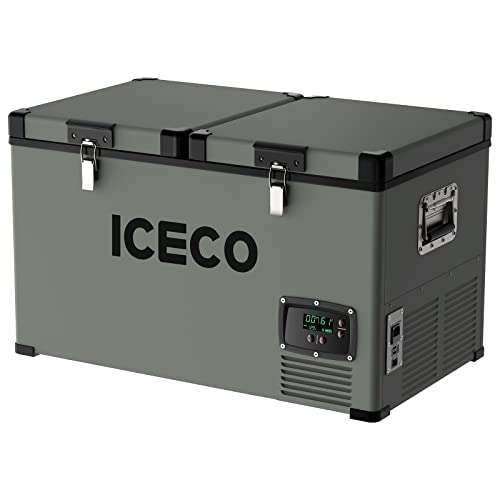
The most dual-zone room here, if your cargo area allows
At a glance
| Product | Capacity | Wattage | Price | |
|---|---|---|---|---|
| BougeRV 12v refrigerator 30 QuartTop pick | 30 Quart | 45-60W | $207.56On sale |
| Dometic CFX2 37-Liter Portable Refrigerator and FreezerUpgrade pick | 37L | — | $769.99 |
| Setpower 12V Refrigerator with APP ControlRunner-up | 59QT | 38-50W | $329.99On sale |
| ICECO VL60 Dual Zone Portable Refrigerator withAlso great | 60L | — | $679.20On sale |
 | EUHOMY 12 Volt RefrigeratorAlso consider | 59QT (55L) | — | $220.99On sale |
 | Anker SOLIX EverFrost 2 40 L ElectricAlso consider | 40L | — | $659.99On sale |
How we picked
Cooling technology. We ruled out anything that couldn't hold a set temperature regardless of how hot the car got. Compressor units do that; thermoelectric ones only pull the air a fixed amount below ambient, which fails in a hot vehicle.
Minimum temperature. We read each manufacturer's rated low temperature rather than the marketing copy. Anything at or below 0°F can freeze food safely for the long haul; anything that stops at 32°F refrigerates only.
Power draw. We compared published steady-state wattage in both eco and max modes, because that number decides how many nights you get off a battery. Under about 45W in eco is where a single 100W solar panel can keep up.
Battery protection. We looked for adjustable cutoff levels, not a single fixed threshold. A fridge that shuts off before it kills your starter battery is the difference between a warm dinner and a tow truck.
Build and portability. We compared weights, external dimensions, and what hinges and handles are made of, using spec sheets and published reviews. Metal hardware and a lid that seals still separate the units that last from the ones that don't.
Top pickOn sale
Real freezing power and quiet running for most trips
BougeRV 12v refrigerator 30 Quart
The CR28 is a 30-quart single-zone compressor fridge that reaches -8°F, runs quietly enough to sleep beside, and sips little enough power to live off a modest battery setup. For one or two people, it's the least complicated way to get real refrigeration into a car.
$207.56fromAmazonList priceIt freezes, it doesn't just chill. BougeRV rates the CR28 from -8°F up to 50°F, so you can run it as a proper freezer and carry ice cream, frozen meat, or actual ice. The spec sheet lists 15 minutes to drop from 77°F to 32°F and about 50 minutes to reach -5°F. That means you can load it at home, plug it in, and be cold before you've cleared town.
It's quiet enough to sleep next to. BougeRV rates it at 45dB, which is roughly a soft conversation in the next room. In a moving vehicle you won't hear it. In a truck bed or a tent at 2 a.m. you'll hear it cycle, but it won't wake you. The unit also has a shock-proof design and keeps running at up to a 30-degree tilt, which matters on washboard roads.
The power draw is modest, so your battery lasts longer. In ECO mode it runs at about 45W, and even flat out in MAX mode it's 60W. BougeRV says a normal duty cycle keeps it under 1kWh per day. That's the difference between one night parked and two. Pair it with a 100W solar panel and a decent auxiliary battery and you're close to break-even in good sun.
Battery protection you can actually set. The CR28 has three selectable cutoff levels, so you decide how much of your starter battery the fridge is allowed to eat before it shuts itself down. Set it high if you're parked overnight and need the engine to turn over. Set it low if you're on an auxiliary bank and want every last watt-hour going into keeping food cold.
It plugs in wherever you are. It runs on 12V or 24V DC in a vehicle and on household AC at home or a powered campsite, and both cords come in the box along with a removable partition board. So it doubles as a spare fridge in the garage between trips, which is genuinely useful. At roughly 23 by 12.6 by 15.5 inches, it fits behind most back seats.
Flaws but not dealbreakers
It's one temperature at a time. The CR28 is single-zone, so it's a fridge or a freezer on any given trip, not both. For a couple that's usually fine — you pick chilled and live with it. If you want cold drinks and frozen meat simultaneously, you need the Setpower DT55 or the ICECO VL60 instead.
The app is Bluetooth only. You can check and adjust the fridge from about 30 feet away, which covers walking around the vehicle. It doesn't cover checking your food from a trailhead or a hotel room. If remote monitoring matters, look at the Setpower.
Keep it out of the sun and out of the rain. BougeRV publishes no IP rating, and its own listing warns that direct sunlight can deform the lid. Throw a cover over it in an open truck bed. The lid hinge is reversible, but it doesn't feel as solid as the stainless hardware on the Dometic.
BougeRV lists two years of tech support on the CR28 rather than a stated parts-and-labor term.
Runner-upOn sale
Two zones and phone control on a tight power budget
Setpower 12V Refrigerator with APP Control
The DT55 splits 59 quarts into a 23-quart and a 36-quart compartment you control independently, and it does that on less power than any other dual-zone unit here. Full app control means you can check both sides from inside your tent.
$329.99fromAmazonList priceYou get a real fridge and a real freezer at the same time. The two compartments have separate digital controls, so one side can hold your beer at 38°F while the other keeps meat at -4°F. That's the single most useful thing a portable fridge can do, and most units here can't. Setpower rates the whole range from -4°F to 68°F, so either side can be either thing.
It's the gentlest unit here on a solar setup. The Smartele compressor draws 38W in MIN mode and 50W in MAX. For a dual-zone box that's remarkably low, and it's the number that decides whether one 100W panel keeps up with you or falls behind. If you're building a van around a finite battery bank, that gap compounds over a week.
The app does more than the Bluetooth units. You set and check both zones from your phone, so you can confirm the freezer side is still holding without walking back to the truck. It's the deepest connectivity of anything here. Small thing on a weekend trip. A big thing if you're leaving food unattended for a day.
Small design choices add up. There's a drainage hole in the bottom, so you rinse it out instead of sponging melted spills. An LED light shows you what you're grabbing after dark. Stackable baskets, an integrated handle, and a magnetic plate for compatible battery packs come in the box, and it runs on 12/24V DC or 100-240V AC.
Flaws but not dealbreakers
There's no battery inside. The DT55 needs a running 12V socket, a wall outlet, or a separate power station. Unplug it at a fuel stop and it's a cooler. If you want the fridge to keep working with the vehicle off and nothing else connected, the Anker is the one built for that.
Running both zones costs you. Two compartments held at two temperatures pull more total watt-hours overnight than a single-zone box the same size. The DT55's low draw softens that, but it doesn't erase it. Turning one zone off is an option and worth using on shorter trips.
Setpower is newer here than the established names. It has less of a track record in the US than Dometic, ICECO, or Alpicool, and the industrial-looking control panel isn't going to impress anyone. If long-term parts availability is a deciding factor for you, that's a fair reason to hesitate.
Setpower lists three years of tech support on the compressor and one year on the remaining parts.
Upgrade pick
The coldest, toughest box here if you skip the smart features
Dometic CFX2 37-Liter Portable Refrigerator and Freezer
The CFX2 37 drops to -7°F and is built with reinforced corners, stainless hinges, and folding ABS handles meant to survive years of trailhead abuse. You give up app control and dual-zone flexibility to get Dometic's hardware.
$769.99fromAmazonIt goes colder than almost anything here. Dometic rates the CFX2 37 down to -7°F, which is well past the 0°F the USDA treats as safe long-term freezing. Only the ARB claims lower. If you're carrying frozen food for a week and opening the lid several times a day, that headroom is what keeps the contents actually frozen rather than merely cold.
The build is the reason to buy it. Reinforced corners, stainless steel hinges, ABS folding handles, and a robust removable lid — this is a box designed to be loaded, dropped, and re-loaded for years. Plastic latches are the first thing to fail on cheaper units, and Dometic's outdoor line has a long track record with overlanders for a reason.
Battery protection watches the vehicle, not just the fridge. The three-stage system monitors draw on your vehicle battery and cuts power before it can leave you stranded at a trailhead with no cell service. That's a mundane feature until the one night it saves your trip.
It packs efficiently and plugs in anywhere. The 37-liter interior takes 48 cans or four 1.5-liter bottles, which is a realistic weekend for a group. It runs on 12/24V DC and 100-240V AC, so the same box works in the truck, at a powered site, and in the pantry at home between trips.
Flaws but not dealbreakers
One zone, one temperature. The whole 37 liters runs at whatever you set, so a freezer trip means no cold produce and a fridge trip means no ice. Both the Setpower and the ICECO give you two zones for less.
No app, no Wi-Fi. Dometic keeps connectivity on its pricier CFX5 line, so what you get here is a physical control panel. If you check the fridge by walking up to the truck, that's fine. If you wanted alerts on your phone, this isn't the one.
You pay for the name and the shell, not the capacity. Thirty-seven liters is modest next to the dual-zone units that cost less, and there's no internal battery — it needs a 12V socket, AC, or a power station. This makes sense if the build quality is what you're after.
Also greatOn sale
The most dual-zone room here, if your cargo area allows
ICECO VL60 Dual Zone Portable Refrigerator with
The VL60 gives you 60 liters split into two independently controlled compartments with separate lids, both able to hold 0°F. For a family of four on a multi-day trip, it's the only unit here with enough room to matter.
$679.20fromAmazonList priceTwo zones, two lids, no compromise. Each compartment has its own control and its own lid, so grabbing a drink from the fridge side doesn't dump warm air onto the frozen side. You can run freezer and fridge, both freezers, or both fridges, and you can switch one off entirely to save power on a shorter trip.
Both sides freeze properly. ICECO rates the range from 0°F to 50°F in either zone, which meets the USDA standard for safe long-term freezing. So a family can carry frozen meat on one side and dairy and produce on the other for three or four days without a grocery stop. That's the whole argument for a box this size.
The compressor is the proven one. The VL60 uses a SECOP compressor, the same Danish design that turns up in the most reliable units in this category. MAX mode cools fast after you load it warm; ECO mode keeps the daily watt-hours down once things settle. A metal shell, thickened inner walls, and a foldable pull-down latch handle the rest.
It's built to be lived in. Two removable wire baskets mean you lift groceries out in one motion instead of digging. An interior light helps after dark. The height is designed to clear a pickup tonneau cover, and separate 12/24V DC and 110-240V AC ports keep the cords from tangling behind it.
Flaws but not dealbreakers
It's big and it's heavy. Sixty liters is the largest footprint here, and loaded it's well past 60 pounds — a two-person carry from the truck to the site. Measure your cargo area before you order, because this is the unit most likely to not fit.
No wheels, no USB port. The smaller VL45 gets a trolley handle and a charging port; this one doesn't. For a fridge this heavy, the missing wheels sting more than the missing USB.
There's no app to check it with. There's no listed Bluetooth or Wi-Fi monitoring on this model, so you check it by opening it. Not a dealbreaker, but worth knowing if you were expecting phone control at this size.
ICECO covers the compressor for five years and all other parts for one year.
Who this is for
Buy one of these if you're tired of managing ice. That's the honest test. Road-trippers, campers, tailgaters, truck drivers, and anyone with a long commute and a lunch to protect all get more out of a compressor fridge than they expect, because it removes a chore rather than just adding cold. If you camp with hookups or you're building out a van, a fridge is usually the first appliance worth buying and the one you'll use every single day.
Skip it if you take one weekend trip a year and a bag of ice does the job, or if you have nowhere to plug it in — none of these except the Anker runs without an external power source. This guide covers portable 12V compressor fridges and one thermoelectric cooler for contrast. It doesn't cover built-in RV absorption fridges, which run on propane and hate being off-level, or passive rotomolded coolers, which are a different purchase entirely.
How we picked
Cooling technology: we only recommend compressor units, because a thermoelectric cooler can't hold a food-safe temperature in a hot car. Minimum temperature: we read the rated low from the spec sheet, since 0°F or colder means real freezing and 32°F means chilling only. Power draw: we compared published eco and max wattage, because that number decides how long you last on a battery. Battery protection: we looked for adjustable cutoffs that shut the fridge down before your starter battery dies. Capacity and fit: we weighed interior liters against external dimensions, since the best fridge is worthless if it doesn't clear your tailgate. Build: we checked what the hinges, handles, and shell are made of, using manufacturer specs and published reviews.
Other portable car refrigerators worth considering
If you want maximum capacity without a premium brand: The EUHOMY 12 Volt Refrigerator ($220.99) — The EUHOMY CF001 gives you 59 quarts — nearly double the BougeRV — with a variable-frequency compressor that's UL certified for efficiency, a real -4°F floor, three-level battery protection, and Bluetooth app control. It settles around 45W at steady state and cools from 68°F to 32°F in about 15 minutes. Read the listing carefully, though: the "two zones" language describes a removable divider meant to keep odors apart, not independent temperature control. It's one door and one compressor. Treat it as a large single-zone box and it's a lot of interior space; expect a second thermostat and you'll be disappointed. At 33 pounds and roughly 27 by 14 by 21 inches, measure first.
If you want the fridge to run with the vehicle off: The Anker SOLIX EverFrost 2 40 L Electric ($659.99) — The Anker SOLIX EverFrost 2 40L builds a removable 288Wh LiFePO4 battery into the fridge, which is a genuinely different proposition. It holds 39°F for about 52 hours unplugged, or 4.3 days with a second battery installed, and recharges from a 100W solar panel, a car socket, a wall outlet, or USB-C. Max, Eco, and Smart modes let you trade cooling speed for runtime. It cools from 77°F to 32°F in 15 minutes and ranges down to -4°F. The catch is weight: with the battery and aluminum-reinforced housing it's about 56 pounds, the heaviest thing here, and it's single-zone. If you're already wiring into a battery bank, the Setpower gives you more per watt.
The competition
These are what our research surfaced, not a complete map of a category that adds new brands constantly. We focused on units with published temperature ratings, stated power draw, and enough of a track record to say something useful about. A product landing here isn't automatically a bad buy — a couple of them are the right answer for a specific person.
Power and installation notes
Do the power math before you buy. Multiply the fridge's average draw by 24 to get daily watt-hours: a 40W unit at a 50% duty cycle uses roughly 480Wh a day. A 100Ah/12V battery stores about 1200Wh, but you should only pull it down halfway, which gives you a little over a day. One 100W solar panel makes 400 to 500Wh in good sun, so you're near break-even; two panels usually run a fridge indefinitely. For regular overnight camping, wire in a dedicated 100-200Ah auxiliary battery instead of leaning on your starter battery. Always turn battery protection on. Pre-chill the fridge and the food at home on AC power, keep the unit out of direct sun, and leave a few inches of clearance around the vents so the condenser can dump heat.
Questions we get
What's the difference between a 12V compressor fridge and a thermoelectric cooler?
A compressor fridge uses the same refrigeration cycle as the one in your kitchen, so it reaches a specific target temperature no matter how hot it is outside. A thermoelectric cooler uses solid-state Peltier elements and can only pull the air roughly 36 to 40°F below ambient. In a 95°F car that's about 55 to 59°F, which isn't food safe. Thermoelectric units are silent and inexpensive, but they're for drinks, not dinner.
Will a 12V fridge drain my battery overnight?
It can. Once the contents are cold, a compressor fridge runs at roughly a 30 to 50% duty cycle and uses about 300 to 500Wh over eight hours. A group 27 deep-cycle battery holds around 1200Wh but should only be discharged halfway, so you're looking at one to two nights. Turn on the fridge's battery protection so it cuts out before your starter battery does. For regular overnight use, add an auxiliary battery or solar.
What size do I need for a family of four?
Plan on 40 to 60 liters for a multi-day trip with four people. The ICECO VL60 at 60 liters is our recommendation there, because the dual zones let you carry frozen meat alongside fresh food. A rough packing benchmark: one liter holds one to two cans or the equivalent in groceries. For trips past four days, plan a resupply stop rather than trying to carry everything.
Can I run one off solar?
Yes — a 12V compressor fridge is one of the friendliest loads for a solar-and-battery setup. A single 100W panel makes roughly 400 to 600Wh a day in decent sun, and a 35 to 45W fridge at a 50% duty cycle uses about 420 to 540Wh. So one panel gets you close to neutral and two give you margin. Pair it with a LiFePO4 battery, which lets you use far more of its rated capacity than lead-acid does.
Which one is quietest?
The BougeRV CR28 is rated at 45dB, which is about as quiet as this category gets — comparable to soft background noise. The Dometic's efficient compressor is quiet in practice, though Dometic doesn't publish a figure for this model. The Alpicool C20 sits around 52dB, roughly normal conversation volume, which you'll notice in a quiet cabin. As a rule: 40 to 45dB is whisper-quiet, 50 to 55dB is audible but easy to ignore, and past 58dB it'll bother you at night.
Do I need dual zone?
Only if you genuinely need frozen and chilled food on the same trip. Dual-zone units cost more, weigh more, and use more power when both sides are running. If you mostly carry drinks, produce, and leftovers, a single-zone box like the BougeRV is simpler and cheaper to run. And watch the listings — a removable divider inside one compartment is not a second temperature zone, no matter what the product title says.
Why you should trust us
For this guide:
- We read the manufacturer spec sheets and full listings for every unit here, comparing rated minimum temperatures, published wattage in eco and max modes, dimensions, and warranty terms side by side.
- We compared published reviews and owner feedback themes across the category to see which flaws come up repeatedly — noise, lid seals, battery cutoffs, and misleading dual-zone claims — rather than relying on marketing copy.
- We did not use, install, or operate any of these fridges; every performance figure here comes from a manufacturer specification or published review.
- We read owner reviews on every listing, weighted toward the critical ones, because that is where the recurring failures show up.
- We have a systematic way of automatically fetching the latest prices, so the numbers on this page stay current.
- This is a research-focused guide, so the team may not own every product listed — though we often do own the top winners, which gives us extra context for the recommendations.
- We don't accept free products, and the retailer commission never changes which product we recommend.
Sources
Best Portable Refrigerators of 2026 — Wirecutter, Wirecutter / The New York Times
Best 12V Car Refrigerators Tested — Outdoor Life, Outdoor Life
Portable Fridge Reviews & Comparisons — RTINGS.com, RTINGS.com
Best Portable Car Fridges 2025–2026 — Overlander Magazine, Overlander Magazine
Car Fridge Buyer's Guide — Consumer Reports, Consumer Reports
Dometic CFX3 Series Official Specifications — Dometic, Dometic
BougeRV CR Pro Review & Testing — The Drive, The Drive
Best Portable Fridges for Camping — REI Expert Advice, REI Co-op
Amazon product listings and owner reviews for all 6 products
Manufacturer specification pages for each product
Some passages in this guide may be paraphrased with AI help. Prices are refreshed automatically.
More like this.
Continue exploring electronics reviews and recommendations.

The Best Portable Car Vacuums
Cleaning a car is mostly a reaching problem. The crumbs live in the seat track, the sand settles into the carpet pile, and the dog hair works its way into…

The Best Portable Car Heaters
A cold car is a visibility problem before it's a comfort problem. You get in, breathe twice, and the windshield fogs over. The factory defroster works,…

The Best Wine Coolers and Beverage Refrigerators
A wine cooler does one job: it holds a steady, cellar-ish temperature so your bottles don't cook on a kitchen counter or freeze in the back of the fridge.…

The 7 Best Portable Bluetooth Keyboards for Travel in 2026: Lightweight, Multi-Device Picks
Expert-tested portable Bluetooth keyboards for travel in 2026. Compare weight, battery life, and multi-device pairing across 7 top picks from Logitech, Keychron, nuphy, and more.

The Best Portable External SSDs
A portable SSD is the drive you grab when your laptop is full, when a shoot wraps and the cards need clearing, or when a console runs out of room…

The Best Portable Projectors
A portable projector turns a bedsheet, a garage door or a hotel wall into a screen bigger than any TV you'd carry up a flight of stairs. That's the…