The Best Car Battery Jump Starters
A dead battery almost never happens at a convenient time. It's the school run, the grocery-store parking lot at dusk, or a driveway on the first genuinely cold morning of the season. A portable jump starter turns that into a two-minute annoyance instead of an hour-long wait for a tow truck. The good ones are small enough to live in your glovebox, safe enough to hand to someone who's never done this before, and they hold a charge long enough that they still work when you finally need them.
Here's the honest catch: no jump starter is a battery you can forget about. Lithium units lose capacity if you leave them baking in a trunk through July, and lead-acid packs need topping off every month or two or they'll be dead right alongside your car. Peak amp numbers are also marketing-first. A unit advertising 1000 amps delivers that for a fraction of a second, not the sustained push a cold V8 wants. Match the unit to your engine, then keep it charged.
We also want to be clear about scope. This guide is built from manufacturer specifications, published reviews and what owners report after living with these units, not from our own bench work. We think that the NOCO Boost GB40 is the best car battery jump starter for most people, and that the NOCO Boost GB70 is the one to buy if you drive a full-size truck, tow regularly, or run a diesel.
Everything we recommend
Foolproof clamps and glovebox size, for almost any car

Twice the punch for trucks and diesels, at twice the bulk

Jump starter, tire inflator and charger in one heavy box
Brute-force cranking for shops, with real weight and upkeep
At a glance
| Product | Peak Amps | Weight | Price | |
|---|---|---|---|---|
| NOCO Boost GB40: 1000A UltraSafe Jump StarterTop pick | 1000A | 2.9982867632 lb | $92.57 |
| NOCO Boost GB70: 2000A UltraSafe Jump StarterUpgrade pick | 2000A | 5 lb | $189.95 |
 | Antigravity Batteries AG-MSA-10B Clampless Starting Harness forAlso in lineup | — | 0.05 lb | $18.99 |
| Clore Automotive Jump-N-Carry JNC660 1700 Peak AmpRunner-up | 1700A | 18 lb | $126.02 |
| DEWALT DXAEJ14 Digital Portable Power Station JumpAlso great | 1600A | 17.3 lb | $169 |
How we picked
Starting power vs. engine. We matched each unit's rated peak amps and manufacturer engine ceilings against the vehicles people actually drive. A unit had to cover its stated engine class with headroom rather than sitting right at the limit.
Safety design. We compared clamp systems across spec sheets, favoring spark-proof and reverse-polarity lockouts over alarms alone. Published reviews and owner feedback both point to bad connections as the most common way people damage something.
Storage and charge retention. We weighed lithium versus lead-acid self-discharge behavior, since a jump starter that's flat when you reach for it is worthless. Owner feedback about units failing after months in a trunk shaped this heavily.
Size and where it lives. We looked at listed weight and dimensions against realistic storage spots — glovebox, center console, truck toolbox, shop shelf. A unit that doesn't fit where you'd keep it won't be with you when you need it.
Cables and clamps. We checked cable gauge and length against the reach needed on trucks and crowded engine bays. Short, thin cables are the flaw owners complain about most across every brand.
Top pick
Foolproof clamps and glovebox size, for almost any car
NOCO Boost GB40: 1000A UltraSafe Jump Starter
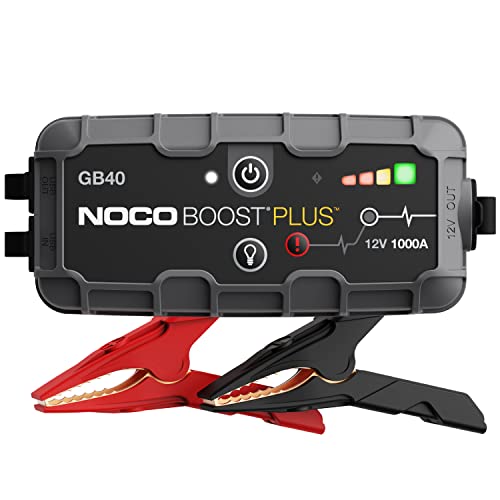
The GB40 packs 1000 peak amps into a 2.5-pound box that fits in a glovebox. Its spark-proof clamps won't energize until they're hooked up correctly, so you can hand it to a nervous first-timer and walk away without worrying.
$92.57fromAmazonThe safety system is the real reason to buy this one. NOCO's UltraSafe clamps stay dead until they detect a properly connected 12V battery. Get the polarity backwards and nothing happens — no spark, no smoke, no damaged alternator. That matters more than any amp figure if you've never jumped a car before, or if you're handing the unit to a family member who hasn't either. Most of the risk in jump-starting is human error, and this design removes it.
It covers the engine in almost every driveway in America. NOCO rates the GB40 for gas engines up to 6.0 liters and diesels up to 3.0 liters, which takes in nearly every sedan, crossover and half-ton pickup on the road. NOCO claims up to 20 starts per charge. If you drive a Camry, a CR-V, a Golf or an F-150 with the 5.0, you're comfortably inside its range with room to spare.
It's genuinely small. At 2.5 pounds and roughly the footprint of a paperback, it slides into a glovebox or a center console and stays there. That's the whole point. A jump starter you have to remember to bring is a jump starter you won't have when the battery dies at the airport parking garage. This one just lives in the car.
The extras earn their keep on a bad night. There's a 100-lumen LED with seven modes, including SOS and strobe, which is exactly what you want when you're crouched over an engine bay in the dark on a shoulder. The USB power bank will get a dead phone back to life so you can call someone. Neither feature is a reason to buy it on its own, but together they make it useful beyond the one emergency it was bought for.
It's built to survive living in a car. The IP65-rated housing with rubberized over-molding shrugs off rain, road dust and the occasional drop onto concrete. That's a real consideration for something that spends its life rattling around under a seat or in a trunk with your tools. Owners who keep it in the vehicle year-round generally report it still works when they finally reach for it.
Flaws but not dealbreakers
It runs out of headroom on big engines. A 1000-amp peak sounds like a lot until you're facing a 6.7-liter diesel on a subfreezing morning. Owners of large diesel pickups and V10s report needing multiple attempts or getting nothing at all. If that's your vehicle, step up to the GB70 rather than hoping this one gets there.
The cables are short. They reach fine on a sedan. On a lifted truck or anything with a deep, crowded engine bay, you may find yourself balancing the unit on the intake manifold because the clamps won't quite reach where you want them. It's an annoyance rather than a dealbreaker, but it's the complaint that comes up most.
Heat is its enemy. Lithium cells degrade in sustained high temperatures, and a closed car in summer gets brutally hot. If you park outside in Phoenix or Houston, expect the pack to lose capacity faster than the spec sheet implies, and plan on topping it off more often than NOCO's one-year storage claim suggests.
NOCO covers the GB40 with a one-year limited warranty.
Upgrade pick
Twice the punch for trucks and diesels, at twice the bulk
NOCO Boost GB70: 2000A UltraSafe Jump Starter
The GB70 doubles the GB40's output to 2000 peak amps and covers gas engines up to 8.0 liters and diesels up to 6.0 liters. You get the same spark-proof clamps, in a heavier package that won't fit in most gloveboxes.
$189.95fromAmazonThis is the one that starts a big diesel. NOCO rates it for 8.0-liter gas and 6.0-liter diesel engines, which covers a Power Stroke, a Cummins, a Duramax and the largest gas V8s. Published reviews single out its cold-morning diesel performance as the thing that separates it from lighter lithium units. If a no-start on a job site costs you a day's work, that headroom is the whole purchase.
It inherits the same foolproof clamps. The UltraSafe system scales up unchanged: the clamps won't energize until they see a correctly connected, discharged 12V battery. That's more valuable at 2000 amps, not less. You're most likely to fumble a connection at 6 a.m. in the cold with gloves on, and this is the unit that forgives that.
You get many more starts per charge. NOCO claims up to 40 starts on a full charge, double the GB40's figure. If you're the person in the crew whose truck has the jump starter, or you're helping out at a trailhead where nobody else brought one, that reserve matters. It recharges in about six hours from empty.
The light is a proper work light. At 400 lumens it's four times brighter than the GB40's, with the same seven modes. That's enough to actually see what you're doing under a truck hood at night rather than just locate the battery terminals. Small thing, but it turns the unit into something you'll grab for non-emergencies too.
Flaws but not dealbreakers
It's not a glovebox device. At 5 pounds and roughly 9 by 6 inches, it needs a dedicated spot — a toolbox, a cab organizer, a trunk cubby. Plan for where it lives before you buy, because a unit rolling loose behind the seat is a projectile in a hard stop.
Most people don't need this much. If you drive a sedan or a crossover, you're paying for capacity you'll never use and carrying weight you don't need. The GB40 does the same job on the same engines with the same safety system. Buy up only if your engine actually demands it.
It still won't love a hot summer. Same lithium chemistry, same caveat. Storing it in a truck bed toolbox that hits 140°F on a July afternoon will shorten its usable life, regardless of how rugged the housing is.
NOCO covers the GB70 with a one-year limited warranty.
Also great
Jump starter, tire inflator and charger in one heavy box
DEWALT DXAEJ14 Digital Portable Power Station Jump
The DEWALT DXAEJ14 pairs 1600 peak amps with a 120 PSI digital air compressor and USB-A and USB-C ports. It's a shop-and-truck-bed tool rather than a glovebox one, and the compressor alone justifies the space for a lot of people.
$169fromAmazonThe built-in compressor is the reason to pick this over a plain jump starter. It runs to 120 PSI with an AUTOSTOP function, so you set the target pressure and it shuts itself off. That handles a slow-leaking tire on the shoulder, a soft bike tire before a ride, or a kid's soccer ball on a Saturday. Nothing else here does that, and low tire pressure is a far more common problem than a dead battery.
It has enough starting power for most of what you'd tow with. DEWALT rates it at 1600 peak amps, good for engines up to a V8. That covers full-size pickups, big SUVs and most work vans. It's short of the GB70 for the largest diesels, but it's well beyond what a passenger car ever asks for.
The charging ports are the modern ones. You get USB-A at 15W and USB-C at 25W, which means it'll actually fast-charge a recent phone rather than trickling it. If you're camping, tailgating or working away from an outlet, that's a real second job for the unit.
The details show shop-tool thinking. The powder-coated metal clamps store on the unit itself, so they're not swinging loose in a truck bed. There's an alternator check to tell you whether the charging system is the actual problem, and a reverse-polarity alarm that warns you before you make a mistake. The compressor has a ten-minute auto shutoff so leaving it running won't cook it.
Flaws but not dealbreakers
It's heavy and awkward. At 17.3 pounds and roughly 13 by 12 inches, this is a two-hands, dedicated-storage-space tool. It goes in a truck bed, a shop shelf or a trunk corner. It is not something you toss in a hatchback and forget about.
The clamps warn you, they don't stop you. A reverse-polarity alarm is not the same as clamps that refuse to energize. You still have to connect it correctly, in the right order, and pay attention to the alarm if it sounds. For a confident DIYer that's fine. For a first-timer, the NOCO approach is safer.
It needs regular maintenance charging. Like other lead-acid-style packs, it self-discharges meaningfully faster than a lithium unit. Leave it in a trunk for six months and there's a good chance it's flat when you need it. Owners who skip the top-off routine are the ones who report it failing at the worst moment.
Runner-up
Brute-force cranking for shops, with real weight and upkeep
Clore Automotive Jump-N-Carry JNC660 1700 Peak Amp
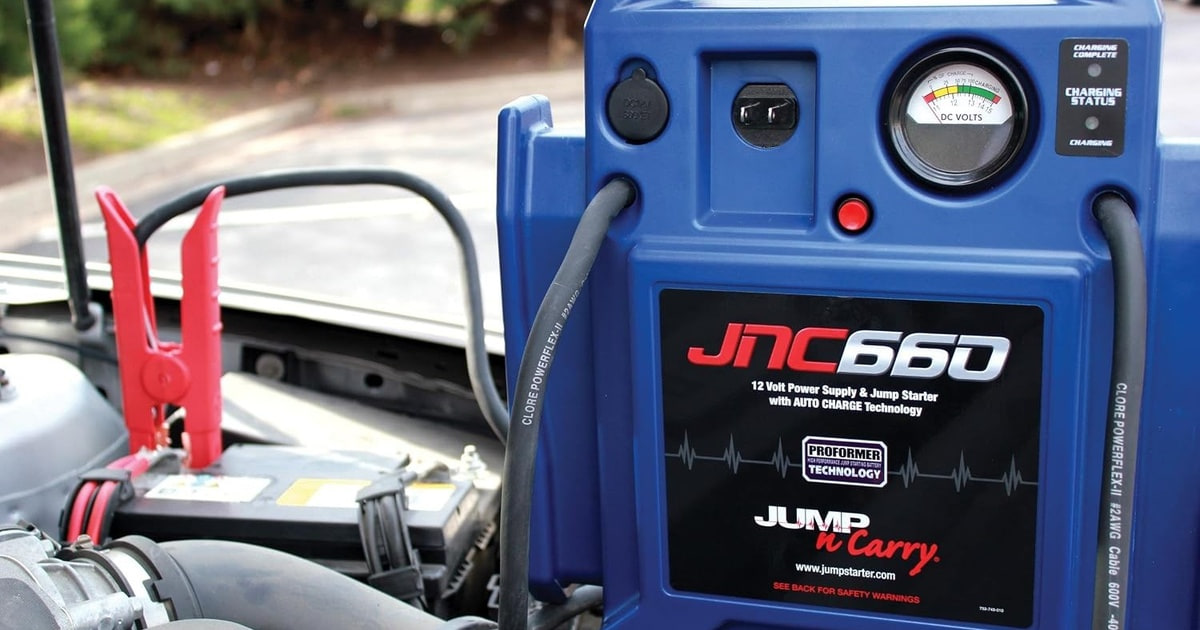
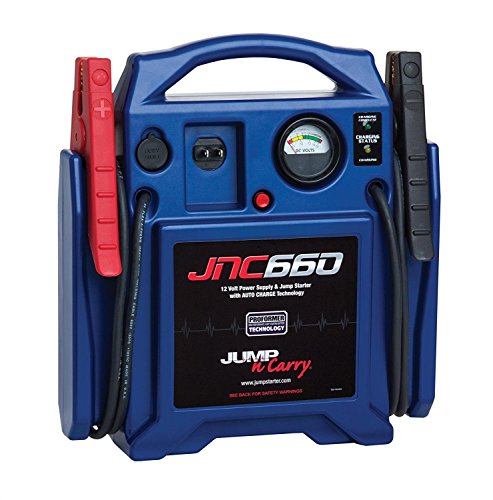
The Jump-N-Carry JNC660 delivers 1700 peak amps through 46-inch, 2 AWG cables from a 22Ah lead-acid pack built for repeated daily starts. It's an 18-pound shop tool with no USB ports, no smart clamps and no pretense of portability.
$126.02fromAmazonIt's built to start engines all day, every day. The 22Ah Clore Proformer battery is designed specifically for jump-starting duty rather than general storage. Lithium units can lose capacity when you deep-cycle them back to back; this one is made for exactly that. If you're a mechanic starting a dozen cars a week, that's the difference between a tool that lasts years and one that fades in a season.
The cables and clamps are the ones you actually want. You get 46 inches of 2 AWG cable, which is heavy-gauge and long enough to reach the battery on a truck without perching the unit on the engine. Thin cables and short reach are the two things people complain about most on consumer jump starters, and this one solves both by being unapologetically industrial.
It tells you where it stands. An onboard voltmeter shows the charge status of the internal battery, so you know before you need it rather than after. There's also a 12V DC outlet for running accessories. No app, no digital display, nothing to fail — just a gauge that works.
It has decades of shop credibility behind it. This design has been a fixture in service bays and fleet garages for a very long time, and it's still there. Published reviews and professional users consistently point to it as the benchmark for high-amp, repeated-use starting. That kind of longevity is hard to fake.
Flaws but not dealbreakers
Eighteen pounds is a commitment. It's roughly 16 by 14 inches and weighs as much as a bag of dog food. This is a shop-floor or service-truck tool. Nobody is carrying this to a stranded car across a parking lot without regretting it.
Skip the maintenance charging and it dies on the shelf. Lead-acid cells sulfate when left discharged, and this pack self-discharges far faster than lithium. Plan on charging it every month or two whether you've used it or not. Owners who treat it like a set-and-forget device are the ones who find it useless in an emergency.
There's no safety net on the connection. No spark-proof clamps, no automatic polarity lockout — just an alarm-free, connect-it-right-or-else design. You need to know the correct procedure: positive first, then negative to a ground point away from the battery. For a pro that's second nature. For a first-time user it's a genuine risk.
It's spartan by modern standards. No USB output, no work light, no AC outlet. If you want your jump starter to also charge a phone or light up an engine bay, this isn't it.
Who this is for
Buy one of these if your car spends nights outside, if your battery is more than three years old, or if you'd rather not depend on a stranger with jumper cables. Anyone who drives in real winter should own one, and so should anyone who stores a vehicle — a car sitting for a month often won't start on its own. If you're buying for a teenager's first car or for a parent who'd rather not pop a hood at all, the safety-locked clamp designs here are worth prioritizing over raw amps.
This guide covers 12V portable jump starters for cars, trucks and small diesels. It doesn't cover permanently installed battery maintainers, solar trickle chargers, 24V commercial equipment, or the traditional jumper cables that require a second running vehicle. If you're diagnosing a battery that dies repeatedly, a jump starter treats the symptom — you need a load test and probably a new battery or alternator, not a bigger booster pack.
How we picked
We started with the specification sheets, then read published reviews and owner feedback for the failure modes that don't show up in a spec table. Starting power: rated peak amps had to comfortably clear the manufacturer's own engine ceiling, not just meet it. Safety: we favored clamps that physically refuse to energize on a bad connection over ones that merely beep. Charge retention: a unit has to survive months of neglect in a trunk, which is where lithium separates itself from lead-acid. Size: weight and dimensions had to match a realistic storage spot, since a jump starter you leave in the garage helps nobody. Cables and clamps: heavy-gauge wire and enough reach for a truck's engine bay, because that's the complaint that comes up again and again.
The competition
Here's what our research surfaced in this category — it isn't every jump starter on the market, and new units appear constantly. These are the listings we looked at alongside the picks, and the reasons they didn't make the cut.
The Antigravity Batteries AG-MSA-10B Clampless Starting Harness for ($18.99) — The Antigravity AG-MSA-10B is a 16-inch clampless starting harness, not a jump starter. It bolts ring terminals directly to your battery and leaves a pigtail you plug a Micro-Start XP-10 or XP-10-HD into, which is genuinely clever if you ride a motorcycle and don't want to pull the seat every time the bike won't turn over. It's popular with sport bike and adventure riders for exactly that reason — you can connect it wearing gloves. But it produces no power on its own and only works with those two specific Micro-Start models. If you already own an XP-10 and a bike, buy it. If you're shopping for something to start a dead car, this isn't it.
Care and storage
Charge any new unit fully before you stash it, then set a reminder. Lithium packs like the NOCO units want a top-off every three or four months; lead-acid units like the JNC660 and the DEWALT need it every four to six weeks, or a trickle maintainer if you'd rather not think about it. Heat is what actually kills these things — sustained temperatures above about 140°F degrade lithium cells fast, so a trunk in July is the worst place you can leave one. If you use it to start a car, recharge it within a day rather than letting it sit deeply discharged. Give the cables a look every few months for cracked insulation, fraying or green corrosion on the clamp jaws. Damaged cables move less current and can turn a routine jump into a problem.
Questions we get
What's the difference between peak amps and cold cranking amps?
Peak amps measure the biggest instantaneous burst a unit can push, which is the number manufacturers put on the box. Cold cranking amps measure sustained output at 0°F for 30 seconds, which is what actually starts a cold engine. A jump starter rated at 1000 peak amps may only deliver 300 to 400 CCA. If your winters go below freezing, the CCA figure is the one to check.
How many amps do I need for a V8 or a diesel?
For a gas V8 in the 5.0 to 6.2 liter range, look for at least 1500 peak amps. For a large diesel like a 6.7-liter Power Stroke or Cummins, target 2000. The NOCO GB70 is the lithium answer at that level, and the JNC660 covers it on the lead-acid side. Always check the manufacturer's engine compatibility rating before you buy.
Are lithium jump starters better than lead-acid ones?
For most people, yes. Lithium units are lighter, far more compact, and hold a usable charge for months instead of weeks, so they survive living in a car. Lead-acid packs still win on raw repeated cranking in a shop where someone recharges them daily. The GB70 narrows that gap by hitting 2000 peak amps in a 5-pound lithium package.
How long will a lithium jump starter hold a charge in my car?
NOCO's specifications say up to a year under normal storage conditions. In practice, top it off every three or four months so you're never guessing. Heat is the variable that breaks that estimate — a car baking in summer sun will drain and degrade the pack considerably faster than a garage will.
Can a jump starter damage my car's electronics?
A properly designed unit with reverse-polarity protection and voltage regulation won't hurt your ECU or infotainment system when used as directed. Connect positive first, then negative to a bare ground point away from the battery. Make sure the jump starter is fully charged before you start, and disconnect it once the engine is running rather than leaving it attached while you drive.
Do I still need jumper cables if I have one of these?
Not for yourself, which is the point — a jump starter works without a second vehicle or a helpful stranger. Cables are still worth keeping in the trunk as a backup, since they never run out of charge and they weigh almost nothing. They're also what you'll reach for if your jump starter is the thing that's dead.
Why you should trust us
For this guide:
- We read the manufacturer specifications for every unit here, comparing rated peak amps, engine ceilings, cable gauge and length, weight and enclosure ratings side by side.
- We reviewed published automotive coverage of these models along with owner feedback, paying particular attention to recurring complaints about cold-weather starts, cable reach and units found dead after long storage.
- We did not use, install or measure any of these products ourselves.
- We read owner reviews on every listing, weighted toward the critical ones, because that is where the recurring failures show up.
- We have a systematic way of automatically fetching the latest prices, so the numbers on this page stay current.
- This is a research-focused guide, so the team may not own every product listed — though we often do own the top winners, which gives us extra context for the recommendations.
- We don't accept free products, and the retailer commission never changes which product we recommend.
Sources
Best Portable Jump Starters — Wirecutter / NYT, Wirecutter / New York Times
Best Jump Starters Tested by Car and Driver, Car and Driver
Best Jump Starters 2026 — Popular Mechanics, Popular Mechanics
Best Jump Starters Reviewed — Road & Track, Road & Track
NOCO GB40 Full Specifications and Safety Features, NOCO
Jump Starters Buying Guide — Consumer Reports, Consumer Reports
Best Jump Starters — Forbes Wheels, Forbes Wheels
Best Portable Jump Starters — AutoWeek, AutoWeek
Amazon product listings and owner reviews for all 5 products
Manufacturer specification pages for each product
Some passages in this guide may be paraphrased with AI help. Prices are refreshed automatically.
More like this.
Continue exploring electronics reviews and recommendations.

The Best Lithium Jump Starter Power Banks
A dead battery almost never happens at a convenient moment. It happens in a parking garage at 11 p.m., or on the first genuinely cold morning of the year,…

The Best Portable Jump Starters
A dead battery never picks a good moment. It's the grocery store parking lot with melting ice cream in the trunk, or a work morning when you're already…

The Best Car Battery Maintainers and Trickle Chargers
A car battery doesn't usually die all at once. It fades over a winter of sitting, or over a summer of two-mile trips to the grocery store, and then one…

The Best Heavy Duty Jumper Cables
A dead battery almost never picks a good moment. It's the grocery store lot at closing time, or your driveway on the coldest morning of the winter. Jumper…

The Best Disc Golf Starter Sets
Disc golf is easy to start and hard to shop for. A course near you is probably free, the rules take five minutes to learn, and one afternoon is usually…

The Best Fish Tank Starter Kits for Beginners
A fish tank is the rare pet that asks for a little work every week instead of a lot every day. But the equipment you start with decides how pleasant that…