The Best Power Towers for Home Gyms
A power tower earns its floor space by doing three things you can't easily do anywhere else at home: pull-ups, dips, and hanging knee raises. Those three cover most of your upper body. EMG work published by the American Council on Exercise puts pull-ups near maximum activation for the lats, and parallel-bar dips high on both triceps and chest. So one frame in the corner of a garage does the job of a lat pulldown machine and a dip station. That's a lot of gym in about four square feet.
Here's the honest part. No freestanding tower is as solid as a bar bolted through your ceiling joists. All of them move a little when you swing, and the light ones move a lot. Ceiling height is the other catch. Most towers stand around seven feet tall, and you need clearance above the bar to get your chin over it. Padding is usually the first thing to wear out, and almost nobody publishes a steel gauge. Measure your room before you buy anything.
So the question isn't which tower lists the most stations. It's which one holds still under you and fits the room you actually have. We compared steel dimensions, base footprints, published weight ratings, grip options, and how much foam sits between your forearms and the frame. We also read what owners say months in, because wobble and rust don't show up on day one. We think that the Titan Fitness Outdoor Power Tower is the best power tower for most people, and that the SogesPower 87in Power Tower is the one to buy if you need an adjustable bar in a low-ceilinged room on a tight budget.
Everything we recommend

Heavy steel and a deep base, so it stays put when you swing
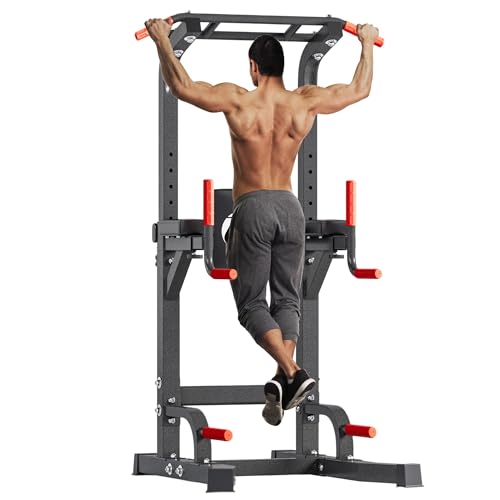
An adjustable bar and a small footprint, with basic hardware

A cage, a pull-up station and cable pulleys in one frame
At a glance
| Product | Weight Capacity | Height | Price | |
|---|---|---|---|---|
| SogesPower 87in Power Tower Pull Up BarBudget pick | — | 65.7-86.6in | $129.99 |
 | XMark Full Power Rack Functional Trainer withAlso consider | 440 lb stack | 102in | $5,265 |
| Titan Fitness Outdoor Power TowerTop pick | — | 86in | $442.99 |
| Marcy Olympic Strength Training Power TowerUpgrade pick | — | 85in | $268.38On sale |
 | Valor Fitness Power Rack with Multi-Grip PullAlso consider | 750 lb | 85in | $1,299.98 |
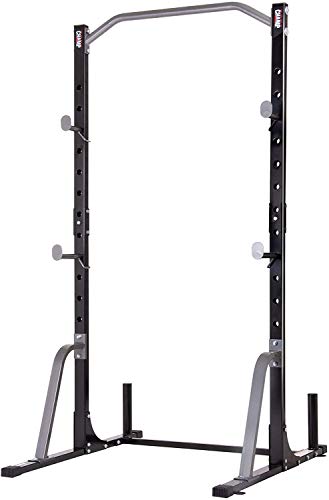 | Body Champ Power Rack System Adjustable SquatAlso in lineup | 300 lb | 62in | $329.99 |
How we picked
Frame and steel. We read every published spec sheet for tubing size, gauge and rated capacity, and treated missing numbers as a warning rather than a neutral. Frames documented at 11 or 12 gauge outranked ones that only say sturdy steel.
Base footprint. Published testing from Garage Gym Reviews shows lateral sway on bases under roughly 44 by 24 inches during hard pull-up sets. We favored frames whose listed depth and width clear that line.
Grips and padding. We compared bar diameter, the number of grip positions, and how much foam covers the knee raise and dip stations, since owner complaints months in almost always land on thin pads and slick bars.
Room and assembly. We checked total height against normal ceilings and read owner reports on build time and hardware quality. Anything that needs more than nine feet of clearance is a different kind of purchase.
Top pick
Heavy steel and a deep base, so it stays put when you swing
Titan Fitness Outdoor Power Tower
This is the sturdiest freestanding tower here: 3-inch steel tubing, a base that runs almost 50 inches front to back, and four stations covering pull-ups, dips, knee raises and elevated push-ups. It weighs close to 100 pounds, which is exactly why it doesn't skate across the floor.
$442.99fromAmazonSteel matters more than the number on the capacity sticker. Titan builds this one from 3-inch tubing and publishes an 11-gauge spec with a 500-pound rating for its power tower, well past what budget frames claim. What you notice is flex, not the sticker. Thin-walled towers shiver on every rep. This one mostly doesn't. If you weigh over 250 pounds, or you like to hang a dip belt, that margin is the whole reason to buy it.
The base runs 49.5 inches deep and 29 inches wide. Depth is what keeps a tower from rocking backward as you sink into the bottom of a dip. Garage Gym Reviews found that frames with bases smaller than roughly 44 by 24 inches sway sideways during hard pull-up sets, while wider, deeper ones stay quiet. Titan clears that comfortably, and the extra weight helps too.
Owner feedback keeps circling back to the bar itself. It's thick, so every set doubles as grip work — good if you're training toward muscle-ups, annoying if you have small hands. The powder coating covers the inside of the tubes as well as the outside, which is why Titan sells this as an outdoor tower. A carport or an unheated garage won't destroy it.
Four stations is fewer than the dozen some brands advertise, and that's fine. The extras on cheaper towers are usually push-up handles you'd use twice. Here you get a multi-grip pull-up bar, dip bars off the forearm frames, a vertical knee raise station, and an elevated push-up position. That's the useful list, and ACE's research says the knee raise station alone beats crunches for lower-ab work by a wide margin.
Flaws but not dealbreakers
The dip bars and the wide pull-up grips are set far apart, and owners of average build say the spread is wider than they'd like. If you're around 5-foot-10 with average arm length, wide-grip pull-ups here go wider than what you'd do at a gym, and dips put more stretch across your shoulders. None of it adjusts, either. The widths are fixed where they are.
It stands 86 inches tall with the bar near the top, so a standard eight-foot ceiling leaves you very little headroom. Tall users will notice. And at 98 pounds assembled, this isn't something you slide against a wall between sessions.
Budget pick
An adjustable bar and a small footprint, with basic hardware
SogesPower 87in Power Tower Pull Up Bar
The pull-up bar moves through ten height settings, from about 66 inches up to nearly 87, so a low ceiling or a shorter user isn't a problem. It's the most basic frame in this guide and it behaves like one: good for strict reps, not for kipping.
$129.99fromAmazonHeight adjustment is rarer than it should be on towers. Most brands bolt the bar at one height and leave you to sort it out. If your basement ceiling is seven feet, or a teenager in the house needs the bar lower to reach it, those ten settings matter more than any number on the box. Drop the bar, do inverted rows, raise it back for pull-ups.
Everything else here is entry-level, and the listing doesn't pretend otherwise. SogesPower says reinforced steel tubing and stops there — no gauge, no published weight rating. In this category that combination usually means 14-gauge tubing and a capacity somewhere in the 250-to-275-pound range. Plan around that. Strict pull-ups, controlled dips and knee raises are well inside what a frame like this handles.
The padded backrest and forearm pads on the knee raise station are the parts you touch most, and on a budget tower they're the parts to watch. The foam is thinner than what heavier frames use, so long ab sets will compress it over time. The push-up handles are a genuinely nice touch, though — they're built into the base tubing rather than bolted on as an afterthought, which is why they don't shift under you.
Flaws but not dealbreakers
There's very little owner feedback on this one, and that's the main reason it isn't ranked higher. Sturdiness on a tower is a long-term question, and nobody has answered it here yet. If you want a frame with a track record behind it, the Titan is the safer buy.
Nothing is published about capacity or steel gauge, so heavier users are guessing. And because the upright telescopes to change height, there's a joint in the middle of the frame that a fixed-height tower doesn't have. That joint is where cheap towers start to rattle, so check the pins and bolts often.
Upgrade pickOn sale
A cage, a pull-up station and cable pulleys in one frame
Marcy Olympic Strength Training Power Tower
This is a full Olympic cage with a multi-grip pull-up bar, a padded dip station, and both high and low pulleys, so you get lat pulldowns and cable rows on top of the bodyweight work. It's 156 pounds and five feet wide, and it wants a dedicated corner.
$268.38fromAmazonList priceIf you miss the lat pulldown machine, this is the only thing here that replaces it. The high pulley covers pulldowns and triceps pushdowns, the low pulley handles rows and curls, and the adjustable bar catches let you bench and squat inside the same footprint. For someone rebuilding a gym routine at home, that's a much shorter list of compromises than a tower alone.
The trade is space and effort. It measures 85 inches tall, 60 wide and 46 deep, and owners describe assembly running about three hours working alone. The boxes are heavy and they arrive in pairs. Get a second person for the top section, and leave every bolt finger-tight until the frame is square — that's the advice owners repeat most often.
Stability here comes from mass, not just wall thickness. At 156 pounds it's the heaviest freestanding piece in this guide, and weight is what stops a frame from creeping when you swing under the bar. Loaded plate storage adds ballast on top of that. For bodyweight work you won't need floor anchors, which matters if you're renting.
Plan for the rest of the setup. A cage without a bench, a barbell and plates does maybe half of what it's capable of. If you already own those, this is a clean step up from a tower. If you don't, the Titan gets you training this weekend and the Marcy gets you a project.
Flaws but not dealbreakers
Some units arrive with light surface rust, which owners describe cleaning off without much fuss. It's cosmetic rather than structural, but it tells you where the finish quality sits.
The pull-up bar lives inside a 60-inch-wide cage, so your widest grip is bounded by the uprights, and the dip station is a bolt-on rather than the main attraction. If bodyweight training is the entire point of your gym, a dedicated tower is more comfortable to use and far less work to build.
Who this is for
Buy a power tower if you want to train pull-ups, dips and hanging ab work at home and you can't drill into a doorway or a ceiling joist. It's the best fit for renters, for anyone rebuilding a gym habit without a membership, and for families who want one piece of equipment several people can use. It's also a straightforward way to cover your whole upper body with bodyweight movements, which is why it keeps outselling fancier machines.
Skip it if you mainly want to squat and bench — that's a rack, not a tower, and we've flagged the racks in this lineup separately. Skip it too if you already have a solid doorway bar and low ceilings, because a tower will just eat floor space to do the same job. This guide covers freestanding multi-station towers and the closest rack alternatives that came up in our research. It doesn't cover wall-mounted bars, dip belts or gymnastic rings.
How we picked
We ranked these on four things. Frame: published tubing size and gauge, with missing specs counted against a product rather than ignored. Footprint: base depth and width measured against the roughly 44-by-24-inch threshold where published testing shows lateral sway begins. Grips and padding: bar thickness, number of grip positions, and how much dense foam sits on the knee raise and dip stations, since those are the parts owners complain about after a few months. Room and build: total height against a normal eight-foot ceiling, plus owner reports on assembly time and hardware quality. Anything demanding nine feet of clearance got treated as a different purchase.
Other power towers for home gyms worth considering
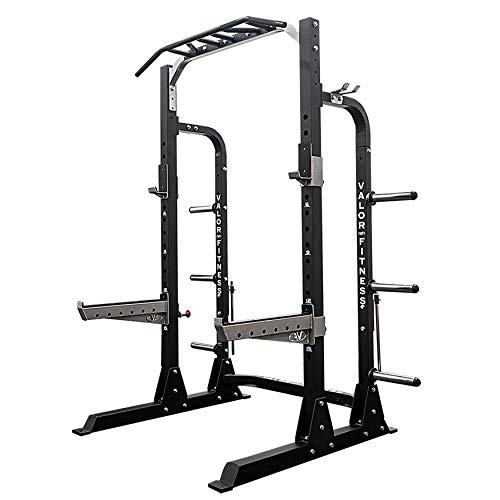
If you want to lift barbells in the same footprint: The Valor Fitness Power Rack with Multi-Grip Pull ($1,299.98) — The Valor Fitness Power Rack is built from 3-by-3-inch 11-gauge steel with a 750-pound capacity, and its pull-up bar gives you five handle positions — wide, neutral, angled and close. You also get adjustable J-hooks, 23-inch spotter arms, and pegs for plates, a barbell and bands. Owners in garages consistently call it solid, including taller lifters. What you give up is the tower part: there's no dip station and no knee raise pads, and because it's a half rack a bit of movement is normal when you swing. At 280 pounds, it goes where you build it and stays there.
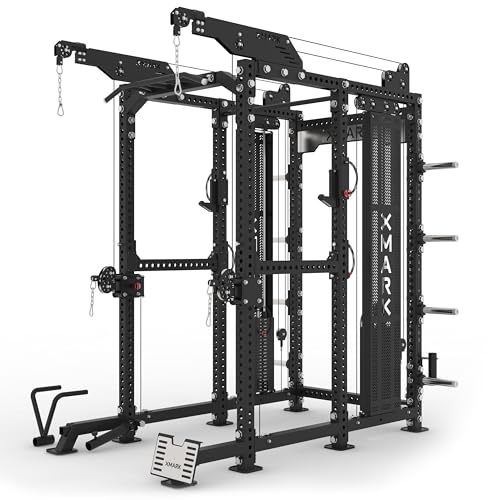
If you want cable stacks and have the ceiling for it: The XMark Full Power Rack Functional Trainer with ($5,265) — The XMark Full Power Rack Functional Trainer is the serious end of this list: 3-by-3-inch 11-gauge steel, dual 220-pound stacks in 10-pound increments, a 1:1 lat pulldown and a 2:1 low row, plus curl bars, a tricep rope, leg cuffs and a landmine. If you want gym-quality cable work at home, nothing else here comes close. But it stands 102 inches tall and needs a nine-foot ceiling minimum, it takes 55 by 91 inches of floor, and there's no dip or knee raise station. It's also new enough that owner feedback is thin.
The competition
This is what our research surfaced, not a full census of the category. Plenty of towers sell through other retailers or turn over too fast to track. The frame below is worth knowing about, but it lost to the picks for a specific reason.
The Body Champ Power Rack System Adjustable Squat ($329.99) — The Body Champ Power Rack System is a squat rack with pull-up duty on the side. It's rated to 300 pounds on the bar, ships with four floor anchors and four rubberized feet, and owners repeatedly describe it as sturdier than it looks with an assembly that takes about an hour. It's also the lightest frame here at 63.5 pounds, and it lacks a dip station, a knee raise station and any padding at all. Choose it if barbell work is your priority and pull-ups are a bonus. If you want the tower stations, look at the Titan instead.
Setup and stability
Most tower wobble comes from two fixable things: bolts that loosened and a floor that isn't flat. Assemble everything finger-tight, square the frame, then torque from the base up — do it in the wrong order and the holes never quite line up. Retighten every bolt after your first week and every couple of months after that. Put a rubber mat or horse-stall mat underneath, which protects the floor, kills noise, and stops a light frame from creeping. If one foot rocks, shim it rather than overtightening that corner. Wipe the pads down after sweaty sessions, since vinyl splits faster than the steel ever will, and check the powder coating for chips if the tower lives in a garage.
Questions we get
What is a power tower, and how is it different from a pull-up bar or a squat rack?
A power tower is a freestanding frame with several stations built in — usually a pull-up bar, parallel dip bars, a vertical knee raise station with forearm pads, and push-up handles. A pull-up bar does one of those and needs a doorway or joists. A squat rack is built around holding a loaded barbell and often has a pull-up bar on top, but no dip or ab stations.
How much ceiling height do I need?
Most towers stand between seven and seven-and-a-half feet tall, and you need clearance above the bar to pull your chin over it. Eight feet works for strict pull-ups if you're average height. If you want kipping pull-ups or muscle-ups, plan on nine to ten feet. Measure from the floor to the lowest thing overhead, including light fixtures and garage door tracks.
Can a power tower replace a gym membership for upper-body training?
For pulling and pressing, it gets you surprisingly far. ACE research puts pull-ups near maximum lat activation and dips at roughly 88 percent for triceps, which is comparable to the machines you'd use at a gym. What you don't get is loaded leg work or heavy pressing. Pair a tower with a set of adjustable dumbbells and you've covered most of a commercial gym's upper body floor.
Are power towers stable enough for kipping pull-ups and muscle-ups?
Some are, most aren't. Explosive movements load the frame sideways, and published testing shows noticeable sway on bases smaller than roughly 44 by 24 inches. If you kip, buy the heaviest frame with the deepest base you can fit — in this lineup that means the Titan or the Marcy cage. Budget towers are built for strict, controlled reps.
Do power towers need to be bolted to the floor?
No, and that's the point of them. A well-built tower stays put through its own weight and footprint, which is why they work for renters. If yours does slide, put a rubber mat underneath before you reach for anchors. Racks are a different story — some, like the Body Champ, include floor anchors for barbell work.
Why you should trust us
For this guide:
- We compared published specifications for every frame here — tubing size, listed steel gauge, rated capacity, base dimensions and adjustment ranges — and noted where a brand doesn't publish a number at all.
- We read EMG research published by the American Council on Exercise on pull-ups, dips and vertical knee raises, along with published testing roundups from Garage Gym Reviews and Fitness Volt on stability and assembly.
- We read owner feedback for each product, looking for the problems that only surface months in: frame wobble, surface rust, pad wear and hardware that works loose.
- We read owner reviews on every listing, weighted toward the critical ones, because that is where the recurring failures show up.
- We have a systematic way of automatically fetching the latest prices, so the numbers on this page stay current.
- This is a research-focused guide, so the team may not own every product listed — though we often do own the top winners, which gives us extra context for the recommendations.
- We don't accept free products, and the retailer commission never changes which product we recommend.
Sources
Best Power Towers for Home Gyms — Garage Gym Reviews, Garage Gym Reviews
Best Power Tower — BarBend, BarBend
Best Power Towers Tested by Fitness Editors — Men's Health, Men's Health
Best Power Towers Reviewed — Fitness Volt, Fitness Volt
Best Power Towers — Verywell Fit, Verywell Fit
Best Power Towers and Pull-Up Stations — Shape, Shape
ACE-Sponsored Research: Core Exercise Muscle Activation — American Council on Exercise, American Council on Exercise (ACE)
Home Gym Equipment Market Size & Growth Report 2025 — Grand View Research, Grand View Research
Titan Fitness Power Tower Official Product Specifications, Titan Fitness
XMark Power Tower XM-4436 Product Specifications, XMark Fitness
IHRSA 2025 Health Club and Home Fitness Industry Report, IHRSA
Amazon product listings and owner reviews for all 6 products
Manufacturer specification pages for each product
Some passages in this guide may be paraphrased with AI help. Prices are refreshed automatically.
More like this.
Continue exploring health reviews and recommendations.

The Best Squat Racks and Power Cages for Home Gyms
A squat rack is the piece of equipment your whole home gym gets built around. It holds the bar at the right height, catches it when a set goes sideways,…

The Best Tow Straps and Kinetic Recovery Ropes
Getting stuck is rarely dramatic. You back down a boat ramp that's slicker than it looked, or you pull onto a soft shoulder in the rain, and suddenly your…

The Best Truck Towing Mirrors
The first time you pull a trailer that's wider than your truck, you notice the problem immediately. Your factory mirrors show you the side of the trailer…

The Best Trailer Hitches and Towing Accessories
Towing gear is the rare purchase where the boring choice is the right one. A hitch bolts to your frame, sits in road salt and spray for years, and then…

The Best Stair Climbers for Home Gyms
Stair climbing is brutally efficient, and your legs figure that out inside of two minutes. You're lifting your own body weight over and over, with no…

The Best Home Gym Flooring
Flooring is the part of a home gym nobody thinks about until something goes wrong. A dumbbell chips the concrete. The treadmill hums through the ceiling…