The Best Powered Car Subwoofers
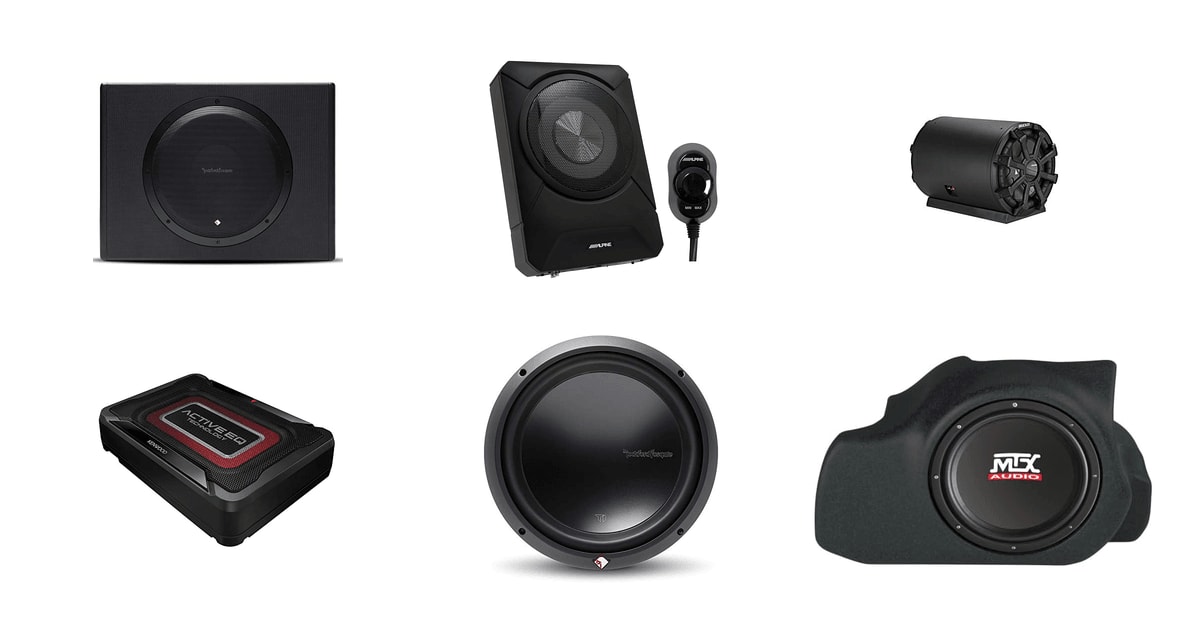
Most factory car stereos stop working somewhere around 80 to 100Hz, according to measurements published by CNET's Roadshow car audio coverage. That's not low. It's roughly the bottom of a male voice, and it means the kick drum in a song you love arrives as a click instead of a thump. A powered subwoofer fills that gap. It's a woofer, a matched enclosure and an amplifier in one housing, so you don't have to shop for three parts and hope they get along.
Here's the honest part: none of these will win a parking-lot bass contest. Anything small enough to hide under a seat or tuck into a trunk corner gives up output to get there, and the ones that do go loud are big, heavy boxes that eat cargo space. You also still have to run a fat power wire from the battery and find a clean chassis ground. Plug-and-play means fewer decisions, not zero work.
We looked at self-contained powered enclosures alongside a few loaded boxes and bare drivers that shoppers cross-shop, and we sorted them by how much bass you get for the space and effort you spend. We think that the Rockford Fosgate Punch P300-12 is the best powered car subwoofer for most people, and that the Alpine PWE-S800 is the one to buy if you're short on space or spending less.
Everything we recommend

Tight, punchy bass with everything you need in one box

Small, simple, and enough bass for most daily driving

Slim enough to hide under a seat, happy with a factory stereo
At a glance
| Product | Woofer Size | Power Output | Price | |
|---|---|---|---|---|
| Rockford Fosgate Punch P300-12 Amplified 12" SubwooferTop pick | 12 Inches | 300W Amp | $388.99 |
| Alpine PWE-S800 8" Compact Powered Subwoofer EnclosureBudget pick | — | 120W (240W Peak) | $279.95 |
 | KICKER 46CWTB102 TB10 10-inch Loaded Weather-Proof SubwooferAlso in lineup | 10 Inch | 400 Watt | $399.99 |
| Kenwood KSC-PSW7EQ Active Compact Subwoofer with ActiveAlso great | 200x130mm | 160W Max | $275On sale |
 | Rockford Fosgate T1D212 Power T1 2-Ohm DVCAlso in lineup | 12" | 800W RMS | $539.99 |
 | MTX Audio Thunderform FMUST05BK12-TNAlso consider | 12" | 200W RMS | $599.95 |
How we picked
Real continuous power. We compared manufacturer specification sheets for continuous RMS output and set aside peak numbers entirely. CEA-2006 testing has shown that budget units advertised at 300 watts peak often measure 75 to 120 watts continuous.
Space it costs you. We compared every enclosure's published dimensions against typical trunk and under-seat clearance. A sub that forces you to give up cargo room has to sound clearly better to justify it.
Factory stereo compatibility. We prioritized units with high-level speaker inputs, because most drivers keep the head unit that came with the car. Signal-sensing turn-on earned extra credit for cutting a wire out of the job.
Enclosure and tuning. We favored sealed designs for music, since published acoustics work shows their 12 dB/octave rolloff is more tolerant of unpredictable cabin response than a ported box's 24 dB slope.
Heat and current draw. We looked for Class-D amplification and published current specs, since enclosed trunk and under-seat spaces have almost no airflow. Class D runs 80 to 90 percent efficient against 50 to 70 percent for Class AB.
Top pick
Tight, punchy bass with everything you need in one box
Rockford Fosgate Punch P300-12 Amplified 12" Subwoofer
This is a 12-inch woofer, a sealed enclosure and a 300-watt amplifier sold as one matched unit. You run power, ground and a signal, set three controls, and you're done — no amp shopping, no box math, no guessing at the right enclosure volume.
$388.99fromAmazonBuying one box instead of three parts is the whole argument here. Rockford builds the woofer, the sealed enclosure and the amplifier as a closed loop, so the crossover point, the box volume and the power are already matched to each other. You aren't stuck reading Thiele-Small charts. Rockford's published data puts response at 35 to 150Hz within ±3 dB, which covers the range your door speakers can't touch.
Sealed boxes behave differently from ported ones, and that difference matters more in a car than in a living room. A sealed enclosure rolls off at 12 dB per octave below resonance, while a ported box drops at 24 dB, per Sound On Sound's write-up on car audio acoustics. The gentler slope makes a sealed sub more forgiving of the weird peaks and nulls every cabin has. Bass notes start and stop when they should.
You get real control without a laptop. There's an adjustable 12 dB/octave low-pass filter, a bass EQ, a 0/180-degree phase switch, and a wired remote level knob that mounts wherever you can reach it. Rockford lists the crossover as adjustable from 50 to 150Hz. So you can turn the sub up for a hip-hop playlist on the highway and back it off for a podcast without pulling over.
It works with the stereo already in your dash. The P300-12 takes speaker-level inputs as well as RCAs, so if your car has a factory head unit with no preamp outputs — most do — you can tap the rear speaker wires and skip the receiver swap entirely. That single feature is why this thing shows up in so many otherwise-stock cars.
Flaws but not dealbreakers
It's a big wedge: roughly 20 inches wide, 15 inches tall and 11 inches deep at the back, weighing 16 pounds. In a hatchback or a small trunk you'll notice what it takes up. Measure before you buy, and plan on strapping or bracketing it down so it doesn't become a projectile.
It's also thirsty. Rockford's data lists a draw around 30 amps at rated output, and Crutchfield's wiring guidance calls for at least 8-gauge power cable for a 300-watt RMS amp. Skimp on the wire and you'll get voltage sag and clipping instead of bass. If you want an SPL trophy, this isn't the box — it's tuned for accuracy, not volume.
The P300-12 comes with a one-year Rockford Fosgate warranty.
Budget pick
Small, simple, and enough bass for most daily driving
Alpine PWE-S800 8" Compact Powered Subwoofer Enclosure
The PWE-S800 pairs an 8-inch dual-voice-coil woofer with a built-in amplifier rated at 120 watts in a compact sealed enclosure. It won't rattle your mirrors. It fills in the bottom that your door speakers can't reach, and it tucks away where a 12-inch box never would.
$279.95fromAmazonEight inches moves less air than twelve, and there's no way around that. Car and Driver's audio lab found 12-inch enclosures average 6 to 8 dB more output at 40Hz than 8-inch units on the same power. But most of what you're missing from a factory system sits between 40 and 80Hz, and the Alpine handles that range fine at normal driving volume. You're adding weight to music, not shaking the car behind you.
The size is the feature. This is the sub you buy when the trunk still has to hold a stroller or a set of golf clubs, or when you'd rather nobody notices you added anything. Alpine ships a wired controller so you can adjust the level from the driver's seat, which matters more than it sounds — bass that's right for one album is too much for the next.
Read the power rating carefully, because Alpine quotes both. It's 120 watts continuous and 240 watts peak, and only the first number describes what the amp actually does over a song. That honesty is worth something in a category where CEA-2006 testing has shown budget units advertised at 300 watts peak measuring closer to 75 to 120 watts of real continuous output.
Flaws but not dealbreakers
Alpine lists frequency response as 10 to 200Hz, which you should treat as a spec-sheet figure rather than a promise. No 8-inch woofer in a box this small produces useful output near 10Hz. Expect solid work in the 40 to 80Hz range and a gentle fade below that.
If you drive a full-size truck or a three-row SUV, this is probably too little sub for the air volume you're trying to fill. It's also a sparse listing — Alpine publishes less detail here than Rockford does, so you're going in with fewer numbers to check.
Also greatOn sale
Slim enough to hide under a seat, happy with a factory stereo
Kenwood KSC-PSW7EQ Active Compact Subwoofer with Active
The KSC-PSW7EQ is a die-cast aluminum wedge under three inches tall, with a Class-D amplifier and a signal-sensing speaker-level input. It slides under a front seat, wakes up when your stereo does, and adds warmth to a factory system without touching your cargo space.
$275fromAmazonList priceNothing else here disappears this completely. The housing measures about 11 inches wide, 8.7 inches deep and 2.8 inches tall, and the whole thing weighs under six pounds. That fits under the driver or passenger seat in most sedans and crossovers, which means you keep the trunk and nobody looking through your windows knows it's there.
The wiring is the easiest of any pick. It takes high-level speaker inputs with automatic signal-sensing turn-on, so you can tap your factory speaker wires and skip hunting for a remote turn-on lead. There's an RCA input too if you've got an aftermarket receiver. Kenwood includes a five-meter wired remote with volume, crossover frequency, phase reverse and an EQ preset switch.
Kenwood uses a Class-D amplifier, which matters in a spot with no airflow. Class D designs run at roughly 80 to 90 percent efficiency versus 50 to 70 percent for older Class AB circuits, per Crutchfield's explainer, so far less of your power turns into heat under a seat cushion. The aluminum housing doubles as the heatsink.
Flaws but not dealbreakers
Kenwood quotes 160 watts as maximum output, not continuous, so the real figure is meaningfully lower. This is a sub that adds body and warmth to a factory system. It won't give you the chest-hit that the P300-12 does, and it'll run out of headroom if you like your bass genuinely loud.
Under-seat mounting has practical catches. Power seat motors and floor rails eat clearance, so measure the actual gap in your car before ordering, and check that the housing won't block a seat-mounted airbag sensor or heater wiring.
Who this is for
Buy one of these if your car's stereo sounds thin and you don't want to redo the whole system. Powered subwoofers are for drivers who want the bottom two octaves back with one box, one power wire and an afternoon of work. They're a good fit if you've kept the factory head unit, if you park in shared garages and don't want to advertise your audio, or if you've never wired car audio before and want the fewest ways to get it wrong.
Skip them if you're chasing volume. Competition-level output means a separate high-current amplifier, a purpose-built box and usually an upgraded alternator — a different project with a different budget. This guide covers self-contained powered enclosures first, and mentions a few loaded boxes and bare drivers only because shoppers keep running into them in the same search results. Those need an external amp, so they aren't plug-and-play by any definition.
How we picked
We ranked these on the things that actually change what you hear and what the install costs you. Continuous power: RMS ratings only, since peak figures are marketing and often overstate real output by three times or more. Space: published dimensions checked against normal trunk and under-seat clearance, because a sub you can't fit is worth nothing. Factory compatibility: high-level speaker inputs and signal-sensing turn-on, so you keep the dash you have. Enclosure: sealed designs preferred for music, given their gentler rolloff in unpredictable cabins. Heat: Class-D amplification, which wastes far less power as heat in spaces with no airflow. Control: a wired remote or accessible level knob, so you can adjust bass between songs instead of between trips.
Other powered car subwoofers worth considering
If you want a factory-look install in a Mustang: The MTX Audio Thunderform FMUST05BK12-TN ($599.95) — The MTX Thunderform is a sealed enclosure molded to the interior contour of one specific Mustang generation, loaded with a 12-inch Terminator woofer rated at 200 watts RMS. Because it's shaped to the car rather than dropped into the trunk, it looks like it came from the factory and leaves your cargo space intact — a Consumer Reports survey found 72 percent of car audio buyers prefer exactly that. MTX tunes each enclosure's internal volume to the driver it ships with, so you skip the box math. The catch is real, though: there's no amplifier inside, so you'll add one plus wiring, and the fit is useless in any other car.
The competition
These are the other products our research turned up in this category, not a survey of everything on the market. Two of them are strong pieces of gear that simply aren't powered subwoofers, and they lose here on that basis rather than on quality.
The KICKER 46CWTB102 TB10 10-inch Loaded Weather-Proof Subwoofer ($399.99) — The Kicker 46CWTB102 TB10 is a loaded tube enclosure with a 10-inch CompR woofer on one end and a passive Reflex radiator on the other, which gives it ported-style low-end reach without a port. The thick ABS housing is weather-resistant, and the bracket system mounts it horizontally or vertically, so it's genuinely good in a Jeep, a UTV or a boat. But there's no amplifier in it — you'll buy and wire a separate amp for the 2-ohm load, which puts it outside what this guide is about. Choose it if you're building a system around an amp you already own and you need something that survives rain and dust.
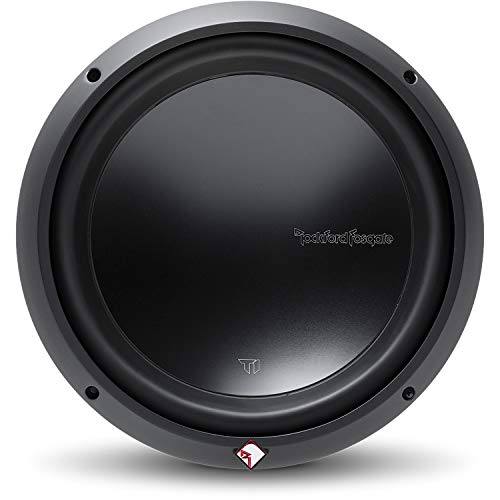
The Rockford Fosgate T1D212 Power T1 2-Ohm DVC ($539.99) — The Rockford Fosgate T1D212 is a bare 12-inch driver, dual 2-ohm, rated at 800 watts RMS, with Rockford's VAST cone treatment that adds up to 25 percent more radiating surface and a 7-inch mounting depth for tight installs. It's a serious woofer for a serious build. It's also just the woofer: no enclosure, no amplifier, and it demands both a properly calculated box and a high-current amp with the electrical system to feed it. If you're designing a custom install and know your target box volume, it belongs on your list. If you want bass this weekend, it doesn't.
Installation notes
Get the power side right and most problems disappear. Run a dedicated cable from the battery — Crutchfield calls for 8-gauge minimum on a 300-watt RMS amp — and fuse it within about 18 inches of the battery terminal. Undersized wire causes voltage sag and clipping, which sounds like distortion and eventually kills drivers. Ground to bare chassis metal, not a seat bolt or a painted panel; sand the paint off and keep the ground run short. For signal, tap the rear speaker wires if you're keeping the factory stereo, or use RCAs if your receiver has preamp outputs. Then bolt or strap the enclosure down. A 16-pound box loose in a trunk is dangerous in a hard stop, and rattles will drive you crazy long before that.
Questions we get
What's the best powered subwoofer for a factory stereo?
Look for high-level speaker inputs, which let the sub take its signal straight off your existing speaker wires. The Rockford Fosgate P300-12 and the Kenwood KSC-PSW7EQ both accept them, and the Kenwood adds signal-sensing turn-on so you don't have to find a remote lead. That combination means you keep the dash exactly as it is.
Do I need a separate amplifier for a powered subwoofer?
No — that's what powered means. The amplifier is built into the enclosure and already matched to the woofer inside it. You only need an external amp for passive products like the Kicker TB10, the MTX Thunderform or the bare T1D212 driver.
What's the difference between RMS watts and peak watts?
RMS is continuous power the amp can actually sustain; peak is a brief burst figure used for marketing. Under CEA-2006 standardized conditions, budget subs advertised at 300 watts peak often measure 75 to 120 watts RMS. Compare RMS numbers only and ignore the big number on the box.
Is a sealed or ported subwoofer better for music?
Sealed, for most people. A sealed box rolls off at 12 dB per octave below resonance versus 24 dB for a ported design, which makes it more forgiving of the strange acoustics inside a car cabin. Ported boxes go louder and deeper on paper, but they tend to sound boomier on anything but bass-forward tracks.
How many watts do I actually need?
For adding bass to a stock system, roughly 100 to 150 watts RMS is plenty in a sedan, and 200 to 300 watts is comfortable in a truck or SUV. More power mostly buys headroom, not better sound. Your wiring and enclosure choice affect the result more than the last hundred watts do.
Will a powered subwoofer drain my battery?
Not while you're driving, since the alternator carries the load — the P300-12 draws around 30 amps at full output, which a healthy charging system handles. Problems show up when you play music with the engine off, or when the sub's turn-on wire is miswired so it never shuts down. Wire the turn-on lead to a switched source and you're fine.
Why you should trust us
For this guide:
- We read manufacturer specification sheets for every enclosure and driver here, comparing continuous power ratings, dimensions, crossover ranges and input types side by side.
- We drew on published reference material from Crutchfield, Sound On Sound, CNET's Roadshow car audio coverage and CEA-2006 standardized power testing to separate real specs from marketing figures.
- We reviewed recurring themes in owner feedback about installation clearance, heat and wiring, and used them to shape the flaws and the installation section.
- We read owner reviews on every listing, weighted toward the critical ones, because that is where the recurring failures show up.
- We have a systematic way of automatically fetching the latest prices, so the numbers on this page stay current.
- This is a research-focused guide, so the team may not own every product listed — though we often do own the top winners, which gives us extra context for the recommendations.
- We don't accept free products, and the retailer commission never changes which product we recommend.
Sources
Best Powered Car Subwoofers — Crutchfield Expert Review 2025, Crutchfield
Car Subwoofer Reviews & Ratings — Car and Driver, Car and Driver
Best Car Subwoofers 2025 — Sound On Sound, Sound On Sound
Powered Subwoofer Comparison — CNET Car Tech, CNET
Car Audio Subwoofer Guide — Consumer Reports, Consumer Reports
Rockford Fosgate P300-12 Technical Specs — Rockford Fosgate Official, Rockford Fosgate
JL Audio Stealthbox Product Overview — JL Audio Official, JL Audio
Alpine PWE-S8 Review — The Drive, The Drive
Car Audio Forum Benchmarks — CEA-2006 Standard Testing, CEA / CTA Standard CEA-2006
Kicker 46CWTB102 Specs — Kicker Official, Kicker
Best Car Subwoofers Buying Guide 2025 — TechRadar, TechRadar
MTX Audio Thunderform Product Overview — MTX Audio Official, MTX Audio
Amazon product listings and owner reviews for all 6 products
Manufacturer specification pages for each product
Some passages in this guide may be paraphrased with AI help. Prices are refreshed automatically.
More like this.
Continue exploring electronics reviews and recommendations.

The Best Car Subwoofers
Factory car audio almost always gives up first at the bottom. You turn up a track with real low end, and the door speakers buzz and smear instead of…

The Best Wireless Subwoofers
Bass is the part of a movie you feel more than hear. A soundbar alone can only move so much air, so explosions land flat and a bass line in a song just…

The Best Car Vacuum Cleaners
A car vacuum spends most of its life doing small, unglamorous jobs. Crushed crackers under the booster seat. Sand in the seat rails after a beach trip.…

The Best Magnetic Car Phone Mounts
A phone mount is one of those small purchases you either forget about or curse daily. You reach for it a dozen times a drive - snapping the phone up for…

The Best Ceramic Coating for Car Paint
A ceramic coating is a thin layer of liquid glass that bonds to your clear coat and changes how your car behaves in the weather. Rain sheets off instead…

The Best Car Window Rain Guards and Vent Visors
Cracking a window is the simplest air conditioning there is. The problem shows up the moment it rains, or the moment you park in a lot and don't want an…