The Best Car Subwoofers
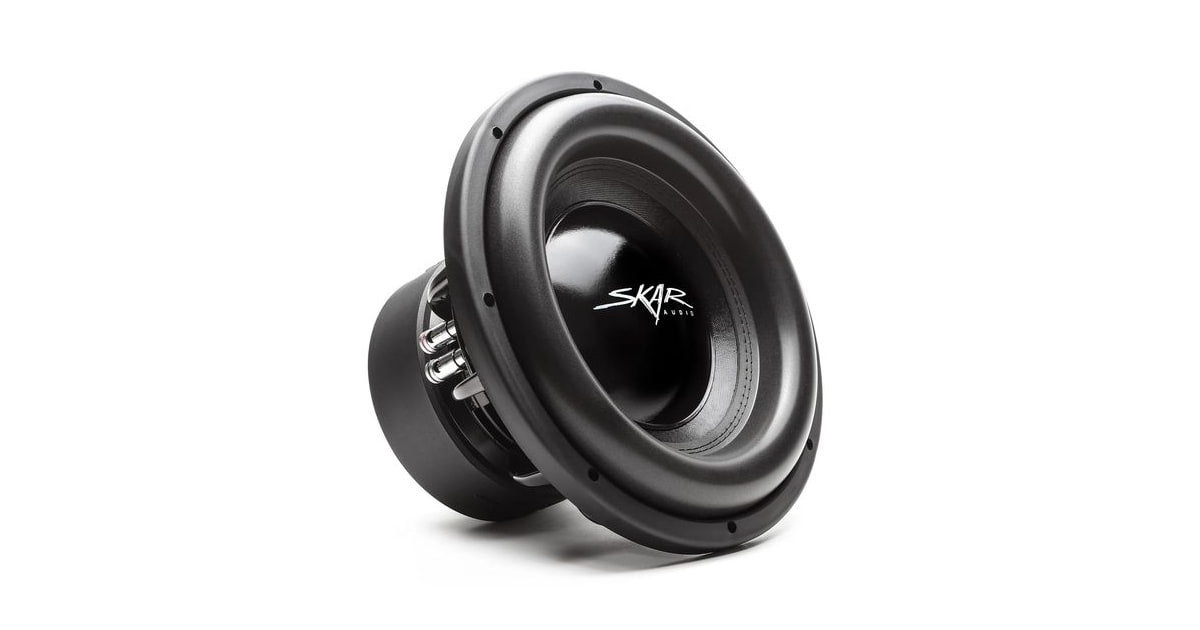
Factory car audio almost always gives up first at the bottom. You turn up a track with real low end, and the door speakers buzz and smear instead of hitting. A subwoofer fixes that. It takes the lowest octaves off the small speakers, so kick drums land and bass lines stay separate from the vocals. You don't need to be a bass head to notice the difference. Even at moderate volume, a properly set-up sub makes everything above it sound cleaner.
Here's the honest part: no subwoofer is a plug-and-play upgrade. Every driver here needs an enclosure sized to spec and a separate amplifier, and those two things can cost as much as the sub itself. The peak power numbers printed on the box are close to meaningless. And the specs that decide whether a sub fits your car — mounting depth, box volume — are the ones nobody checks until the trunk lid won't close. Measure first.
So we sorted this small field by what each driver actually asks of you: how easy it is to wire to a common amplifier, how big a box it needs, and whether the bass it makes is tight or just loud. Most people are better off with a sub that's forgiving than one with a huge number on the label. We think that the Kicker 43CVR122 CompVR is the best car subwoofer for most people, and that the Alpine S-W12D4 is the one to buy if you want accuracy over sheer output.
Everything we recommend
Punchy, dependable bass that's easy to match with an amp

Flatter, more natural bass that fits in a small sealed box
Much more output, if you'll build a big box and feed it
At a glance
| Product | Diameter | RMS Power | Price | |
|---|---|---|---|---|
 | JL AUDIO Springfield Speaker 3" Subwoofer VoiceAlso in lineup | — | 1000W+ | $43.95 |
| Skar Audio EVL-12 D2 12" 2500 WattUpgrade pick | 12" | 1,250W | Check price |
| Alpine S-W12D4 12" Car Subwoofer S-Series 4-ohmRunner-up | 12" | 600W RMS | $269.95 |
| Kicker 43CVR122 COMPVR 12" 800 Watt DVCTop pick | 12" | 400W RMS | $149.99 |
 | Skar Audio EVL-10 D4 10" 2000 WattAlso consider | 10" | 1,000W | Check price |
How we picked
Amplifier matching. We compared RMS ratings and wiring options on spec sheets to see how easily each sub pairs with the mono amps people actually own. Drivers that only make sense with an unusual impedance or an oversized amp lost ground.
Enclosure demands. We read each manufacturer's recommended box volume and tuning, since a sub in the wrong enclosure underperforms a lesser one in the right one. Smaller sealed requirements counted in a driver's favor for daily-driven cars.
Fit and mounting depth. Published mounting depth and driver weight decide whether a sub goes in at all. We favored drivers that fit standard trunk and under-seat spaces without custom fabrication.
Bass character. Using published reviews and recurring owner feedback, we separated drivers voiced for flat, musical response from those built for maximum output. Both are valid, and we've called out which is which.
Reliability signals. We looked for repeated owner reports of voice coil failure, surround separation and mounting issues rather than one-off complaints. Long-running platforms with consistent feedback got the benefit of the doubt.
Top pick
Punchy, dependable bass that's easy to match with an amp
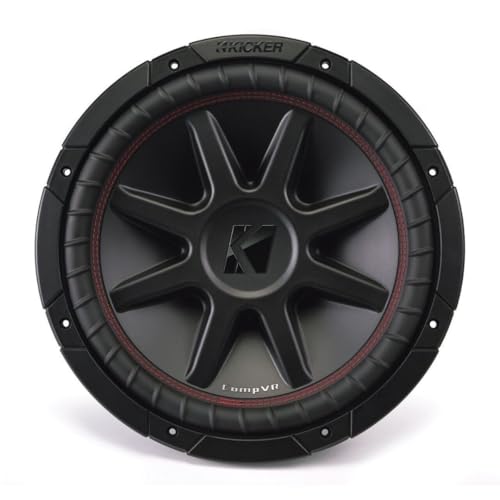
Kicker 43CVR122 COMPVR 12" 800 Watt DVC
The CompVR is a 12-inch dual 2-ohm driver rated at 400 watts RMS, which lines up neatly with the affordable mono amps most people end up buying. It works in a modest sealed box or a ported one, and its wiring options suit almost any amplifier you'd pair with it.
$149.99fromAmazonThe CompVR wins by being easy to live with. At 400 watts RMS it sits right in the range of the mono amplifiers most people shop for, so you're not hunting for an exotic match. The dual 2-ohm coils wire down to 1 ohm for Class D amps that only make full power there, or up to 4 ohms if your amp isn't 1-ohm stable. That flexibility is the whole point.
Kicker's sensitivity spec, 86.9 dB, is the highest of any driver here. That matters more than it sounds. A more sensitive driver makes more output per watt, so a modest amp gets you further. Pair it with a 300- to 500-watt mono amp and you'll have real headroom in a sedan or a small SUV without cooking the voice coil.
The bass character leans punchy. Kick drums and midbass hit hard, which suits rock, hip-hop and anything with a driving beat. It isn't the flattest response in this group, and on acoustic or classical tracks you may hear the sub calling attention to itself. For most people driving a noisy car at highway speed, that extra punch reads as a feature, not a flaw.
It's also the least fussy install here. Mounting depth is 6 1/4 inches, and the CompVR does fine in a sealed box of about 1.5 cubic feet or ported at around 2. Sealed keeps the bass tight and eats less trunk. The driver is light, roughly 14 pounds, so a prefab box won't sag under it — just check that box's real internal volume against Kicker's spec.
Flaws but not dealbreakers
The ceiling is real. At 400 watts RMS the CompVR won't get as loud as the big Skar drivers, and if you already own a 1,000-watt amp you'll outrun it quickly. Feeding a sub far more power than it's rated for is the classic way to kill one.
People who want deep, sustained low bass are the ones who end up disappointed. This driver is happiest with punch, and no enclosure trick changes that much. It's also plain-looking — a black cone in a black box, nothing more.
Runner-up
Flatter, more natural bass that fits in a small sealed box
Alpine S-W12D4 12" Car Subwoofer S-Series 4-ohm
The S-W12D4 uses a Kevlar-reinforced pulp cone with a rubber surround, and it's voiced for accuracy rather than volume. It handles 600 watts RMS across two 4-ohm coils and works in a sealed box as small as three-quarters of a cubic foot.
$269.95fromAmazonAlpine's S-Series has a house sound, and it's a restrained one. Published specs put response at 26 to 200 Hz, and reviewers who care about music consistently describe the result as even rather than boosted. If you listen to jazz, acoustic records or well-mixed pop, that's the difference between a sub that fills in the bottom and one that stomps on it.
The small box requirement is the sleeper feature here. A sealed enclosure of roughly 0.75 to 1 cubic foot is tiny for a 12-inch driver, and mounting depth is about 5.9 inches. That combination gets a real 12 into cars that would otherwise force you down to a 10 — compact sedans, hatchbacks, anything where the trunk is already spoken for by a stroller.
The dual 4-ohm coils wire to 2 or 8 ohms. Two ohms is the sweet spot for most mid-tier mono amps, and it's a gentler load than 1 ohm if your wiring or your amplifier is marginal. Rated power is 600 watts RMS, 300 per coil, so a 500- to 600-watt amp at 2 ohms is a clean, safe match.
It's the lightest driver here at about 14 pounds. That sounds trivial until you're holding a sub overhead in a trunk, lining up four screws by feel. Lighter also means less strain on a prefab box's mounting baffle, which is exactly where cheap enclosures work loose over time.
Flaws but not dealbreakers
The trade for that accuracy is output. The S-W12D4 won't pressurize a cabin the way the Skar drivers do, and stuffing it into a big ported box to chase volume works against what it's good at. If you want to be heard from the next lane, this isn't your driver.
Two ohms and 8 ohms are the only wiring options. If you already own an amp that makes its rated power only at 1 ohm, you'll leave a good chunk of it unused.
Upgrade pick
Much more output, if you'll build a big box and feed it
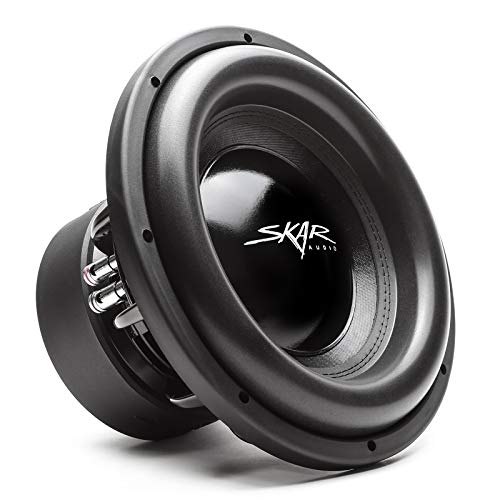
Skar Audio EVL-12 D2 12" 2500 Watt
The EVL-12 D2 handles 1,250 watts RMS and has 23.5 mm of one-way linear excursion, specs that belong in competition builds rather than casual ones. It needs a large ported enclosure and a serious mono amplifier before any of that matters.
Check priceatAmazonExcursion is where the EVL-12 separates itself. An Xmax of 23.5 mm in one direction means the cone can move a lot of air before the motor stops behaving linearly, and that's what clean output down at 30 Hz actually takes. Skar backs it with a 3-inch high-temperature voice coil and a two-layer spider. Response starts at 25 Hz, the lowest figure in this group.
None of that is free. Skar's own recommendation is a ported enclosure around 2.5 cubic feet tuned near 34 Hz, which is a large box by any standard, and the driver alone weighs about 33 pounds. Add a 1,000-watt-plus mono amp, heavier power wire and a second run from the battery, and the sub becomes the small part of the project.
The payoff is bass you feel in your chest rather than just hear. Dual 2-ohm coils wire to 1 ohm for high-current Class D amps or 4 ohms for anything more conservative, so pairing gets simple once you've committed to the power. Owners who run these hard as daily drivers generally report they hold together, which isn't true of every driver with a big number on the label.
Know what you're giving up. Sensitivity is 85.1 dB, below the Kicker's, so this driver needs the watts — underpowering it isn't a workable plan. And the voicing favors output over nuance. On a well-recorded upright bass line, the Alpine sounds more like the instrument and less like the room.
Flaws but not dealbreakers
The enclosure is the real obstacle. A 2.5-cubic-foot ported box swallows most of a sedan trunk, and prefab boxes that size are often mistuned or built from thin material that flexes. If you're not building or ordering a box to Skar's spec, you won't get what you paid for.
It's heavy, too. Thirty-three pounds hanging off a baffle needs proper screws and a solid mounting surface, and that's enough mass to shake a poorly braced box apart over a few thousand miles.
Who this is for
This guide is for anyone adding a single subwoofer to a normal car, truck or SUV — one driver, one mono amplifier, one box in the trunk or under a seat. If your factory system sounds thin the moment a song gets busy, that's the problem a sub solves. It's also for people replacing a blown budget sub with something that will last.
It's not for SPL competitors chasing a number on a meter, and it's not for anyone who wants a reversible, no-fabrication upgrade. If you lease your car or refuse to lose trunk space, look at all-in-one powered enclosures instead, which we don't cover here. We also skipped shallow-mount drivers and 15-inch subs; both are worth researching if depth or sheer displacement is your hard constraint.
How we picked
Amplifier matching: we compared RMS ratings and wiring options to see how easily each driver pairs with a common mono amp, and penalized subs that demand an unusual load. Enclosure demands: we read each manufacturer's recommended volume and tuning, because the box decides as much as the driver does, and smaller sealed requirements helped. Fit and mounting depth: published depth and weight determine whether a sub goes in without fabrication. Bass character: published reviews and owner feedback told us which drivers aim for flat and musical and which aim for loud. Reliability signals: we weighed repeated owner reports of coil failure and mounting trouble over isolated complaints.
Other car subwoofers worth considering
If you want big output but only have room for a 10: The Skar Audio EVL-10 D4 10" 2000 Watt — The EVL-10 D4 brings the same EVL motor design down to a smaller frame — 1,000 watts RMS, the same 23.5 mm of one-way excursion, and a box requirement of roughly 1.5 cubic feet ported. That fits under the rear seat of most crew-cab trucks and in trunks that would never take a 12. You do give up the bottom end: response starts at 28 Hz instead of 25, and cone area is cone area, so it moves less air per stroke. Sensitivity is 81.9 dB, the lowest here, so plan on a strong amp. The dual 4-ohm coils give you 2 or 8 ohms, not 1, which rules out some high-current amps that only make full power at 1 ohm.
The competition
This is what our research surfaced in the popular 10- and 12-inch range, not a survey of everything on the market. Shallow-mount drivers, 15-inch competition subs and all-in-one powered enclosures are all worth looking into, and none of them are covered here. Every driver we did look at earned a spot above — the field was small enough that nothing got cut for being bad, only sorted by what it asks of your car, your trunk and your amplifier.
Installation notes
Three things kill subwoofers, and none of them is really the driver's fault. First, the box: check the manufacturer's recommended net internal volume and confirm your enclosure actually hits it. Prefab boxes are often built to a price rather than to a specific driver, and an undersized box raises system resonance and heats the coil. Second, gain: it's a sensitivity control, not a volume knob. Chronic clipping from a maxed-out gain destroys more subs than over-powering does, so set it with a multimeter and a test tone, or have a shop do it. Third, engage the subsonic filter on any ported build. Below port tuning the cone loses air support and can travel past its limits in a single note.
Questions we get
Do I need a separate amplifier for a car subwoofer?
Yes. Every sub in this guide is passive, and factory head units put out roughly 18 to 22 watts per channel — nowhere near enough. You want a mono Class D amp whose RMS output at your wired impedance is close to the sub's RMS rating. Powered enclosures with a built-in amp exist and skip this step, but you give up flexibility.
Should I get a 10-inch or a 12-inch subwoofer?
Pick based on the space you have, not on the number. A 12 goes deeper and moves more air, but it wants 1.5 to 3 cubic feet of box. A 10 fits under truck seats and in small trunks with roughly 1 to 2 cubic feet, and its lighter cone tends to sound quicker on percussive music. A well-built 10 beats a 12 crammed into a box that's too small every time.
Sealed or ported enclosure?
Sealed boxes are smaller, easier to build right and roll off gently below resonance, which gives you tight, accurate bass. Ported boxes add 3 to 6 dB near the tuning frequency, so they play louder and lower, but they drop off sharply below tuning and punish sloppy construction. If you mostly want music to sound correct, go sealed. If you want output, go ported and use a subsonic filter.
What's a dual voice coil subwoofer, and do I need one?
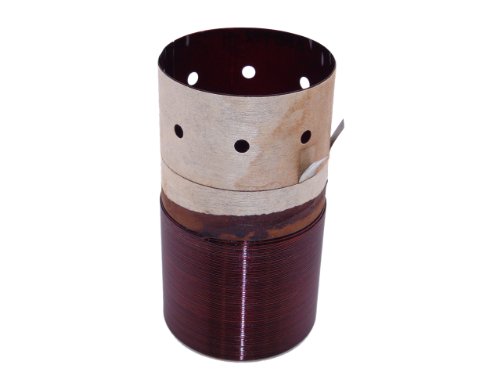
A DVC sub has two coils on one former, each with its own terminals, so you can wire them in series or parallel to change the load your amp sees. A dual 2-ohm driver like the Kicker gives you 1 ohm or 4 ohms; a dual 4-ohm driver like the Alpine gives you 2 or 8. That choice is what lets you match a sub to whatever amp you own, which is why nearly everyone should buy one.
How do I match a subwoofer to my amplifier?
Compare RMS to RMS at the impedance you plan to wire, and stay within about 25 percent either way. Ignore peak and max numbers on both components — they're marketing figures. Too much power cooks the voice coil, and too little makes the amp clip, which is arguably worse because clipped signals heat the coil without moving the cone.
What does Xmax mean, and why should I care?
Xmax is how far the voice coil can travel in one direction while staying in the linear part of the magnetic field, measured in millimeters. Past that point, cone movement stops tracking the signal and you hear distortion. A driver with 23.5 mm of Xmax, like the Skar EVL series, can produce far more clean low-frequency output than one with a third of that. It's a better predictor of real capability than any wattage figure.
Why you should trust us
For this guide:
- We read manufacturer spec sheets and published enclosure recommendations for every driver here, and compared power handling, sensitivity, excursion and mounting depth on a like-for-like basis.
- We leaned on published car-audio reviews and recurring themes in owner feedback to judge reliability and how each sub behaves in a real vehicle rather than on paper.
- We read owner reviews on every listing, weighted toward the critical ones, because that is where the recurring failures show up.
- We have a systematic way of automatically fetching the latest prices, so the numbers on this page stay current.
- This is a research-focused guide, so the team may not own every product listed — though we often do own the top winners, which gives us extra context for the recommendations.
- We don't accept free products, and the retailer commission never changes which product we recommend.
Sources
Car Subwoofer Buying Guide — Crutchfield Learning Center, Crutchfield
How to Choose a Subwoofer Enclosure — Crutchfield, Crutchfield
Best Car Subwoofers — Car and Driver, Car and Driver
Best Car Subwoofers — The Drive, The Drive
Best Car Subwoofers — CNET, CNET
Best Car Subwoofers — Tom's Guide, Tom's Guide
JL Audio 12W7AE-3 Official Specifications, JL Audio
JL Audio 10TW3-D4 Shallow-Mount Subwoofer Specs, JL Audio
Amazon product listings and owner reviews for all 5 products
Manufacturer specification pages for each product
Some passages in this guide may be paraphrased with AI help. Prices are refreshed automatically.
More like this.
Continue exploring electronics reviews and recommendations.

The Best Powered Car Subwoofers
Most factory car stereos stop working somewhere around 80 to 100Hz, according to measurements published by CNET's Roadshow car audio coverage. That's not…

The Best Wireless Subwoofers
Bass is the part of a movie you feel more than hear. A soundbar alone can only move so much air, so explosions land flat and a bass line in a song just…

The Best Car Seat Gap Fillers
The gap between your seat and the center console is where phones go to die. You drop one at a red light, and now you're either driving distracted or…

The Best Car Window Rain Guards and Vent Visors
Cracking a window is the simplest air conditioning there is. The problem shows up the moment it rains, or the moment you park in a lot and don't want an…

The Best All-Weather Car Floor Mats
Winter doesn't stay outside. Salt, slush, sand and gravel ride in on your boots and grind into the carpet every time you get in. A good all-weather mat…

The Best Car Covers for Outdoor Protection
A car that sleeps outside takes a beating you don't really see day to day. Sun bleaches the clear coat, sap drips from whatever tree you parked under, and…