The Best Siding Cleaners
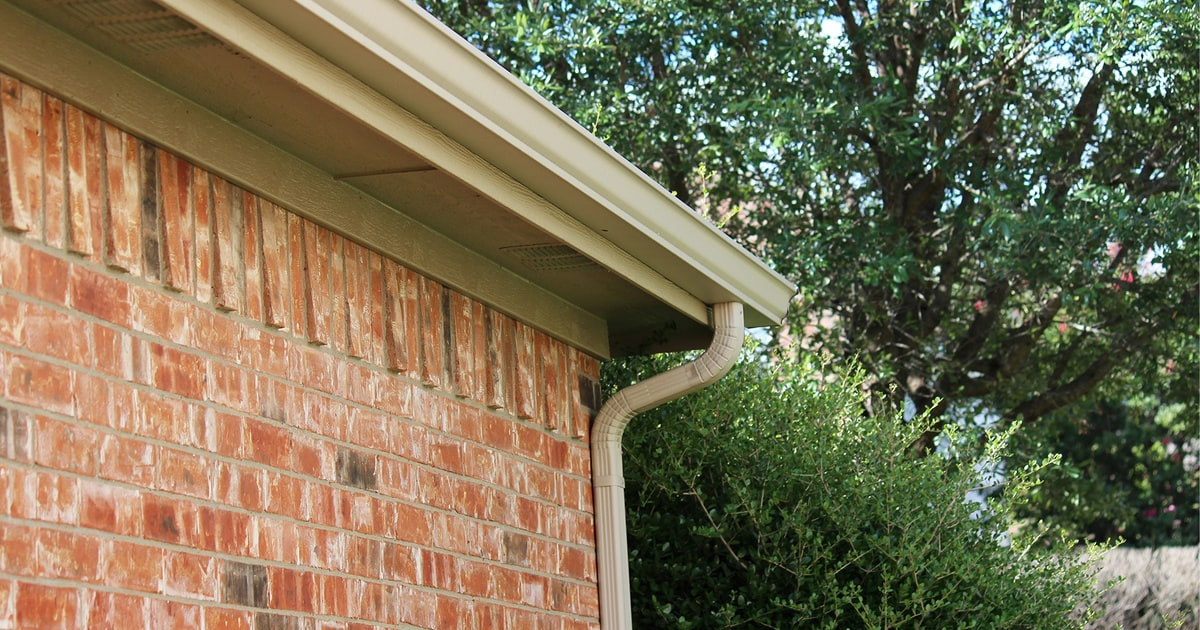
Siding gets dirty in a way you don't notice until you do. Green streaks creep down the shaded north wall, black speckles collect under the eaves, and one day the house just looks tired. It's not only cosmetic. Mold and algae hold moisture against the wall, and on wood or fiber cement that moisture is the real problem. A good cleaner turns a weekend of scrubbing into an hour with a garden hose. You don't need a pressure washer, and you don't need to hire anyone.
Here's the honest part: no single bottle does everything. The fast, bleach-based formulas wipe out heavy mold in minutes, but they can lighten dark trim and burn plants if you're careless. The gentle peroxide and oxygen-bleach options are safe around the vegetable bed, but they're slower on years-old black staining. And nothing here reverses the chalky haze of UV-oxidized vinyl except a product built specifically for that, which in turn won't kill anything. Expect to match the cleaner to the stain.
Most people are cleaning a reasonably maintained house once a year, and for that you want something cheap, gentle, and simple. We think that the Krud Kutter Multi Purpose House Wash is the best siding cleaner for most people, and that the Simple Green Oxy Solve Total Outdoor Cleaner Concentrate is the one to buy if you have pets, kids, or garden beds right up against the wall.
Everything we recommend

Spray, wait, rinse — enough for a yearly cleaning
The plant-safe option when the flower bed is right there
Heavy-duty bleach chemistry for mold you've stopped fighting
Green algae disappears while you're still standing there
At a glance
| Product | Coverage Area | Concentrate or Ready-to-Use | Price | |
|---|---|---|---|---|
| Krud Kutter Multi Purpose House WashTop pick | — | Concentrate | $10.29 |
| Simple Green Oxy Solve Total Outdoor CleanerAlso great | 6,400 sq ft | Concentrate | $23.99 |
 | Wet & Forget Outdoor MossAlso consider | 2,000 sq ft | — | $36.40 |
| 30 SECONDS Outdoor Cleaner DirtBudget pick | — | Concentrate | $11.96On sale |
 | Rejuvenate Dual System Outdoor Window Cleaner &Also consider | 3000 sq ft | Concentrate | $16.88 |
 | OxiClean Versatile Stain Remover PowderAlso in lineup | — | — | $11.79 |
| Mold Armor FG51164 E-Z House WashUpgrade pick | — | — | $26.35 |
How we picked
What it actually removes. We compared manufacturer claims against published reviews and owner feedback to separate cleaners that kill mold from those that only lift surface dirt. Products had to match a specific stain type — algae, black mold, or chalky oxidation — rather than promise everything.
Surfaces it's rated for. We read the label surface lists and looked for cleaners explicitly rated for vinyl plus at least one other common cladding. Anything that risked bleaching painted wood or fiber cement got flagged rather than recommended broadly.
Effort per wall. We favored spray-and-rinse and hose-end formulas over anything requiring sustained scrubbing. Owner reports of needing a brush on textured stucco counted against a product's ease score.
Plant and pet safety. We treated EPA Safer Choice certification as the strongest available evidence of ingredient safety around kids, pets and landscaping. Bleach-based picks stayed in the running, but only with clear precautions attached.
Coverage per container. We compared rated square footage and dilution ratios rather than shelf price, since a concentrate that doubles with water covers far more wall than a ready-to-use bottle of similar size.
Top pick
Spray, wait, rinse — enough for a yearly cleaning
Krud Kutter Multi Purpose House Wash
Krud Kutter's house wash is a concentrate you dilute, spray on, and hose off. It handles the light-to-moderate dirt, mildew and green film that a once-a-year cleaning is meant to catch, on vinyl, brick, stucco and gutters alike.
$10.29fromAmazonIt's the least complicated way to wash a house. Dilute it, load a pump sprayer or hose attachment, wet the siding, wait a few minutes, rinse. That's the whole job. There's no scrubbing step, no pressure washer to rent, and no mixing chart to decode. If the reason your siding is still dirty is that cleaning it sounds like a project, this is the one that removes that excuse.
One bottle covers most of what's on your house. The label rates it for vinyl, brick, stucco and gutters, which is nearly every surface on a typical exterior. So you're not buying a siding product and a masonry product and something else for the downspouts. Owners cleaning mixed exteriors — vinyl walls with a brick skirt, say — report it works the same on both.
The formula is mild by design. It's water-based, biodegradable and free of xylene, which matters more than it sounds. You're spraying this over foundation plantings, onto window gaskets, and down into the soil at the base of the wall. Compared with the bleach-based options here, you'll do far less masking, pre-wetting and rinsing of everything nearby.
It rinses clean on light-colored siding. Published reviews and owner feedback both point the same way: no chalky film left behind on white and light-gray vinyl, and no bleaching of the panel color. That's the failure mode people worry about most with a strong exterior cleaner, and it's largely absent here.
Flaws but not dealbreakers
The bottle is small, and you'll notice on a big house. It's a 32-ounce concentrate. Diluted for whole-house coverage on a two-story home, you may well go through two of them in one session. Buy accordingly, and check your wall area before you start rather than halfway through the second side.
It's not the tool for years of neglect. On deeply embedded black mold — the kind that's been growing since before you moved in — it's noticeably less decisive than the bleach-based formulas here. Owners describe good results on annual grime and disappointing ones on heavy colonization. If your siding hasn't been touched in three or more years, do a first pass with Mold Armor or 30 SECONDS, then use this for maintenance after.
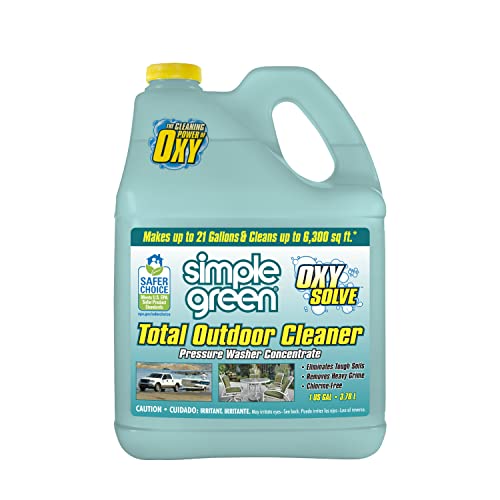
Also great
The plant-safe option when the flower bed is right there
Simple Green Oxy Solve Total Outdoor Cleaner
Simple Green's Oxy Solve is a peroxide concentrate with EPA Safer Choice certification, rated to cover up to 6,400 square feet per bottle. It cleans wood, vinyl, concrete, brick and composite without chlorine, so you can spray near the tomatoes.
$23.99fromAmazonThe certification is the reason to buy it. EPA Safer Choice evaluates every ingredient in the formulation, not just the finished product, for human and aquatic safety. Plenty of cleaners call themselves gentle. This one has a third party's name attached to that claim, which is about as good as the evidence gets in this category.
You can clean the deck and the siding in the same afternoon. One bottle is rated for up to 6,400 square feet across wood, vinyl, concrete, brick and composite. If your Saturday plan is house walls, then the back deck, then the patio slab, this covers all three without a second trip to the store or a second product.
It's the one to use on wood. Chlorine bleach raises the grain on cedar and pine and can pull tannins to the surface as ugly brown streaks. Peroxide chemistry avoids both. Published reviews of oxygen-based cleaners on wood siding consistently report cleaner results and no color shift, which is why this is our recommendation for cedar, pine and painted wood.
It works with whatever equipment you already own. Run it through a pressure washer if you have one, or mix it in a pump sprayer and give it three to five minutes of dwell time. On flat vinyl and concrete the manual method gets you most of the way there. You're not locked into buying gear to use it properly.
Flaws but not dealbreakers
It's slower on entrenched mold, and sometimes you'll scrub. Heavy black growth on rough stucco or fiber cement usually needs a longer dwell, a second application, or a soft brush. Owners cleaning textured surfaces mention the brush step more often than owners cleaning smooth vinyl. It's a real time cost on a big wall.
Speed isn't what you're paying for here. If mold coverage is extensive or visibly raised off the surface, Mold Armor resolves it in a single pass and this won't. Buy Oxy Solve because you want the safety profile, not because you want to be done fastest.
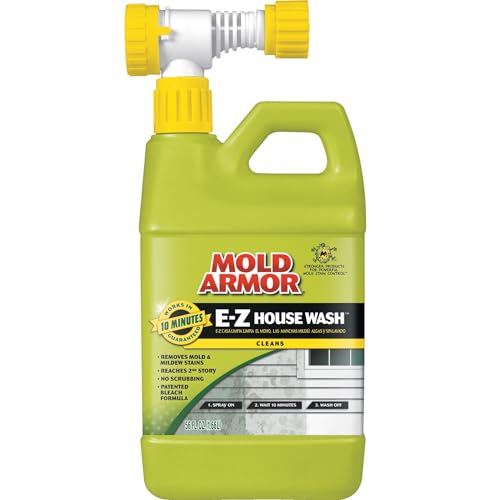
Upgrade pick
Heavy-duty bleach chemistry for mold you've stopped fighting
Mold Armor FG51164 E-Z House Wash
Mold Armor's E-Z House Wash is a bleach-based formula that comes with a hose-end sprayer built in. It kills heavy, multi-season mold and mildew on contact, and you can be spraying about a minute after opening the box.
$26.35fromAmazonBleach chemistry kills spores instead of loosening them. That distinction matters on porous stucco, rough wood and textured vinyl, where growth roots below the visible surface. Oxygen and enzyme cleaners break organic matter down gradually. This kills it outright, which is why published reviews consistently name bleach-based washes for severe biological growth.
The sprayer is in the bottle, so there's no setup. Screw it onto your garden hose and go. No pump sprayer to buy, no concentrate to measure, no bucket. For anyone facing a wall of black mold and looking for reasons to postpone, removing the equipment step genuinely helps.
It clears staining in minutes, not weeks. Owners describe visible results on established mold within a few minutes of application, which matches what the manufacturer claims. The follow-up rinse carries away both the solution and the loosened growth. One session, one visibly different wall.
It gives you enough product for a real job. At 64 ounces of hose-end concentrate, it covers meaningfully more wall than the small bottles here. That matters when you're doing the whole house in one pass rather than spot-treating the shady side.
Flaws but not dealbreakers
It can lighten dark siding and trim. Spot-test somewhere inconspicuous before you commit, especially on dark pigments and painted trim. Repeated high-concentration exposure is also hard on silicone caulk, so rinse windows and joints promptly when you're done.
Your landscaping needs protecting. Soak nearby grass, shrubs and beds with plain water before you spray, and rinse them again after. Skip that and you'll find scorched leaf edges within a few days. Gloves and eye protection aren't optional either.
It's overkill for a clean house. The hose-end dilution also limits your control if you want a stronger mix on one stubborn patch. For routine annual cleaning, Krud Kutter or Oxy Solve get you a similar-looking wall with far less chemical fuss.
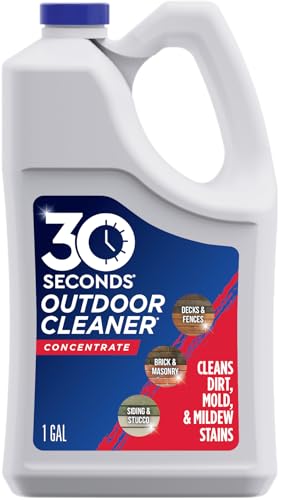
Budget pickOn sale
Green algae disappears while you're still standing there
30 SECONDS Outdoor Cleaner Dirt
30 SECONDS mixes one-to-one with water, so a gallon of concentrate becomes two gallons of solution. Green algae and mildew staining start dissolving within a minute of contact, which makes it the pick when the house needs to look good by Saturday.
$11.96fromAmazonList priceIt's genuinely fast, and that changes how you work. Applied at full 1:1 strength to green-stained vinyl, staining visibly breaks down in well under a minute. You spray a section, watch it lift, and move on. Compare that with a maintenance product where you spray and come back in two weeks.
The dilution is impossible to get wrong. One part concentrate, one part water. No ounces-per-gallon math, no label squinting. A gallon of concentrate becomes two ready-to-use gallons, which is a lot of wall for a single container.
The surface list is unusually broad. Decks, composite, concrete, brick, masonry, gutters, siding, canvas, plastic, stucco, fences, painted surfaces. If you're cleaning up a whole property rather than just the walls, one jug handles the driveway and the fence too.
It's the right first pass on a neglected house. Buying a place with three years of green on the north side? Use this to strip the biological staining, then switch to something gentler for annual upkeep. Published reviews and owner feedback both point to it as a reset button rather than a routine cleaner.
Flaws but not dealbreakers
Bleach chemistry means plant precautions. The label calls it lawn-safe when used as directed, but owners still report leaf burn where overspray concentrated. Pre-wet everything green nearby, rinse again after, and stay well away from ponds and streams.
It's more prep than a hose-end bottle. You're mixing into a pump sprayer and rinsing afterward. That's two steps the self-diluting products skip. Not a dealbreaker, but budget the extra fifteen minutes.
It won't touch chalky oxidation. Faded, powdery vinyl isn't a stain, and no amount of bleach fixes it. Clean off the biology first, then decide whether you also have a fading problem.
Who this is for
This guide is for homeowners washing their own siding with a garden hose and maybe a pump sprayer. That covers most single-family houses with vinyl, brick, stucco, painted wood or fiber cement walls. If you're dealing with the usual annual layer of dirt and a bit of green on the shaded side, any of the picks here will handle it, and you'll spend an hour rather than a weekend.
Some jobs are past this. If mold covers more than about ten square feet, keeps returning after two treatments, or you suspect moisture is getting behind the panels, that's a remediation and inspection question, not a cleaning-product one. We also don't cover pressure washers, roof cleaning, or panel replacement — cracked and brittle vinyl needs a contractor, not a bottle. And if your siding looks chalky and faded rather than dirty, read the also-consider section, because that's a different chemistry entirely.
How we picked
We weighed five things. What it removes: the cleaner had to target a real stain type — algae, entrenched black mold, or UV chalking — not just claim general cleaning power, and we checked those claims against published reviews and owner feedback. Surfaces: it needed a label rating for vinyl plus at least one other common cladding, with no meaningful risk of bleaching painted wood or fiber cement. Effort: spray-and-rinse and hose-end delivery beat anything that expects you to scrub a two-story wall by hand. Plant safety: EPA Safer Choice certification carried the most weight, and bleach-based products stayed in only where the precautions are simple and well documented. Coverage: we compared rated square footage and dilution ratios instead of shelf price, because a 1:1 concentrate stretches much further than its bottle suggests.
Other siding cleaners worth considering
If your siding is chalky and faded rather than dirty: The Rejuvenate Dual System Outdoor Window Cleaner & ($16.88) — Rejuvenate's Dual System is the only thing here aimed at UV oxidation — the powdery white film that appears on vinyl after years of sun. Its optical brighteners restore apparent color rather than just stripping dirt, and the pack includes a second bottle for windows, so you can do walls and glass in one hose-end pass without a ladder. It's rated for 3,000 square feet and explicitly safe for plants and grass. The catch is that it contains no mildewcide. Spray it over live mold and you get a brighter wall for a few weeks before the growth comes back. Use it after a mold-killing pass, not instead of one.
If you'd rather not rinse anything at all: The Wet & Forget Outdoor Moss ($36.40) — Wet & Forget is the passive option. Attach the 48-ounce bottle to your hose, spray a dry surface on a cool day, and walk away — no scrubbing, no rinsing, no ladder. The jet tip reaches about 30 feet, which gets you second-story siding from the ground, and the fan tip handles the driveway. Green staining clears over one to two weeks as wind and rain work the product across the surface, and treated walls can stay clean for a year or more. But black or long-established stains take months, sometimes six to twelve. Don't buy it if the house goes on the market next month.
The competition
These are the products our research surfaced in this category, not a complete map of what's for sale. A cleaner ending up here usually means it does one thing well but asks something of you that our picks don't, or it isn't really built for exterior walls in the first place.
The OxiClean Versatile Stain Remover Powder ($11.79) — OxiClean's 5-pound powder is a laundry product that plenty of people repurpose for outdoor cleaning, and the oxygen-bleach chemistry does translate. Mixed into a pump sprayer, it lifts organic staining from vinyl, painted wood and fiber cement without the color-stripping risk of chlorine, and the tub makes a lot of solution. The problem is that the label gives you no exterior dilution guidance at all, so you're guessing at concentration for each stain severity. It also wants five to ten minutes of dwell and a soft brush on anything textured, and it's slower than bleach on heavy mold. If you already own a tub and your siding is only lightly dirty, it's a reasonable thing to try. As a purchase made specifically for siding, our picks are better matched to the job.
Application notes
Work in sections, from the bottom of the wall up, and rinse from the top down. Cleaning upward stops streaks where solution runs over dry siding; rinsing downward carries the dirt away instead of into it. Pick a cool, overcast day — sun dries the product before it can work, especially on dark panels. Before any bleach-based cleaner, soak nearby grass, shrubs and beds with plain water, then rinse them again the moment you're finished. That one habit prevents nearly all landscaping damage. Spot-test on an inconspicuous panel first, particularly on dark siding and painted trim. And keep contact time short on caulk joints and window gaskets, which don't tolerate repeated strong exposure.
Questions we get
What's the best cleaner for vinyl siding if I don't have a pressure washer?
You don't need one. Krud Kutter works through a pump sprayer or hose attachment for light-to-moderate staining, and Mold Armor's hose-end sprayer handles heavy mold with nothing but a garden hose. Wet & Forget needs only a hose and skips rinsing entirely. Every product in this guide works without pressure equipment.
Can I use bleach on vinyl siding safely?
Yes, with care. The Vinyl Siding Institute recommends no more than 30% bleach by volume for mold treatment on vinyl. Pre-formulated products like Mold Armor and 30 SECONDS contain sodium hypochlorite at concentrations already calibrated for exterior use, which is safer than mixing raw household bleach. Straight bleach at high strength can damage caulking, window gaskets and dark siding pigments.
How do I get black mold off vinyl siding?
Reach for bleach-based chemistry. Apply Mold Armor or 30 SECONDS at the recommended dilution, give it three to five minutes, then rinse thoroughly. Light agitation with a soft-bristle brush during the dwell helps on textured panels. If staining survives a second application, the growth has penetrated past the surface, and anything over about ten square feet is worth a professional look.
What's the chalky white film on my siding, and can I remove it?
That's UV oxidation. Plasticizers in the vinyl migrate to the surface over years of sun and oxidize into a powdery layer. Ordinary cleaners remove dirt but can't reverse that chemistry. Rejuvenate's siding formula contains optical brighteners made for exactly this, though badly cracked or warped panels need replacing rather than brightening.
How often should I clean my siding?
Once a year is the general recommendation, usually in spring to clear winter moisture and early growth. Humid climates, heavily shaded walls and homes near water may want twice-yearly attention. Staying on a yearly schedule with something gentle is much easier than letting buildup reach the point where you need heavy bleach chemistry.
Are these cleaners safe on fiber cement siding like HardiePlank?
Oxygen-bleach and gentle formulas are the safer route. Simple Green Oxy Solve is appropriate for fiber cement at standard dilution, and OxiClean solution works too. Avoid strong sodium hypochlorite on painted fiber cement, since it can bleach factory or field-applied finishes. Rinse thoroughly either way — the porous substrate holds more solution than smooth vinyl.
Why you should trust us
For this guide:
- We compared manufacturer labels, dilution ratios and rated coverage figures across every cleaner in this guide.
- We read published reviews of exterior house washes and looked for agreement on which chemistries handle algae, entrenched black mold and UV chalking.
- We reviewed owner feedback themes for each product, paying particular attention to reports of plant damage, streaking and stains that came back.
- We read owner reviews on every listing, weighted toward the critical ones, because that is where the recurring failures show up.
- We have a systematic way of automatically fetching the latest prices, so the numbers on this page stay current.
- This is a research-focused guide, so the team may not own every product listed — though we often do own the top winners, which gives us extra context for the recommendations.
- We don't accept free products, and the retailer commission never changes which product we recommend.
Sources
Best Vinyl Siding Cleaners — This Old House Reviews, This Old House
How to Clean Vinyl Siding — Bob Vila, Bob Vila
Vinyl Siding Care & Maintenance Guide — Vinyl Siding Institute, Vinyl Siding Institute (VSI)
Best House Wash Products Tested — Popular Mechanics, Popular Mechanics
Exterior Cleaning Products Review — Consumer Reports, Consumer Reports
Amazon product listings and owner reviews for all 7 products
Manufacturer specification pages for each product
Some passages in this guide may be paraphrased with AI help. Prices are refreshed automatically.
More like this.
Continue exploring home reviews and recommendations.

The Best Tineco Floor Cleaners
If you have hard floors and anything that makes a mess - a dog, a toddler, a partner who cooks - you already know the routine. You vacuum, then you mop,…

The Best Eco-Friendly Cleaning Products
Cleaning products are one of the few things you buy that you also breathe. You spray them on the counter where your kid eats breakfast, and you wipe them…

The Best Robot Window Cleaners
We evaluated ten suction-mounted window robots on grip, finish and reach, for anyone tired of ladders and…

The Best Pressure Washer Surface Cleaners
A surface cleaner is the attachment that makes a pressure washer worth owning. Instead of one jet carving stripes into your driveway, two nozzles spin…

The Best Dryer Vent Cleaning Kits
Your dryer vent is easy to forget. It sits behind the machine, out of sight, and it fills with lint a little more every time you dry a load. Then one day…

The Best Pool Cleaning Robots
A pool robot buys back your Saturday morning. Instead of dragging a pole around the deck and pushing dirt into corners, you drop a machine in the water,…