The Best Smokeless Indoor Electric Grills
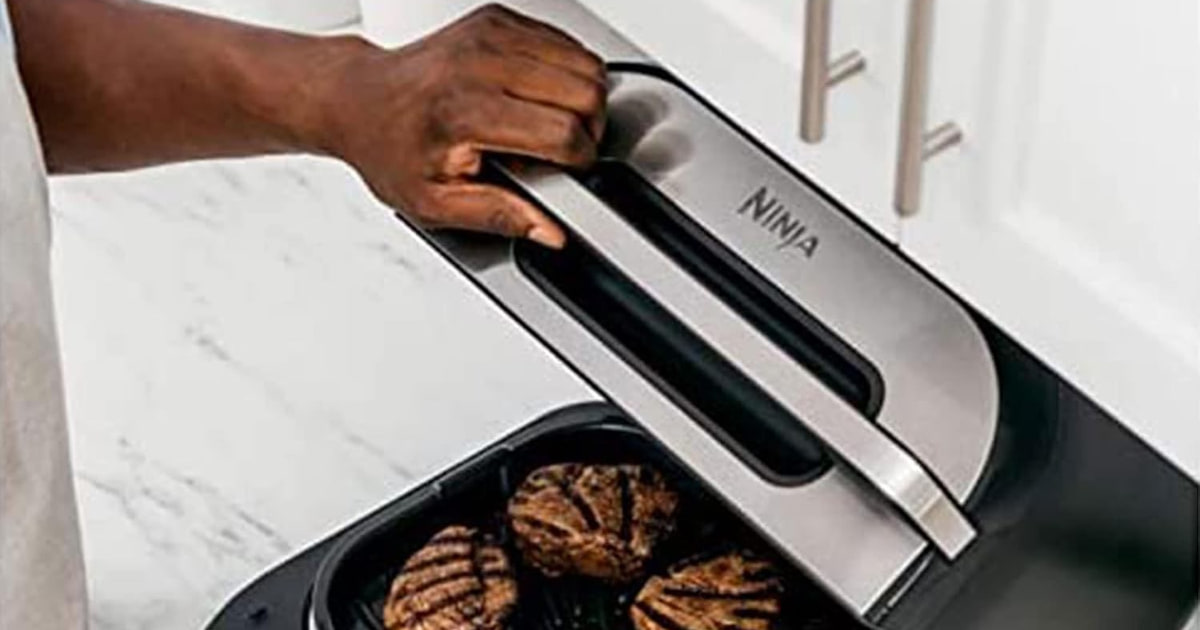
Indoor electric grills solve a specific problem: you want a seared burger in February, or you live somewhere a propane tank isn't allowed on the balcony. The good ones get hot enough to actually brown meat instead of gently poaching it. That threshold matters more than any other spec. A grill that tops out around 350°F will cook your chicken through, but it won't give you the dark crust and grill lines you're picturing. The rest of what you're paying for is smoke management, how big a batch you can cook, and whether the plates come out for the dishwasher.
Here's the honest part: none of these are smokeless. That word is marketing, not physics. Fat hitting a 450°F surface makes smoke, and no fan, filter, or lid changes the chemistry. What these grills do is cut the smoke down a lot compared with searing in a skillet on your range. Some do it with an enclosed lid, some with a dedicated fan pulling air through a filter. All of them still work better with a range hood running or a window cracked, especially with ribeye or skin-on thighs.
The other tradeoff nobody mentions upfront is counter space. The models that sear best are also the bulkiest, and a 20-pound appliance you have to haul out of a cabinet gets used less than one that lives on the counter. We think that the Ninja Foodi Smart XL FG551 is the best smokeless indoor electric grill for most people, and that the Hamilton Beach 25360 is the one to buy if you want straightforward searing without the multi-function bulk.
Everything we recommend
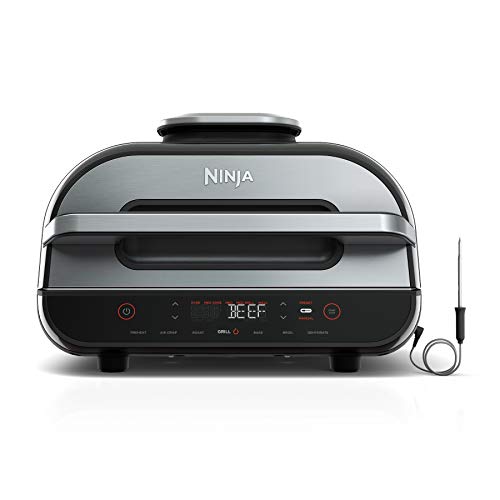
The hottest, smartest grill here, if you have the counter space

Straightforward searing heat without the multi-function bulk
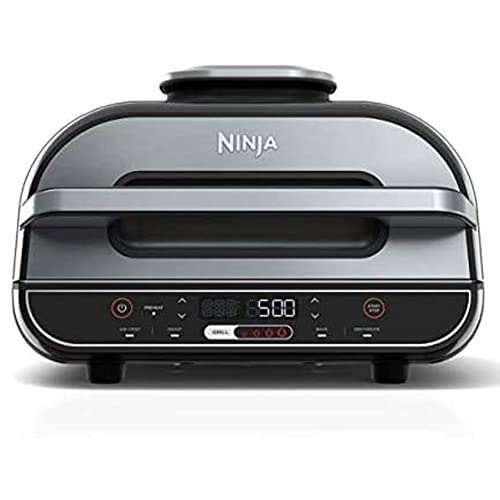
Same 500°F sear, with a fan built specifically for smoke

The right pick if your building's smoke alarm is a problem
At a glance
| Product | Cook Surface | Max Temp | Price | |
|---|---|---|---|---|
| NinjaTop pick | 6 Steaks/24 Hot Dogs | 500°F | $199.99On sale |
 | Indoor Smokeless Electric Grill GriddleAlso in lineup | 16in Round | — | $59.89 |
| Hamilton Beach Electric Indoor Searing Grill withBudget pick | 118 Sq In | 450°F | $84.95 |
 | Cuisinart Griddler Indoor GrillAlso consider | — | 425°F | $99.95On sale |
| Ninja Foodi 5 In 1 Indoor GrillAlso great | 4 Qt Basket | 500°F | $199.95 |
| PowerXL Smokeless Grill EliteRunner-up | 13.75x8in | 450°F | $200 |
 | George Foreman Indoor/Outdoor Electric Patio GrillAlso consider | 15-Serving | — | $101.99On sale |
How we picked
Maximum temperature. We treated 450°F as the floor and 500°F as the mark of a genuine searing grill, based on manufacturer specs and the browning behavior published reviews describe. Anything topping out near 350°F steams food instead of grilling it.
Smoke handling. We compared the actual mechanism each grill uses: an active fan and filter, an enclosed lid, or nothing but a drip tray. Owner feedback about odors traveling through apartments told us which approaches hold up in small spaces.
Cooking surface. We looked for at least 100 square inches for households of four or more, and read owner reports about batch sizes to check whether the listed capacity matches real dinners.
Cleanup. Removable, dishwasher-safe plates and drip trays were close to a requirement. Owner reviews across every category make clear that a grill you have to scrub by hand gets used less.
Wattage and recovery. Spec sheets showing 1500W or more indicate a grill that holds its surface temperature when cold food hits it. Lower-wattage units drop heat and brown poorly, which owner complaints confirm.
Top pickOn sale
The hottest, smartest grill here, if you have the counter space
Ninja
This is a 500°F indoor grill that also air fries, roasts, bakes, broils and dehydrates. The built-in probe thermometer takes the guesswork out of steak, and every part you dirty goes in the dishwasher.
$199.99fromAmazonList priceIt gets hot enough to actually sear. Ninja rates the cyclonic grilling at 500°F, and that's the number that separates real grilling from indoor steaming. Below about 450°F, meat browns weakly and the texture goes soft. At 500°F with circulating air, you get the dark crust and defined grate lines that make a burger taste grilled. That's the whole reason to own one of these.
The probe thermometer is the feature you'll miss on everything else. You stick the dual-sensor probe into your chicken breast, pick the protein and the doneness you want, and the grill manages the rest. No cutting into a steak to peek. No guessing whether pork is done. Nothing else in this lineup offers it, and if you cook thick proteins more than occasionally, it changes how relaxed the whole process feels.
One appliance covers a lot of counter jobs. Six modes means grill, air fry, roast, bake, broil and dehydrate, with a 4-quart crisper basket for the frying side. If you've been eyeing a standalone air fryer and a grill, this replaces both. Ninja says the crisper basket cuts fat by up to 75% versus deep frying, based on their own comparison with hand-cut fries.
Cleanup is genuinely realistic for weeknight use. The grill grate, crisper basket and cooking pot all go in the dishwasher. That sounds minor until you've scrubbed a fixed grill surface by hand three nights in a row. Owner feedback on Ninja's indoor grills consistently points to easy cleaning as the reason the unit stays on the counter instead of migrating to a cabinet.
The grate holds a real dinner. Ninja lists capacity at six steaks or 24 hot dogs. For a family of four, that means everything comes off at once instead of in batches with the first round going cold. If you're cooking for one or two, that capacity is more than you need, and the footprint becomes a liability.
Flaws but not dealbreakers
It's big, and there's no getting around it. The unit runs roughly 16.5 inches wide and just over 15 inches deep, and it weighs more than 22 pounds. That's a permanent chunk of counter. Owners of Ninja's indoor grills who returned them almost always cite size, not performance. Measure your counter before you order, and be honest about whether you'll lift this in and out of a cabinet.
The splatter shield needs cleaning after every greasy cook. Grease builds up on it, and once it's coated the smoke reduction drops off. This isn't optional maintenance you can put off for a week. If you cook bacon or fatty ground beef, plan on wiping it down each time.
Smoke is reduced, not gone. At 500°F with a well-marbled steak, you'll see some. Run your range hood. If your building has a hair-trigger communal smoke detector, this is the wrong grill for you.
Budget pick
Straightforward searing heat without the multi-function bulk
Hamilton Beach Electric Indoor Searing Grill with
This does one thing: it heats a large grate to 450°F and sears food properly. The PFAS-free plate and drip tray both come out for the dishwasher, and it weighs about eight pounds, so storing it is easy.
$84.95fromAmazon450°F is enough for most of what you'll cook. It's not the 500°F the Ninjas hit, but it clears the practical bar for browning burgers, chops and chicken. The dial runs from 200°F up to 450°F with actual temperature markings, not just low-medium-high, which owners repeatedly call out as the reason they trust it over simpler grills.
The grate is big for what this costs. At 118 square inches, it fits six burgers or four boneless chicken breasts in one go. Owners describe cooking eight filets at once. That's family-dinner capacity from a unit that weighs about eight pounds and slides into a cabinet without a fight.
The coating is PFAS-free, which not everything here can claim. If you're wary of older nonstick formulations at sustained high heat, this is the clearest answer in the lineup. Hamilton Beach states it explicitly on the listing.
Everything that gets dirty comes apart. The grill plate, the extra-large drip tray and the lid are all removable and dishwasher safe. The tray sits directly under the grate and catches drips before they hit the counter. Owners consistently mention that lifting off the cover, pulling the pan and rinsing the grate takes a couple of minutes.
Flaws but not dealbreakers
Smoke control is just the lid. There's no fan, no filter, no active anything. Closing the lid limits how much escapes, and it's fine for most kitchens with a hood running. But some owners note the grilling smell carries through an apartment, and if that's a dealbreaker for you, look at the PowerXL instead.
It only grills. No air fry, no griddle plate, no panini mode. If you want one appliance doing several jobs, this isn't it.
Nonstick wears out with heavy use. Long-term owner feedback describes the coating degrading after years of frequent grilling. That's normal for the category, but worth knowing if you plan to use it several times a week.
Also great
Same 500°F sear, with a fan built specifically for smoke
Ninja Foodi 5 In 1 Indoor Grill
This Ninja matches the Smart XL's 500°F surround searing and adds a dedicated Smoke Control System with variable fan speed. You give up the probe thermometer and a bit of air-fry capacity to get it.
$199.95fromAmazonYou get the full 500°F without the top pick's price. Surround searing circulates hot air around the food, so char marks land about the same as on the Smart XL. If searing is what you're after and the smart thermometer isn't, this is the more sensible buy.
The Smoke Control System is real hardware, not a label. Variable fan speed, a temperature-controlled grill gate, a splatter shield and a cool-air zone work together to pull smoke-laden air away from the food. Owners in poorly ventilated condos specifically credit it with keeping meat and fish smells from taking over the place.
GrillControl gives you four usable heat levels. Low, medium, high and max, spanning 105°F to 500°F on a digital display. That range covers delicate fish at the bottom end and thick pork chops at the top. The digital readout beats guessing at a dial position.
It's a five-mode machine. Grill, roast, bake, dehydrate and air crisp, with a 4-quart crisper basket, cooking pot and removable grill gate. All the cooking parts are dishwasher safe.
Flaws but not dealbreakers
There's no built-in thermometer. For thick steaks or bone-in chicken you'll want an instant-read probe on hand. That's a real step down from the Smart XL, and it's the main reason this isn't the top pick.
It's not actually small. Listed dimensions run 19 by 18 by 15 inches and Ninja's own spec sheet puts the weight around 29 pounds. Despite the reputation as the compact Ninja, it takes up more counter than the Smart XL does. Some owners return it purely on size.
The lid cuts power when you open it. Owners note that lifting the lid shuts the heat off and it takes a moment to recover. It's a safety behavior, not a defect, but it slows you down when you're flipping.
Runner-up
The right pick if your building's smoke alarm is a problem
PowerXL Smokeless Grill Elite
A dedicated Smoke Capture Fan pulls smoky air through a mesh filter instead of letting it drift into the room. It tops out at 450°F, so searing is competent rather than exceptional, but smoke handling is the best here.
$200fromAmazonActive filtration beats a closed lid for smoke. The AirFlow Technology routes air through a fan and mesh filter rather than trusting a seal to contain it. Owners in apartments say they can grill steak without odors spreading through the place. If your concern is a shared smoke detector or an open-plan studio, this is the design that addresses it directly.
450°F on a die-cast plate handles most proteins. Burgers, chicken, chops and vegetables all brown properly. The ceramic coating keeps things from sticking and cuts down on how much oil you need.
The footprint is narrow. The grill surface measures 13.75 by 8 inches, which is family-meal sized, but the unit is only about 6.5 inches deep. If your counter has more length than depth, that shape works in your favor.
Grease goes somewhere sensible. Drippings drain into a dishwasher-safe tray. The removable plate makes wiping down after a cook quick, which owners mention often.
Flaws but not dealbreakers
Steak is the weak spot. Multiple owners report red meat coming out gray and rubbery rather than browned. That tracks with the 450°F ceiling and a flat die-cast plate. If steak is your main event, the Ninjas are the better call.
The mesh filter is a chore you can't skip. PowerXL says to clean it regularly for proper airflow, and that's not boilerplate. A clogged filter kills the exact feature you bought the grill for. Plan on cleaning it every couple of cooks.
The cord is short and fussy. Owners flag the length as too short for a comfortable setup, and the listing warns that the cord has to be firmly seated in both the outlet and the heating element before you preheat. It's an extra step to remember.
Who this is for
Buy one of these if you live somewhere an outdoor grill isn't practical, or if you want grilled food in weather that keeps you inside. They're a good fit for apartments, condos with no-propane rules, and anyone tired of hauling a cover off a gas grill to cook one burger. They also make sense as a second grill for winter. If you already own an outdoor grill you use happily most of the year, an indoor unit is a convenience purchase, not a necessity.
Skip these if you're chasing steakhouse results on thick cuts. Gas grills reach 500°F to 600°F at the grate and charcoal can pass 700°F, and that gap shows on a two-inch ribeye. For burgers, chicken, fish and steaks up to about an inch and a half, the 500°F models get close enough that most people won't care. This guide covers countertop electric grills marketed for indoor use. We're not covering outdoor gas or charcoal grills, pellet smokers, or stovetop grill pans.
How we picked
We built this guide from manufacturer spec sheets, published reviews and owner feedback, weighted toward a handful of things that actually determine whether you'll keep using the grill. Heat: 450°F is the floor for browning and 500°F is where indoor grilling starts resembling the outdoor kind. Smoke: an active fan and filter handle it better than a lid, and that difference matters most in small or shared spaces. Capacity: 100 square inches or more feeds four without batching; smaller surfaces are fine for one or two. Cleanup: plates and trays should come out and go in the dishwasher, full stop. Power: 1500W or higher keeps the surface hot when cold food lands on it, which is why budget units brown so poorly.
Other smokeless indoor electric grills worth considering
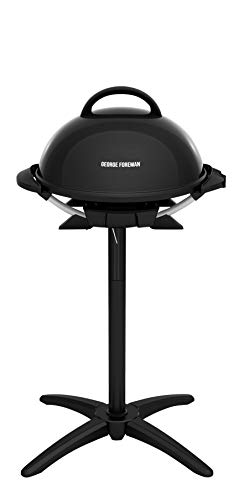
If you want one grill that works on the patio too: The George Foreman Indoor/Outdoor Electric Patio Grill ($101.99) — The George Foreman Indoor/Outdoor is the only model here genuinely built for both. The stand clips on for patio use and detaches for the countertop, and the fully electric design means no charcoal or propane, which is why it carries apartment-approved certification. Capacity is the largest in this lineup at 15 servings, with five heat settings and a sloped surface that drains fat into the tray. Owners in condos with no-grill rules love it. What you give up is smoke control: the open design lets more escape than any enclosed or fan-filtered model here, and the maximum temperature isn't rated, so assume it lands below the Ninjas. Use nylon scrubbers only, since metal will chew up the George Tough coating.
If you want a griddle and a panini press too: The Cuisinart Griddler Indoor Grill ($99.95) — The Cuisinart Griddler GR-4NP1 does five things: contact grill, panini press, full grill, full griddle, and half-and-half. The reversible plates go ribbed for grill marks or flat for pancakes and eggs, and they're dishwasher safe. Owner feedback on longevity is unusually strong, with people reporting a decade of regular use. The catch is heat. Griddle mode tops out at 425°F, and contact cooking presses food between two plates, which gives you a compressed texture rather than open-grate char. It's the most useful appliance here for breakfast and sandwiches, and the least suited to a thick steak. It comes with a limited three-year warranty.
The competition
These are the models our research surfaced across this category, not a complete map of everything for sale. We focused on grills that are widely available and that publish enough spec detail to compare honestly.
The Indoor Smokeless Electric Grill Griddle ($59.89) — The hoehew Indoor Smokeless Grill Griddle sits in a different performance tier than everything else here. Its 1000W element is well under the 1500W that sustained searing needs, and the flat 16-inch surface has no raised ridges, so you won't get grill lines. It's a griddle wearing a grill's name. Owner feedback is thin and split, with reports of the unit failing within weeks and complaints about build quality, and there's no track record behind the brand. It's genuinely compact and lightweight, so if you're outfitting a dorm room or an RV and mostly cook eggs, pancakes and thin burgers, it'll do that. For anyone cooking meat with any regularity, stepping up to the Hamilton Beach is a decisive difference in results.
Care and maintenance
Let the grill cool to warm before you clean it, not all the way cold. Fat that re-solidifies is much harder to lift off. Pull the plate or grate and soak it in warm soapy water for five to ten minutes, then wash or run it through the dishwasher if the manufacturer allows it. Empty the drip tray every cook, not every few. On the PowerXL, clean the mesh airflow filter after every two or three sessions, since a clogged filter directly undercuts the smoke capture you bought it for. On the Ninja models, wipe the splatter shield after anything greasy. Use nylon scrubbers on nonstick surfaces and keep metal utensils away from the grate, which is the fastest way to ruin a coating.
Questions we get
Do smokeless indoor grills actually work, or is that just marketing?
They work, but the word is relative. These grills cut smoke substantially compared with searing in a pan on your range, using water trays, active fan filtration, or enclosed lids that limit fat contact with hot metal. At 450°F to 500°F with a fatty cut, some smoke is chemically unavoidable. The PowerXL's active Smoke Capture Fan does the most aggressive job of the models here.
Can you get real grill marks on a steak indoors?
Yes, but essentially only on the 500°F models. Both Ninjas reach that mark, which is hot enough to trigger the browning reactions that create a crust and visible char lines. Grills capping out between 350°F and 425°F will color the meat and leave faint marks, but the texture reads closer to steamed. Maximum temperature is the single best predictor of how a steak comes out.
How do the two Ninja models differ?
Both hit 500°F and both do multiple cooking modes, so the differences are in the details. The Smart XL FG551 adds the dual-sensor probe thermometer with four protein presets and nine doneness levels, plus a sixth function and a larger grate. The 5-in-1 skips the thermometer but includes the dedicated Smoke Control System with variable fan speed. If you want hands-off doneness, take the Smart XL; if smoke is your bigger worry, take the 5-in-1.
Do I still need a range hood or an open window?
Yes, with every model here. Smokeless describes a large reduction versus stovetop or outdoor cooking, not a zero-smoke guarantee. Position the grill near an active hood or a cracked window when you're cooking ribeye or skin-on thighs at full heat. Starting at a lower setting and ramping up also helps if your building has a sensitive detector.
What wattage should I look for?
Aim for 1500W or higher. Lower-wattage units can't hold surface temperature when cold food lands on them, so the food steams in its own moisture instead of browning. The hoehew griddle's 1000W element is the clearest example of that problem. Higher-wattage grills also recover faster between batches, which matters if you're cooking in rounds.
Are the grill plates dishwasher safe?
On most modern models, yes, but confirm before you buy. The Hamilton Beach 25360, the Cuisinart GR-4NP1 and both Ninja Foodi models all have removable, dishwasher-safe plates or grates. Some entry-level grills still use fixed cooking surfaces that you have to scrub by hand, which we'd treat as a dealbreaker for anything you plan to use weekly.
Can I put one of these on the counter under my cabinets?
Yes, with normal clearance. Leave four to six inches between the grill and any cabinet, wall or flammable material. These units have feet or stands that keep heat off the countertop, and none puts out enough radiant heat to hurt quartz or granite. Don't set one directly on a glass cooktop, since concentrated heat can crack the glass.
Why you should trust us
For this guide:
- We read the manufacturer spec sheets for every grill in this lineup, comparing maximum temperature, wattage, cooking surface area and smoke-management design.
- We reviewed published coverage of indoor electric grills to understand where the searing threshold sits and how different smoke-reduction approaches compare.
- We read through owner feedback for each model, looking for repeated themes around smoke, durability, cleanup and counter footprint rather than isolated complaints.
- We read owner reviews on every listing, weighted toward the critical ones, because that is where the recurring failures show up.
- We have a systematic way of automatically fetching the latest prices, so the numbers on this page stay current.
- This is a research-focused guide, so the team may not own every product listed — though we often do own the top winners, which gives us extra context for the recommendations.
- We don't accept free products, and the retailer commission never changes which product we recommend.
Sources
Best Indoor Grills — Wirecutter (NYT), Wirecutter
Best Indoor Electric Grills Tested by the Good Housekeeping Institute, Good Housekeeping
Best Indoor Grills of 2026 — CNET, CNET
Indoor Grills Buying Guide — Consumer Reports, Consumer Reports
Best Indoor Grills — Forbes Home, Forbes Home
Amazon product listings and owner reviews for all 7 products
Manufacturer specification pages for each product
Some passages in this guide may be paraphrased with AI help. Prices are refreshed automatically.
More like this.
Continue exploring appliances reviews and recommendations.

The Best Indoor and Countertop Composters
A kitchen composter solves a small, daily annoyance: the coffee grounds, onion skins and half-eaten banana that sit in your trash can getting riper by the…

The Best Indoor Rowing Machines
Rowing is the rare cardio machine that works almost your whole body at once. One stroke pulls in your legs, core, back and arms, so twenty minutes does…

The Best Indoor Air Quality Monitors
You can't see most of what you breathe at home. Cooking throws fine particles across the kitchen. A closed bedroom door pushes CO2 past the point where…

The Best Indoor Security Cameras
An indoor camera earns its keep in small moments. You're at work and the dog has gone quiet. A package gets dropped inside the door and you want to know…

The Best Cat Trees and Condos for Indoor Cats
A cat tree isn't decoration. For an indoor cat, it's the closest thing to territory - a high spot to nap, a post to shred instead of your sofa arm, and a…

The Best Indoor Hydroponic Herb Garden Kits
Fresh herbs are the one grocery item that always seems to rot before you use half the bunch. That's the pitch for a countertop hydroponic garden: you snip…