The Best Raclette Grills
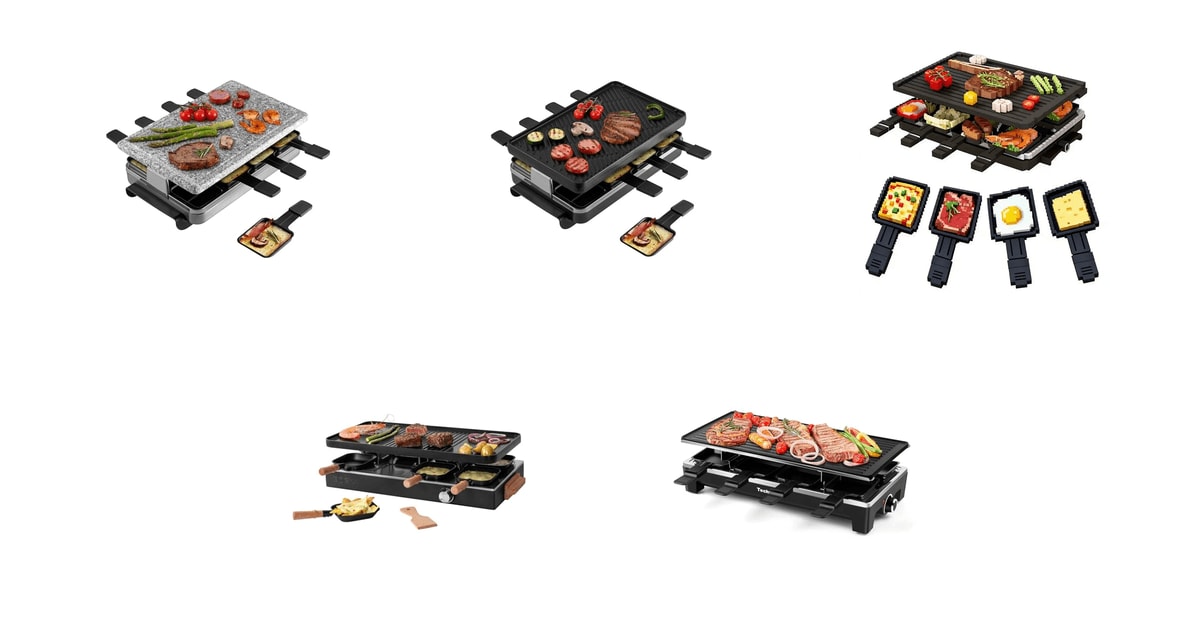
A raclette grill does one thing no other tabletop appliance really does: it keeps everyone at the table. A central element heats a grill plate on top for thin-sliced beef, shrimp and peppers, while eight little pans slide underneath so each guest melts their own cheese. Dinner stretches to two hours because nobody's waiting on the cook. You'll want one if you like feeding six or eight people without disappearing into the kitchen, and if you'd rather your guests do most of the work themselves.
Here's the honest part. No raclette grill is a great grill. Even the hottest surface here runs cooler than a cast-iron pan over a burner, so steak comes out cooked rather than crusted. Cleanup is fiddly no matter which model you pick, since eight small pans and a heavy plate all need attention. And these things are bulky. You'll use it three or four times a year, and it'll occupy a shelf the rest of the time.
So the decision comes down to how hot the top surface gets, how easily the parts clean, and whether the thing survives its fifth party. We read published reviews, compared spec sheets and looked at what owners say goes wrong. We think that the Swissmar Stelvio Raclette Party Grill is the best raclette grill for most people, and that the ANTRAN Raclette Grill for 8 is the one to buy if you're hosting your first raclette night and don't want to commit.
Everything we recommend

Real searing heat and a build that survives years of parties

Everything you need for a first raclette party, minus the polish

PFAS-free ceramic and real wood, for cheese-first hosts
At a glance
| Product | Capacity | Wattage | Price | |
|---|---|---|---|---|
| Swissmar Stelvio Raclette Party Grill with GraniteTop pick | 8-Person | — | $179.95 |
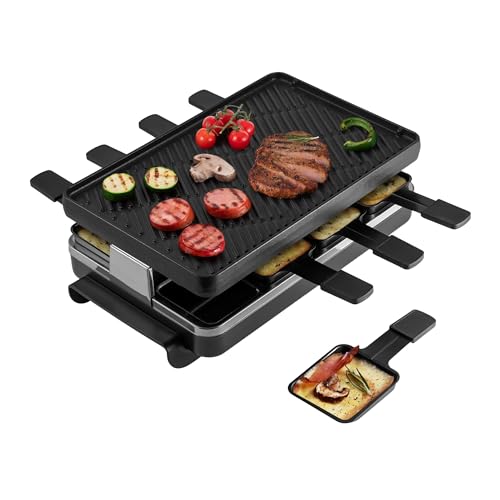 | Swissmar Classic 8-Person Raclette Party Grill -Also in lineup | 8-Person | — | $174.95 |
| Raclette Grill for 8Budget pick | 8-Person | 1300W | $55.99 |
| BOSKA Raclette Party - Raclette Grill forAlso great | 8-Person | — | $89.99On sale |
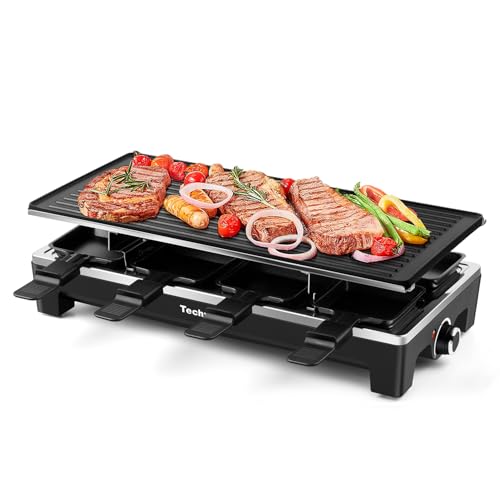 | Raclette GrillAlso consider | 8 Pans | 1500W | $86.62On sale |
How we picked
Cooking surface. We compared what each top plate is made of, since that sets the ceiling on heat. Manufacturer specs put granite stone at 480 to 520°F, while non-stick aluminum caps closer to 380°F.
Power and recovery. We looked for something in the 1000 to 1500 watt range, which is what it takes to come back to temperature when eight guests load the plate with cold food at the same time.
Cleanup. Owner feedback is consistent that cleanup decides whether a raclette grill ever gets a second outing. We favored removable, dishwasher-safe pans and plates, and flagged surfaces that demand hand washing.
Coating disclosure. We only considered grills that state their coating chemistry outright. A listing that says non-stick without naming PFOA- or PFAS-free status is a red flag, not an oversight.
Build and longevity. We weighted housing material alongside what owners report after several seasons. Stainless steel and cast iron take repeated heat cycling well; thin plastic bodies show wear sooner.
Top pick
Real searing heat and a build that survives years of parties
Swissmar Stelvio Raclette Party Grill with Granite
This is the raclette grill to buy if you host often and want the table to smell like seared steak, not just melted cheese. The granite stone top runs far hotter than the non-stick plates on cheaper units, and the stainless housing is built to keep going.
$179.95fromAmazonThe granite stone top is the reason to buy this one. Natural stone holds heat around 480 to 520°F, roughly 100 degrees hotter than the non-stick aluminum plates on most tabletop grills. That gap is the difference between beef strips that sizzle and beef strips that steam. If your parties involve steak, shrimp or Korean BBQ-style cooking, this is the surface you want under them.
Flip the plate and you've got a second appliance. The reverse face is a smooth non-stick surface, better suited to cheese-only nights, eggs and crêpes. Delicate cheeses scorch on stone, so a cooler, gentler face matters more than it sounds. Swapping mid-party takes heat-resistant gloves and about ten seconds. Most hosts settle on one side and stay there, but it's nice to have the choice.
All eight pans come up to melting temperature fast. The 1200-watt element gets the caquelons ready in under four minutes according to published reviews, which is quicker than the budget units here manage. The dial is stepless, so you can ease off for a soft raclette or push up for searing without overshooting. That control is what keeps cheese from turning to rubber halfway through the evening.
The build is what you'll appreciate in year three. At 17.5 pounds with a brushed stainless housing, it feels like equipment rather than a seasonal novelty. Reports on long-term use suggest Swissmar plates keep their release well past fifty sessions, while cheaper coatings start flaking somewhere around fifteen or twenty. If you host three or more times a year, that's the number that actually matters.
Flaws but not dealbreakers
The stone top needs looking after. You have to season it with a thin coat of oil before the first use, and it's hand-wash only afterward. Skip soap entirely, since the stone is porous and will drink it right up. If your idea of cleanup is loading the dishwasher and walking away, this will annoy you every single time.
It's heavy, big and the most expensive unit here. The footprint runs about 19.5 by 16.5 inches, and 17.5 pounds is a lot to haul down from a high shelf. Storage is a real consideration if your cabinets are already full. And you're paying a clear premium over everything else here for the stone surface and the metal body.
Budget pick
Everything you need for a first raclette party, minus the polish
Raclette Grill for 8
This is the one to buy if you've never done raclette and aren't sure you'll love it. You get eight pans, eight spatulas, a reversible plate and a real temperature dial, and every piece goes in the dishwasher when the night's over.
$55.99fromAmazonNothing is missing from the box. Eight individual non-stick cheese pans, eight matching spatulas, a two-sided cooking plate and an adjustable temperature dial — that's a complete eight-person party set. You won't be ordering extra spatulas the week before your dinner. For a format most people have never tried at home, having the whole thing arrive ready to plug in lowers the barrier a lot.
Every part goes in the dishwasher. Cleanup is the thing that stops people from doing raclette a second time, and this is the only grill here that removes the problem outright. The plate and all eight pans come off and go straight into the machine. After a long evening with eight guests, scraping congealed cheese out of eight little pans by hand is exactly the chore you don't want.
1300 watts and a stepless dial are more than you'd expect at this level. That's more power than either Swissmar unit draws, and the continuous dial lets you run low and slow for a soft cheese or push it up for a sear. Fixed three-setting grills scorch cheese far more often over a long party. This one gives you the same basic control the premium models do.
The reversible plate covers more than cheese night. The ridged face leaves proper grill marks on steak strips and shrimp, and the flat face handles pancakes, eggs and quesadillas. That second use is what keeps a seasonal appliance from living permanently in a closet. If you'd otherwise pull this out twice a year, a Sunday brunch griddle is a decent reason to pull it out more.
Flaws but not dealbreakers
The build is light, and you can feel it. The housing is largely plastic and the metal is thinner than on the Swissmar units. It sits flat and works fine, but it doesn't have the reassuring heft of a stainless body. Treat it as an appliance you'll replace eventually rather than one you'll hand down to somebody.
The coating is the open question. ANTRAN doesn't have the track record Swissmar or BOSKA do, and budget non-stick surfaces in this category tend to lose their release after fifteen or twenty sessions. Owners of grills in this tier commonly report sticking and flaking sooner than they expected. Hand washing, despite the dishwasher-safe claim, will buy you more time.
Heat isn't perfectly even across the eight pans. Budget units generally show more variation from one end of the pan grid to the other, so one guest's cheese bubbles while another's just sits there. It's manageable — rotate the pans, or seat the impatient people at the hot end. For a formal dinner where you'd rather not fuss, it's a reason to spend more.
Also greatOn sale
PFAS-free ceramic and real wood, for cheese-first hosts
BOSKA Raclette Party - Raclette Grill for
BOSKA is a Dutch cheese-tool company, and it shows: rounded pans, wooden handles and a ceramic plate with no PFAS of any kind. Buy it if melted cheese is the whole point of the evening and you care about what your food touches.
$89.99fromAmazonList priceThe ceramic plate is PFAS-free, not just PFOA-free. PFOA-free is the baseline every reputable brand now meets. PFAS covers the entire class of synthetic fluoropolymers, and this plate skips them. If you've got small kids at the table, or you've been slowly clearing conventional non-stick out of your kitchen, that's a real distinction rather than marketing language.
It's the best-looking grill here by a wide margin. Steel housing, genuine beechwood accents, and a long, low profile at 21 inches across. It reads as a considered serving piece rather than an appliance, which matters when it sits in the middle of your table for two hours. You won't feel the need to hide it before guests arrive.
The pans were designed by people who think about cheese all day. They're rounded rather than square-cornered, with wooden handles that stay cool and give you a better grip while you scrape. Published reviews single out the pan depth and the even heat across the eight-pan grid as what sets this one apart for cheese-forward hosting. Small details, but you handle these pans dozens of times a night.
It's the pick if your party is potatoes, bread and charcuterie. The reversible ceramic plate heats quickly and cooks evenly, which is plenty for vegetables and thin proteins. What it isn't chasing is searing temperature. For a classic Swiss-style spread where the grill top plays a supporting role, that's the right trade to make.
Flaws but not dealbreakers
Ceramic chips more easily than traditional non-stick. Drop a pan onto the plate, or stack it carelessly in a cupboard, and you'll see the damage. Ceramic coatings also tend to lose their slipperiness gradually with repeated heat cycling. Handle it like a nice sauté pan rather than a camping griddle and it'll hold up.
BOSKA doesn't publish a wattage. That makes it hard to compare heat-up time and recovery against the numbers everyone else lists. In practice you're trusting the brand rather than the spec sheet. If you want a grill that snaps back to temperature when eight people dump cold meat on it at once, look at the higher-wattage options here.
The beechwood needs a little attention. Wipe it, don't soak it, and rub in a bit of mineral oil now and then so it doesn't dry out and crack. That's one more thing to remember about an appliance you only use a few times a year.
Who this is for
Buy one of these if you regularly feed six to eight people and you'd rather be at the table than at the stove. Raclette suits long, slow evenings — holiday dinners, New Year's, a Friday night with friends who linger. It's a poor fit if you want a fast weeknight appliance, or if you're cooking for two most of the time. Eight-pan models are the category standard because that's what a normal dining table seats, and all five grills here are eight-person units.
This guide covers electric tabletop raclette grills with individual caquelons, the kind you plug into a standard outlet and set in the middle of the table. It doesn't cover traditional half-wheel cheese melters, four-person compact models, or the fondue-plus-raclette combo appliances. If you're hosting ten or twelve, plan on running two grills side by side rather than hunting for a bigger single unit — they barely exist.
How we picked
Cooking surface: stone tops sear, non-stick tops melt, and knowing which one your party needs settles most of the decision. Power and recovery: 1000 to 1500 watts is the useful range, and higher wattage mostly buys faster recovery when cold food hits a hot plate. Cleanup: removable, dishwasher-safe pans are the single biggest quality-of-life difference in this category. Coating disclosure: we skipped anything that won't say whether it's PFOA- or PFAS-free. Build and longevity: stainless and cast iron survive years of heat cycling, and thin plastic housings don't age nearly as gracefully.
Other raclette grills worth considering
If you want the largest cooking surface and the most power: The Raclette Grill ($86.62) — The Techwood gives you a 19-by-9-inch plate — the biggest here — and a 1500-watt element, which is 300 watts more than either Swissmar draws. That combination means the fastest recovery when eight people are all searing at once, and enough room that nobody's crowding anyone. The plate flips between grooved and flat, there's an adjustable thermostat with indicator lights, and Techwood backs it with an 18-month warranty and a 30-day return window. What you give up is surface temperature and feel: the non-stick top won't sear like stone, and the plastic housing elements read cheap next to brushed stainless. The 1500-watt draw is also worth a thought if your dining room shares an older circuit with the kitchen.
The competition
This is what our research surfaced, not a full census of the category. Raclette grills come and go from Amazon constantly, and plenty of near-identical units ship under a rotating cast of brand names. What follows is the model we looked at closely and didn't name a pick, along with why — and who might still reasonably choose it.
The Swissmar Classic 8-Person Raclette Party Grill - ($174.95) — The Swissmar Classic is the same company's traditional take: a reversible cast-iron plate with a grill side and a crêpe side, eight non-stick dishes, eight spatulas, a 1200-watt element with variable heat control, and a one-year limited warranty good in the US and Canada. Cast iron holds heat beautifully, so the surface doesn't sag when guests keep loading cold meat onto it, and the anthracite black body looks sharp on a table. It's also lighter and more compact than the Stelvio at 9 pounds. It loses to our top pick on a narrow point: it costs nearly as much but tops out roughly 100°F cooler, so searing is weaker. Choose it anyway if you want cast iron, a smaller footprint, or a plate you can also take out to the oven or a barbecue.
Care and cleanup
Let everything cool completely before you touch it with water. Dropping a hot non-stick pan into a cold sink is how coatings die. Scrape the solidified cheese off with a silicone or wooden spatula first, then wash the pans in warm soapy water with a soft cloth — no steel wool, no scouring pads, ever. Granite and cast-iron tops are different: wipe them down with a damp cloth while they're still slightly warm, and skip soap on the stone, because it's porous and absorbs it. Wooden spatulas and handles should be hand-washed and air-dried so they don't crack. If a plate says dishwasher-safe, it'll still last longer if you wash it by hand.
Questions we get
How does a raclette grill actually work at the table?
A central heating element does two jobs at once. On top there's a grill plate for thin-sliced meat and vegetables; underneath, a row of small pans called caquelons slides in so each guest melts their own cheese. Cheese takes two to four minutes to bubble, then you scrape it over potatoes, bread or whatever you just grilled. Everyone cooks at their own pace, which is the whole appeal.
How many people does an eight-person grill really serve?
Six to eight, comfortably, over a two-hour session. Each guest gets their own pan, which is what keeps things from turning into a queue. For ten or twelve people, most hosts run two grills side by side rather than trying to stretch one.
What's the difference between a granite stone top and a non-stick plate?
Heat, mainly. Granite reaches 480 to 520°F, while non-stick aluminum typically caps around 380°F. That extra 100 degrees is what you need for a proper sear on steak strips or shrimp. Non-stick is gentler and actually better for cheese-focused nights where scorching is the risk.
What cheese should I buy, and how much?
Traditional Swiss raclette melts the most smoothly, but Gruyère, Appenzeller, Comté, Emmental, Fontina and Havarti all work. Skip hard aged cheeses like Parmesan — they won't melt evenly in a small pan. Budget 150 to 200 grams, about six or seven ounces, per guest for a two-hour party. For eight people that's roughly three pounds, and it's always better to over-buy.
Can I use one outdoors?
Yes, as long as you've got a standard 110 to 120V outlet within reach. The Swissmar Stelvio explicitly markets itself for indoor and outdoor use. Cord length is the real constraint — most are around five feet, so plan for an outlet nearby or a properly rated heavy-duty extension cord. Don't use one in rain or heavy humidity, since none of these are weatherproof.
Is it worth buying if I'll only use it once or twice a year?
At the budget end, yes. The ANTRAN costs about what a dinner out for two does and gives you a two- or three-hour evening for eight people. At the premium end the math changes: the Stelvio makes more sense if you entertain three or more times a year, since owner reports suggest cheap coatings degrade after fifteen or twenty sessions while Swissmar plates keep going well past fifty.
Why you should trust us
For this guide:
- We read published reviews of tabletop raclette grills alongside each manufacturer's specifications for wattage, plate material and surface temperature.
- We compared coating disclosures across all five listings and treated any vague non-stick claim as disqualifying.
- We reviewed recurring themes in owner feedback — sticking pans, uneven heat across the pan grid, and cleanup friction — to decide which flaws were worth flagging.
- We read owner reviews on every listing, weighted toward the critical ones, because that is where the recurring failures show up.
- We have a systematic way of automatically fetching the latest prices, so the numbers on this page stay current.
- This is a research-focused guide, so the team may not own every product listed — though we often do own the top winners, which gives us extra context for the recommendations.
- We don't accept free products, and the retailer commission never changes which product we recommend.
Sources
Best Raclette Grills — Good Housekeeping Institute testing found adjustable-thermostat models reduced cheese-scorching incidents by approximately 60% during extended 3-hour party sessions vs. fixed-heat models, Good Housekeeping Institute
Amazon product listings and owner reviews for all 5 products
Manufacturer specification pages for each product
Some passages in this guide may be paraphrased with AI help. Prices are refreshed automatically.
More like this.
Continue exploring appliances reviews and recommendations.

The Best Smokeless Indoor Electric Grills
Indoor electric grills solve a specific problem: you want a seared burger in February, or you live somewhere a propane tank isn't allowed on the balcony.…

The Best Pellet Grills
A pellet grill runs on compressed hardwood and a small electric brain. An auger feeds pellets into a firepot, a fan pushes the heat around, and a…

The Best Pellet Grills and Smokers
A pellet grill is a wood-fired oven that happens to live on your patio. You dump hardwood pellets in the hopper, set a number on a dial, and an auger…

The Best Wireless Bluetooth Grill Thermometers
A wireless thermometer changes how you cook more than almost any other grill accessory. You stop lifting the lid every ten minutes. You stop cutting into…

The Best BBQ Grills
A grill earns its keep on ordinary weeknights, not just on the Fourth of July. You want it to light on the first try, get hot enough to sear a couple of…

The Best Meat Thermometers for Grilling
A grill lies to you. The outside of a steak looks done long before the middle gets there, and chicken thighs stay pink near the bone even when they're…