The Best Stair Climbers for Home Gyms
Climbing stairs is one of the few cardio movements that feels hard right away. There's no coasting, no downhill, no long warm-up — you step, and your legs and lungs notice inside a minute. That's why a stair climber earns its floor space. The machines that do this well share a few traits: a step deep enough for your whole foot, a frame that doesn't sway when you push off the top, and resistance you can nudge up a little at a time instead of in big jumps.
No stair climber solves the space problem. A real rotating-step machine stands tall enough that you'll be climbing well above the floor, so a basement with low joists is out. Mini steppers fit anywhere, but they trade away most of the range of motion, and your heart rate shows it. Noise is the other honest gap. Hydraulic steppers are quiet, yet the cheap ones develop a squeak or a sticky cylinder after heavy use, and nothing here is silent for the neighbor below you.
So the right pick depends mostly on your ceiling, your floor space and how hard you plan to go. Someone training for a hiking season needs a different machine than someone who wants 20 easy minutes in front of the TV. We read spec sheets, published reviews and owner feedback across both ends of that range. We think that the Matrix Fitness C50 Climbmill is the best stair climber for home gyms for most people, and that the StairMaster 8 Series 8G Gauntlet is the one to buy if you want the gym-floor machine you already know.
Everything we recommend

Real revolving steps, sized and quieted for a home room
The gym-floor standard, if your ceiling can take it

Barely any range of motion, but it fits under the couch

A full-size stepping motion from something that folds flat
At a glance
| Product | Step height | Machine height | Price | |
|---|---|---|---|---|
| StairMaster 8 Series 8G Gauntlet Stepmill StepperRunner-up | 8 in, revolving | 89 in | $7,299.99 |
 | StairMaster SM5 StepMill Stair Climber - D1Also in lineup | — | 78 in | $6,299 |
| Matrix Fitness C50 Climbmill with XR DisplayTop pick | 5.6 in | 75 in | $5,499 |
| Sunny Health & Fitness Mini Stair StepperBudget pick | — | 13.5 in | $45.31On sale |
| Stamina SpaceMate Folding Stepper with Adjustable-ResistanceAlso great | — | 54.5 in | $149 |
 | YYJO Twist Mini Stepper with Resistance BandsAlso consider | — | 54 in | $42.99 |
How we picked
Step height and travel. We pulled step rise, depth and width from manufacturer spec sheets, because that's what decides how hard each rep is. A machine had to state either a real stair rise or an adjustable step range to make the list.
Footprint and clearance. We compared published frame dimensions against common ceiling heights and spare-room sizes. Anything tall enough to be a clearance problem had to earn it with a genuinely better climb.
Noise and impact. Owner feedback is the best evidence here, and it consistently separates quiet hydraulic steppers from chain-driven StepMills. We favored machines people describe as livable in an apartment or a shared house.
Frame and weight limit. We looked at stated weight capacity, frame material and shipping weight as a rough proxy for stability. Heavier frames and clearly published limits beat vague claims.
Console and tracking. We read listings and published reviews for what each console actually reports and whether it connects to anything. Basic, reliable readouts counted for more than long feature lists.
Top pick
Real revolving steps, sized and quieted for a home room
Matrix Fitness C50 Climbmill with XR Display
The C50 gives you the same revolving-step climb as a gym machine, but Matrix built this one for a house: it's shorter overall, and the brake is tuned to run quietly. Twenty-five resistance levels and a 24-to-137 step range mean you can crawl or sprint.
$5,499fromAmazonThis is the rare commercial-style climber that was actually designed to live in a house. Matrix says it's built with the same components as its club equipment, then engineered for quiet, comfortable in-home use. At 75 inches tall it needs less headroom than the StairMaster Gauntlet, which matters a lot if your gym is a basement or a converted bedroom with an eight-foot ceiling.
The step geometry is the part most shoppers never check. The C50's steps are 9 inches deep and 15.8 inches wide, with a 5.6-inch rise. That's a shallower stair than the Gauntlet's 8-inch step, so your knee travels through a smaller arc on every rep. If you're coming back from a knee problem, or you're just not used to climbing, you'll feel that difference in the first session.
Speed runs from 24 to 137 steps per minute, with 25 resistance levels layered on top. In practice that's two different machines in one frame. You can set a slow, heavy grind for 40 minutes of easy aerobic work, or spike the speed for 30-second intervals and let the steps punish you. Most home climbers give you one of those, not both.
At 297 pounds, this thing isn't moving once it's placed. Plan the delivery and the room before you order. It's heavier than most treadmills, the footprint is 53 by 28 inches, and a flight of stairs is a real obstacle for whoever carries it in. The upside is a frame that doesn't flex or creak when a heavier climber drives hard off the top step.
Flaws but not dealbreakers
The console is the big unknown. Matrix publishes little about what the XR display connects to, and this machine lands in homes rarely enough that there's almost no owner feedback to lean on. If you want a screen full of guided classes and a leaderboard, a connected bike will do more for you.
It's also the most expensive unit here, and that shallower 5.6-inch step is a real ceiling at the top end. A tall, strong climber who wants the biggest possible stride will prefer the Gauntlet. Service is on you, too — you'll be arranging a dealer visit rather than dropping it off somewhere.
Runner-up
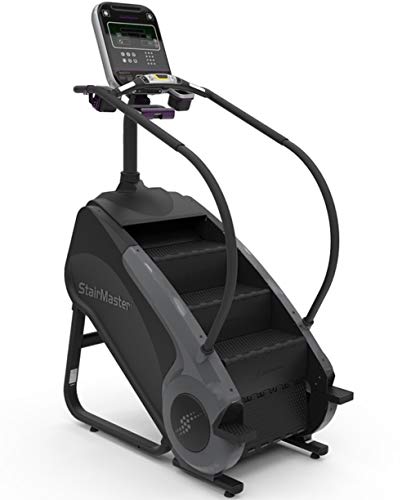
The gym-floor standard, if your ceiling can take it
StairMaster 8 Series 8G Gauntlet Stepmill Stepper
This is the machine you've already climbed at the gym, in the same 343-pound frame. You get revolving 8-inch steps, a range from 26 to 162 steps per minute, and 10 programs including intervals and heart-rate work — but it stands 89 inches tall before you add a person.
$7,299.99fromAmazonWalk into almost any commercial gym and the Gauntlet is the staircase in the corner with a line for it. That familiarity counts for something. You know how the steps feel, you know the console, and you know the thing survives hours of daily abuse from strangers who don't own it.
The 8-inch step is the real reason to pay for this one. It's a taller rise than the Matrix, so there's more work per step and more glute and hamstring involvement at the top of the climb. If you're training for hiking, stadium stairs or a fire-service test, that bigger step is closer to what you're actually preparing for.
Speed tops out at 162 steps per minute, which is faster than most people can hold for long. The low end matters more day to day. At 26 steps per minute you can warm up and cool down without stepping off, and that's genuinely useful on a machine where the first minute is otherwise a shock to the legs.
Measure before you buy. The frame is 89 inches tall, and you stand on a step that keeps rising, so your head ends up well above that number. A standard 8-foot ceiling doesn't work. This machine wants a basement with high joists, a garage, or a room with a 9- or 10-foot ceiling, plus a clear path wide enough to move 343 pounds into place.
Flaws but not dealbreakers
The console is dated, and that's the honest trade. You get time, calories, floors climbed and heart rate from a Polar chest strap you buy separately. No app, no streaming classes, no phone mirroring. For a machine this serious, plenty of buyers will find that hard to swallow.
It's also the biggest and heaviest machine in this guide, and parts and service for a commercial unit sitting in a house are yours to arrange. Owner feedback on home-delivered Gauntlets is thin enough that you're buying partly on reputation and partly on the seller's freight and setup terms. Read those terms closely.
Budget pickOn sale
Barely any range of motion, but it fits under the couch
Sunny Health & Fitness Mini Stair Stepper
This is a roughly 13-pound hydraulic stepper that lives under a couch and still gets your heart up. A knob adjusts step height, the LCD counts steps and minutes, and two included resistance bands let you add curls and presses while you step.
$45.31fromAmazonList priceThe appeal is obvious the first time you pick one up. It weighs about 13 pounds and covers roughly a 15.7-by-12.4-inch patch of floor. You can step for 15 minutes while a toddler naps in the next room, then slide it under the bed. For a lot of people, a machine that's always within reach beats a better machine out in the garage.
The adjustable step height is what separates this from the junk steppers. A knob on the frame changes how far the pedals travel. Set it low and you can hold a conversation for half an hour. Set it high and your quads give out fast. Owners who stick with these tend to be the ones who found a setting that matched their fitness instead of fighting the default.
Dual hydraulic cylinders handle the resistance, so there's no motor, no cord and very little sound — just a soft hiss as the pistons compress. That makes it the pick for an upstairs apartment with a thin floor. The LCD tracks time, step count, steps per minute and an estimated calorie number, and it runs on a replaceable battery.
Flaws but not dealbreakers
The range of motion is short, and no knob fixes that. Your foot travels a few inches rather than a full stair rise, so the climb is nothing like a StepMill and the calorie burn won't match one either. Treat it as a way to add easy movement to your day, not as a substitute for a real climber.
Durability is the other catch. These are inexpensive machines, and owner feedback keeps pointing the same two directions: hydraulic cylinders that lose resistance or weep oil after heavy use, and LCD monitors that quit reading. Some owners replace a worn unit and carry on happily. Others are finished with the category.
There's also no handlebar. You'll want a wall, a counter or a doorframe within arm's reach for balance, especially at the taller step settings or when you're tired.
Also great
A full-size stepping motion from something that folds flat
Stamina SpaceMate Folding Stepper with Adjustable-Resistance
The SpaceMate steps like a full machine — foam handlebars, textured pedals, two adjustable hydraulic cylinders — then folds with one pin and rolls under a bed. It supports users up to 250 pounds and stands 54.5 inches tall, so ceiling height is a non-issue.
$149fromAmazonThe handlebars change the exercise more than you'd expect. On a mini stepper you spend energy balancing. Here you hold on, which lets you lean in and drive through your hips without worrying about tipping. Owners who doubted a folding stepper could be challenging tend to come around after a few sessions at higher tension.
It folds, and that's the whole point. Pull a pin and the frame collapses in seconds, then rolls on wheels to a closet or under a bed. At 41 pounds it's heavy enough to feel planted while you're on it and light enough for one person to move. If your home gym is also your living room, that combination is hard to beat.
Resistance comes from two adjustable hydraulic cylinders, so the motion stays quiet and low-impact — no belt, no motor, no slam at the bottom of the stroke. Runners nursing sore shins often like this kind of machine for exactly that reason. The battery-powered monitor counts time, steps, steps per minute and output, which is enough to keep you honest.
Flaws but not dealbreakers
The 250-pound weight limit is a hard line, and it's lower than what some of the small steppers here claim. The pedal path is also more of a rocking arc than a true vertical stair, and a few owners find that foot angle uncomfortable over longer sessions.
Customer service is a recurring sore point in owner feedback — hardware that doesn't seat properly during assembly, and slow responses when buyers call about a part. Assembly itself is short, but leave yourself room for a snag.
Who this is for
This guide is for anyone building cardio into a home — a spare bedroom, a basement, a corner of the living room. If you want the hardest low-impact cardio you can get standing up, and you've got the ceiling and the floor space, a rotating-step machine is the right end of the lineup. If you mostly want to move more while you watch TV or take calls, a hydraulic stepper does that job for a fraction of the commitment, and you'll use it more often than you'd use something bulkier.
It isn't for everyone. If you need a machine for a knee rehab plan, talk to a physical therapist first, because climbing loads the joint through a deep bend. If you're after guided classes and a big screen, look at connected bikes and rowers instead — nothing here competes on software. We also stuck to machines we could verify on Amazon, so dealer-only commercial climbers and a few well-known hybrid trainers aren't covered.
How we picked
Step height and travel: we read spec sheets for step rise, depth and width, because that's what sets the difficulty of every rep. Footprint and clearance: we checked published frame dimensions against ordinary ceilings and spare rooms, since a StepMill puts your head far above the base. Noise and impact: owner feedback separates quiet hydraulic steppers from chain-driven machines, and we favored what people call livable in an apartment. Frame and weight limit: stated capacity, steel construction and shipping weight gave us a rough read on stability. Console and tracking: we looked for readouts that work reliably over long feature lists nobody uses.
Other stair climbers for home gyms worth considering
If you want a twisting motion and a higher weight limit: The YYJO Twist Mini Stepper with Resistance Bands ($42.99) — The YYJO adds a side-to-side twist to each step, so your waist and obliques get pulled in and the movement feels less monotonous than straight up-and-down stepping. The frame is rated to 330 pounds, which is higher than what the Sunny or the Stamina claims, and it ships nearly assembled with cushioned pads on the pedals to keep the noise down. What you give up is track record. It's a newer listing from a small brand with thin owner feedback, the twist is awkward if your knees are cranky, and the dimensions in the listing contradict each other — worth confirming with the seller before you clear a spot for it.
The competition
This is what our research surfaced, not a census of every stair climber for sale. Plenty of machines never made the cut because they're discontinued, sold only through dealers, or impossible to verify from a listing. Here's the one we looked at closely and passed on.
The StairMaster SM5 StepMill Stair Climber - D1 ($6,299) — The StairMaster SM5 is a true StepMill with the same revolving-step action as the 8 Series, in a smaller frame — 78 inches tall and 29 inches wide, which fits more rooms than the Gauntlet does. The catch is what's actually being sold. This is a remanufactured unit with the older D1 console, and the listing says almost nothing about step dimensions, speed range, or which parts were replaced during the rebuild. Remanufactured commercial cardio can be a smart way into real StepMill motion, and if you can get straight answers from the seller about the console, the drive and the warranty on the rebuild, it deserves a look. We'd want those answers first.
Clearance, placement and upkeep
Measure twice before anything ships. For a revolving-step machine, add your own height to the top step and then some — the Gauntlet's frame alone is 89 inches, and a standard 8-foot ceiling won't clear it. Leave a foot of air above your head and a clear path behind you to step off safely. Upkeep is simple on either kind of machine. Wipe the rails and steps down after each session, because sweat is what kills consoles and bearings. On a StepMill, keep the step chain and drive lubricated on the schedule in the manual. On a hydraulic stepper, check the pivot bolts every month or so. They work loose, and a loose bolt is where the squeak starts.
Questions we get
Are stair climbers good for weight loss?
They're good at burning calories in a short window, which helps. Published activity tables put stair-treadmill climbing at roughly 9 METs, firmly in vigorous territory, and Harvard Health's table lists about 180 calories in 30 minutes for a 125-pound person and roughly 250 for someone near 185 pounds. What you eat still decides more than the machine does. A climber you'll use three times a week beats a better one you won't.
How much ceiling height do I need for a StepMill?
More than you'd guess. The StairMaster 8G frame is 89 inches tall on its own, and you stand on a step that rises above the base, so an 8-foot ceiling is too low. Plan on 9 feet or more for a rotating-step machine, or choose a shorter frame — the Matrix C50 is 75 inches and the Stamina SpaceMate is 54.5. Mini steppers have no clearance issue at all.
Are stair climbers bad for your knees?
Climbing is low-impact in the sense that you never land hard, but it does load the knee through a deep bend, and a taller step loads it more. If your knees are sensitive, a shallower rise helps — the C50's step is 5.6 inches against the Gauntlet's 8. Start with short sessions, keep your weight in your heels, and don't hang off the handrails. Check with a physical therapist if you're working around an injury.
Are home stair climbers quiet enough for an upstairs apartment?
Hydraulic steppers are the quiet option. There's no motor and no belt, just the hiss of a cylinder, and both the Sunny and the Stamina use skid-resistant feet that keep the frame from drumming on the floor. A rotating-step machine is a different story, with a chain, a drive and your full body weight landing on each step. Put a mat under whatever you buy.
What's the difference between a StepMill and a mini stepper?
A StepMill is a moving staircase. The steps rotate under you, you climb a full stair rise, and the machine sets the pace. A mini stepper is two hydraulic pedals that travel a few inches, you set the pace, and it hides in a closet. The StepMill is a far harder workout. The mini stepper is the one that's actually sitting in your living room.
Can I use a stair climber every day?
For most healthy adults, yes, as long as you vary the intensity. The CDC recommends at least 150 minutes of moderate or 75 minutes of vigorous aerobic activity per week, and climbing counts as vigorous, so four or five short sessions cover it. Hard climbing every single day will beat up your calves and knees. Alternate an easy 20 minutes with a harder day.
Why you should trust us
For this guide:
- We compared manufacturer spec sheets across this lineup for step height, step depth, speed range, weight capacity and frame dimensions.
- We read published reviews of commercial StepMills alongside owner feedback on budget steppers, looking for themes that repeat rather than one-off complaints.
- We read owner reviews on every listing, weighted toward the critical ones, because that is where the recurring failures show up.
- We have a systematic way of automatically fetching the latest prices, so the numbers on this page stay current.
- This is a research-focused guide, so the team may not own every product listed — though we often do own the top winners, which gives us extra context for the recommendations.
- We don't accept free products, and the retailer commission never changes which product we recommend.
Sources
Calories burned in 30 minutes for people of three different weights - Harvard Health, Harvard Health Publishing
Compendium of Physical Activities (stair-treadmill ergometer MET values), Compendium of Physical Activities
StairMaster product pages, StairMaster (manufacturer specs)
Bowflex Max Trainer product pages, Bowflex (manufacturer specs)
Matrix Fitness Climbmill product pages, Matrix Fitness (manufacturer specs)
Fitness equipment testing and reviews, Consumer Reports
Physical activity guidelines for adults, CDC
Fitness equipment and exercise machine buying guidance, American Council on Exercise
Amazon product listings and owner reviews for all 6 products
Manufacturer specification pages for each product
Some passages in this guide may be paraphrased with AI help. Prices are refreshed automatically.
More like this.
Continue exploring health reviews and recommendations.

The Best Climbing Shoes for Beginner Boulderers
Your first pair of climbing shoes changes how bouldering feels. Rental shoes are soft, stretched out and shaped by a hundred other feet. Your own pair…

The Best Baby Gates for Stairs
A baby who can crawl will find the stairs within a week. That's the whole reason this category exists. A stair gate has to hold up to a toddler leaning on…

The Best Attic Stair Insulation Covers
A pull-down attic stair is a hole in your ceiling with a thin piece of plywood over it. That panel does almost nothing thermally - think single-pane…

The Best Rock Climbing Harnesses
A harness is the piece of gear you notice least when it's right and constantly when it's wrong. You hang in it at the anchor. You sit in it while your…

The Best Crampons For Ice Climbing And Mountaineering
Crampons are one of the few pieces of gear where the wrong choice isn't just annoying - it's dangerous. A good pair bites into hard blue ice, stays put on…

The Best Smart Home Gym Systems
A home gym only works if you'll walk over to it on a Tuesday night when you're tired. That's the whole game. The best connected systems shrink the…