The Best Turntables for Beginners
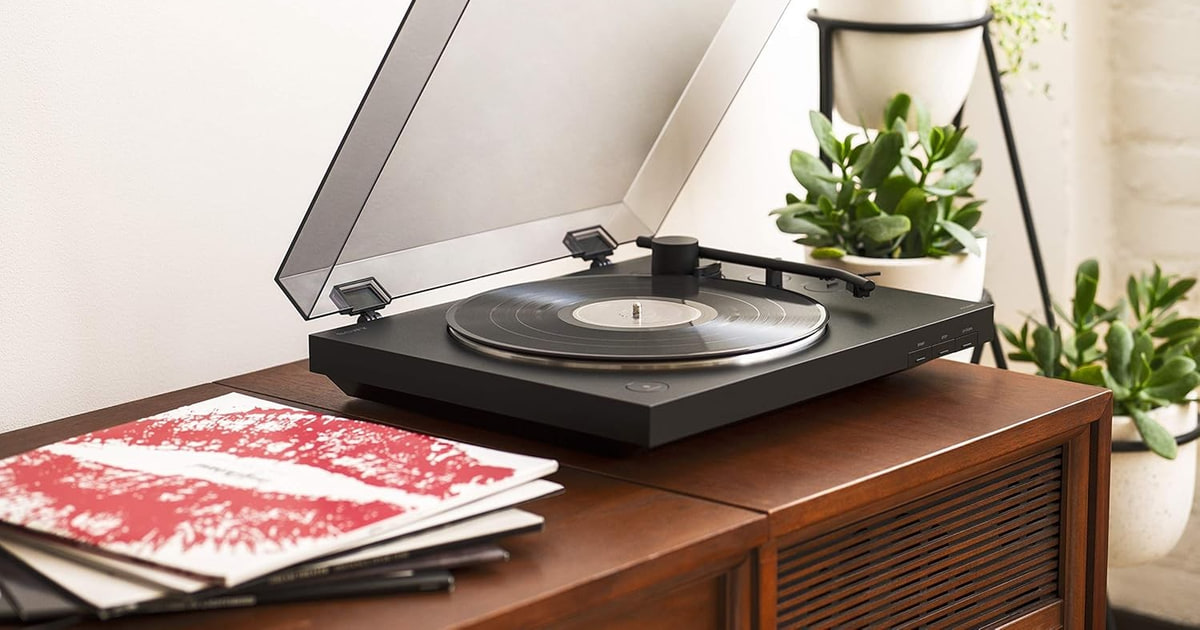
A turntable is one of the few gadgets you still operate with your hands. You choose a record, set it down, drop the needle, and then you're committed to one side for twenty minutes. That's most of the appeal. But it also means the machine has to get out of the way. A beginner deck needs to plug into whatever speakers you already own, spin at the right speed, and track the groove without chewing it up. Everything past that is a bonus.
Here's the honest part. No turntable at this end of the market is a finished system. Every one of these needs something else, whether that's powered speakers, a receiver, or a separate phono stage, and none of them come with speakers in the box. The stock cartridges are decent rather than special, and most people who stay with vinyl swap them eventually. Any of these will also sound worse than a good streaming setup if your speakers, your room, or your records are rough.
So aim for a deck that's hard to use wrong. Automatic operation lifts the arm at the end of a side, which matters if you tend to fall asleep to side two. A built-in preamp lets you run one cable to a powered speaker and be done. Crutchfield reports that roughly one in three first-time buyers don't know whether their deck has one, and it's the most common setup mistake. We think that the Audio-Technica AT-LP60X is the best beginner turntable for most people, and that the Fluance RT81 is the one to buy if you want better sound and don't mind cueing the arm yourself.
Everything we recommend

Automatic, forgiving, and the easiest way into vinyl
Better cartridge and a heavier build, if you'll cue it yourself

Direct drive, USB ripping, and controls you can actually adjust

Audiophile parts and a quieter background, if you'll fuss a bit
Prices as of Oct 24, 6:27 AM PT · Details
At a glance
| Product | Drive type | Speeds | Price | |
|---|---|---|---|---|
| Audio-Technica AT-LP60X-BK Fully Automatic Belt-Drive Stereo TurntableTop pick | Belt drive | 33-1/3, 45 RPM | $178 |
| Audio-Technica AT-LP120XUSB-BK Direct-Drive TurntableAlso great | Direct drive | 33/45/78 RPM | $399 |
| Fluance RT81 Elite High Fidelity Vinyl TurntableRunner-up | Belt drive | — | $299.99 |
 | Sony PS-LX310BT Belt Drive Turntable: Fully AutomaticAlso consider | Belt drive | 33 1/3, 45 rpm | $448 |
 | U-Turn Audio - Orbit PlusAlso consider | External belt drive | 33 and 45 RPM | $399 |
 | Victrola Hi-Res Onyx - Wireless Bluetooth TurntableAlso in lineup | — | 33 1/3 & 45 rpm | $199.99 |
| Pro-Ject Debut Carbon EVO Wired Turntable withUpgrade pick | — | 33/45 r.p.m. | $649 |
 | House of Marley Stir It Up LuxAlso in lineup | — | 45 and 33 RPM | $399.99 |
Prices as of Oct 24, 6:27 AM PT · Details
How we picked
Plug-and-play setup. Crutchfield reports that about one in three first-time buyers don't know whether their turntable has a built-in preamp, which is the most common setup mistake in this category. We favored decks whose specs confirm a phono stage on board, or that say plainly you'll need one.
Cartridge and stylus. Published reviews consistently rank elliptical styli above the conical tips bundled with most entry decks, and What Hi-Fi? singles out the Fluance's AT95E on those grounds. We treated a factory-mounted elliptical cartridge as a real advantage, not a spec-sheet flourish.
Steady speed. Wow-and-flutter is the number that separates a turntable from a toy. RTINGS measured the AT-LP60X within 0.1% weighted and lists the direct-drive AT-LP120XUSB at 0.2% WRMS, both inside the range where casual listeners won't hear pitch drift.
Room to upgrade. We looked for standard half-inch cartridge mounts, removable headshells, and adjustable counterweights, since owners who stay with the hobby usually upgrade the cartridge before anything else. Decks that lock you into one stylus scored lower.
Honest wireless. SoundGuys found that Bluetooth turntables like the Sony PS-LX310BT roll off high frequencies above 15 kHz compared with a wired connection. We treated wireless as a convenience trade rather than an upgrade, and only recommended it where the wired option is still there.
Top pick
Automatic, forgiving, and the easiest way into vinyl
Audio-Technica AT-LP60X-BK Fully Automatic Belt-Drive Stereo Turntable
It's fully automatic, so the arm starts and returns on its own, and it plugs straight into powered speakers with no extra boxes. The sound is honest rather than thrilling, but nothing else here is as likely to survive a beginner's first year of mistakes.
$178fromAmazonPrices as of Oct 24, 6:27 AM PT · Details
This is the deck we'd hand to someone who has never owned one. You set the record down, press start, and the arm swings over and lowers itself. At the end of the side it lifts and goes home. The cartridge arrives mounted and aligned, so there's no counterweight to balance and no anti-skate dial to guess at. For a first turntable, that quietly removes almost every way to get it wrong.
Picture the last hour of a party, or the last twenty minutes before you fall asleep. That's when a manual arm gets left riding a locked groove, scrubbing away at the run-out. Automatic operation isn't about laziness. It's simple insurance for your stylus and your records, and it's why we keep choosing this deck over a few models that sound slightly better.
The measurements back up the easy setup. RTINGS puts its wow-and-flutter within 0.1% weighted, comfortably inside what a casual listener would hear as wobble. Belt drive keeps motor noise from reaching the platter, the platter itself is anti-resonance die-cast aluminum, and the AC adapter does its conversion outside the chassis so that hum stays out of the signal. None of that makes this a hi-fi deck. It makes it a steady one.
It also has a built-in phono preamp, which is the feature that decides whether your first evening goes well. One cable to a pair of powered speakers and you're playing records. Wirecutter's testers called it the most reliable automatic turntable in its class after living with it long-term, and owners echo that: the complaints are about ambition, not failures. At about eight pounds it's light, so give it a solid shelf.
Flaws but not dealbreakers
The upgrade path basically ends here. You can replace the stylus when it wears, but the cartridge isn't a standard half-inch mount, so you can't drop in an Ortofon or a Grado later. There's no counterweight or anti-skate adjustment either. That's the right call for a first deck and a real limit on your second year with it.
The plinth is light, and light decks are fussy about where they live. On a springy floor, footsteps can jog the needle, and setting it on the same surface as a speaker will feed bass back into the platter. There's no Bluetooth and no USB output, so wireless listening and digitizing are off the table.
Runner-up
Better cartridge and a heavier build, if you'll cue it yourself
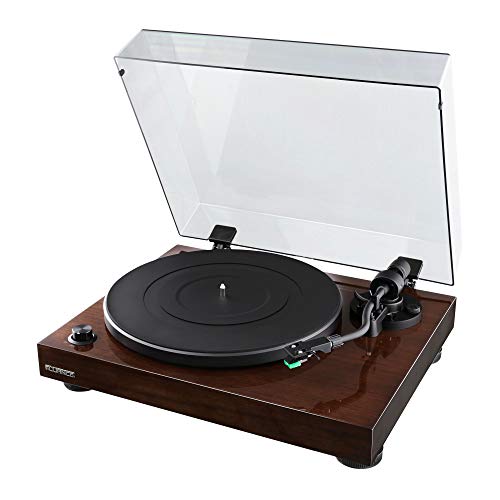
Fluance RT81 Elite High Fidelity Vinyl Turntable
The RT81 gives you an elliptical Audio-Technica cartridge, a heavy MDF plinth, and a built-in preamp, so it plays into ordinary powered speakers. You give up automatic operation, which means you place the arm at the start and come back for it at the end.
$299.99fromAmazonPrices as of Oct 24, 6:27 AM PT · Details
The RT81 asks for about ten extra minutes on the first day. You balance the counterweight, set anti-skate, and get the arm sitting right. It's a fifteen-minute job with the manual open, and after that it's just a turntable. If that sentence made you nervous, buy the AT-LP60X. If it sounded kind of fun, this is your deck.
The cartridge is the reason to move up to this one. It ships with Audio-Technica's AT95E and its diamond elliptical stylus, which What Hi-Fi? notes is a step above the conical styli that come on most entry decks. An elliptical tip sits deeper in the groove and reads more of the wiggle in the walls, so you hear more detail and cymbals stop turning to fizz. It also spreads tracking force more evenly, which is easier on your records.
The rest of the build follows through. The walnut cabinet is high-mass MDF with isolation feet, an aluminum platter, and a rubber mat, and the whole thing weighs about fourteen pounds. That mass is doing real work: it soaks up the footfalls and speaker bass that make lighter decks skip. Inside there's a built-in Texas Instruments preamp with a ground terminal and gold-plated RCA outputs, so you still get the one-cable setup.
Because the tonearm takes a standard cartridge, this is a deck you can keep. Swapping in a better moving-magnet cartridge is the highest-value upgrade most people make after a year of listening, and it usually does more for the sound than replacing the whole turntable. The RT81 is built to accept that upgrade instead of dead-ending.
Flaws but not dealbreakers
It's manual, and that's the trade. You lower the arm onto the lead-in yourself, and when the side runs out you have to get up and lift it off. Fall asleep mid-record and the stylus sits in the run-out groove until you wake up.
There's no Bluetooth and no USB, so wireless speakers and ripping to your laptop are out. It's also big and heavy at roughly sixteen and a half inches wide, and the walnut finish is a look. On a modern white shelf it can read as your parents' console stereo, shrunk.
Also great
Direct drive, USB ripping, and controls you can actually adjust
Audio-Technica AT-LP120XUSB-BK Direct-Drive Turntable
This is the DJ-style deck: direct drive, three speeds including 78, pitch control with quartz lock, and a removable headshell. It also has a USB output for turning records into files, which no other pick here manages as cleanly.
$399fromAmazonPrices as of Oct 24, 6:27 AM PT · Details
Everything about the LP120XUSB is built to be handled. The platter sits directly on a DC servo motor, so it reaches speed in a fraction of a turn and fights back when you touch it. The S-shaped tonearm has adjustable anti-skate, a real counterweight, a hydraulically damped lift, and a lockable rest. At roughly twenty pounds, it stays where you put it.
If you have any interest in scratching or beatmatching, this is the only pick that qualifies. Belt drive is fine for listening, but belts slip and stretch when you nudge a record. RTINGS lists this one's direct-drive motor at 0.2% wow-and-flutter, in line with the entry-level DJ tables it's clearly modeled on. Add the variable pitch slider and quartz speed lock and you have the actual toolkit, not a costume of one.
The USB output is the other reason people buy it. Plug it into a Mac or PC, open the free Audacity software, and you can record a side straight to a file. That's how you rescue a live album nobody streams, or a 78 you inherited, since this deck plays 78 RPM as well as 33 and 45. The recording is a real-time job, not a button press.
It's also the easiest deck here to grow into. The headshell detaches, so upgrading the cartridge later takes a thumbscrew instead of a soldering iron, and you can keep a second headshell set up for a different stylus. Between that, the pitch lock, and the adjustable arm, this is a deck people keep for years while everything around it in the system changes.
Flaws but not dealbreakers
It's fully manual with no auto return, and unlike a lighter beginner deck it invites you to fiddle. You'll set tracking force and anti-skate yourself. That's a feature if you want the hobby and a chore if you just want music.
It's the biggest and heaviest pick here, close to eighteen inches wide and twenty pounds, and the silver-and-black DJ styling is not subtle furniture. The stock cartridge is competent but it's the first thing most owners replace. And if you never plan to mix, you're paying for a pitch slider you'll never move.
Upgrade pick
Audiophile parts and a quieter background, if you'll fuss a bit
Pro-Ject Debut Carbon EVO Wired Turntable with
The Debut Carbon EVO is the step where a turntable stops being an appliance. It comes with a Sumiko Rainier moving-magnet cartridge on a carbon fiber arm, and it's strictly wired, with no preamp listed in the box.
$649fromAmazonPrices as of Oct 24, 6:27 AM PT · Details
Buy this only if you already know vinyl is going to stick. It's aimed at the person who has filled a shelf, started reading about cartridges, and noticed their first deck sounds a bit flat. The carbon fiber tonearm is light and stiff, with an effective mass of 6 grams, which keeps the arm from adding its own resonance to what the stylus reads. Pro-Ject rates the signal-to-noise ratio at 68 dB.
What the extra money buys is mostly quiet and control. Better bearings and a denser build mean less of the low-level rumble that smears bass on cheaper decks, and the Sumiko Rainier is a genuine moving-magnet cartridge, the kind you'd otherwise buy separately and mount yourself. Records you know well will hand you small things you'd stopped noticing: room tone, a singer's breath, the decay at the end of a chord.
Plan the rest of the chain before you buy. The listing doesn't include a phono preamp, so you'll need a receiver with a phono input or an outboard stage, and there's no Bluetooth or USB anywhere on it. This is a wired, two-channel deck for a wired, two-channel system. TechRadar's advice to set aside money for a preamp and a cartridge upgrade applies double here.
It rewards care in a way the cheaper decks don't. Level the surface, set the tracking force with a gauge, and keep it away from your speakers, and the payoff is audible. Skip that and you've bought an expensive turntable that sounds like a mid-priced one. If you'd rather not think about any of it, the AT-LP60X is the better buy.
Flaws but not dealbreakers
The total setup costs more than the deck, because it isn't a complete system on its own. Between a preamp and speakers, this is the pick that assumes you already own, or are ready to buy, the rest of a stereo.
It's manual, so you cue and lift the arm every side. And the parts it's proud of, the carbon arm and the Sumiko cartridge, only pay off through revealing speakers. On a pair of small desktop monitors, most of what you paid for stays hidden.
Who this is for
This guide is for you if you're buying your first turntable, or buying one as a gift, and you want to be playing records the same evening. That means you already have powered speakers, a soundbar with an input, or a receiver, or you're ready to buy a pair. If you inherited a crate of records and want to hear them without spending a weekend reading forums, start with the top pick and stop there.
It's not for you if you already own a deck with an adjustable counterweight. In that case a better cartridge will do more for your sound than a new turntable, and it costs a fraction of one. We're covering full-size decks that sit on furniture and connect to speakers, so suitcase all-in-ones, paired DJ setups, and high-end audiophile rigs are outside the scope, and so are the speakers themselves.
How we picked
We built the shortlist around the things that decide whether a first turntable gets used or gets shelved. Setup: we favored decks with a built-in phono preamp, or that clearly state you need an external one, because Crutchfield calls that confusion the most common first-time mistake. Cartridge: an elliptical stylus mounted at the factory beats the conical tips on most entry decks, per What Hi-Fi? and the manufacturers' own specs. Speed: we relied on published RTINGS wow-and-flutter figures, which put our picks in the 0.1% to 0.2% range where drift stays inaudible. Upgrades: standard cartridge mounts and removable headshells matter, since owners replace the cartridge before anything else. Wireless: SoundGuys found Bluetooth decks roll off the top end above 15 kHz, so we treated it as a convenience trade. Handling: automatic operation protects the stylus for anyone likely to walk away mid-side.
Other turntables for beginners worth considering
If you want wireless speakers and no cables across the room: The Sony PS-LX310BT Belt Drive Turntable: Fully Automatic — The Sony PS-LX310BT is the wireless pick that doesn't strand you. It's fully automatic with one-step start, stop, and return, it has a switchable built-in preamp with three gain settings, and it sends audio to Bluetooth speakers or headphones. RCA cables come in the box, so you can still run it wired when you care, and there's a USB output for ripping records to MP3. The catch is what wireless always costs: SoundGuys found Bluetooth decks like this one roll off above 15 kHz next to a wired connection, and CNET's latency figures are low enough for a soundbar but not for live monitoring. At about eight pounds it's also on the light side.
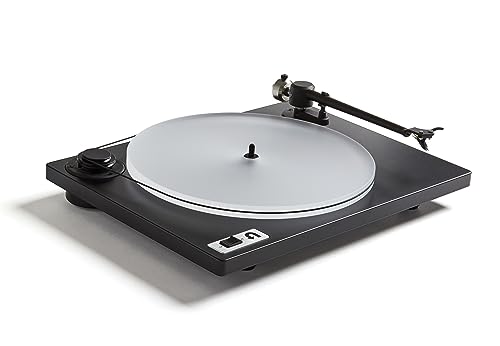
If you want to tinker and upgrade piece by piece: The U-Turn Audio - Orbit Plus — The U-Turn Orbit Plus is the enthusiast's starter deck. You get a grooved acrylic platter, which resists resonance better than the MDF platters on entry decks and holds speed more consistently, plus an Ortofon OM5E elliptical cartridge and an OA3 gimbal tonearm with a one-piece magnesium armtube, internal anti-skate, and an adjustable counterweight. It's a lot of real hardware in a minimalist package. What it gives up is convenience. There's no built-in preamp, so you need an external one or an amp with a phono input, speed changes mean moving the belt by hand, and there's no Bluetooth, USB, or automatic operation. Owner feedback is also thinner than for the bigger brands here.
The competition
This is what our research surfaced, not a survey of everything for sale. The wireless corner of this category turns over quickly, and plenty of decks sell well without much published measurement behind them. Here's what else we looked at and why it didn't make the list.
The Victrola Hi-Res Onyx - Wireless Bluetooth Turntable — The Victrola Hi-Res Onyx reads like a much better deck on paper: an Audio-Technica AT-VM95E cartridge, a removable headshell, an adjustable counterweight, a switchable preamp with standard RCA outs, and aptX Adaptive Bluetooth, which is the better-sounding wireless codec when your speakers or headphones support it. An auto-stop sensor parks it at the end of a side. The problem is owner feedback, which runs noticeably more mixed than for anything we recommend, clustering around setup and consistency rather than one specific defect. If you want a swappable cartridge and good wireless in a single box, it's the only deck here offering both.
The House of Marley Stir It Up Lux — The House of Marley Stir It Up Lux is the sustainability pick, built from a solid bamboo plinth, REGRIND silicone and cork, glass, and recyclable aluminum. It's a genuinely handsome object, and the spec list holds up: Bluetooth 5.3, a switchable built-in preamp, RCA and 3.5 mm outputs, and a replaceable AT-95E elliptical stylus from the same family that makes the Fluance sound good. It lost the wireless slot to the Sony because automatic start and return, documented gain settings, and a much deeper pool of owner feedback make that one a safer first deck. If the materials are what you're buying, this is the one to get.
Setup and care
Put the turntable on something solid and level, ideally a wall shelf or a heavy cabinet, and never the same surface as your speakers. Bass travels through the plinth and comes back out as a low howl. Check level with a phone app, since a tilted deck pushes the arm against one wall of the groove. Keep the dust cover down between sides and brush records with a carbon-fiber brush before you play them, because most of the crackle people blame on old vinyl is dust. Styli wear out gradually enough that your ears won't flag it until the damage is done, so check the manufacturer's rated hours and replace on schedule. A worn stylus grinds the groove walls, and that damage doesn't come back.
Questions we get
Do I need a phono preamp for a turntable?
You need one somewhere in the chain, but it may already be built into your deck. A turntable's output is far quieter than a phone's, so it has to be boosted and equalized before regular speakers can use it. Crutchfield says roughly one in three first-time buyers don't check this, and it's the most common setup mistake. Our top pick, the Fluance, the Sony, and the Marley all have one on board; the U-Turn and the Pro-Ject need an external stage or a receiver with a phono input.
Is belt-drive or direct-drive better for beginners?
For listening, belt drive has the edge, because the belt isolates the platter from motor vibration. For scratching or beatmatching, direct drive wins, since it comes up to speed instantly and holds pitch when you touch the record. If you just want to play albums, take the belt-drive AT-LP60X or RT81. If mixing is even a maybe, get the direct-drive AT-LP120XUSB.
What's the difference between automatic and manual turntables?
An automatic deck moves the tonearm for you: press start and it drops the needle on the lead-in, then lifts and returns at the end of the side. A manual deck leaves both jobs to you. Automatic operation is the single best protection against a stylus grinding in the run-out groove all night, which is why we recommend it for a first turntable. Manual decks tend to sound better at the same level because that money went into the arm and cartridge instead.
Can a beginner turntable damage my records?
It can, mostly through neglect rather than design. A worn stylus, a badly set tracking force, or an arm left riding a locked groove will all abrade vinyl over time. Any of the decks here play records safely if you set the counterweight correctly and replace the stylus when the manufacturer says to. Automatic models reduce the risk further, since they lift the arm without you remembering to.
Do USB turntables sound worse than non-USB models?
No, the USB circuit sits on a separate path and doesn't touch the analog output. On the AT-LP120XUSB and the Sony, you can ignore the USB port entirely and listen through the RCA outputs with no penalty. The files you rip won't match a good outboard analog-to-digital converter, but they're perfectly good for a phone or a car. Ripping happens in real time, so a full album takes an album's length.
What accessories do I need with a new turntable?
At minimum, something to make sound: powered speakers, a soundbar with a line input, or a receiver plus passive speakers. Add a carbon-fiber record brush and a dust cover if the deck doesn't include one. TechRadar suggests setting aside money for a phono preamp and a cartridge upgrade in the first year, and the cartridge upgrade is usually the one that changes the sound most. A stylus force gauge is worth having for any manual deck.
Why you should trust us
For this guide:
- We read published measurements and reviews from RTINGS, Wirecutter, What Hi-Fi?, SoundGuys, CNET, Stereophile, Digital Trends, TechRadar, and Crutchfield, then checked them against each manufacturer's own spec sheet.
- We compared listing details for all eight decks side by side, focusing on drive type, cartridge, preamp, and upgrade paths.
- We read owner feedback themes for each model, looking for complaints that repeat across many buyers rather than isolated defects.
- We read owner reviews on every listing, weighted toward the critical ones, because that is where the recurring failures show up.
- We have a systematic way of automatically fetching the latest prices, so the numbers on this page stay current.
- This is a research-focused guide, so the team may not own every product listed — though we often do own the top winners, which gives us extra context for the recommendations.
- We don't accept free products, and the retailer commission never changes which product we recommend.
Sources
Best Turntables 2026 - Wirecutter, Wirecutter
Audio-Technica AT-LP60X Review, RTINGS.com
Audio-Technica AT-LP120XUSB Review, RTINGS.com
Fluance RT81 Elite High Fidelity Vinyl Turntable Review, What Hi-Fi?
Best Turntables for Beginners, SoundGuys
How to Buy Your First Turntable, TechRadar
U-Turn Orbit Basic Review, Digital Trends
Pro-Ject Debut Carbon EVO Review, Stereophile
Sony PS-LX310BT Review, CNET
Victrola Stream Onyx Works with Sonos Review, The Verge
Vinyl Record Sales Statistics and Trends, RIAA
Do You Need a Phono Preamp? A Beginner's Guide, Crutchfield
Amazon product listings and owner reviews for all 8 products
Manufacturer specification pages for each product
Some passages in this guide may be paraphrased with AI help.
Product prices and availability are accurate as of the date/time indicated and are subject to change. Any price and availability information displayed on Amazon.com at the time of purchase will apply to the purchase of this product.
More like this.
Continue exploring electronics reviews and recommendations.

The Best Turntables for Budget Vinyl Listening
Vinyl asks something of you that streaming doesn't. You get up, flip the record, set the needle down. That ritual is most of the appeal, and a good budget…

The Best Lacrosse Sticks for Beginners
A first lacrosse stick has one job: make the ball stay in the pocket long enough for a kid to learn what cradling feels like. Everything else is…

The Best Home Gym Equipment for Beginners
The gear that actually gets used is the gear that's already out. That's the whole game when you're starting out. A dumbbell pair sitting by the couch gets…

The Best Yoga Blocks and Props for Beginners
A yoga block is just a brick you can't fall through, and that's the whole point. When your hamstrings won't let your hand reach the floor in Triangle, a…

The Best Fish Tank Starter Kits for Beginners
A fish tank is the rare pet that asks for a little work every week instead of a lot every day. But the equipment you start with decides how pleasant that…

The Best Fishing Gear for Beginners
Fishing asks less of you than almost any other outdoor hobby. You need something to cast with, something to tie on the end, and a place to stand. But the…