The Best Trampolines
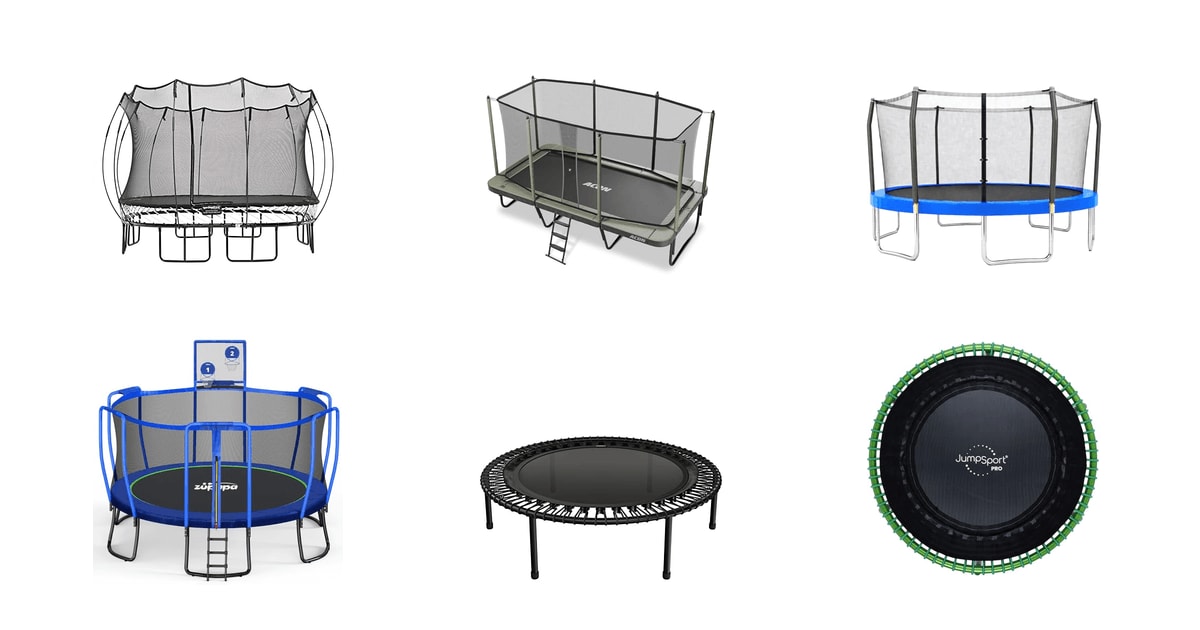
A trampoline is one of the few things you can put in a backyard that kids will actually use every day for years. It's also a piece of equipment that sends a lot of people to the emergency room. The Consumer Product Safety Commission estimates around 100,000 trampoline injuries get treated in ERs each year, and nearly three-quarters of those come from falls off the mat or contact with exposed springs and frame hardware. So the thing you're really shopping for isn't bounce. It's the stuff between a jumper and the ground.
Here's the honest part: no trampoline is safe the way a couch is safe. The American Academy of Pediatrics recommends that kids under 6 stay off them entirely and that only one person jump at a time — and that second rule gets broken constantly, by basically every family. A great enclosure and a springless mat lower your odds. They don't erase them. Trampolines also eat yard space, need seasonal attention, and take a full afternoon and two people to assemble.
We looked at backyard trampolines for families, performance rectangles for athletes, and indoor rebounders for adults who want low-impact cardio. Different jobs, different machines. We think that the Springfree 11 x 11 ft Large Square Trampoline is the best trampoline for most people, and that the ACON 16 HD Rectangular Trampoline is the one to buy if you have real athletes in the house and the yard to hold it.
Everything we recommend

No springs, no frame at jump height, no arguing about it

A real athlete's bounce, if you have the yard and the budget
The sane family choice when springless isn't in the budget

Quiet, stable indoor cardio that's gentle on bad knees
At a glance
| Product | Jump Size | Weight Capacity | Price | |
|---|---|---|---|---|
| Springfree 11 x 11 ft Large SquareTop pick | 11 x 11 ft | — | $1,999.99 |
| ACON 16 HD Rectangular Trampoline 17x9.8 ftUpgrade pick | 17 x 9.8 ft | 330 lb | $2,599 |
 | Skywalker Trampolines 15 Ft Round Trampoline withAlso consider | 15 ft round | — | $310.99 |
| Zupapa 1800LBS Capacity No-Gap Design 16 15Runner-up | 15 ft round | 1800 lbs | $639.99 |
 | bellicon Mini Trampoline 44''Also consider | 44 in | 330 lbs | $879 |
| JumpSport 39" PRO Fitness Trampoline for AdultsAlso great | 39 in | — | $409.99On sale |
 | Merax 14FT Trampoline for Kids and AdultsAlso in lineup | 14 ft round | 1200 lbs | $239.99On sale |
How we picked
Safety architecture. We prioritized designs that remove or fully cover the two things CPSC injury data implicates most — exposed springs and rigid frame at jump height. Any trampoline without a gap-free enclosure attachment was out.
Certification floor. We treated ASTM F381 or equivalent TUV certification as a hard minimum, since uncertified trampolines have no guaranteed standard for mat strength, enclosure attachment or frame padding in the U.S.
Frame and weather. We read spec sheets for tube gauge, galvanizing method and UV treatment on mats and nets, because published durability reviews show budget models degrading within a season or two of year-round outdoor use.
Capacity and users. We compared rated static loads and single-jumper limits, favoring trampolines that adults can genuinely use rather than ones rated for children only.
Warranty by component. We treated warranty terms segmented by frame, mat and springs as a proxy for build confidence, since long frame coverage tracks closely with the brands that owners still like after five years.
Top pick
No springs, no frame at jump height, no arguing about it
Springfree 11 x 11 ft Large Square
Springfree's rods sit under the mat instead of steel coils around the edge, and the frame lives below the jumping surface. You give up some of the snappy bounce a spring trampoline has, and you pay a lot, but the two things that hurt people most just aren't there.
$1,999.99fromAmazonThis is the only design here that removes the injury sources instead of padding them. Springfree replaces coil springs with flexible composite rods mounted beneath the mat, and drops the steel frame below jump height. Springfree's own engineering materials claim the design cuts injury risk by up to 90% versus a traditional spring trampoline. That's a manufacturer number, so take it with the appropriate salt. But the underlying logic checks out against what the CPSC says actually injures people.
The 11-by-11 square gives you 113 square feet to work with, which is a real jumping area rather than a marketing number. Square works well for backyards because the corners don't waste as much lawn as a round of similar mat size. Kids can tumble. Adults can do cardio. Owners consistently mention that the safety design is what convinced them, and that the whole family ends up on it, not just the children.
The FlexiNet is attached to flexible poles rather than rigid steel ones, so a kid who runs into the net gets bounced back instead of hitting a pipe. SafeKids Worldwide identifies the enclosure as the single highest-impact safety feature you can prioritize, specifically when it's installed without gaps at the entry. This one closes the gap between mat and net by design, not by asking you to thread a rope correctly.
Springfree also backs the thing longer than anyone else in this guide, which matters more than it sounds. Warranty length is the best cheap proxy for build quality — a company that expects to eat replacement costs builds differently. And if you're the kind of person who reads a trampoline guide before buying, you're probably planning to keep this for a decade.
Flaws but not dealbreakers
Assembly is genuinely hard. Owners repeatedly warn that you need to follow the manual exactly, that the frame feels alarmingly loose until the last step, and that it's a multi-hour, two-person job with a lot of hand strength involved. Several people wished they'd paid for professional installation. Budget an afternoon and a helper who won't quit halfway.
The bounce is softer and less springy than a good coil trampoline. Some jumpers love that; gymnasts don't. If your kid is training tumbling passes, this is the wrong shape and the wrong feel.
It's the most expensive backyard option here by a wide margin, and not every unit holds up. A minority of owners report warping, mat tearing, and net failure inside the first year — a small share of the feedback, but it exists, and it stings more at this price.
Springfree backs this trampoline with the longest warranty in the category, segmented by component.
Upgrade pick
A real athlete's bounce, if you have the yard and the budget
ACON 16 HD Rectangular Trampoline 17x9.8 ft
The ACON 16 HD is a 17-by-9.8-foot rectangle with 140 heavy-duty springs and a galvanized frame static-tested to 1,650 pounds. It bounces evenly across the whole mat instead of dumping you toward the center, which is exactly what tumbling and trick training need.
$2,599fromAmazonRectangles bounce differently, and that's the whole point. On a round trampoline the perimeter spring tension pushes an off-center jumper back toward the middle — a safety feature for general family use, and a nuisance if you're trying to land a pass where you took off. The ACON gives you a consistent bounce across the full 14.2-by-7.2-foot jump zone. If someone in your house does gymnastics, cheer, or freestyle skiing dryland, this is the shape you want.
The build quality is the reason people who buy this one don't shop again. Galvanized and powder-coated 2.4-inch steel tubes with 0.1-inch walls, hand-welded joints, and a 330-pound single-jumper rating. Owners describe it as built like a tank and note the hardware and tools are all included and actually good. Several report assembling it solo in two to three hours, which — compared with our top pick — is a pleasant surprise.
The safety layer is thoughtfully done for a spring trampoline. A 2-inch foam buffer plus a spring-covering skirt gives two layers between a jumper and the coils. The net uses a No Finger Access weave and a zipperless two-level entry, which closes off the gap point that SafeKids flags as the common failure. It's CE and ASTM certified, so it clears the F381 floor that budget models often skip.
It's not just a kid thing. Adults over 50 show up in the owner feedback using this for fitness, and the weight rating supports it. The UV-protected mat, net and padding are built for year-round outdoor exposure, so you're not hauling it into a garage every autumn.
Flaws but not dealbreakers
It's enormous. Seventeen feet by nearly ten, plus clearance on all sides and overhead — this needs a real yard, not a patio. Measure before you fall in love.
Rectangular trampolines are less forgiving than round ones for mixed-age free play. The even bounce that athletes want means an off-center jumper keeps going off-center. For a yard full of unsupervised six-year-olds, a round trampoline is the more sensible shape.
This is the priciest option in the guide and it's still a spring trampoline. You get excellent padding over those springs, not the absence of them.
Runner-up
The sane family choice when springless isn't in the budget
Zupapa 1800LBS Capacity No-Gap Design 16 15
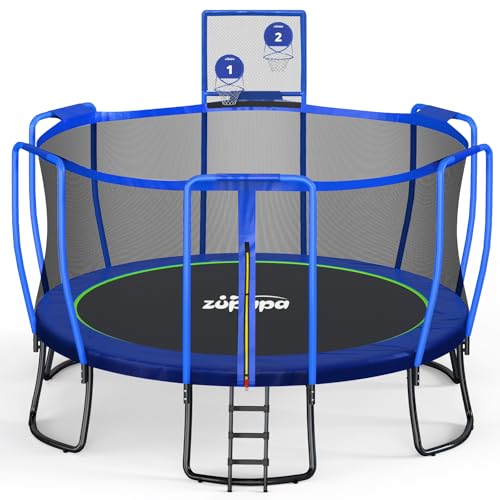
Zupapa's 15-foot round exceeds ASTM and TUV standards, uses a patented no-gap design where the mat meets the pad, and rides on a hot-dip galvanized frame rated to 1,800 pounds. It's the most complete backyard package here for the money.
$639.99fromAmazonFor most families, this is the practical middle of the market. You get the round shape that redirects off-center jumpers toward the padded middle, a 1,800-pound frame rating, curved net poles that keep hard steel away from the netting, and both ASTM and TUV certification. That last part isn't a nice-to-have — ASTM F381 is the only thing guaranteeing a minimum standard for mat strength, enclosure attachment and frame padding in the U.S.
The no-gap patent addresses the specific spot where cheap trampolines pinch fingers and toes: the seam between jumping mat and spring pad. Zupapa closes it. The frame uses hot-dip galvanizing rather than ordinary galvanizing, which is a meaningful difference if your trampoline lives outside through wet winters. Outward-sloping legs with full-area footpads make it noticeably harder to tip.
Owner feedback on this one skews unusually positive on the company itself, not just the product. People describe storm damage handled without a fight and replacement parts sent quickly. That's worth something on a product where a single broken net pole can sideline the whole thing for a month. One owner who works in a trauma center specifically bought it after researching trampoline safety, which is a decent endorsement.
It ships complete. Enclosure net, spring pad, ladder, and dual-height basketball hoops with soft metal-free rims are all in the box. You aren't hunting down accessories a week later. Assembly is step-by-step and manageable, though a few owners wanted clearer instructions in a couple of spots.
Flaws but not dealbreakers
It's still a coil-spring trampoline, and springs are half of what the CPSC injury data points at. The pad and no-gap design mitigate that; they don't remove it.
Fifteen feet of round takes a serious bite out of a small yard, and the enclosure adds nearly nine feet of height. If your lot is tight or you have low branches, size down within the range Zupapa offers.
A handful of owners report needing extra hands and extra patience during assembly, and the instructions could be better. Plan for two people and a free afternoon.
Zupapa includes a 10-year quality assurance commitment on this trampoline.
Also greatOn sale
Quiet, stable indoor cardio that's gentle on bad knees
JumpSport 39" PRO Fitness Trampoline for Adults
The JumpSport 350 PRO is a 39-inch rebounder on elastic cords rather than steel springs, with arched legs and a lifetime frame warranty. It's quiet enough for an apartment and steady enough for people rehabbing a joint replacement.
$409.99fromAmazonList priceRebounding is one of the rare fitness trends with real research behind it. A NASA-commissioned study by Bhattacharya and colleagues found that bouncing on a mini-trampoline delivered cardiovascular conditioning comparable to jogging while producing roughly 68% less biomechanical stress on knees, ankles and back. For a 155-pound adult, a 30-minute session runs somewhere around 150 to 200 calories. If running hurts and you're bored of the treadmill, this is a legitimate substitute rather than a gimmick.
The EnduroLast cords are what make it apartment-viable. No metal springs means no squeak and no metallic clang on every landing, which matters a lot when someone lives below you. Owners describe it as silent and dead stable with no wobble — a common complaint about cheaper rebounders. The patented arched legs are the reason; they widen the footprint without widening the mat.
It's forgiving for people who need forgiveness. Owner feedback includes people in their sixties, people recovering from hip and knee replacements, and people managing lymphedema after node removal, all describing short gentle sessions rather than workouts. The lay-flat mat secures the skirt edge and extends the usable bouncing area, so you have room to move your feet rather than being stuck bouncing in place.
At 39 inches it fits in a corner, and the frame carries a lifetime warranty — the longest term on any product in this guide. Purchase includes a 60-day trial of JumpSport's streaming workout library, which is a reasonable on-ramp if you have no idea what to do on a rebounder besides bounce.
Flaws but not dealbreakers
This is cardio equipment, not a backyard toy. Kids will want to use it and it isn't built for horseplay or for two people.
The 39-inch mat is compact. Taller users and anyone wanting to do wide lateral moves may want a larger diameter, and a handful of owners debated exactly that before ordering.
There's no handlebar in the box. If balance is the reason you're buying a rebounder in the first place, you'll need to add one separately.
JumpSport backs the steel frame and legs with a lifetime warranty.
Who this is for
Buy a backyard trampoline if you have kids over 6, at least fifteen feet of clear flat lawn with overhead clearance, and you're willing to enforce one-jumper-at-a-time. That last rule is the one families ignore, and it shows up in the majority of injury reports. If your children are under 6, the American Academy of Pediatrics says skip it entirely — and we'd rather tell you that than sell you a net.
If what you actually want is low-impact cardio for yourself, you want a rebounder, not a backyard trampoline, and you'll be happier with one. This guide covers full-size backyard round and rectangular trampolines plus indoor adult fitness rebounders. It doesn't cover toddler trampolines, competition-grade gymnastics beds, or water trampolines, and it doesn't cover trampoline parks, which have their own injury profile entirely.
How we picked
Safety architecture: we favored springless rod systems and, failing that, spring trampolines with two-layer padding and a gap-free net attachment, because falls and spring contact drive nearly three-quarters of trampoline ER visits. Certification: ASTM F381 or TUV was a hard floor, since anything below it has no guaranteed minimum for mat strength or enclosure attachment. Frame and weather: we compared tube gauge, hot-dip versus standard galvanizing, and UV treatment on mats and nets. Capacity: we looked at both static load and single-jumper ratings so adults aren't shut out. Warranty: long, component-segmented coverage is the most honest signal a manufacturer sends about how long it expects the thing to last.
Other trampolines worth considering
If you want the gentlest possible bounce for joints or rehab: The bellicon Mini Trampoline 44'' ($879) — The bellicon 44-inch rebounder uses bungee suspension instead of any spring, and the company documents an oscillation period roughly 30% longer than coil equivalents — meaning a slower, deeper landing that spreads impact over more time. Physical therapists prescribe these for post-surgical recovery, which tells you something. It's larger than the JumpSport at 44 inches, the legs fold for storage, and it handles up to 330 pounds. You pay a steep premium for that suspension, and this particular listing has almost no owner feedback behind it yet, so you're buying on the brand's clinical reputation rather than on a body of buyer experience.
If you want a big round mat from a name families already know: The Skywalker Trampolines 15 Ft Round Trampoline with ($310.99) — The Skywalker 15-foot round has been a backyard default for years, and its patented Stay-Put enclosure connects the net directly to the mat at each V-ring through a buttonhole — no rope to thread and no gap to get wrong. The arched, foam-padded enclosure frame holds netting away from the poles. It undercuts our runner-up on price and matches it on footprint. But owner feedback is more mixed: some report years of daily use by five kids, while others describe a loud trampoline that came apart inside a year. The Zupapa's heavier frame and longer coverage are worth the step up if you can manage it.
The competition
This is what our research surfaced, not a census of every trampoline sold. Plenty of good ones — including several Springfree and ACON sizes — aren't here simply because we scoped to what we could verify.
The Merax 14FT Trampoline for Kids and Adults ($239.99) — The Merax 14-foot round is a competent entry-level backyard trampoline: galvanized steel frame rated to 1,200 pounds, 72 heavy-gauge springs, a UV-proof net on foam-padded curved poles, and a two-step ladder in the box. The 14-foot size fits yards that can't take a 15. It lost to the Zupapa on frame rating, certification detail and warranty, and there's very little owner history to judge long-term durability by — published testing repeatedly finds budget outdoor trampolines showing mat deformation within a year or two. Buy it if the price gap is what stands between you and a trampoline at all, and know you may be replacing the mat sooner.
Care and maintenance
Anchor it. A staked or auger anchor kit is the difference between a windstorm being an inconvenience and your trampoline landing in a neighbor's fence. Sweep leaves and standing water off the mat, since wet debris rots stitching and grows algae you'll be scrubbing later. Check spring hooks, net attachment points and frame bolts a couple of times a season — a single detached hook is how the pad shifts and exposes hardware. In snow country, most owners either remove the net and pad for winter or take the whole thing down; galvanized frames handle cold fine, but repeated snow load stretches a mat. Expect a mat and net to be consumables on a multi-year cycle even when the frame outlasts them by a decade. Replace them rather than nursing a frayed one.
Questions we get
What's the safest trampoline for a backyard?
A springless one with a gap-free enclosure, which is why the Springfree is our top pick. Its rods sit under the mat and the steel frame is below jump height, so the two things CPSC data most often implicates aren't within reach. No trampoline is risk-free, though. Enforcing one jumper at a time does more for safety than any feature you can buy.
Are trampolines actually good exercise for adults?
Yes, and there's real evidence behind it. A NASA-commissioned study found rebounding delivered cardiovascular conditioning comparable to jogging with roughly 68% less biomechanical stress on knees, ankles and back. A half-hour session burns roughly 150 to 200 calories for a 155-pound adult. That combination is why rebounders get recommended to people who can't run anymore.
Is a springless trampoline worth the extra cost?
If you have young kids or joint concerns, we think so. Springless designs remove exposed coils and lift the rigid frame out of the jumping plane, which addresses the two most common injury sources rather than padding over them. If your household is teens and adults who mostly bounce carefully, a well-padded spring trampoline with a good enclosure covers most of the gap for far less.
Are rectangular trampolines better than round ones?
Better for different things. Round trampolines have higher perimeter spring tension that redirects off-center jumpers back toward the padded middle — a safety advantage for general family use. Rectangles give an even, dead-zone-free bounce across the whole mat, which is what gymnasts and tumblers need. For a yard full of kids, buy round. For an athlete, buy the ACON.
Can adults and kids jump at the same time?
They shouldn't, regardless of weight rating. The American Academy of Pediatrics recommends one jumper at a time, and multi-jumper use shows up in the majority of reported injuries — a heavier person's bounce can launch a lighter one unpredictably. High static ratings like the ACON's 1,650 pounds describe frame strength, not permission. Take turns.
Can I leave a trampoline outside all winter?
Galvanized frames handle cold and wet fine, so the frame can stay. The mat, pad and net are the vulnerable parts, and most owners remove the net and pad before heavy snow. Repeated snow load stretches a mat over time. If you get real winters and have storage space, taking it down adds years to the soft components.
Why you should trust us
For this guide:
- We compared manufacturer spec sheets across all seven trampolines for frame gauge, galvanizing method, weight ratings, enclosure attachment design and warranty terms by component.
- We reviewed published safety guidance from the CPSC, the American Academy of Pediatrics, SafeKids Worldwide and ASTM F381, plus the NASA-commissioned rebounding research, to set our criteria before looking at any product.
- We read owner feedback across each listing for recurring themes around assembly difficulty, first-year durability and how manufacturers handled replacement parts.
- We read owner reviews on every listing, weighted toward the critical ones, because that is where the recurring failures show up.
- We have a systematic way of automatically fetching the latest prices, so the numbers on this page stay current.
- This is a research-focused guide, so the team may not own every product listed — though we often do own the top winners, which gives us extra context for the recommendations.
- We don't accept free products, and the retailer commission never changes which product we recommend.
Sources
Best Trampolines 2026 — Good Housekeeping Institute Testing, Good Housekeeping
Best Trampolines — Wirecutter (New York Times), Wirecutter
Trampolines and Trampoline Parks — AAP Policy Statement, American Academy of Pediatrics (Pediatrics Journal)
Trampoline Safety — CPSC Consumer Guide, U.S. Consumer Product Safety Commission (CPSC)
ASTM F381 Standard Safety Specification for Trampolines, ASTM International
Trampoline Safety Tips for Families, SafeKids Worldwide
Rebounding Exercise: Health Benefits and How-To, Healthline (citing Harvard Health Publishing)
Physiological Responses to Exercise on a Minitrampoline — NASA Technical Report, NASA Technical Reports Server (Bhattacharya et al., 1980)
Best Trampolines for Kids and Adults — Forbes, Forbes
Springfree Trampoline Safety Engineering Overview, Springfree Trampoline (Manufacturer White Paper)
Global Trampoline Market Size & Forecast Report 2024–2030, Grand View Research
Amazon product listings and owner reviews for all 7 products
Manufacturer specification pages for each product
Some passages in this guide may be paraphrased with AI help. Prices are refreshed automatically.
More like this.
Continue exploring lifestyle reviews and recommendations.

The Best Mini Trampolines and Rebounders
A rebounder is one of the few pieces of home cardio gear that people actually keep using. It takes up about as much floor space as an armchair, it doesn't…

The Best Robotic and Cordless Electric Lawn Mowers
Mowing is the one chore you can't skip, and for most of us it eats a Saturday morning every week from April through October. Electric mowers change that…

The Best Lawn Mowers
A lawn mower is one of the few tools you use on a schedule, whether you feel like it or not. So the boring stuff matters most: whether it starts on the…

The Best Ergonomic Snow Shovels
Shoveling is one of the few chores where the tool you grab decides how your back feels the next morning. A driveway after a six-inch storm means dozens of…

The Best Truck Bed Tents
A truck bed tent turns the back of your pickup into a bedroom that's level, off the ground, and ready the moment you park. That matters more than it…

The 8 Best Snorkeling Gear Sets, Masks & Fins of 2026: Tested & Reviewed
Expert-tested snorkeling gear for every budget: complete sets, standalone masks, and fins from Cressi, TUSA, Atomic Aquatics, Mares, and more.