The Best Boat Navigation Lights
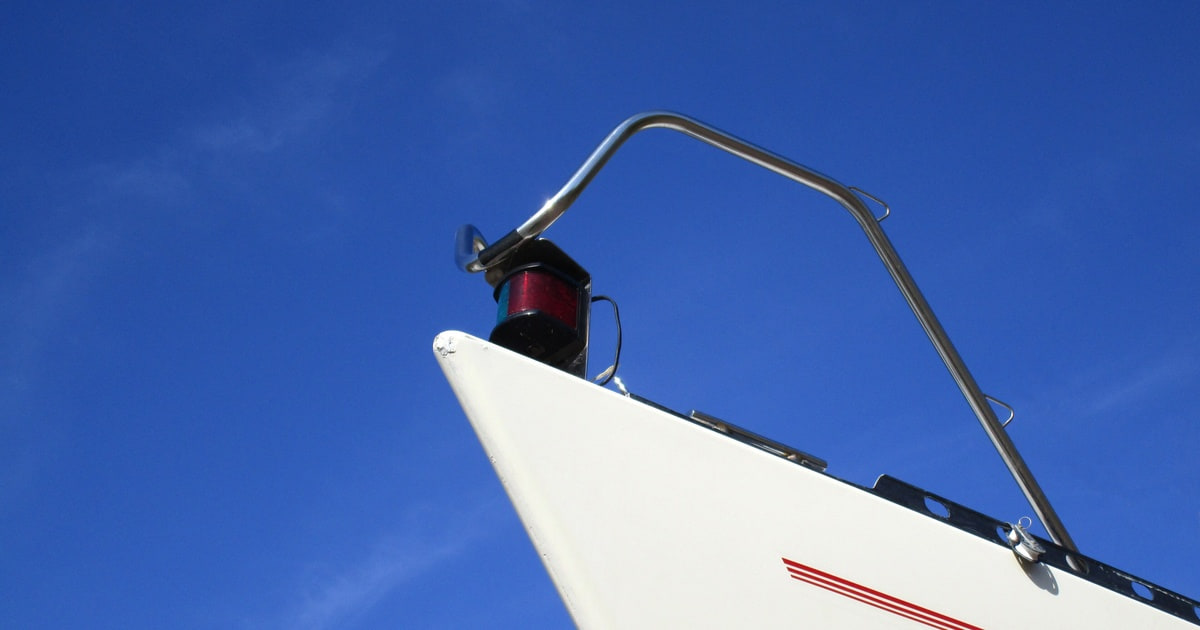
Navigation lights are the simplest safety gear on your boat and the easiest to ignore until it's dark. They tell every other skipper out there which way you're pointed and how big you are. Red on port, green on starboard, white behind you. The Coast Guard requires them from sunset to sunrise and any time visibility drops, fog and heavy rain included. The BoatUS Foundation points to missing or broken lights as a factor in nighttime collisions reported to the Coast Guard. A light that works is worth more than one that looks good on the foredeck.
Here's the honest part: no navigation light on the market solves the problem for you. The rules scale with your boat's length, so a fixture that's legal on a 20-foot center console isn't necessarily legal on a 45-foot sportfisherman. Nothing in the box checks that for you. Housings also age faster than the LEDs inside them, and a clouded lens still glows while quietly falling short of its rated distance. You'll be looking at these lights every season whether you like it or not.
So buy for your boat, not for the picture. Get your registered length, figure out whether you need 1-mile or 2-mile sidelights, and look hard at the mounting surface you actually have before you order anything. Then pick the housing that will survive where you keep the boat. We think that the attwood LightArmor Round Bi-Color LED Deck Mount Navigation Light is the best boat navigation light for most people, and that the Perko 1310DP0CHR Chrome-Plated Bi-Color Bow Light is the one to buy if you're replacing an aging light on an older boat and want the original chrome look back.
Everything we recommend
A 2-mile bow light that bolts flat to almost any deck

Old-school chrome that usually drops onto an older bow

Sealed against salt water, with almost nothing to maintain

A pull-out white pole light for the stern and for anchoring
Prices as of Oct 25, 6:48 AM PT · Details
At a glance
| Product | Visibility | Mounting | Price | |
|---|---|---|---|---|
| attwood LightArmor Round Bi-Color LED Deck MountTop pick | 2 nautical miles | Deck mount | $37.39 |
| Perko 1310DP0CHR Chrome-Plated Bi-Color Bow Light withRunner-up | — | — | $45.21 |
| ''Hella Marine" Bsh Naviled Pro Bi-Color NavigationUpgrade pick | 2 nautical miles | — | $187.89 |
 | Lopolight Series 200-024 - Navigation Light -Also in lineup | 2NM | Vertical mount | $398.61 |
| Aqua Signal 22246-7 All-Round Plug-in Stern LightAlso great | 1NM | — | $58.04 |
 | Innovative Lighting - 560-1110 Portable LED BowAlso consider | — | Suction cup | $46.37 |
 | attwood Portable Navigation LED Light KitAlso consider | — | — | $42.49 |
Prices as of Oct 25, 6:48 AM PT · Details
How we picked
Rated visibility. We matched each light's stated nautical-mile rating against the U.S. Coast Guard Navigation Center's requirements under COLREGS Rule 22. A light had to clearly state the vessel length and visibility distance it's certified for.
Corrosion resistance. We looked at housing material on every spec sheet, favoring stainless steel, chrome-plated die-cast and sealed composite over painted metal. Owner feedback on older lights consistently points to pitting and water intrusion as the reason for replacement.
Power draw. We favored LED fixtures, which West Marine puts under half an amp against 1.5 to 2 amps for an equivalent incandescent. That difference decides whether you can run lights all night on one battery.
Mounting and fit. We read owner reports for how often a light dropped onto existing holes versus needing fresh drilling and rebedding. Deck-mount, bracket-mount and plug-in pole styles each rule out certain boats.
Lens durability. Practical Sailor's long-term evaluation found UV clouding of the lens, not LED failure, to be the usual cause of lost visibility. We gave weight to UV-stabilized lenses and to warranties that name yellowing.
Top pick
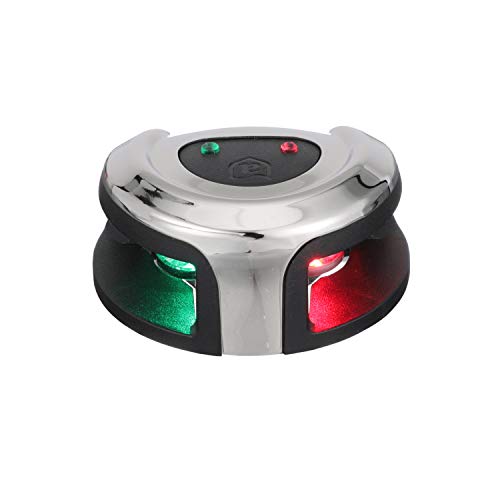
A 2-mile bow light that bolts flat to almost any deck
attwood LightArmor Round Bi-Color LED Deck Mount
This is a one-piece bi-color LED that covers the bow of any boat under 20 meters and meets the Coast Guard's 2-mile sidelight standard. The stainless housing and low deck mount keep it clear of jib sheets, dock lines and your anchor rode.
$37.39fromAmazonPrices as of Oct 25, 6:48 AM PT · Details
If you want the bow sorted once and then forgotten, this is the light. attwood rates it at 2 nautical miles and builds it for boats up to 65.6 feet, which covers nearly every trailer boat, center console and small cruiser out there. It carries USCG CFR 183.81 certification along with ABYC C-5 and A-16 compliance. You don't have to cross-check your hull length against a chart. If your boat is under 20 meters, you're covered.
The round housing holds red and green in one fixture, so you drill one hole and run one pair of wires. On a bow that's already crowded with an anchor roller and a cleat, that matters. A pair of separate sidelights means two mounts, two seals and two chances for water to find its way in. One fixture is one thing to keep sealed.
LEDs are the whole reason to replace a working incandescent light. A typical incandescent bow light pulls somewhere around 1.5 to 2 amps, while West Marine puts LED fixtures under half an amp. On a night run home with the chartplotter, the VHF and the bilge pump all sharing one battery, that's real. It also means no bulb to burn out on you halfway through the season.
Installation is where this one earns its keep. The deck-mount base sits low and flat on the foredeck, with no tall stalk to snag a line. attwood builds the housing in stainless steel, which is the right call for a fitting that spends its life getting rinsed with salt spray and then baked in the sun. Owners replacing an aging light generally report a straightforward swap.
Flaws but not dealbreakers
The deck mount is the catch. If your bow light currently sits on a vertical bracket on the pulpit or hangs upside down under a molded overhang, this round base won't drop into those holes, and you'll be filling and rebedding. Measure the surface and look at the hole pattern before you order.
The LED module also isn't a bulb you swap at the ramp. When the fixture eventually dims or fails, you replace the whole thing. That's the trade you make for a sealed light, and it's the normal deal across this category.
Runner-up
Old-school chrome that usually drops onto an older bow
Perko 1310DP0CHR Chrome-Plated Bi-Color Bow Light with
Perko's chrome bow light has been the factory choice on production runabouts for a very long time, and it often drops onto an older boat with the same footprint. It ships with 12-volt bulbs rather than LEDs, so you trade efficiency for a familiar look and an easy repair.
$45.21fromAmazonPrices as of Oct 25, 6:48 AM PT · Details
Perko has been making this bow light in more or less this shape for decades, and that's exactly why people keep buying it. If your boat came from the factory with a Perko, there's a good chance the replacement lands on the same footprint. Owners of older runabouts consistently report a clean swap with no new holes. Some report having to drill anyway, so pull the old light and check the pattern before you commit.
The chrome-plated top over a polymer base is a smarter split than it looks. The zinc alloy top takes the chrome and the sunlight. The polymer base doesn't corrode where it meets a wet deck. Perko points to the plated die-cast base as the reason these hold up in coastal and offshore use. And it simply looks right on a boat with chrome rails and stainless hardware, which counts for something on a hull you care about.
It's certified for power-driven vessels under 39.4 feet, which is the 12-meter line in the COLREGS. Under that length, the Coast Guard Navigation Center calls for sidelights visible at 1 nautical mile and a white light visible at 2. Above 12 meters you need sidelights rated to 2 miles and a masthead light rated to 3, and this light is out of its class. Check your registration before you order.
One detail worth knowing: the lens can be opened and reversed. Plenty of people mount a bow light upside down under a molded pulpit, and owners report flipping the lens to keep red on port and green on starboard. If that's how your boat is built, this is one of the few lights that handles it without a custom bracket.
Flaws but not dealbreakers
It comes with 12-volt bulbs, not LEDs. That means higher current draw, a filament that will eventually give up, and a housing you'll have to open sooner or later. If you're counting amp-hours on a long night, this isn't your light.
Owner reports also point to the seal as the weak spot over years of service. A cracked lens or a tired gasket lets water into the housing, and it isn't obvious from the outside until the light goes dim or stops working entirely. Pull it apart once a season and look at the gasket while it's easy.
Upgrade pick
Sealed against salt water, with almost nothing to maintain
''Hella Marine" Bsh Naviled Pro Bi-Color Navigation
The NaviLED PRO is a sealed, IP68-rated bi-color lamp with a UV-stabilized lens and a five-year warranty covering saltwater corrosion and lens yellowing. If your boat lives in salt water and you run after dark often, this is the one that stays legal the longest.
$187.89fromAmazonPrices as of Oct 25, 6:48 AM PT · Details
Salt water is what kills navigation lights, not the LEDs. Hella builds the NaviLED PRO as a sealed unit rated IP68, with a UV-stabilized lens and a housing meant to shrug off the vibration of a hull pounding into a chop. There's no gasket for you to re-bed and no bulb socket to corrode green. For a boat that lives in a slip on the coast, that's the entire argument.
The lens matters more than the LED, and that's where your money goes here. Practical Sailor's long-term evaluation of LED navigation lights found that lens clouding from UV exposure, not LED failure, was the usual reason a light stopped meeting its rated visibility. A yellowed lens still glows. It just doesn't carry two miles anymore. Hella's warranty names lens yellowing specifically, which tells you what the company expects to fail first.
It's rated at 2 nautical miles for both the port and starboard sides, so it satisfies the sidelight requirement for anything under 20 meters, including boats in the 12-to-20-meter band where a 1-mile light won't do. Boating Magazine makes a good point that gets skipped: the horizontal cutoff matters as much as the mile rating. A clean edge is what tells another skipper which way you're actually pointed.
Low draw here is a bonus rather than the headline. Hella lists low power consumption for extended battery life, which in practice means you can leave the nav lights burning through a whole night passage without watching the voltmeter creep down. If you anchor out, fish after dark, or run home late, that adds up across a season of use.
Flaws but not dealbreakers
It's the most expensive hardwired bi-color here, and the extra buys you sealing and warranty coverage rather than more light on the water. Two nautical miles is two nautical miles. If your boat trailers home to a garage and only sees fresh water, the attwood does the same legal job.
The listing is also thin on mounting detail, and Hella sells this line in several housing and mount configurations. Confirm the fitment against your pulpit or hull side before you buy, and be ready to fabricate a bracket or fill old holes.
Hella Marine backs the NaviLED PRO series with a five-year warranty against saltwater corrosion and lens yellowing.
Also great
A pull-out white pole light for the stern and for anchoring
Aqua Signal 22246-7 All-Round Plug-in Stern Light
This is a 24-inch plug-in white pole light for boats up to 12 meters, with an LED rated for 20,000 hours. It lifts out of its socket and stows in a locker when you're done, which is why it ends up on so many bass boats and center consoles.
$58.04fromAmazonPrices as of Oct 25, 6:48 AM PT · Details
Your bow light only covers the front of the boat. You still need white light showing aft, and if you're going to sit at anchor after dark you need an all-round white light too. This Aqua Signal pole light handles the stern job on a small boat and pulls straight out of its base when you're running in daylight or trailering home.
The removable pole is the reason to buy this style over a fixed fitting. A permanently mounted stern light on a small open boat is something you'll eventually hit with a rod, a cooler or a fender. Pulling the pole out and dropping it in a rod locker takes about three seconds. The socket stays put and stays wired, so there's nothing to re-connect the next time out.
Aqua Signal rates it for vessels up to 12 meters with 1 nautical mile of visibility, which lines up with what the Coast Guard Navigation Center asks of a stern light on a boat that size. The LED is rated at 20,000 hours, so the honest expectation is that the plug contacts and the lens will age long before the light itself does.
It's a plain black housing, and that's fine. On a bass boat or a center console, a white pole light is a tool, not trim. Owner feedback on this style of light tends to focus on the socket connection rather than the fixture, which is a good reminder to keep the contacts clean and to cap the base when the pole is out.
Flaws but not dealbreakers
Its rated visibility is 1 nautical mile. That's what the rules ask of a stern light on a boat under 12 meters, but it falls short of the 2-mile all-round rating many vessels need for an anchor or masthead light. Read Rule 22 against your own boat before you treat this as your only white light.
The pole is 24 inches, which is right on an open boat and short on one with a high transom or a raised outboard. Set too low, the light sits in the glare of your own cockpit and hides behind the engine. Measure from the socket location to the top of your powerhead before you order this length.
Who this is for
This guide is for anyone who needs to replace, upgrade or add navigation lights on a recreational boat under 20 meters. That covers most of what's on the water: runabouts, center consoles, pontoons, small cruisers, bass boats, tenders and cruising sailboats. If your current lights are dim, cracked or dead, or if you're still running incandescent bulbs and watching your battery sag on the way home, you should replace them now rather than at the start of next season.
If your boat is over 20 meters, stop here and talk to a marine electrician. The rules change: you need separate sidelights, a masthead light rated to 3 nautical miles or more, and a specific arrangement that a bi-color light legally cannot provide. We also don't cover deck lights, spreader lights, courtesy lights or underwater lights, none of which are navigation lights and none of which count toward compliance. And we haven't covered every fixture sold. Marine chandleries stock plenty of good lights that never surface in a retail search.
How we picked
We started with the law and worked outward. Rated visibility: every light had to state a nautical-mile rating and a vessel length, checked against COLREGS Rule 22 as published by the U.S. Coast Guard Navigation Center. Corrosion resistance: stainless, chrome-plated die-cast and fully sealed composite housings beat painted metal, because owner feedback on failed lights almost always describes pitting or water inside the lens. Power draw: we favored LEDs, which West Marine puts under half an amp against 1.5 to 2 amps for an incandescent. Mounting and fit: we weighed how likely each light is to land on your existing holes. Lens durability: UV-stabilized lenses matter, because Practical Sailor found clouding, not LED failure, is what dims a light over time.
Other boat navigation lights worth considering
If your boat has no wiring at all: The attwood Portable Navigation LED Light Kit — The attwood Portable Navigation LED Light Kit is the answer for a jon boat, a tender, a rowboat or a small skiff with no 12-volt system. You get a clamp-on red/green bow light and a white stern light on a telescoping pole, both on quick-release C-clamps, running off three AAA batteries for more than 150 hours. The BoatUS Foundation notes that boats under 7 meters without an electrical system can legally use a portable kit like this, displayed while underway at night. Clamp it on at dusk, pull it off at the ramp. The trade-offs are real: the mounts are only as good as the rail or gunwale you clamp to, the housings are water-resistant rather than sealed for a life outdoors, and you have to remember the batteries. But for a boat that would otherwise be running dark, that's not much of an argument.
If you want a bow light you can stick on and pull off: The Innovative Lighting - 560-1110 Portable LED Bow — The Innovative Lighting 560-1110 is a portable LED bow light that mounts with a suction cup, which makes it a common choice on aluminum boats, small pontoons and inflatables with a smooth, flat, clean surface up front. It solves the same no-wiring problem as the attwood kit, and it's a lighter, simpler thing to stow. But it's a bow light alone, so you still need white light showing aft to be legal. The suction cup is also the whole plan. On a hull that's textured, curved, gelcoat-chalked or wet with spray, that's a lot of trust to put in one mount, and a light that falls off at 20 knots isn't doing anything for you. Wipe the surface dry before you set it, and check it before you leave the dock.
The competition
This is what our research surfaced, not everything on the market. Navigation lights are a deep and fragmented category, and plenty of solid fixtures from marine chandleries and smaller suppliers never show up on a retail search page.
The Lopolight Series 200-024 - Navigation Light - — The Lopolight Series 200-024 is a vertical-mount white light rated at 2 nautical miles, made by a company whose fixtures turn up on race boats, superyachts and commercial vessels. Lopolight lists current draw around a tenth to two-tenths of an amp per light, about as low as this category gets, and the flush, low-profile shape cuts windage and gives a jib sheet nothing to catch on. Two things kept it out of the picks. It's a single white light rather than a bow bi-color, so it only solves part of the problem and you'll be buying more than one. And it's the most expensive fixture here by a wide margin. If you're rigging a performance sailboat and want lights that disappear into the deck, this is the line to look at.
Installation notes
Most navigation light failures start at the wiring, not the fixture. Before you drill anything, pull the old light and look at what's behind it. Corroded butt connectors and a crumbling ground wire will make a brand-new LED flicker, and you'll blame the light. Use marine-grade tinned wire, adhesive-lined heat-shrink connectors and a little dielectric grease at every joint. Bed the base in a flexible marine sealant rather than hardware-store silicone, and don't overtighten screws into a cored deck. Going from incandescent to LED, confirm your existing switch and fuse are happy at the lower current. Most are. Then run the boat after dark once, before you need to, and look at your own lights from a dinghy or the dock if you can.
Questions we get
What navigation lights does a boat under 12 meters need?
Under COLREGS Rule 22, a power-driven vessel under 12 meters needs sidelights visible from at least 1 nautical mile and a masthead or all-round white light visible from 2 nautical miles. On most small boats that means a bi-color light at the bow plus a white light aft. Between 12 and 20 meters the bar rises to 2-mile sidelights and a 3-mile masthead light. Check your registered length, not your eyeball estimate.
Are LED navigation lights legal under Coast Guard rules?
Yes, as long as the fixture is certified for your vessel's length and rated visibility. The rules care about how far the light is visible and across what arc, not about what makes the light. Look for a USCG certification reference on the housing or the listing, such as CFR 183.81. A bare LED bulb dropped into an old incandescent housing is not automatically compliant, because the reflector and lens were designed around a filament.
Do I need an anchor light if I already have bow and stern lights?
Yes, and it's a different light. Sidelights and a stern light say you're underway. An anchor light is a single all-round white light shown while you're stopped and not making way, and it must be visible through the full 360 degrees. Running your bow and stern lights at anchor tells other boats the wrong story and can get you cited.
What's the difference between a bi-color and a tri-color light?
A bi-color combines red and green into one housing at the bow, and the Coast Guard Navigation Center allows it only on vessels under 20 meters. A tri-color adds white to the aft side and is meant for a sailboat masthead, where it replaces separate deck-level sidelights and stern light while under sail. A tri-color is legal under sail only, so you switch back to your deck lights the moment the engine goes on.
Can I use battery-powered navigation lights instead of hardwired ones?
On a boat under 7 meters with no electrical system, yes. The BoatUS Foundation notes that a portable, battery-powered kit displayed while underway at night is legal on those boats. On anything larger, or on a boat that has a 12-volt system, you should hardwire proper fixtures. A clamp-on light is also only as reliable as its mount and its batteries, so check both before dark.
What's the best setup for a kayak or canoe at night?
A paddle craft is a vessel under oars, so the requirement is an all-round white light or an electric torch you can show in time to prevent a collision. Most paddlers use a small white light on a short pole behind the seat, which keeps it out of your own eyes. Adding a red-and-green bow light isn't required, but it helps a powerboat figure out which way you're going. Either way, carry a spare set of batteries in a dry bag.
Why you should trust us
For this guide:
- We read the U.S. Coast Guard Navigation Center's requirements under COLREGS Rule 22 and matched each light's rated visibility against the vessel lengths it claims to cover.
- We compared manufacturer spec sheets for housing material, sealing rating and current draw, alongside published guidance from Practical Sailor, Boating Magazine, West Marine and the BoatUS Foundation.
- We read through owner feedback for recurring themes around fit, water intrusion and mounting-hole patterns on replacement lights.
- We read owner reviews on every listing, weighted toward the critical ones, because that is where the recurring failures show up.
- We have a systematic way of automatically fetching the latest prices, so the numbers on this page stay current.
- This is a research-focused guide, so the team may not own every product listed — though we often do own the top winners, which gives us extra context for the recommendations.
- We don't accept free products, and the retailer commission never changes which product we recommend.
Sources
Navigation Rules and Regulations Handbook, U.S. Coast Guard Navigation Center
Required Boating Equipment: Navigation Lights, BoatUS Foundation
Navigation Light Buying Guide, West Marine
COLREGS Rule 22 — Visibility of Lights, U.S. Coast Guard Navigation Center
NaviLED PRO Technical Specification Sheet, Hella Marine
LightArmor Navigation Light Product Specifications, Attwood Marine
Series 200 Navigation Lights Technical Data, Lopolight
Fig. 1257 Bi-Color Navigation Light Spec Sheet, Perko
How to Choose the Right Navigation Lights for Your Boat, Boating Magazine
LED Navigation Light Testing and Reliability Review, Practical Sailor
Small Boat and Kayak Night Lighting Requirements, BoatUS Foundation
Series 25 All-Round Light Installation Guide, Aqua Signal
Amazon product listings and owner reviews for all 7 products
Manufacturer specification pages for each product
Some passages in this guide may be paraphrased with AI help.
Product prices and availability are accurate as of the date/time indicated and are subject to change. Any price and availability information displayed on Amazon.com at the time of purchase will apply to the purchase of this product.
More like this.
Continue exploring electronics reviews and recommendations.

The Best GPS Navigation Systems for Cars
A dedicated car GPS does one job, and it does it without asking anything of your phone. It already has the map onboard, so it keeps calling out turns…

The Best Motorcycle GPS Navigation Devices
A phone in a handlebar clamp works right up until it doesn't. Then you're squinting at a washed-out screen in afternoon sun, or watching the map freeze…

The Best Rechargeable LED Work Lights
Most of the time you need a work light, both of your hands are already busy. You're under a hood chasing a dropped bolt, or up in an attic splicing wire,…

The Best Smart Light Bulbs
A smart bulb earns its keep in the small moments. You're carrying groceries and the kitchen lights come on by themselves. You're already in bed when you…

The Best Outdoor Smart Plugs for Christmas Lights
Stringing lights is the fun part. Remembering to unplug them at 11 p.m. in the freezing cold, night after night, is not. An outdoor smart plug fixes that:…

The Best Phone Tripods and Ring Lights
Good video comes down to two boring things: your phone has to hold still, and your face has to be lit. That's it. Everything else - the camera in your…