The Best Food Dehydrators
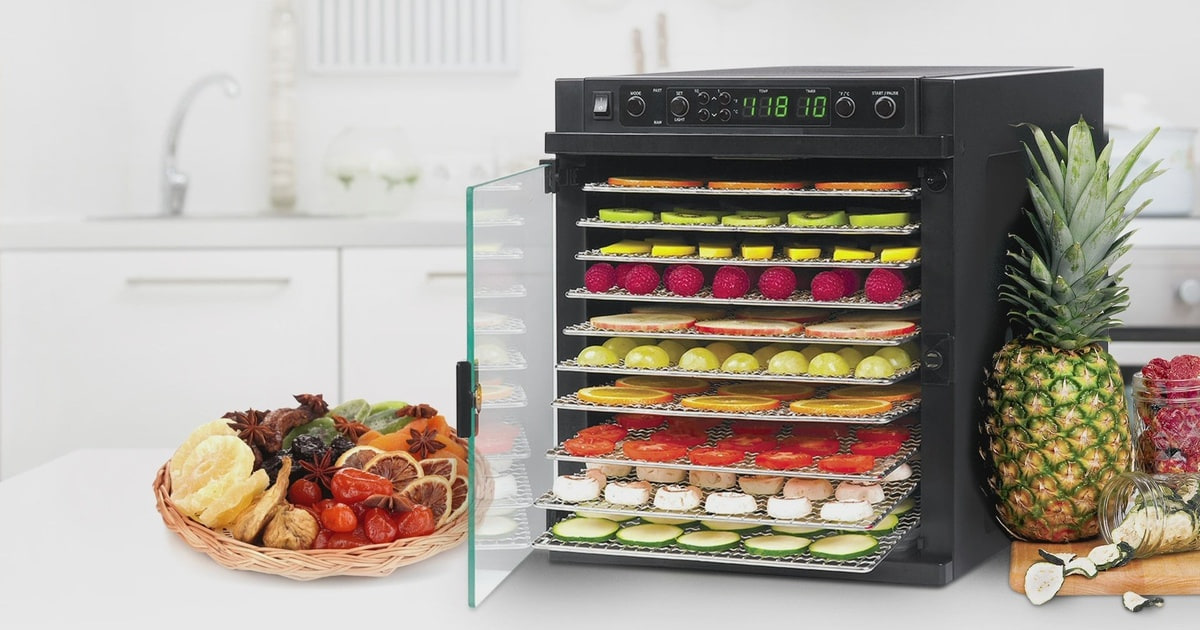
A dehydrator is a slow appliance that quietly saves you money. It pulls 80 to 95 percent of the moisture out of food, which drops water activity below the level where bacteria, mold and yeast can grow. That's why a bag of apple slices you dried yourself can sit in the pantry for years. If you hunt, garden, hike or just hate throwing out sad strawberries, this is the machine that turns a surplus into snacks. And it sips power compared with running your oven all day.
Here's the honest caveat: no home dehydrator makes jerky safe on its own. The USDA says meat needs to hit 160°F internally, 165°F for poultry, and the agency specifically warns that most home dehydrators can't get there. You'll need to heat the meat in your oven before or after drying. That's a real step, not a footnote. Dehydrators are also slow — figure 8 to 24 hours per batch — and the good ones are big enough that you'll want to measure your counter first.
The single feature that matters most is where the fan sits. A rear-mounted horizontal fan pushes air across every tray at once, so you don't have to shuffle trays halfway through. Top-mounted fans leave hot and cool spots, and uneven drying is both annoying and, with meat, a safety problem. We think that the Excalibur Performance Series 10-Tray is the best food dehydrator for most people, and that the Magic Mill Pro is the one to buy if you want horizontal airflow and stainless trays without paying the Excalibur premium.
Everything we recommend

The most even drying and the widest temperature range

Horizontal airflow and steel trays for a lot less money
Dual zones and a 77°F floor for raw and fermenting

Start with five trays, grow to twelve when you need to

Steel trays and a rear fan in a small, efficient package
At a glance
| Product | Trays | Temp Range | Price | |
|---|---|---|---|---|
| Excalibur Electric Food Dehydrator Performance Series 10-TrayTop pick | 10 Trays | 85-165°F | $379.99 |
| NESCO FD-75A Snackmaster Pro Food DehydratorBudget pick | 5-12 Trays | 95-160°F | $64.05 |
| Tribest Sedona Express SDE-S6780-B Digital Food DehydratorUpgrade pick | 11 Trays | 77-167°F | $549.95 |
| Magic Mill Pro Food Dehydrator MachineRunner-up | 10 Trays | — | $159.99On sale |
| BioChef Arizona Sol Food Dehydrator with 6Also great | 6 Trays | 95-158°F | $91.18 |
 | Hamilton Beach Digital Food Dehydrator for FruitAlso consider | 5 Trays | 100-160°F | $59.95 |
How we picked
Airflow design. We treated a rear-mounted horizontal fan as the single most important feature, based on published testing showing it removes moisture more consistently across every tray. Top-mounted designs had to earn their place another way, like expandability or price.
Temperature range. We compared each spec sheet against the National Center for Home Food Preservation's guidance, which spans 95°F for herbs up to 155°F for jerky. Anything that couldn't cover that 70°F spread was out.
Timer and shutoff. Drying runs 8 to 24 hours, so we favored units with a countdown timer and automatic shutoff for unattended overnight use. A 12-hour minimum was the bar; 48 hours or more was better.
Tray material. We weighted stainless steel trays heavily after reviewing durability findings that put them well ahead of BPA-free plastic over 18 months of regular use above 150°F. Dishwasher safety was part of that call.
Capacity and footprint. We looked at square feet of drying space against listed dimensions and weight, because a 10-tray unit that won't fit your counter isn't a bargain. Owner feedback about storage headaches shaped this criterion.
Top pick
The most even drying and the widest temperature range
Excalibur Electric Food Dehydrator Performance Series 10-Tray
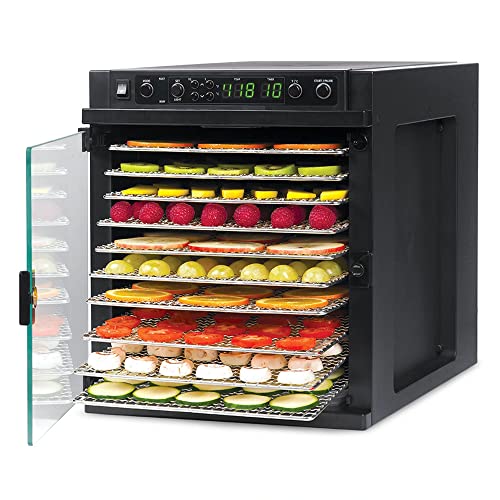
The Excalibur Performance Series gives you 16 square feet of drying space across 10 stainless steel trays, with a rear-mounted fan that dries every tray evenly. It spans 85°F to 165°F and runs up to 80 hours, so it handles herbs, fruit leather and jerky without compromise.
$379.99fromAmazonThe rear fan is why you buy this. Excalibur's Horizontal Parallex airflow, paired with its Hyperwave Pulse Technology, pushes heat across all 10 trays at once. Wirecutter's long-term testing found this design removed moisture more consistently across every tray than any vertical top-mounted model in the group. In practice that means you load it, set it, and walk away. No swapping tray three with tray nine at hour six.
The temperature range covers everything you'd want to dry. It runs from 85°F all the way to 165°F. The National Center for Home Food Preservation calls for herbs at 95°F–115°F, vegetables at 125°F–135°F, fruit at 135°F, and jerky at 145°F–155°F — a 70°F spread. The Excalibur clears both ends with room to spare, and the low end works if you dry below 118°F for raw food.
Sixteen square feet is a lot of food. That's the largest drying area in this lineup, and it's the difference between doing your tomato harvest in one run or three. If you're processing a deer, a berry patch or a case of mangoes, you'll appreciate not babysitting batch after batch. The trays are stainless steel, so they go in the dishwasher and won't warp after repeated runs above 150°F.
The 80-hour timer covers even the slowest projects. Most drying jobs finish overnight, but thick jerky strips, dense root vegetables and fruit leather can stretch well past a single sleep cycle. An 80-hour ceiling means you're never restarting a run because the timer maxed out. The LED control panel shows a progress bar, and the glass door lets you check without opening it and dumping heat.
It's built to be used hard, not stored away. At nearly 27 pounds with a metal-and-glass front, this isn't a stacking plastic tower. Owners who preserve seriously — homesteaders, hunters, people who buy produce by the flat — tend to keep these for years. If dehydrating is going to be a habit rather than a novelty, that durability is what you're paying for.
Flaws but not dealbreakers
It's big and it's heavy. Roughly 21 inches deep, 17 tall and almost 27 pounds. That's a permanent counter resident or a two-hands-and-a-grunt trip from the cabinet. Measure your space before you commit, especially the depth — it's deeper than most microwaves.
It's the most expensive unit here by a wide margin. If you dry a couple of batches of jerky a year, you won't get your money's worth. This is a machine for people whose freezer and garden overflow, not for occasional snack projects.
Like every home dehydrator, it can't make jerky safe by itself. Its 165°F ceiling is at the edge of what the USDA wants for poultry, and hitting a set temperature in the chamber isn't the same as hitting it inside the meat. Plan on an oven step before or after drying. No dehydrator gets you out of this.
Runner-upOn sale
Horizontal airflow and steel trays for a lot less money
Magic Mill Pro Food Dehydrator Machine
The Magic Mill Pro gives you the two features that matter most — a rear-mounted fan and 10 stainless steel trays — at a fraction of the Excalibur's cost. It adds a digital countdown timer with auto shutoff and a keep-warm function, and it's noticeably lighter to move.
$159.99fromAmazonList priceYou get the important part of the Excalibur for much less. The Magic Mill uses a rear-mounted fan with air-circulation ducting, so heat moves horizontally across all 10 trays and you skip tray rotation. That's the design Wirecutter found produced the most consistent results. If your budget won't stretch to the Excalibur, this is how you avoid settling for a top-mounted fan.
All 10 trays are food-grade stainless steel, and they're dishwasher safe. Good Housekeeping Institute testing found stainless-tray units scored substantially higher on long-term durability than BPA-free plastic ones after 18 months of regular use, especially after repeated cycles above 150°F. Plastic trays go cloudy and warp; steel just gets clean. Sticky fruit leather and greasy jerky drippings rinse off far more easily too.
The digital timer shuts it off for you. You set a countdown, and when it's done, the machine stops. That's what makes an overnight run reasonable — you're not doing math at 11pm about when to wake up. The display counts down so you can glance at it and know where things stand. There's also a keep-warm mode if a batch finishes before you get to it.
It ships with the accessories you'd otherwise buy separately. You get mesh trays for small things like herbs, nuts and sliced chives that fall through standard racks, plus fruit leather sheets that double as drip trays underneath messy loads. Buying those piecemeal for other machines adds up fast. Starting with them means you can make fruit roll-ups the first weekend.
It's a manageable size for a 10-tray unit. At 14 pounds and roughly 15.5 inches deep, it's about half the weight of the Excalibur and takes noticeably less counter. If you need to store it between harvests, you can actually lift it into a cabinet without planning ahead.
Flaws but not dealbreakers
Its drying area is smaller than the tray count suggests. Ten trays sound like Excalibur territory, but the trays themselves are shallower and the cabinet is several inches less deep. If you're drying whole apple rings or long jerky strips, you'll fit fewer per tray and run more batches than you expected.
The build is lighter-duty than the Excalibur's. At 14 pounds it moves easily, and that's partly because there's less machine here — more plastic in the housing, a lighter door. Owner feedback points to fan and control-panel issues as the parts most likely to give out over years of heavy use.
It still can't finish jerky safely on its own. Like every home dehydrator here, it can't reliably bring meat to the 160°F internal temperature the USDA requires. Budget for the oven step every single time you make jerky.
Upgrade pick
Dual zones and a 77°F floor for raw and fermenting
Tribest Sedona Express SDE-S6780-B Digital Food Dehydrator
The Tribest Sedona Express runs two independently programmable heating zones, so you can dry below 118°F on one side while the other runs hot. Its 77°F floor opens the door to fermenting, and 11 stainless steel trays sit behind a hinged glass door with an interior light.
$549.95fromAmazonTwo zones mean you stop choosing between projects. The Sedona Express runs each chamber on its own program. So you can keep sprouted crackers under 118°F for raw-food purposes in one half while the other half dries jerky at full temperature. According to Tribest, it's the only mainstream consumer model that does this. If your household includes both a raw eater and a jerky maker, that's the whole pitch.
The temperature floor goes far lower than anything else here. It starts at 77°F, which is below room temperature in a lot of kitchens in summer. That range is meant for fermenting cycles, not just gentle drying — think yogurt, koji, cultured nut cheeses. Research published in the Journal of Food Science shows that drying below 140°F holds on to considerably more Vitamin C and B-complex vitamins than hotter methods.
The Two-Stage Sequential Temperature Timer lets you program a drop. You can start hot to move moisture fast, then automatically step down to a lower temperature for the long finish. That's a technique people otherwise do by hand at 2am. Combined with the 167°F ceiling, which Tribest notes conforms with USDA jerky preparation guidance, it covers the whole range in one programmed run.
You can see what's happening without opening the door. A hinged glass door with an internal LED light means checking on a batch costs you nothing in heat or airflow. There's also a washable, reusable air filter and a catch tray for debris, both of which matter when you're running the thing for days at a time and don't want to disassemble it to clean.
Eleven stainless trays in a compact body. It's about 17.5 inches deep and 21 pounds — more trays than the Excalibur in a smaller footprint. If you want capacity but your counter is short on depth, that trade works in your favor.
Flaws but not dealbreakers
It costs the most to buy and it's the most complicated to learn. Dual zones, sequential timers and a fermenting range give you a lot of settings you may never touch. If you just want dried apples, most of this machine will go unused and you'll have paid for it.
Dual zones halve your capacity per project. Running one side raw and one side hot is great, but if you're doing a single big harvest, you're managing two chambers instead of one open cavity. For pure bulk work, the Excalibur's undivided space is simpler.
Budget pick
Start with five trays, grow to twelve when you need to
NESCO FD-75A Snackmaster Pro Food Dehydrator
The NESCO FD-75A Snackmaster Pro is the sensible entry point. It starts at five trays and expands to 12 with add-a-tray accessories, so your batch size can grow without buying a new machine, and it ships with fruit roll sheets and jerky seasoning.
$64.05fromAmazonExpandability is the reason to choose this over other cheap dehydrators. You start with five trays and stack up to 12, adding trays a few at a time as your needs change. Most budget units lock you into a fixed capacity, so outgrowing them means starting over. If you're not sure yet whether you'll dry two pounds of jerky a year or twenty, this is the low-risk path.
The 600-watt Converga-Flow system handles the basics well. NESCO routes air down the outside and across each tray, which keeps drying reasonably even for a top-mounted design. It won't match the Excalibur's rear fan, but you're not stuck rotating trays every hour either. The 95°F–160°F range covers herbs at the low end and jerky at the high end.
The top-mounted fan keeps drips out of the heating element. With the motor up top, juice from peaches or marinade from jerky strips falls away from the heat source instead of onto it. That means less scorched residue and fewer cleaning sessions with a toothbrush. It's a practical advantage of the stacking design.
It's light enough to actually put away. Under 8 pounds, and the trays nest. If your kitchen has no room for a permanent appliance, this one lives in a cabinet between uses without turning into a chore. That alone keeps a lot of dehydrators in circulation rather than gathering dust.
You can start the day it arrives. It includes fruit roll sheets, Clean-A-Screens for small items, and a jerky seasoning sample. For a first-timer that's the difference between making fruit leather on day one and waiting on another order.
Flaws but not dealbreakers
The fan is top-mounted, so drying is less even than the horizontal models. Wirecutter's testing found rear-fan units removed moisture more consistently across all trays than every vertical model. Expect to swap tray positions on long, full loads, especially with thick jerky.
The trays are plastic, not steel. Good Housekeeping's durability findings favored stainless over BPA-free plastic after 18 months of regular use, particularly above 150°F. These work fine — they're just more likely to stain, discolor or warp over years of hot cycles.
There's no timer or auto shutoff. You set a temperature and it runs until you turn it off. For overnight batches that means either waking up to check or accepting some over-drying. If unattended runs are a priority, spend up for a digital model.
Also great
Steel trays and a rear fan in a small, efficient package
BioChef Arizona Sol Food Dehydrator with 6
The BioChef Arizona Sol pairs a rear-mounted horizontal fan with six full stainless steel trays in a body that fits under most cabinets. Its 420-watt motor is the most frugal here, and it comes with a two-year motor-and-parts warranty.
$91.18fromAmazonIt's the smallest unit here with real horizontal airflow. Most compact dehydrators cut corners by putting the fan on top. The Arizona Sol keeps the rear-mounted fan and the even drying that comes with it, in a body about 17.7 inches deep. If you want the good airflow design but don't need 10 trays, this is the sweet spot.
All six trays are stainless steel and BPA-free. That matters at dehydrating temperatures, where plastic can off-gas and warp over time. Good Housekeeping's testing put stainless well ahead of plastic on long-term durability. For raw-food and health-focused users who care what touches their food during a 14-hour run, steel removes the question entirely.
At 420 watts, it's the most energy-efficient model here. Consumer Reports notes that a typical 600-watt dehydrator running 10 hours uses about 6 kWh, against 20 to 50 kWh for an oven doing the same job. The Arizona Sol draws less than that baseline. Over long overnight cycles, several times a week, the difference on your bill adds up.
The 95°F–158°F range covers nearly everything. Herbs at 95°F–115°F, vegetables in the 120s and 130s, fruit at 135°F, jerky in the 145°F–155°F band — all within reach. It also sits below the 118°F raw-food threshold, which is why it's popular with that crowd. You'll still need the oven step for jerky safety.
It comes with what you need and a real warranty. A fine mesh sheet, a non-stick sheet and a drip tray are included, so herbs and fruit leather work out of the box. BioChef backs the motor and parts for two years plus a 30-day satisfaction period, which is longer coverage than most dehydrators carry.
Flaws but not dealbreakers
Six trays and 6.24 square feet is modest. That's under half the Excalibur's capacity. If you're preserving a garden harvest or a whole deer, you'll be running batch after batch. It's sized for a household, not a homestead.
The timer maxes out at 19.5 hours. That covers the vast majority of drying jobs, but very thick jerky or dense fruit leather can push past it and require a restart. The Excalibur's 80 hours and the Hamilton Beach's 48 both give you more headroom.
The BioChef Arizona Sol comes with a two-year motor-and-parts warranty plus a 30-day satisfaction guarantee.
Who this is for
Buy a dehydrator if you already have more food than you can eat before it turns. Gardeners with a August tomato glut, hunters with a freezer full of venison, backpackers who'd rather not pay for freeze-dried meals, and families tired of composting soft bananas all come out ahead. Raw-food eaters need one too, since drying below 118°F isn't something an oven does. If you make jerky more than a few times a year, the math works fast.
Skip it if you dry things once or twice a year — your oven on its lowest setting will do, even if it costs more to run and ties up the kitchen. This guide covers electric countertop dehydrators for home use, from compact five-tray stackers to 10- and 11-tray cabinet models. We don't cover freeze dryers, which cost several times as much and need floor space and a vacuum pump, or commercial-scale drying cabinets. And no machine here replaces the oven step the USDA requires for jerky safety.
How we picked
Airflow: We favored rear-mounted horizontal fans, since published testing shows they dry every tray evenly without rotation, while top-mounted fans leave hot and cool spots. Temperature range: Each unit had to cover roughly 95°F to 160°F to handle herbs through jerky, per the National Center for Home Food Preservation's guidance. Timer and shutoff: With runs that stretch overnight, we looked for a countdown timer and automatic shutoff, ideally 48 hours or more. Trays: Stainless steel got the nod over BPA-free plastic on durability and cleaning, based on long-term durability findings above 150°F. Capacity and footprint: We compared square feet of drying space against listed dimensions and weight, because the biggest machine is useless if it can't live in your kitchen. Efficiency: We noted wattage, since a 600-watt unit over 10 hours uses roughly 6 kWh against 20 to 50 kWh for an oven doing the same job.
Other food dehydrators worth considering
If you want the lowest-risk way to find out whether you like dehydrating: The Hamilton Beach Digital Food Dehydrator for Fruit ($59.95) — The Hamilton Beach 32100A is the smallest and simplest machine here — five stackable BPA-free trays, 4.2 square feet, a 500-watt base-mounted heater and a footprint around 13 by 10.5 inches. What sets it apart from other entry-level units is the digital timer, which counts down from 1 to 48 hours and shuts the machine off automatically. That's genuinely useful for overnight jerky, and it's a longer timer than the BioChef offers. The 100°F–160°F range covers fruit, vegetables and jerky, though it can't go low enough for herbs at 95°F or for strict raw-food drying below 118°F. Trays and lid go in the dishwasher, and the vented clear lid lets you peek without breaking the seal. You give up capacity and the even drying of a rear fan, but as a first dehydrator or a gift, it asks very little of you.
The competition
Here's what our research surfaced, not a survey of everything sold. We looked at the models that come up repeatedly in published reviews and owner discussion, and every one of them appears somewhere above or below.
Care and maintenance
Clean the trays right after a run, while the residue is still soft — dried fruit leather and jerky glaze turn into cement overnight. Stainless steel trays and most plastic ones are dishwasher safe, but hand wash mesh screens so the fine holes don't clog. Wipe the housing with a damp cloth and never submerge the base or the fan unit. If your machine has a washable air filter, rinse it every few batches, since grease and fruit particles restrict airflow and stretch drying times. Store finished food in airtight containers in a cool, dark place; fruits and vegetables last one to four years that way, and vacuum sealing with oxygen absorbers pushes past two years reliably. Check jars after the first week — any condensation means the food wasn't dry enough, so put it back in.
Questions we get
Are horizontal or vertical dehydrators better for even drying?
Horizontal, and it's not close. A rear-mounted fan pushes air across every tray at once, and Wirecutter's long-term testing found it removed moisture more consistently across all trays than any vertical model. With a top-mounted fan you'll usually need to rotate trays partway through a full load. That's why our top pick and runner-up both use rear fans.
What temperature do I need to dehydrate jerky safely?
The USDA requires meat to reach 160°F internally, or 165°F for poultry, to destroy Salmonella and E. coli O157:H7. The agency explicitly warns that most home dehydrators can't reach that on their own. So heat the meat in your oven either before or after drying — this step isn't optional. Dry at 145°F to 155°F, per the National Center for Home Food Preservation.
How long does dehydrated food last in storage?
Most fruits and vegetables keep one to four years in airtight containers at room temperature, according to Colorado State University Extension. Vacuum sealing with oxygen absorbers, stored somewhere cool and dark, reliably pushes past two years. The key is getting the moisture out — dehydration removes 80 to 95 percent of it, dropping water activity below the 0.6 threshold where microbes can grow.
Can I leave a dehydrator running overnight?
Yes, and most people do, since batches take 8 to 24 hours. Use a unit with a countdown timer and automatic shutoff so it stops on its own — the Magic Mill, Tribest, BioChef and Hamilton Beach all have one. Put it on a hard, clear surface away from curtains and cabinet undersides. The NESCO has no timer, so plan to check it.
How noisy are dehydrators, and can I use one in an apartment?
They run at a steady fan hum, roughly like a bathroom exhaust fan, for the whole cycle. Rear-mounted fans generally run quieter than top-mounted ones, which is worth knowing if the machine will sit near a bedroom. In a studio or small apartment you'll notice it overnight. Running it during the day, or in a closed kitchen, solves most of the problem.
Do I really need stainless steel trays?
You don't need them, but they hold up better. Good Housekeeping Institute testing found stainless-tray units scored substantially higher on durability than BPA-free plastic after 18 months of regular use, especially after repeated cycles above 150°F. Plastic trays can stain, warp and cloud over years. If you dehydrate occasionally, plastic is fine; if it's a weekly habit, go steel.
Why you should trust us
For this guide:
- We read manufacturer specifications for every unit here, comparing temperature ranges, wattage, tray material and timer limits side by side.
- We reviewed published testing from Wirecutter, America's Test Kitchen, Consumer Reports and the Good Housekeeping Institute on airflow design, thermostat accuracy, energy use and long-term tray durability.
- We drew food safety and storage guidance from the USDA Food Safety and Inspection Service, the National Center for Home Food Preservation and Colorado State University Extension.
- We read owner reviews on every listing, weighted toward the critical ones, because that is where the recurring failures show up.
- We have a systematic way of automatically fetching the latest prices, so the numbers on this page stay current.
- This is a research-focused guide, so the team may not own every product listed — though we often do own the top winners, which gives us extra context for the recommendations.
- We don't accept free products, and the retailer commission never changes which product we recommend.
Sources
The Best Food Dehydrators — Wirecutter, The New York Times, Wirecutter
Best Food Dehydrators — America's Test Kitchen, America's Test Kitchen
Jerky and Food Safety — USDA Food Safety and Inspection Service, USDA FSIS
How to Dry Foods at Home — National Center for Home Food Preservation, NCHFP / University of Georgia Extension
Best Food Dehydrators — Serious Eats, Serious Eats
Best Food Dehydrators 2026 — Good Housekeeping, Good Housekeeping Institute
Best Food Dehydrators — The Spruce Eats, The Spruce Eats
Best Food Dehydrators — CNET, CNET
Excalibur 3926TB Product Specifications — Excalibur, Excalibur (Manufacturer)
Tribest Sedona Express SDE-S6780-B Specifications — Tribest, Tribest (Manufacturer)
NESCO FD-75A Snackmaster Pro Specifications — NESCO, NESCO (Manufacturer)
Drying Foods — Colorado State University Extension, Colorado State University Extension
Amazon product listings and owner reviews for all 6 products
Manufacturer specification pages for each product
Some passages in this guide may be paraphrased with AI help. Prices are refreshed automatically.
More like this.
Continue exploring appliances reviews and recommendations.

The Best Food Processors
A food processor pays for its counter space in ten-minute chunks. It shreds a block of cheddar before your pan is hot. It turns a pile of onions, carrots…

The Best Probiotics and Fermented Foods for Gut Health
Your gut doesn't care much about marketing. It responds to what you feed it, most days, over months. So the useful question isn't which probiotic is…

The Best Dry Dog Food
Your dog eats the same thing twice a day, every day, for years. That makes dry food one of the few purchases where consistency matters more than novelty.…

The Best Dog Food Brands
You buy dog food more often than almost anything else you own a decision about. Twice a day, every day, for ten or fifteen years. That repetition is what…

The Best Baby Food Makers
Making your own baby food sounds ambitious until you do it once. You steam a sweet potato, blend it smooth, spoon it into a tray, and freeze it. That's…

The Best Dry Dog Food
Dog food is the one purchase you make over and over, and your dog eats nothing else. So the small stuff compounds. A bag that's a little too rich can mean…