The Best Hand Mixers
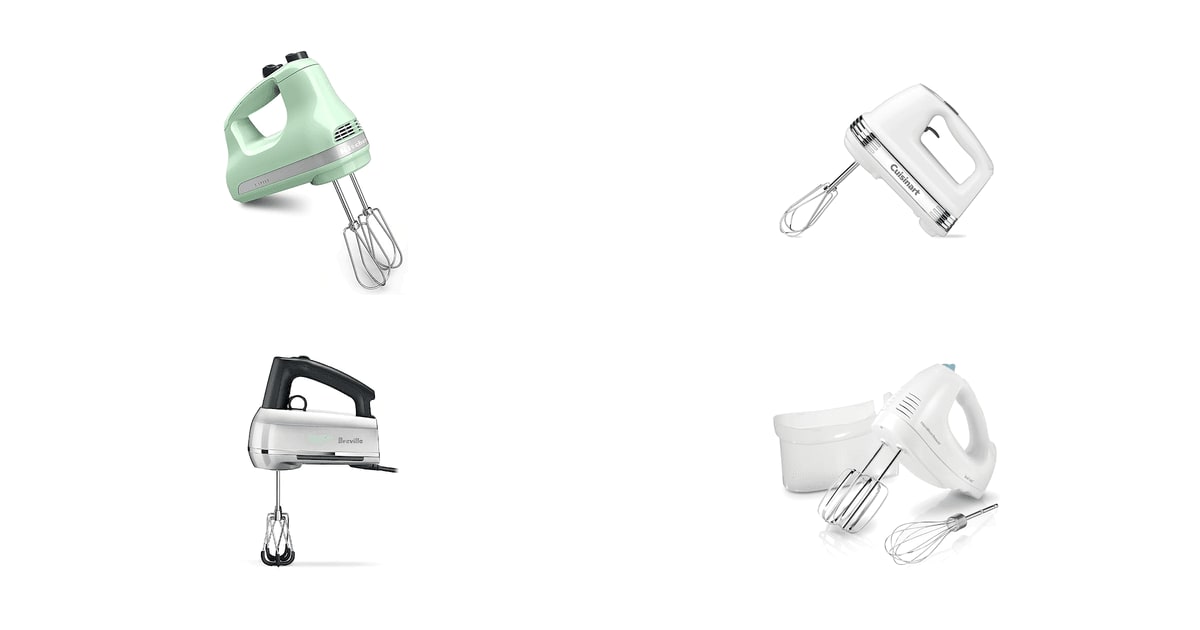
A hand mixer is the small appliance you actually reach for. It whips cream for a last-minute dessert, creams butter and sugar for a batch of cookies, and beats eggs for a birthday cake — then goes back in the drawer. You don't clear counter space for it. You don't dread hauling it out. For most people who bake a few times a month, that convenience matters more than raw power, and a good hand mixer covers nearly every recipe a home kitchen throws at it.
But no hand mixer is a stand mixer, and the ones that try to be get heavy and loud. You're holding the motor, so every ounce and every decibel lands in your hand and your ears. Stiff cookie dough will slow almost any of these down. Long kneading sessions will overheat them. And the cheaper the mixer, the more likely it flings flour across your counter the second you pull the trigger, because slow-start is the first feature manufacturers cut.
We read published reviews, compared manufacturer specifications, and worked through owner feedback across five widely sold models to see which ones hold up in everyday baking. What separates them isn't wattage so much as speed calibration, beater material, and whether the mixer starts gently. We think that the KitchenAid 5-Speed Ultra Power Hand Mixer is the best hand mixer for most people, and that the KitchenAid 9-Speed Digital Hand Mixer is the one to buy if you bake weekly and want soft-start and dough hooks.
Everything we recommend

Quiet, light, and gentle on speed one — right for most baking

Soft-start, nine speeds, and the attachments to knead dough

Six speeds, a whisk, and a case — for occasional baking

Scraper beaters and near-silent mixing, if you bake constantly
Strong motor and a long cord, but it starts abruptly
At a glance
| Product | Speeds | Wattage | Price | |
|---|---|---|---|---|
| KitchenAid 5-Speed Ultra Power Hand MixerTop pick | 5 Speeds | — | $44.99On sale |
| Cuisinart Power Advantage 5-Speed Hand MixerRunner-up | 5 Speeds | 220W | $49.95 |
| Breville BHM800SIL Handy Mixer for BakingAlso great | 9 Speeds | — | $159.95 |
| Hamilton Beach 6-Speed Electric Hand Mixer withBudget pick | 6 Speeds | 250W | $27.95 |
| KitchenAid 9-Speed Digital Hand Mixer with TurboUpgrade pick | 9 Speeds | — | $84.94 |
How we picked
How it starts. Splatter is the complaint that shows up most in owner feedback, so we weighted slow-start and low-speed calibration heavily. A mixer whose speed one is genuinely slow beats one with more settings that all feel fast.
Motor headroom. We compared manufacturer wattage ratings alongside published reviews and owner accounts of stiff cookie dough and thick frosting. What mattered wasn't peak wattage but whether the motor holds speed under load instead of sagging.
Weight and grip. Specifications gave us listed weights, and owner feedback told us where fatigue actually kicks in. We favored lighter units with thumb-reachable speed controls, since you shouldn't have to shift your grip mid-mix.
Beaters and extras. We looked at beater material, whether the set includes a whisk or dough hooks, and whether everything is dishwasher-safe. Stainless resists staining and warping in ways plastic doesn't.
Storage and noise. Snap-on cases and onboard storage keep accessories from disappearing, and reviews and owner reports told us which models are pleasant to run in an open kitchen and which ones aren't.
Top pickOn sale
Quiet, light, and gentle on speed one — right for most baking
KitchenAid 5-Speed Ultra Power Hand Mixer
This is the mixer that does everything a home baker needs without fuss. Five well-separated speeds, stainless steel beaters that won't stain or warp, and a genuinely gentle start that keeps flour in the bowl instead of on your shirt.
$44.99fromAmazonList priceThe low speed is the reason to buy it. Most hand mixers treat speed one as a formality — you press the trigger and flour goes everywhere. This one ramps up gradually, and owners bring it up constantly as the thing that surprised them coming from an older mixer. If you've ever cleaned cocoa powder off a backsplash, you'll notice the difference on the first batch.
Noise is the other thing people mention without being asked. Compared with the budget models here, it runs noticeably quieter, which matters more than you'd think in an open kitchen or an apartment where someone's on a call in the next room. It's still an appliance with a motor. But you can talk over it.
At about two pounds it's among the lighter mixers here, and that shows up over a long session. Holding a mixer above a deep bowl for eight minutes of buttercream is where weight turns into wrist ache. The balance is good too — it doesn't nose-dive forward when you tilt it into the batter.
The stainless steel beaters are a real durability upgrade over plastic. They don't pick up color from lemon curd or berry frosting, they don't warp in the dishwasher, and batter slides off them more cleanly. The single-button eject means you drop them straight into the sink without touching the messy end. The swivel cord locks to one side, which sounds trivial until you're working left-handed at a crowded counter.
Where it falls short is the accessory list. You get beaters, and that's the core of it — no dough hooks, no blending rod. If your baking runs to cinnamon rolls and enriched doughs, that's a real gap, and the 9-speed KitchenAid below fills it.
Flaws but not dealbreakers
Five speeds is fewer than the premium models here, and there's no digital readout or timer. In practice that's fine for cake batter and whipped cream, but if you develop recipes and want to write down the exact setting that worked, an analog dial gives you less to go on.
No dough hooks in the box. This is a mixing-and-whipping tool, not a kneading one, and pretty much any bread work means either buying elsewhere or doing it by hand. The cord also runs shorter than the Cuisinart's, which is worth checking against where your outlets actually are.
Upgrade pick
Soft-start, nine speeds, and the attachments to knead dough
KitchenAid 9-Speed Digital Hand Mixer with Turbo
The most capable mixer here, and the one that comes closest to replacing a stand mixer for small batches. Nine speeds, a digital display, a genuine soft-start, plus dough hooks, a pro whisk, and a blending rod in the box.
$84.94fromAmazonSoft-start is the feature that justifies the upgrade. No matter which speed you dial in, the motor eases into it rather than snapping to full tilt. Owners who came from older mixers describe the same thing over and over: flour stays in the bowl. If splatter is your main complaint about the mixer you own now, this is the specific fix.
The digital display sounds like a gimmick until you bake the same thing twice. You can see the exact speed you're running, note it, and hit it again next time. For anyone tweaking a recipe over several attempts, that repeatability is genuinely useful — an analog dial only tells you roughly where you were.
Nine speeds isn't padding on this one. Speed one is slow enough to fold chocolate chips in without throwing them, and speed nine is rated for kneading yeast dough. The stainless Turbo Beater II attachments handle dense mixtures, the pro whisk covers meringue and custard, and the dough hook does enriched breads. There's a blending rod for smoothies and dressings too.
Longevity is the quiet argument here. Owners report daily use — breads, cookies, cheese — running past a year with no change in performance, and several mention replacing KitchenAid hand mixers they'd owned for decades. That's the kind of pattern that makes a higher price easier to swallow if you bake often.
It's also a good pick if grip strength is a concern. Several owners with arthritis single it out, because the soft-start and the powerful motor mean you're not fighting the tool through a stiff mixture.
Flaws but not dealbreakers
It costs the most of the KitchenAid options here, and it's heavier than the 5-speed because of the bigger motor. If you bake once a month, you'll pay for precision you never use.
Nine speeds and a digital readout add steps to simple jobs. Some people just want a dial with a few clear positions, and this isn't that mixer.
Budget pick
Six speeds, a whisk, and a case — for occasional baking
Hamilton Beach 6-Speed Electric Hand Mixer with
The mixer to buy if you bake a handful of times a year or you're setting up a first kitchen. It comes with a whisk, traditional beaters, and a snap-on case, and its 250-watt peak motor handles cake batter and whipped cream without complaint.
$27.95fromAmazonFor light baking, this does everything the expensive mixers do. Whipped cream, cake batter, boxed brownie mix, beaten eggs — none of it strains a mixer, and owners consistently describe this one as more than powerful enough for those jobs. The six speeds give you more room than most budget models, which often stop at three.
The snap-on case is the feature that earns it real goodwill. Beaters and the whisk clip into one unit, so nothing wanders to the back of a drawer. There's also a bowl-rest feature that lets the mixer perch on the rim of your bowl while you go grab the vanilla, and drips land in the batter instead of on the counter.
It's a well-worn design with a long track record. Owners routinely mention replacing a Hamilton Beach mixer that lasted them fifteen or twenty years, which tells you something about how these age under light, occasional use.
The QuickBurst button gives you a short shot of extra power without changing speeds — handy when you hit a dense pocket in cookie dough and just need to push through it.
Flaws but not dealbreakers
The motor audibly strains on stiff dough and thick frosting, and the speed drops before it recovers. Stick to light-duty work and it's fine. Push it regularly and you'll wish you'd spent more.
It's noticeably louder than the KitchenAid options, and the beaters are plastic rather than stainless — they're more prone to staining and won't feel as solid years in. There's no slow-start either, so expect a flour cloud unless you ease into things. Owners also note the storage case is top-heavy and tips over easily on a shelf.
Also great
Scraper beaters and near-silent mixing, if you bake constantly
Breville BHM800SIL Handy Mixer for Baking
Breville's mixer wraps its beaters in silicone so they sweep the bowl as they turn, which cuts down on stop-and-scrape breaks. It's the quietest of the bunch and the best equipped, with scraper beaters, dough hooks, and balloon whisks all included.
$159.95fromAmazonThe scraper beaters solve a problem you've stopped noticing. Standard beaters leave a ring of unmixed batter on the bowl wall, so you stop, pull the beaters, scrape with a spatula, and start again — several times on a layer cake. The silicone edges here sweep that ring back into the mix as they rotate.
That same silicone makes it strikingly quiet. There's no metal-on-ceramic clanging, and owners bring up the low noise more than almost any other feature. If you bake early in the morning in a small apartment, that's a genuine argument for this mixer over anything else in the guide.
It's the most thoroughly equipped of the five. Two scraper beaters, two dough hooks, and two balloon whisks come in the box, and the mixer detects which attachment is fitted and adjusts its speed range to match. There are nine speeds plus a boost, a bowl light, and a timer built into the handle for recipes that call for exact mixing times.
The catch is the silicone itself. Some owners report the coating wearing at the edges after a few months of regular use, and replacement beaters have been hard to find. That's the risk you take on a design this specific — the part that makes it special is also the part that wears.
Flaws but not dealbreakers
It's the heaviest mixer here by a wide margin, and you feel it during a long whipping session. If wrist fatigue is a concern for you, look at the KitchenAid 5-speed instead.
The scraper beaters take more effort to clean than smooth metal ones, since batter collects along the silicone edge. And it's the most expensive mixer in this guide by a good stretch, which is hard to justify unless you're baking most weeks.
Runner-up
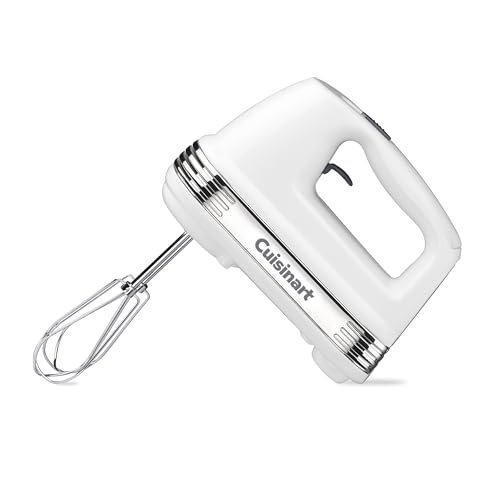
Strong motor and a long cord, but it starts abruptly
Cuisinart Power Advantage 5-Speed Hand Mixer
Cuisinart's mixer has more torque than its 220-watt rating suggests and a 60-inch swivel cord that reaches wherever you need it. Its beaters have no center post, so batter doesn't pack into them — but there's no gentle start.
$49.95fromAmazonIt's more powerful than the spec sheet implies. Owners who came here after cheaper mixers failed to stiffen egg whites report this one gets there without complaint, and more than a few call it almost too strong for small jobs. If your last mixer bogged down, this is a real step up.
The extra-long beaters are a smart design. With no center post, batter doesn't wad up in the middle where you'd have to dig it out — you rinse them and they're basically clean. They're dishwasher-safe, and an eject lever drops them out without you touching the messy end.
That 60-inch swivel cord solves a real annoyance. It reaches across a counter to a far outlet, and the swivel works whether you're right- or left-handed, so the cord isn't draped over the bowl. Cuisinart also backs this one with a longer warranty than most mixers in this range.
But the missing slow start is a persistent complaint, and it's why this lands behind the KitchenAid. It jumps to speed the moment you engage it, even on the lowest setting. Use a deep bowl and push the beaters into the batter before you start, and you'll manage. Forget once and you're wiping the wall.
Flaws but not dealbreakers
No gentle start, and combined with a strong motor that means splatter. Owners describe ingredients spraying even on the lowest setting, and it's the single most common frustration with this mixer.
There's no storage case, so beaters end up loose in a drawer. And while most owners get years out of it, a minority report the motor developing a rough, stuttering sound after heavy use — the trade-off of a strong motor in a lightly built body.
The Cuisinart Power Advantage comes with a limited three-year warranty.
Who this is for
Buy a hand mixer if you bake in small to moderate batches, don't want to give up counter space, and want something you can wash and put away in a couple of minutes. It'll handle cakes, cookies, quick breads, frostings, whipped cream, and beaten egg whites without any trouble. If you already own a stand mixer, a hand mixer still earns its place for the small jobs where dragging out the big machine isn't worth it.
Skip it if you make big batches of stiff bread dough on a regular basis. Hand mixers with dough hooks handle enriched doughs like brioche and cinnamon rolls, but high-gluten artisan loaves needing eight to ten minutes of kneading will overheat the motor. This guide covers corded handheld mixers for home baking. It doesn't cover stand mixers, immersion blenders, or commercial equipment.
How we picked
We compared specifications, published reviews, and owner feedback across the models in this lineup against a handful of things that decide whether you'll still like a mixer in six months. Start behavior: whether speed one is genuinely gentle, or whether the motor snaps to full power and throws flour across the counter. Motor headroom: whether the mixer holds its speed through thick frosting and stiff dough instead of audibly bogging down. Weight and grip: lighter units with thumb-accessible controls, since fatigue over a long session comes from the ounces you're holding. Beaters and extras: stainless over plastic, and a whisk or dough hooks included rather than sold separately. Storage and noise: a case or onboard holder so nothing gets lost, and a motor you can talk over.
The competition
This is what our research surfaced across a few widely sold models, not a survey of every hand mixer on the market. Each of the five here made the guide because it does something clearly well, and every one of them ended up as a pick — there was no model in this lineup that we'd steer you away from entirely. Which one is right depends far more on how often you bake than on any gap in quality between them.
Care and cleaning
Get the beaters into water before the batter dries. Butter and flour turn to cement in about twenty minutes, and a soak makes the difference between a rinse and a scrub. Every mixer here has dishwasher-safe attachments, but silicone-edged scraper beaters do better with a hand wash so the coating doesn't take a beating from hot cycles. Never put the motor housing in water — wipe it with a damp cloth and dry it. Store the unit with the cord loosely wrapped rather than pulled tight against the housing, since a sharp bend at the base is where cords eventually fail. And if a snap-on case came with your mixer, use it. Beaters that live loose in a drawer bend, and a bent beater wobbles against the bowl forever after.
Questions we get
How many watts do I need for cakes and cookies?
For standard cakes and cookies, anything in the 200-to-250-watt range is plenty. Wattage isn't the whole story anyway — motor design, beater shape, and speed calibration all shape how a mixer actually behaves. If you regularly mix stiff drop cookies or enriched doughs, lean toward the higher end of that range so the motor has room to work.
Is a hand mixer good enough for whipping cream and egg whites?
Yes, and these are the easiest jobs you'll give it. Whipping needs sustained speed rather than torque, so even a budget mixer gets cream and egg whites to stiff peaks. Start with cold cream and a chilled metal bowl, run low for the first thirty seconds to start the aeration, then go to full speed.
Can a hand mixer knead bread dough?
For soft, enriched doughs like brioche, cinnamon rolls, or dinner rolls, dough hooks on a hand mixer will get you there — it just takes longer and needs watching. For dense, high-hydration sourdough or whole-wheat loaves, it's the wrong tool, and you risk overheating the motor. Knead those by hand or use a stand mixer.
Hand mixer or stand mixer — which should I buy?
A hand mixer is portable, easy to clean, and right for small-to-medium batches of almost anything you'd bake at home. A stand mixer is hands-free, more powerful, and better for large batches and heavy bread doughs. If you're in an apartment or bake casually, a good hand mixer covers your needs without the counter space or the cost.
Which one is best for arthritis or limited grip strength?
Weight and start behavior matter most here. The KitchenAid 5-Speed is among the lightest options and starts gently, and the 9-Speed Digital's soft-start means you're not wrestling the tool at the beginning of a mix. Skip the Breville if fatigue is your main concern — it's the heaviest mixer in this guide.
Do more speed settings actually matter?
Only if the settings are genuinely different from one another. Five or six well-calibrated speeds cover everything most home bakers do, and a poorly designed six-speed can have four settings that feel identical. Nine speeds pay off if you bake often and want fine control over folding and whipping.
Why you should trust us
For this guide:
- We read through published reviews and manufacturer specifications for every mixer in this lineup, comparing wattage, weight, speed counts, and included attachments side by side.
- We worked through owner feedback for each model to find the failure modes people actually run into — splatter at low speed, motor strain on stiff dough, and coatings that wear.
- We weighed those recurring themes against the specifications rather than taking either at face value.
- We read owner reviews on every listing, weighted toward the critical ones, because that is where the recurring failures show up.
- We have a systematic way of automatically fetching the latest prices, so the numbers on this page stay current.
- This is a research-focused guide, so the team may not own every product listed — though we often do own the top winners, which gives us extra context for the recommendations.
- We don't accept free products, and the retailer commission never changes which product we recommend.
Sources
Best Hand Mixers of 2026 — Wirecutter, Wirecutter / The New York Times
Best Hand Mixers, Tested by Food Network Kitchen, Food Network
The Best Hand Mixers of 2026 — Serious Eats, Serious Eats
Best Hand Mixers — America's Test Kitchen Equipment Reviews, America's Test Kitchen
Hand Mixer Reviews and Ratings — Consumer Reports, Consumer Reports
Best Hand Mixers 2026 — Good Housekeeping Institute, Good Housekeeping Institute
Best Hand Mixers — The Spruce Eats Testing Lab, The Spruce Eats
KitchenAid KHM512 5-Speed Ultra Power Hand Mixer — Official Specifications, KitchenAid
Amazon product listings and owner reviews for all 5 products
Manufacturer specification pages for each product
Some passages in this guide may be paraphrased with AI help. Prices are refreshed automatically.
More like this.
Continue exploring appliances reviews and recommendations.

The Best Hand Grip Strengtheners for Therapy
Hand strength shows up in the small stuff. Opening a jar, turning a key, holding a coffee cup without thinking about it. When an injury, surgery, or…

The Best Rechargeable Hand Warmers
Cold hands ruin an otherwise good day outside. A rechargeable hand warmer is a small lithium battery wrapped in a metal or plastic shell that heats up on…

The Best Stand Mixers for Baking
A stand mixer earns its counter space by taking over the jobs your arms hate. Creaming butter and sugar until it's genuinely pale and fluffy. Kneading a…

The Best Stand Mixer Attachments
Your stand mixer is a motor with a bowl bolted to it. That motor spends most of its life whipping cream and kneading bread, but the little hub on the…

The Best Portable Concrete Mixers
Mixing concrete by hand sounds fine until bag four. Then your shoulders quit, the first batch starts stiffening, and the slab you poured in sections shows…

The Best Stainless Steel Mixing Bowl Sets
A mixing bowl is the thing you grab before you've decided what you're making. You crack eggs in it, toss a salad in it, let dough rise in it, then wash it…