The Best Sunscreens for Sensitive Skin
If your skin flares at the wrong moisturizer, sunscreen is the hardest product to get right. You have to wear it every day, on the most reactive skin you own, in the amount that actually works. That rules out anything that stings, clogs pores or sits like a plastic film by noon. The three usual triggers are fragrance, oxybenzone and a heavy occlusive texture, and they turn up in most drugstore SPF. So the ingredient list matters more here than in almost anything else you buy.
Here's the honest part: nothing in this category does everything. Mineral filters are the gentler choice, but zinc oxide and titanium dioxide sit on top of your skin, and on medium-to-deep tones that usually means some cast. The formulas that vanish completely tend to come in small tubes, so you'll rebuy often. And "hypoallergenic" and "dermatologist-tested" aren't regulated terms — any brand can print them on a box. Whatever you choose, you'll still need to patch-test it and reapply it, which is where most people quietly give up.
So we sorted these by the situation you're actually in. Daily face wear with redness or breakouts is a different problem from a long beach day, and skin recovering from a peel is different again. Barrier ingredients like ceramides and niacinamide count for a lot, because reactive skin gets less reactive once the barrier recovers. We think that the EltaMD UV Clear Tinted Sunscreen SPF 46 is the best sunscreen for sensitive skin for most people, and that the La Roche-Posay Anthelios Mineral SPF 50 is the one to buy if your skin is post-procedure or simply reacts to everything.
Everything we recommend

Calms redness while it blocks UV, if you can pay for it

Dual mineral filters for skin that reacts to almost everything
A genuinely invisible mineral finish, for a lot less

Repair-focused protection for skin that's already sun-damaged

Built for swimming, sweating and long days outdoors
At a glance
| Product | SPF | Formula | Price | |
|---|---|---|---|---|
| EltaMD UV Clear Tinted Sunscreen for FaceTop pick | SPF 46 | Zinc Oxide | $48 |
| La Roche-Posay Anthelios Mineral Sunscreen SPF 50Runner-up | SPF 50 | 100% Mineral | $25.97 |
| CeraVe Invisible Mineral Sunscreen SPF 50Budget pick | SPF 50 | Mineral | $12.74On sale |
 | CeraVe 100% Mineral Sunscreen SPF 50 withAlso consider | SPF 50 | 100% Mineral | $16.97On sale |
| ISDIN Eryfotona Actinica SPF 50+Upgrade pick | SPF 50+ | 100% Mineral | $73 |
| Blue Lizard SENSITIVE Mineral Sunscreen with ZincAlso great | SPF 50+ | Mineral | $8.97On sale |
How we picked
Filter type. We treated mineral-only formulas as the default, since zinc oxide and titanium dioxide sit on the surface instead of absorbing UV chemically. A chemical sunscreen had to be fully fragrance-free and offer something mineral formulas can't to make the list at all.
Fragrance and sensitizers. Every product here is fragrance-free on its own label, not merely unscented. We also checked for oxybenzone, parabens and heavily botanical ingredient lists, since essential oils and plant extracts trigger plenty of contact reactions.
SPF and water resistance. We set SPF 50 as the working threshold for daily wear, with SPF 46 the only exception because of what else that formula does. For anything meant to be worn outdoors for hours, we looked for the 80-minute water-resistance rating.
Finish on real skin. Published reviews and owner feedback agree on where mineral sunscreens fail: white cast, pilling under makeup and a greasy feel by midday. We favored formulas that people report wearing daily rather than abandoning after a week.
Barrier support. Ceramides, niacinamide and hyaluronic acid make reactive skin less reactive over time, so we gave weight to formulas that include them. It's the difference between a sunscreen that avoids harm and one that helps.
Top pick
Calms redness while it blocks UV, if you can pay for it
EltaMD UV Clear Tinted Sunscreen for Face
This is a fluid, lightly tinted face sunscreen built on transparent zinc oxide, with niacinamide to quiet redness and fade the marks breakouts leave behind. It sinks in fast, it's oil-free, and it's the formula dermatologists point reactive patients toward more than any other.
$48fromAmazonIt protects and treats in the same step. Most sunscreens only block. This one carries niacinamide, the ingredient most often recommended for visible redness and uneven tone, and the listing is explicit that it's meant for hyperpigmented skin. If your face flushes easily or holds a dark mark for months after a pimple, you're getting a calming active in the one product you already have to apply daily.
The texture is why you'll actually wear it. Zinc oxide usually means thick and pasty. This is a thin fluid that disappears in seconds and leaves no residue, which is unusual for a mineral formula. Owners who've given up on other mineral sunscreens tend to stay with this one for exactly that reason. A sunscreen you don't dread applying is the sunscreen you'll wear on a cloudy Tuesday.
It's built for skin that breaks out. The base is oil-free and non-comedogenic, and EltaMD aims it squarely at oily, acne-prone and rosacea-prone faces. That combination is rare. Plenty of gentle sunscreens are so rich they trigger congestion within a week, which just trades one kind of inflammation for another. This one holds up under a mask or a helmet without leaving you with a fresh crop of clogged pores.
The tint does work your makeup would otherwise have to. The sheer, warm tint neutralizes redness rather than covering it, so a lot of people stop layering foundation on top. That's one less product touching reactive skin every morning. It also comes in a travel-size pump that's TSA-friendly, so the tube in your bag is the same one you use at home.
Flaws but not dealbreakers
You'll go through it faster than you'd like. The bottle is small, and it's one of the pricier options here per ounce. Apply the amount that actually gives you the labeled protection, then reapply outdoors, and a bottle doesn't last long. If this is your only face sunscreen, budget for a steady rebuy — or keep it for daily wear and use something cheaper for beach days.
One tint can't match every face. The shade is sheer and forgiving on light-to-medium skin, but very deep complexions may see it read ashy or simply do nothing useful. EltaMD sells an untinted version, and that's the safer starting point if you're unsure. Anyone who wants a mineral sunscreen to disappear completely rather than tint will be happier with the CeraVe below.
Runner-up
Dual mineral filters for skin that reacts to almost everything
La Roche-Posay Anthelios Mineral Sunscreen SPF 50
A 100% mineral lotion using both zinc oxide and titanium dioxide, plus an antioxidant complex La Roche-Posay calls Cell-Ox Shield. It's oil-free, oxybenzone-free and labeled for face and body, which makes it the simplest thing to reach for when your skin is healing or flaring.
$25.97fromAmazonThis is what you want when your skin is in rough shape. La Roche-Posay built the Anthelios line around sensitized and post-procedure patients, and the listing notes it's rigorously tested for skin tolerance. If you're a week out from a peel or laser session, or mid-rosacea flare, you want the shortest possible list of things that could go wrong. No oxybenzone, no chemical filters, no fragrance.
Two mineral filters instead of one. Zinc oxide and titanium dioxide together cover the UVA and UVB range without leaning on any chemical absorber. That matters if you've ever reacted to a sunscreen and never worked out which ingredient did it. Going fully mineral eliminates the whole class of filters most often blamed for allergic contact dermatitis, which is a reasonable trade if your skin is unpredictable.
The antioxidants cover what the filters miss. No sunscreen blocks everything, and the UV that gets through generates free radicals in the skin. The Cell-Ox Shield complex is there to mop that up. It's a small edge rather than a headline feature, but if you have chronic inflammation or you're protecting skin that's already been treated, small edges add up over a summer.
One tube handles your face and the rest of you. It's labeled for both, so you're not managing two products with two ingredient lists and two chances to react. For anyone who's spent years finding a single formula their skin tolerates, that simplicity is the whole appeal. The finish is soft rather than dewy, and it's clean enough to wear under light makeup.
Flaws but not dealbreakers
It can go chalky if you rush it. La Roche-Posay's own instructions tell you to dispense onto your fingers, warm it in a circular motion and work in small sections — which tells you what happens if you don't. Medium-to-deep skin tones will see a cast in thick layers. It blends out, but it needs a minute you may not want to give it on a weekday morning.
It's heavier than a face-only formula. The lotion sits between fluid and cream. Under full-coverage foundation it can feel like an extra layer, and oily or combination skin will find it more comfortable in cool weather than in August humidity. If you want something that vanishes on your face, the CeraVe or the ISDIN below are the better texture.
Budget pickOn sale
A genuinely invisible mineral finish, for a lot less
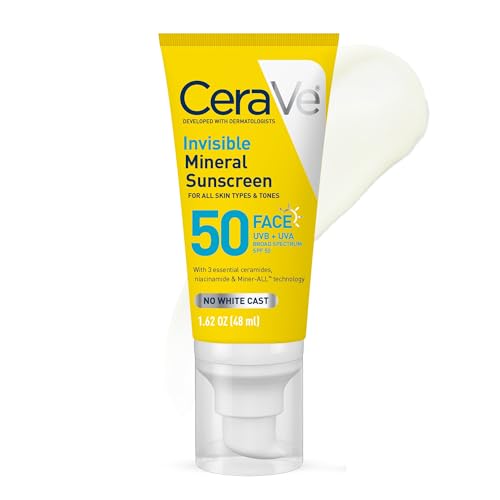
CeraVe Invisible Mineral Sunscreen SPF 50
A mineral face sunscreen that really does disappear, across skin tones, using finely milled zinc oxide and titanium dioxide. It also carries ceramides, niacinamide and vitamin E, so it doubles as the moisturizing step for a barrier that's been through too much.
$12.74fromAmazonList priceIt fixes the complaint that keeps people off mineral sunscreen. CeraVe's pitch is a 100% invisible finish on all skin tones, and that's the reason to buy it. If you've tried zinc formulas and hated the gray flatness in every photo, this is the one to try next. It's also invisible on beards, which almost no mineral sunscreen manages, since most of them collect in stubble and go white.
The barrier ingredients aren't decoration. You get CeraVe's three ceramides, plus niacinamide and vitamin E, in a formula the brand rates for 24 hours of hydration. Reactive skin is usually barrier-compromised skin, and a barrier that's rebuilding is a barrier that reacts less. If your skin is dry, eczema-prone or wrecked from over-exfoliating, this is doing two jobs at once.
It fits into the rest of your routine without a fight. It's fragrance-free, noncomedogenic and works as a hydrating primer under makeup. Nothing pills, nothing needs a waiting period beyond the usual half hour before sun. For most people the practical question isn't whether a sunscreen works in theory, it's whether it survives the four things you put on after it.
It costs a fraction of the premium face sunscreens. That's the real argument. The most protective sunscreen is the one you'll apply generously, and cheap product makes generous application easy. It's also FSA and HSA eligible, which takes another bite out of what you actually pay.
Flaws but not dealbreakers
The tube is small. This is the travel size, and at the amount you need for face and neck it runs out in a matter of weeks. That's fine if you're topping up a routine, less fine if it's your only sunscreen and you'd rather buy once a season. Keep an eye on it before a trip.
You have to shake it, every time. The filters settle, and CeraVe says so on the label. Skip the shake and you get patchy coverage — which means patchy protection, in a way you won't see until you burn in stripes. It's an easy habit, but it's an easy habit to forget when you're late.
Upgrade pick
Repair-focused protection for skin that's already sun-damaged
ISDIN Eryfotona Actinica SPF 50+
An ultralight, all-zinc emulsion carrying photolyase enzymes and vitamin E that ISDIN calls DNA Repairsomes, formulated to work on damage that's already there. It's the choice if a dermatologist has flagged precancerous spots or you spent decades outdoors without much cover.
$73fromAmazonIt's aimed at the damage behind you, not just the sun ahead. ISDIN's DNA Repairsomes contain photolyase, an enzyme that activates in light and targets the specific DNA lesions UVB creates. The brand's clinical work centers on reducing new actinic keratoses in high-risk patients. No other sunscreen here makes that claim, and if your dermatologist has been freezing spots off your face, it's the one worth asking about.
It's zinc oxide and nothing else. For genuinely sensitized skin, that single-filter simplicity is the point. There's no titanium dioxide, no chemical absorber and no fragrance to work around. If you've reacted to sunscreen before and you've never pinned down the culprit, a short mineral list gives you the fewest variables to argue with.
It doesn't feel like a mineral sunscreen at all. The emulsion is ultralight and absorbs within seconds, with no white cast — a genuinely hard trick for an all-zinc formula. Owners who need high protection but refuse anything heavy tend to land here. It layers under makeup and doesn't turn greasy through a hot afternoon.
The bottle lasts. It's a larger tube than most dedicated face sunscreens here, and used for the face alone it stretches across months rather than weeks. That softens the sting of buying it. If you're applying daily for medical reasons rather than cosmetic ones, the per-use cost looks a lot better than the sticker.
Flaws but not dealbreakers
It's the most expensive product here by a wide margin. There's no getting around that. Per ounce it costs several times what the CeraVe does, and the extra money buys the repair technology rather than better everyday UV protection.
Most people don't need what makes it special. If you're a healthy adult with sensitive skin who just wants protection that doesn't sting, the repair claim isn't doing much for you. It earns its keep for documented photodamage, a history of precancerous lesions or physician-confirmed risk. Otherwise, buy the EltaMD or the CeraVe and put the difference toward reapplying more often.
Also greatOn sale
Built for swimming, sweating and long days outdoors
Blue Lizard SENSITIVE Mineral Sunscreen with Zinc
A fragrance-free zinc oxide lotion at SPF 50+ with serious water resistance and a cap that turns blue in UV light. It's the tube to keep in a beach bag for the whole family, cast and all.
$8.97fromAmazonList priceIt's made for the day you'll sweat it off. Blue Lizard Sensitive carries the FDA's maximum 80-minute water-resistance rating, which is what you want for swimming, surfing or anything that involves a towel. Daily face sunscreens tend to slide off in that setting. This one is built to stay put, and it holds SPF 50+ broad-spectrum protection while doing it.
The cap is a better reminder than your phone. Smart Cap technology turns the lid blue when UV is present, which is a small, silly-sounding feature that solves the biggest real-world failure in sunscreen: nobody reapplies. Sitting on a picnic blanket, a blue cap in your line of sight does more than an alarm you'll swipe away.
The ingredient list is short and boring, in the best way. No chemical actives, no fragrance, no parabens, plus aloe to take the edge off. It's a hypoallergenic formula that has been a pediatrician staple for a long time, and a sunscreen safe enough for a toddler is usually safe enough for a reactive adult. It's also formulated without oxybenzone or octinoxate, so it's fine in reef-protection zones.
It stretches across a family without stress. It costs far less per ounce than the face picks, which means you can apply it as thickly as the label assumes and reapply after every swim. Generous application on a cheap sunscreen beats a thin smear of an expensive one, every time.
Flaws but not dealbreakers
It leaves a cast. This is a straightforward zinc lotion, and on medium-to-deep skin tones it shows. For a pool day that's a fair trade. For your face on a workday it isn't, and you should keep one of the face picks for that.
It needs real rubbing in. The texture is thicker than the ultralight formulas here, so it takes more work to spread evenly — and uneven application is how people end up with a burned stripe down one shin. Give it more time than you think you need, particularly on kids who won't sit still.
Who this is for
Buy from this guide if sunscreen has ever burned, itched, flushed your cheeks or broken you out — or if you've got rosacea, eczema, or skin that's healing from a peel, laser session or a long stretch on a retinoid. It's also for you if you're fair, photosensitive from a medication, or simply want the shortest ingredient list you can find. If your skin tolerates any sunscreen without complaint, you don't need to be here; you have more options and most of them cost less.
This guide covers face and body sunscreens sold as lotions, fluids and gels for sensitive skin. It doesn't cover sprays, sticks, powders or baby-specific lines, and it isn't medical advice. If you've had a real allergic reaction to a sunscreen, get patch-tested rather than guessing, and patch-test anything new on your inner forearm for a couple of days before it goes anywhere near your face.
How we picked
Filters: we started with mineral-only formulas built on zinc oxide or titanium dioxide, and let a chemical sunscreen through only when it was fully scentless and did something mineral can't. Fragrance: every pick is fragrance-free on its own label, with no parfum, no masking scent and no heavy botanical load. Protection: SPF 50 was the working bar for daily wear, and anything meant for a pool or a trail had to carry the 80-minute water-resistance rating. Finish: published reviews and owner feedback told us which mineral formulas actually disappear and which leave you gray in photographs. Barrier: ceramides, niacinamide and hyaluronic acid earned extra credit, because calmer skin over months beats a formula that merely avoids making things worse.
Other sunscreens for sensitive skin worth considering
If you want a body sunscreen for eczema-prone skin: The CeraVe 100% Mineral Sunscreen SPF 50 with ($16.97) — CeraVe's 100% Mineral Sunscreen for Body comes in a tube big enough to actually cover your arms, legs and back, which is where chemical filters cause the most trouble simply because there's so much skin involved. It uses zinc oxide and titanium dioxide only, and it's free of oxybenzone, avobenzone and benzene, so it's fine in Hawaii and other reef-protection zones. The ceramides and hyaluronic acid are the reason to pick it over Blue Lizard: dry, itchy, eczema-prone body skin gets a moisturizer in the same step. What you give up is elegance. It's a thick lotion, it goes white if you glob it on, and it feels heavy in real heat — so apply it thin and massage it in properly.
The competition
This is what our research turned up, not a census of every sunscreen on the shelf. Sensitive-skin SPF is a crowded category, and there are gentle formulas we haven't looked at. The product below is here because it's worth knowing about, even though it lost out to the picks for most reactive skin.
How to apply and reapply
Most sunscreen failures are application failures. Use roughly a quarter teaspoon for your face and neck, and about a shot glass for your whole body — most people use half that and get half the protection. Put it on 15 to 30 minutes before you go out, and reapply every two hours outdoors, plus immediately after swimming or toweling off, since a towel takes the layer with it. Shake any mineral formula before use, or the filters stay in the bottle. If rubbing a lotion into already-irritated skin makes things worse, a mineral powder brushed on or a hydrating SPF mist gives you a midday top-up without friction. And patch-test anything new on your inner forearm for a couple of days first.
Questions we get
Is mineral or chemical sunscreen better for sensitive skin?
Mineral is the lower-risk starting point. Zinc oxide and titanium dioxide sit on the surface and scatter UV rather than absorbing it, and they're the filters most often recommended for rosacea, eczema and post-procedure skin. Chemical filters aren't universally bad — a fragrance-free one like the Supergoop! here works fine for plenty of people. But if you're reacting and don't know why, switch to mineral first and change one thing at a time.
Which ingredients should I avoid?
Fragrance is the big one, and it hides under parfum, aroma, essential oils and botanical extracts. After that, oxybenzone and octinoxate are the chemical filters most often linked to allergic contact dermatitis. Parabens, PABA and formaldehyde-releasing preservatives are worth skipping too. Read the full ingredient list rather than trusting the front of the box, since hypoallergenic and dermatologist-tested aren't regulated claims.
Is SPF 50 actually worth it over SPF 30?
For fair or photosensitive skin, yes. SPF 50 blocks roughly 98% of UVB versus about 97% for SPF 30, which sounds trivial until you flip it: you're letting through about half as much UVB. Across a full summer, or if you're on a photosensitizing medication or have a history of precancerous spots, that gap matters. Five of the six products we recommend here meet or exceed SPF 50.
Why does my sunscreen sting my eyes if it's labeled for sensitive skin?
Usually it's chemical filters migrating with sweat or oil into the eye area, or alcohol in the base. A sensitive-skin label says nothing about what happens around your eyes. Mineral formulas sting far less there — apply a small amount along the orbital bone with your ring finger and stay off the waterline. If nothing is tolerable, sunglasses and a brimmed hat cover that skin without any product at all.
Can I use kids' sunscreen on my sensitive adult skin?
Yes, and it's often a good idea. Children's mineral formulas are held to strict fragrance-free, low-allergen standards because they're designed for the most reactive skin there is. Blue Lizard Sensitive is a pediatrician staple and works perfectly well on adults. The gap between baby and adult sunscreen is mostly marketing, not protection.
How do I reapply if touching my face sets off a reaction?
Reapply every two hours outdoors regardless, but change the method. A mineral powder SPF swept on with a soft brush or a hydrating SPF mist adds a layer without any rubbing. Don't massage fresh lotion into skin that's already inflamed. If reapplication itself keeps triggering flares, talk to your dermatologist about a powder-and-spray strategy.
Why you should trust us
For this guide:
- We read dermatologist guidance and published sunscreen reviews for this category, then compared each formula's active filters, fragrance status and water-resistance claims against its own labeling.
- We leaned on owner feedback for the things a spec sheet hides — white cast on deeper skin tones, pilling under makeup and how quickly a tube runs out at the recommended dose.
- We did not use, apply or evaluate any of these sunscreens ourselves.
- We read owner reviews on every listing, weighted toward the critical ones, because that is where the recurring failures show up.
- We have a systematic way of automatically fetching the latest prices, so the numbers on this page stay current.
- This is a research-focused guide, so the team may not own every product listed — though we often do own the top winners, which gives us extra context for the recommendations.
- We don't accept free products, and the retailer commission never changes which product we recommend.
Sources
Sunscreen FAQs — American Academy of Dermatology, American Academy of Dermatology (AAD)
EWG's Guide to Sunscreens 2025 — Environmental Working Group, Environmental Working Group (EWG)
The Best Sunscreens — Wirecutter, The New York Times, Wirecutter
Best Sunscreens for Sensitive Skin, According to Dermatologists — Healthline, Healthline
Skin Cancer Facts & Statistics — Skin Cancer Foundation, Skin Cancer Foundation
Amazon product listings and owner reviews for all 6 products
Manufacturer specification pages for each product
Some passages in this guide may be paraphrased with AI help. Prices are refreshed automatically.
More like this.
Continue exploring health reviews and recommendations.

The Best Moisturizers for Dry, Sensitive Skin
Dry, sensitive skin doesn't need a complicated routine. It needs the same boring cream, twice a day, especially right after a shower. A good moisturizer…

The Best Retinol Creams for Sensitive Skin
Retinol is the rare skincare ingredient with decades of clinical evidence behind it. It speeds up cell turnover, softens fine lines, and evens out tone…

The Best Sunscreens for Every Skin Type
Sunscreen only works if you actually wear it. That sounds obvious, but it's the whole ballgame. The American Academy of Dermatology says SPF 30 filters…

The Best Electric Toothbrushes for Sensitive Teeth
If your gums bleed when you brush, or a sip of cold water makes you wince, the problem often isn't the toothbrush - it's how hard you're pushing it.…

The Best Sunscreens for Outdoor Activities
Sunscreen for a long day outside has a different job than the stuff you dab on before the commute. It has to survive sweat running down your forehead, a…

The Best Mineral Sunscreens for Face
Sunscreen only works if you'll actually wear it. That's the whole game with a daily face SPF: it has to feel good enough that you reach for it on a gray…