The Best Yoga Mats and Accessories for a Home Practice
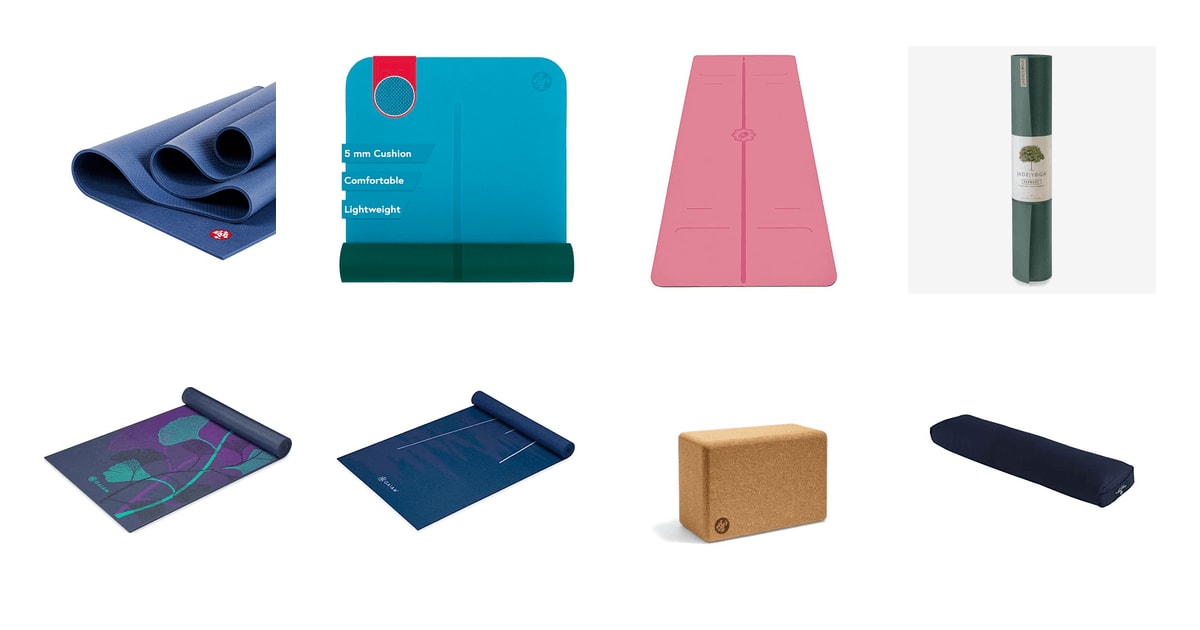
A yoga mat is the one piece of gear that touches every part of your practice. It decides whether your hands slide forward in downward dog, whether your knees complain in a long kneeling sequence, and whether you actually unroll it on a Tuesday night instead of skipping. Most people grab whatever mat is closest to hand and discover the problems later — a slick surface once their palms sweat, a spongy top layer that wobbles in tree pose, a plastic smell that lingers for weeks. The right mat quietly disappears under you.
Here's the honest catch: no mat does everything. Grip and cushioning pull against each other, so the mats that feel best on your knees tend to feel least stable on one foot. Natural rubber grips beautifully but weighs a lot and hates sunlight. Closed-cell surfaces stay hygienic but need a break-in period before they stop feeling slick. And nearly every mat, at any price, arrives with some off-gassing smell that takes days of airing out. You're choosing which compromise you can live with, not escaping the compromise.
We read manufacturer specifications, published reviews and owner feedback across mats, blocks and bolsters to sort out which trade-offs actually matter at home. We think that the Manduka PRO is the best yoga mat for most people, and that the Liforme Evolve is the one to buy if you sweat heavily or want alignment guides printed under your hands.
Everything we recommend

Dense cushioning and a mat that outlasts your interest in yoga

The grippiest surface here, with alignment marks to practice against

Plenty of cushion for a first mat, without the commitment

Natural rubber grip on hardwood, and no PVC anywhere

The prop that stops collapsing under you in arm balances
At a glance
| Product | Thickness | Weight | Price | |
|---|---|---|---|---|
| Manduka PRO Yoga Mat 71" - 6mmTop pick | 6mm | 7.5 lbs | $144On sale |
 | Manduka Begin Yoga Mat 68" - 5mmAlso consider | 5mm | 2.1 lbs | $59.98 |
| Liforme Evolve Yoga Mat - Patented AlignmentRunner-up | 4.2mm | 5.51 lbs | $165 |
| JadeYoga Harmony Yoga MatAlso great | 3/16 in | 5 lbs | $126.50 |
| Gaiam Premium Yoga MatBudget pick | 6mm | 3.08 lbs | $34.99 |
 | Gaiam Yoga Mat Classic PrintAlso in lineup | 4mm | 2.2 lbs | $21.23 |
| Manduka Yoga Block - Fine-Grain Cork BlockUpgrade pick | — | 2.2 lbs | $26 |
 | Hugger Mugger Pranayama Yoga BolsterAlso consider | — | 2.6 lbs | $78 |
How we picked
Grip, wet and dry. We compared surface materials and construction against published reviews and recurring owner feedback about sliding hands. Any mat that owners consistently describe as slick once they sweat couldn't be recommended for vigorous practice.
Cushioning versus stability. We looked at thickness alongside foam density, because a soft 6mm mat and a dense 6mm mat behave completely differently in balance poses. We wanted joint protection without a sinking, unstable feel.
Materials and safety. We checked manufacturer specifications for PVC, natural rubber, TPE and cork, plus certifications like OEKO-TEX Standard 100 and phthalate-free claims. Off-gassing complaints in owner feedback counted against a mat.
Durability and warranty. We weighed stated warranty terms against long-term owner reports of surface wear and compression. Published long-term testing showing PVC mats losing texture around 200 hours of use set our bar for what counts as durable.
Size and storage. We favored mats that come in lengths beyond the standard 68 inches, and noted weight for anyone in a small apartment who has to roll and stash a mat daily.
Top pickOn sale
Dense cushioning and a mat that outlasts your interest in yoga
Manduka PRO Yoga Mat 71" - 6mm
The PRO is 6mm of ultra-dense closed-cell foam that protects your knees without feeling squishy underfoot. It's heavy and it needs breaking in, but it comes with a lifetime guarantee and studios have been running the same ones for over a decade.
$144fromAmazonList priceDensity is what separates this mat from every cheap 6mm mat. Plenty of mats are 6mm thick. Most of them are also soft, which means your standing foot sinks and rolls and you fight for balance. The PRO's foam is packed tight, so you get joint padding in kneeling and reclined poses while your feet stay level in warrior. That combination is genuinely hard to find, and it's why teachers keep recommending it.
The lifetime guarantee is the part that changes the math. Manduka warrants the PRO for life, and owner feedback backs the claim up — people describe mats still in service after ten and fifteen years of regular practice. If you replace a budget mat every couple of years because the texture wears smooth, the PRO stops looking expensive fairly quickly. Long-term testing by Wirecutter found PVC mats losing measurable surface texture after roughly 200 hours; the PRO's density is built to resist that.
The surface is closed-cell, which means moisture sits on top instead of soaking in. Sweat, spilled water and general floor grime wipe off. Nothing works its way into the foam to grow into a smell later. That's a real advantage if your mat lives in a closet or a car trunk between sessions. Manduka also certifies the PVC to OEKO-TEX Standard 100, free of 362 restricted substances.
At 71 by 26 inches, it's wider and longer than the standard 68 by 24. If you're tall, or if you've ever put a hand down in a twist and found bare floor, those extra inches matter more than you'd guess. The underside uses a dotted no-slip pattern that keeps the mat planted on hardwood and tile without a rug underneath.
Flaws but not dealbreakers
You have to break it in. Straight out of the box the top surface is slick, and new owners often assume they got a defective mat. It takes a few weeks of regular use — some people speed it up by scrubbing it with coarse salt — before the grip comes in. If you want a mat that's grippy on day one, this isn't it.
It's heavy. At 7.5 pounds, the PRO is a mat you leave rolled in the corner of a room, not one you sling over your shoulder for a walk across town. And it's PVC, not rubber or cork, so if plastic-free materials are your priority you'll want to look at the Jade Harmony instead.
Once you're sweating hard, the closed-cell surface has nowhere to put the moisture and it gets slippery. Owners who do hot classes generally pair it with a towel. For non-heated practice at home that's rarely an issue.
The PRO carries a lifetime guarantee from Manduka.
Runner-up
The grippiest surface here, with alignment marks to practice against
Liforme Evolve Yoga Mat - Patented Alignment
The Liforme Evolve pairs a polyurethane top layer that grips harder as it gets damp with a printed alignment system under your hands and feet. It's the mat to get if you sweat through your practice or you're still learning where your limbs belong.
$165fromAmazonIf your hands slide, this is the fix. Liforme's polyurethane surface holds onto damp palms rather than turning glassy, which is the exact failure point of most PVC mats. Owners who practice hot yoga describe it as the mat that finally let them stop laying a towel down. That single property is worth more than any other spec if sweat is why you've been unhappy with your current mat.
The AlignForMe grid is more useful than it sounds. Liforme developed it with experienced teachers and maps over 20 standard alignment points onto the surface — a center line, foot placement markers, hand positions. If you practice alone at home with no one correcting your stance, those etched guides give you something objective to square up against. The Evolve version is a simplified take on the original grid, which is less visually busy.
At 72.8 by 26.8 inches it's the longest and widest mat in this guide, and at 4.2mm it splits the difference between padding and floor feel. You get enough cushion for wrists without the sinking wobble of a thick foam mat. It's PVC-free, built from eco-polyurethane over a rubber base, and it ships with a carry bag.
Compared with our top pick, the Evolve is the better choice for beginners and for anyone who runs hot; the PRO is better if you want maximum knee padding and a mat that will still be around in fifteen years. Neither is a mistake.
Flaws but not dealbreakers
The grip cuts both ways. Some owners find there's so much traction that repositioning a foot mid-flow means lifting it rather than sliding, and hands and hips can feel the floor more than they'd like at 4.2mm. If you have sensitive wrists or knees, that thinness is a real consideration.
The textured surface collects everything. Lint, pet hair and dust cling to it, and it doesn't wipe clean as easily as a smooth closed-cell mat. Plan on a soft brush or a damp cloth after most sessions.
It's expensive, and it's not covered by a lifetime guarantee the way the PRO is.
Budget pick
Plenty of cushion for a first mat, without the commitment
Gaiam Premium Yoga Mat
The Gaiam Premium gives you 6mm of padding and a sticky textured PVC surface for a fraction of what the premium mats cost. It's the sensible choice if you're not yet sure how much yoga you'll actually do.
$34.99fromAmazonFor a first mat, cushioning matters more than refinement. Beginners spend a lot of time on their knees, forearms and hips, and 6mm takes the sting out of a hard floor — ACE Fitness guidelines put a 6mm mat at roughly 40% more impact absorption than a 3mm one. The Gaiam's textured sticky surface holds well enough in dry conditions on hardwood, tile and carpet, which covers most home practice.
Nothing here is premium, and that's the point. The foam is softer than the Manduka PRO's, so you'll feel a little more wobble in balance poses, and it won't hold up for a decade. But it's a mat you can buy without deliberating, use for a year while you figure out whether you're a three-times-a-week person, and replace without regret. Owners describe theirs still looking new after a year of regular use.
It's also the mat to get if you care what your practice space looks like. Gaiam prints these in a wide range of patterns, and at 3 pounds it's light enough to roll up and stash behind a door in a small apartment. The PVC is free of the six restricted phthalates.
Flaws but not dealbreakers
It gets slippery once you sweat. Owner feedback is consistent on this — the sticky texture works dry and stops working wet, so it's a poor match for hot yoga or vigorous flow unless you add a towel.
Expect a plastic smell out of the box. Gaiam recommends unrolling and airing it out for two to three days before your first session, and that's honest advice rather than a formality.
The soft foam will compress and the surface texture will wear smooth with heavy use. Treat this as a mat with a shelf life, not a lifetime purchase.
Also great
Natural rubber grip on hardwood, and no PVC anywhere
JadeYoga Harmony Yoga Mat
The Jade Harmony is open-cell natural rubber, which grips hardwood floors better than any plastic mat and keeps working as your hands get damp. Jade plants a tree for every mat sold, and it's made in the United States.
$126.50fromAmazonRubber grips in a way PVC simply doesn't. The Harmony's open-cell natural rubber grabs the floor and grabs your hands, and it holds that traction on slick hardwood where sticky-textured PVC mats start to travel. Yoga Journal named it best for grip. If your practice space is a wood floor in a living room, this is the material difference that solves the problem.
It's the pick for anyone who cares about materials. There's no PVC, EVA or synthetic rubber in it — the rubber is tapped from rubber trees, and Jade has planted over a million trees through its partnership with Trees for the Future, one for each mat sold. The mat is made in the US, which is unusual in this category.
At 3/16 of an inch (about 5mm) and 5 pounds, it lands between the PRO and the Liforme on both padding and heft. It comes in 68- and 74-inch lengths, so taller practitioners aren't stuck hanging off the end, and there's a long list of color options.
Flaws but not dealbreakers
Natural rubber has a distinct smell when new. It fades, but it's stronger than the plastic smell of a PVC mat and some people never fully stop noticing it. It also rules the mat out if you have a latex sensitivity.
Sunlight destroys it. Liforme's own guidance notes that natural rubber degrades roughly four to six times faster in direct sun than PVC, as UV breaks down the polymer chains and causes surface cracking and grip loss. Store this one rolled up away from a window, not draped over a sunny balcony rail.
Because the surface is open-cell, it absorbs sweat rather than shedding it, so cleaning takes more care than a wipe-down. Skip the soaking and the harsh cleaners.
Upgrade pick
The prop that stops collapsing under you in arm balances
Manduka Yoga Block - Fine-Grain Cork Block
Manduka's fine-grain cork block gives you a support that doesn't compress when you put weight through it. It's the single accessory upgrade that changes how stable a half-moon or a jump-back feels.
$26fromAmazonFoam blocks squash, and that's the whole argument for cork. Cork registers around 8–12 lb/ft³ against EVA foam's 1.5–2.5, which makes it four to eight times less compressible. When you're pressing real body weight through a block in half moon or a jump-through, that difference is the gap between a solid platform and something that gives underneath you. Women's Health found cork blocks holding their full height after a year of daily use while foam blocks compressed 15 to 20%.
The extra weight is a feature, not a penalty. At 2.2 pounds the block stays where you set it instead of skidding across a hardwood floor when you reach for it, and the fine-grain surface gives your palm something to hold. The standard 4-by-6-by-9-inch shape means it works on all three faces for different pose heights.
Cork is also naturally antimicrobial, so it resists the smell that foam blocks pick up over time. Manduka sources the cork from renewable cork oak trees with no toxic chemicals in the process.
If you're brand new to yoga and mostly sitting, stretching and doing gentle standing poses, a foam block is fine and cheaper. This is the block to buy when you start putting weight on it.
Flaws but not dealbreakers
It's hard. Owners point out that pressing a knee or a forearm into cork in poses like lizard is less pleasant than resting on foam. If you want a block mainly for restorative propping, softness is actually the thing you want.
The weight that keeps it planted also makes it the wrong choice if you're carrying props to a studio across town. And a dropped cork block on a bare toe is memorable.
Cork can chip along the edges over years of hard use, though the rounded corners here help.
Who this is for
This guide is for anyone setting up or upgrading a practice at home. That's a much bigger group than it used to be — Yoga Alliance's Yoga in America Study found 37% of U.S. practitioners practicing exclusively at home, up from 17% before 2020. If you're buying your first mat, a budget 6mm mat and one block will get you a long way. If you already practice several times a week and your current mat has gone smooth under your hands, this is where the premium mats earn their keep. And if you're adding restorative or yin work, a bolster will do more for your practice than another mat.
You can skip most of this if you practice only at a studio that supplies mats, or if your interest is general floor exercise rather than yoga — for planks and ab work, cushioning is all that matters and any thick mat will do. We've focused on mats, blocks and bolsters. We haven't covered straps, wheels, mat towels or cleaning sprays, and we don't cover the specialty ultra-thin travel mats meant to fold into a suitcase.
How we picked
We built the shortlist around a handful of things that actually determine whether you like a mat six months in. Grip: the surface has to hold your hands dry and, for anyone who sweats, damp too — this is the most common reason people abandon a mat. Cushioning: thickness alone tells you little, so we weighed it against foam density, since a dense 6mm mat protects joints without the wobble of a soft one. Materials: we noted PVC, natural rubber, TPE and cork, along with certifications like OEKO-TEX and phthalate-free claims, and counted persistent off-gassing complaints against a mat. Durability: stated warranties matter, but so do owner reports of surface texture wearing smooth and foam packing down. Size and storage: we favored options longer than the standard 68 inches, and tracked weight for anyone stashing a mat behind a door every night.
Other yoga mats and accessories for a home practice worth considering
If you want to add restorative or yin yoga at home: The Hugger Mugger Pranayama Yoga Bolster ($78) — The Hugger Mugger Pranayama Bolster is the prop that makes passive practice work. It's a firm, narrow cylinder built to run lengthwise along your spine, which opens the chest and ribcage in a way no stack of pillows manages. Kapok-style firm fill is the key — soft bolsters sag under you within minutes and you end up unsupported. Owners describe theirs holding shape after years of daily use, and it's handmade in the US with upholstery-grade fabric and handles at both ends. The trade-off is that firmness: some people find it borderline hard at first and can only lie on it for a few minutes. It's also narrow, so it's better for chest openers, supported fish and propping under knees than for wide supported bridge work.
If you want a light beginner mat with an alignment stripe: The Manduka Begin Yoga Mat 68" - 5mm ($59.98) — The Manduka Begin is 5mm of TPE foam at just 2.1 pounds, with a center alignment stripe and a reversible two-color design. It's the easiest mat here to carry and to roll out, which genuinely matters if the reason you skip practice is that unrolling feels like a chore. Beginners report good grip in non-heated sessions and comfortable landings for knees. What you give up is grip under sweat — owner feedback is clear that vigorous or hot practice will have you sliding — and long-term durability, since TPE foam doesn't hold up like the PRO's dense PVC or Jade's rubber. Buy it as a light, forgiving starter mat rather than a mat you'll keep for a decade.
The competition
Here's what else we looked at from this lineup. This is the field our research surfaced, not a survey of every mat and prop sold — plenty of good gear from smaller brands didn't make it into the comparison.
The Gaiam Yoga Mat Classic Print ($21.23) — The Gaiam Classic Print is the 4mm version of our budget pick, in the same textured PVC with the same wide range of patterns. It's lighter, at about 2.2 pounds, and easier to roll and store. But 4mm is thin enough that owners regularly mention feeling the floor through it, and the off-gassing smell draws the same complaints as the 6mm — sometimes stronger. We'd steer most beginners toward the 6mm Premium for the extra padding. Choose this one if you're short on storage space, practice mostly standing sequences, and want a light mat you can carry easily.
Care and storage
How you store a mat matters more than how you clean it. Keep natural rubber out of direct sunlight — Liforme notes that UV breaks down rubber four to six times faster than PVC, causing surface cracking and grip loss over months. Roll it and put it in a closet, not on a sunny balcony. For closed-cell mats like the Manduka PRO, wipe the surface after practice with a mild mat wash; skip household cleaners and alcohol, which strip the surface and shorten its life. Open-cell rubber absorbs sweat, so wipe it down promptly and let it air-dry flat before rolling. Never soak or submerge a mat. Cork blocks need almost nothing — a damp cloth handles them, and cork's natural antimicrobial quality keeps odor down. Air out any new PVC mat for two to three days before the first session.
Questions we get
What thickness yoga mat is best for beginners?
Start at 5 or 6mm. ACE Fitness guidelines put a 6mm mat at roughly 40% more impact absorption than a 3mm one, and beginners spend a lot of time on their knees and forearms. Thinner mats around 3 to 4mm give you better balance feedback, but that's a trade you'll appreciate later. Density matters as much as the number — a dense 6mm mat feels far more stable than a soft one.
What's the best yoga mat for hardwood floors that won't slip?
Natural rubber is the answer here. The Jade Harmony's open-cell rubber grabs a wood floor in a way that sticky-textured PVC doesn't, which is why it's a common studio pick. If you'd rather have PVC, look for a mat with a purpose-built no-slip underside — the Manduka PRO uses a dotted bottom layer for exactly this. Either way, skip thin foam mats on hardwood.
What yoga accessories do I actually need to start a home practice?
A mat and one block cover most beginner needs. Blocks bring the floor closer to you in standing forward folds and triangle, which is the difference between a pose you can hold and one you can't. Add a bolster only if you're doing restorative or yin work — for that style, it's the single most useful prop you can own. Straps and wheels can wait until you know what your practice looks like.
Are cork yoga blocks better than foam blocks?
For anything weight-bearing, yes. Cork runs about 8–12 lb/ft³ against foam's 1.5–2.5, making it four to eight times less compressible, so it doesn't give under you in arm balances and half moon. Women's Health found cork blocks keeping their full height after a year of daily use while foam compressed 15 to 20%. Foam still wins if you want something soft to rest a knee on, or something light to carry.
What's the best yoga mat for hot yoga and heavy sweating?
Look for a polyurethane surface or natural rubber, not standard PVC. The Liforme Evolve's top layer holds grip when it's damp, which is why hot yoga practitioners keep landing on it. Closed-cell mats like the Manduka PRO seal moisture out, which is hygienic but means sweat pools on top — pair one with a mat towel if you run hot. Cheap textured PVC mats get slick fast and are the wrong tool for this.
How long does a yoga mat last before it needs replacing?
It depends entirely on the material and how often you practice. Wirecutter's long-term testing found PVC mats losing measurable surface texture after roughly 200 hours of use, while natural rubber mats showed no grip degradation at the same point. A budget foam mat used several times a week might last a year or two. A dense mat like the Manduka PRO, which carries a lifetime guarantee, can run a decade or more. Replace when the surface goes smooth and slick or the foam stops springing back.
Why you should trust us
For this guide:
- We read manufacturer specifications and certification claims for every mat, block and bolster here, including material composition, dimensions, weight and stated warranty terms.
- We compared published reviews and long-term durability findings from outlets including Wirecutter, Yoga Journal and Women's Health, alongside guidance from ACE Fitness and industry data from Yoga Alliance.
- We read owner feedback across each listing for recurring themes — break-in periods, off-gassing, wet grip and how props hold up over years — and used those patterns to shape the flaws and caveats in this guide.
- We read owner reviews on every listing, weighted toward the critical ones, because that is where the recurring failures show up.
- We have a systematic way of automatically fetching the latest prices, so the numbers on this page stay current.
- This is a research-focused guide, so the team may not own every product listed — though we often do own the top winners, which gives us extra context for the recommendations.
- We don't accept free products, and the retailer commission never changes which product we recommend.
Sources
The Best Yoga Mats of 2026 — Wirecutter, Wirecutter
Best Yoga Mats, Tested by Editors — Yoga Journal, Yoga Journal
Best Yoga Mats — Self Magazine, Self Magazine
Best Yoga Mats of 2026 — Well+Good, Well+Good
Best Yoga Mats Tested and Reviewed — Good Housekeeping, Good Housekeeping
Best Yoga Accessories to Elevate Your Practice — Healthline, Healthline
Best Yoga Blocks of 2026 — Women's Health, Women's Health
Yoga in America Study — Yoga Alliance, Yoga Alliance
Yoga Mat Market Size & Growth Forecast — Grand View Research, Grand View Research
How to Care for Your Yoga Mat — Liforme, Liforme
Yoga Equipment Selection Guide — ACE Fitness, ACE Fitness
Amazon product listings and owner reviews for all 8 products
Manufacturer specification pages for each product
Some passages in this guide may be paraphrased with AI help. Prices are refreshed automatically.
More like this.
Continue exploring lifestyle reviews and recommendations.

The Best Yoga Mats for a Home Studio
A yoga mat is the one piece of home fitness gear you touch with your whole body. Your palms slide on it in downward dog. Your knees press into it in low…

The Best Yoga Mats
A yoga mat is one of the few pieces of fitness gear you touch with your whole body. You kneel on it, sweat on it, press your palms into it while upside…

The Best Golf Practice Nets
A practice net does one useful thing: it lets you hit real golf balls without leaving your driveway. That's a bigger deal than it sounds. Twenty swings…

The Best Yoga Blocks
A yoga block is the least glamorous thing in your gear bag and probably the most useful. It brings the floor up to your hands in a standing forward fold.…

The Best Yoga Blocks and Props for Beginners
A yoga block is just a brick you can't fall through, and that's the whole point. When your hamstrings won't let your hand reach the floor in Triangle, a…

The Best Yoga Wheels
A yoga wheel is a simple thing: a rigid hoop with padding wrapped around the outside. You lie back over it, let it hold the arch of your spine, and…