The Best Allergy Relief Medications

Seasonal allergies wreck ordinary days. You wake up with a nose that won't stop running, eyes that itch through your morning meeting, and a head that feels packed with cotton. More than 60 million Americans deal with allergic rhinitis every year, which makes it the sixth most common chronic illness in the country, according to the CDC and AAAAI. The good news is that the drugstore aisle now holds medications that used to require a prescription. The hard part is knowing which one matches your symptoms.
Here's the honest catch: no single allergy product fixes everything. Oral antihistamines are quick and easy, but allergist guidelines from the ACAAI consistently rate nasal corticosteroid sprays as more effective for nasal symptoms. Sprays, though, take one to two weeks of daily use to reach full effect, per Mayo Clinic — so they're useless if you want relief this afternoon. And none of these treat the cause. They manage symptoms while pollen is in the air, and that's it.
Tree pollen seasons in the U.S. have stretched about 20 days longer since 1990, with peak spring concentrations up 21% in the Northeast and Midwest. So starting early matters more than it used to. We think that the Flonase Allergy Relief Nasal Spray is the best allergy relief medication for most people, and that the Allegra Adult 24-Hour tablets are the ones to buy if you need same-day, genuinely non-drowsy relief in a pill.
Everything we recommend

The most effective single product, if you start it early
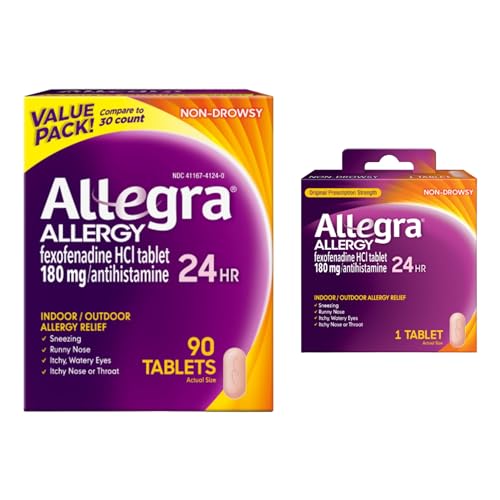
The pill to take when drowsiness isn't an option

Reliable non-drowsy coverage at the lowest cost per day

The strongest of the three pills, with a chance of sleepiness

Nasal steroid strength without the sting or the smell
At a glance
| Product | Active Ingredient | Count/Size | Price | |
|---|---|---|---|---|
| Allegra Adult 24-Hour Allergy Relief TabletsRunner-up | 180mg Fexofenadine | 91 Tablets | $39.99 |
| Zyrtec 24-Hour Allergy Relief TabletsAlso great | 10mg Cetirizine | 93 Count | $43.89 |
| Claritin Allergy Medicine for AdultsBudget pick | 10mg Loratadine | 100 Tablets | $44.97On sale |
| Flonase Allergy Relief Nasal Spray Fluticasone PropionateTop pick | Fluticasone Propionate | 72 Sprays | $16.74 |
| Nasacort 24-Hour Adult Allergy Nasal Spray Non-DrowsyUpgrade pick | — | 150 Sprays | $28.99 |
 | Extra Strength Pataday Once Daily Allergy ItchAlso consider | 0.7% Olopatadine | 2.5mL x 2 Pack | $26.83On sale |
How we picked
Clinical evidence. We prioritized products whose active ingredients appear in ACAAI guidelines and peer-reviewed comparisons, including a 2023 meta-analysis of 47 randomized controlled trials on antihistamine sedation. Marketing claims on a box carried no weight on their own.
Drowsiness profile. Daytime function is the reason most people abandon an allergy medication. We favored active ingredients with the lowest documented sedation above placebo and flagged the ones that could interfere with driving or work.
Symptom coverage. We looked for products that address the symptoms people actually complain about — congestion, itchy eyes, sneezing — rather than one narrow slice. Where a product covers only one symptom well, we said so.
Tolerability. A medication you stop using because it burns isn't working. We weighed additive-free and fragrance-free formulations, drawing on head-to-head tolerability comparisons and recurring themes in owner feedback.
Cost per dose. We compared count sizes and dosing frequency rather than sticker price, and we noted where a store-brand generic with an identical active ingredient makes more sense than the name on the box.
Top pick
The most effective single product, if you start it early
Flonase Allergy Relief Nasal Spray Fluticasone Propionate
Flonase is a nasal corticosteroid that calms the immune overreaction behind sneezing, congestion, runny nose, and itchy eyes. It's the closest thing to one-product coverage in the allergy aisle, and it's the category allergists reach for first.
$16.74fromAmazonA nasal steroid does more than an antihistamine pill, and the guidelines say so plainly. ACAAI clinical practice guidelines rate intranasal corticosteroids as more effective than oral antihistamines when used alone, and they cover nasal, ocular, and skin symptoms at once. In a Forbes Health survey of 200 licensed pharmacists, 71% recommend a nasal steroid as first-line therapy before adding a pill. That's about as close to professional consensus as over-the-counter medicine gets.
Congestion is where the gap shows up most. Antihistamines are good at sneezing and itching but weak on a blocked nose, which is why so many people end up reaching for a decongestant on top. Flonase handles congestion as part of its normal job. If your main complaint is that you can't breathe through your nose during oak or grass season, this is the shelf you want to be looking at.
The 72-spray bottle lasts a while at the standard one-to-two sprays per nostril each day. Dosing is once daily, so it fits into a morning routine next to brushing your teeth. It's labeled for adults and children 12 and older. Fluticasone is also the most prescribed allergy medication, so if a doctor has handed you a prescription spray before, this is likely the same molecule at the same strength.
The catch is patience. Mayo Clinic notes that nasal corticosteroids need one to two weeks of consistent daily use to reach full effect. Take one spray on a bad day and you'll conclude it doesn't work. Owners who love it are almost always the ones who started before the trees bloomed and kept going. Treat it like a daily habit for the season, not a rescue medication, and it earns its reputation.
Flaws but not dealbreakers
Flonase contains alcohol in its formulation, and some people find it stings or burns going in. Head-to-head tolerability data compiled by Drugs.com puts nasal burning and irritation reports about 40% higher for original Flonase than for alcohol-free budesonide. Owner feedback also mentions a faint scent and the occasional drip down the back of the throat.
Spray technique matters more than the box suggests. Aim toward the outer wall of your nostril, not straight up at the septum, or you'll get irritation and sometimes a nosebleed. Some owners also report that pump quality varies bottle to bottle, with one spraying a fine mist and the next feeling like a squirt.
It won't help you today. If you need relief in an hour for an unexpected trip to a friend's cat-filled apartment, reach for a pill instead.
Runner-up
The pill to take when drowsiness isn't an option
Allegra Adult 24-Hour Allergy Relief Tablets
Allegra uses fexofenadine, the one second-generation antihistamine with essentially no sedation signal in clinical trials. It starts working in about an hour and covers sneezing, runny nose, itchy eyes, and itchy throat for a full day.
$39.99fromAmazonIf you drive, operate anything, or just need your brain, fexofenadine is the safest bet. A 2023 meta-analysis of 47 randomized controlled trials published in the Journal of Allergy and Clinical Immunology found sedation in only 3.1% of fexofenadine users above placebo. Cetirizine came in at 13.5% and loratadine at 7.8%. For comparison, the University of Iowa Human Performance Laboratory found that older antihistamines like diphenhydramine impair driving about as much as a 0.05% blood alcohol level.
Onset is roughly an hour, which makes it useful in a way the nasal spray isn't. You can take it after you already feel the sneezing start. Owners describe it as their reliable everyday choice — small tablets, easy to swallow, no grogginess and no next-morning fog. The 90-count package plus a single travel tablet covers most of a pollen season for one person.
It handles the full outdoor spread: pollen, ragweed, grass, trees, dust, mold, and pet dander. If your symptoms live mostly above the neck but outside your nose — itchy eyes, itchy throat, endless sneezing — a pill like this does the job without the two-week ramp-up a spray needs.
One quirk worth knowing: fruit juice can cut absorption. Grapefruit, orange, and apple juice all interfere, so take it with water. That's a small ask, but it's the kind of detail that quietly explains why a medication seemed to stop working for someone.
Flaws but not dealbreakers
Antihistamines don't do much for congestion. If your nose is blocked rather than running, Allegra will leave that symptom largely untouched, and you'll want a nasal steroid alongside it.
It costs more than store-brand fexofenadine, which contains the identical active ingredient. You're paying for the name and the packaging. Some longtime users also report it seeming to work less well over time, though that's more often a heavier pollen season than true tolerance.
Budget pickOn sale
Reliable non-drowsy coverage at the lowest cost per day
Claritin Allergy Medicine for Adults
Claritin's loratadine is the antihistamine with the longest non-drowsy track record and the widest generic availability. A 100-tablet box covers most of a season, and store-brand versions of the same drug cost dramatically less.
$44.97fromAmazonList priceLoratadine has been over the counter longer than the others, and that maturity shows up in your wallet. Consumer Reports' bioequivalence analysis confirms store-brand loratadine performs identically to Claritin at 40% to 70% lower cost. If you're medicating a whole household through spring, that difference is real money. Buy the name brand for the packaging you trust, or buy the generic and pocket the savings — the tablet is the same.
It's the gentlest of the three on alertness, short of fexofenadine. The meta-analysis puts loratadine's sedation at 7.8% above placebo, comfortably below cetirizine. Owners describe taking it daily for years without grogginess. It's also approved for children 6 and up in this formulation, and loratadine is approved down to age 2 in children's versions, which makes it a common family-wide answer.
Coverage is the standard second-generation spread: sneezing, runny nose, itchy watery eyes, itchy nose and throat, across more than 200 indoor and outdoor allergens. A 100-count box at one tablet a day gets you through spring and well into summer. If you want to set it and forget it, this is the least fussy option in the guide.
The research is consistent that cetirizine, loratadine, and fexofenadine are similarly effective overall. What separates them is how your body responds. Loratadine is a sensible place to start precisely because it's cheap enough that switching costs you little if it doesn't suit you.
Flaws but not dealbreakers
Loratadine is generally considered the mildest of the three for severe symptoms. People with heavy pollen exposure often find cetirizine or a nasal steroid does more, and some owners report needing to move up when a season turns bad.
Onset is slower than cetirizine's roughly one hour, so it's less useful as a same-day rescue. Take it in the morning and give it time.
Check expiration dates on large-count boxes. Owners occasionally report receiving stock closer to expiry than they'd like, which matters when you're buying 100 tablets at once.
Also great
The strongest of the three pills, with a chance of sleepiness
Zyrtec 24-Hour Allergy Relief Tablets
Zyrtec's cetirizine works fastest and hits hardest among the second-generation antihistamines, and it's the one that also handles hives. The trade-off is a real chance of mild drowsiness, which some people turn into an advantage by dosing at night.
$43.89fromAmazonWhen symptoms are severe, cetirizine is usually the pill that finally works. It starts at about the one-hour mark and covers sneezing, runny nose, itchy watery eyes, and itchy nose or throat across more than 200 allergens. It's also the go-to among these three for hives and skin symptoms, which loratadine and fexofenadine handle less reliably. If milder antihistamines have left you still miserable, this is the logical next step.
The drowsiness is real but manageable. That 2023 meta-analysis put cetirizine's sedation at 13.5% above placebo — the highest of the second-generation group, though nowhere near first-generation territory. Plenty of owners report no sleepiness at all. Others take it at bedtime and wake up covered for the day. If you have a desk job and no commute, the risk is low. If you drive a truck, choose fexofenadine.
This package includes a 90-count bottle plus three single-tablet packs, which is a genuinely useful touch for a bag or glove box. Cetirizine is also suitable for children 6 and older at this dose. Like the others, it's usually HSA- and FSA-eligible.
One medical note that matters: cetirizine is cleared by the kidneys, so people with kidney impairment may need a reduced dose. Talk to a pharmacist if that applies to you. It's a two-minute conversation that's worth having before you commit to a 90-day bottle.
Flaws but not dealbreakers
Sedation is the headline drawback, and it's unpredictable — some people feel nothing, others feel foggy all morning. There's no way to know which group you're in without trying it.
Some longtime users report a rebound itch when they stop cetirizine after months of daily use. It's uncommon and temporary, but it's worth tapering rather than quitting cold if you've been on it all season.
Upgrade pick
Nasal steroid strength without the sting or the smell
Nasacort 24-Hour Adult Allergy Nasal Spray Non-Drowsy
Nasacort delivers triamcinolone with no scent and no harsh taste, which solves the single most common complaint about Flonase. It's the nasal spray for people who've tried one before and quit because of the burn.
$28.99fromAmazonPlenty of people abandon nasal sprays not because they don't work but because using them is unpleasant. The alcohol and fragrance in some formulations sting on the way in and leave a taste at the back of your throat. Nasacort skips both. Owners consistently describe it as the one they can actually tolerate every day, which matters enormously for a medication that only works if you take it daily.
Clinically, you're not giving anything up. Triamcinolone is a nasal corticosteroid like fluticasone, and it targets the same nasal congestion, sneezing, runny nose, and itchy nose without drowsiness. Nasacort's own labeling notes it contains the most doctor-recommended type of medicine for nasal allergy congestion. The choice between the two sprays is about tolerability, not effectiveness.
This package includes a 120-spray bottle plus a 30-spray bottle, 150 sprays in total, which is roughly double what the standard Flonase bottle holds. At once-daily dosing that covers a long season, and the second bottle travels well. The carton is recyclable, which is a small thing but a real one if you're buying several a year.
The same patience rule applies here. Owners note it takes a day or two to feel anything and one to two weeks to reach full strength, exactly as Mayo Clinic describes for the class. If you start in late winter, you'll be at full coverage when the trees let go.
Flaws but not dealbreakers
It costs more per bottle than the more common nasal sprays, and you're partly paying for the additive-free formulation. If Flonase doesn't bother your nose, you don't need to spend the difference.
Congestion relief builds gradually, so this is a poor choice for a sudden flare-up. Keep an antihistamine on hand for those days.
As with any nasal steroid, angling the spray at your septum can cause irritation or nosebleeds. Aim outward, toward your ear on that side.
Who this is for
This guide is for adults and older kids dealing with seasonal pollen allergies — the sneezing, congestion, runny nose, and itchy eyes that arrive with tree, grass, and ragweed season. It's also useful if you're managing year-round triggers like dust or pet dander. If you're switching from a prescription to something you can buy off the shelf, most of what used to require a doctor's note is now sitting in the allergy aisle at the same strength.
It's not for everyone. If you're pregnant, nursing, have high blood pressure, glaucoma, kidney problems, or take other daily medications, talk to a pharmacist or doctor before starting anything here — especially any product with a decongestant in it. We don't cover prescription options, allergy shots, or immunotherapy, and we don't cover children under 6, whose dosing differs enough that a pediatrician should make that call. If your symptoms include wheezing or shortness of breath, that's asthma territory and needs a doctor, not a drugstore aisle.
How we picked
Clinical evidence: We leaned on ACAAI guidelines, Mayo Clinic guidance, and peer-reviewed trial data rather than package claims. Drowsiness: We favored active ingredients with the lowest documented sedation above placebo, since daytime function is why most people quit an allergy medication. Symptom coverage: Congestion, itchy eyes, and sneezing are the complaints that ruin a day, and we preferred products that handle more than one. Tolerability: Burning and scent drive people to abandon nasal sprays, so alcohol-free and fragrance-free formulations earned credit. Cost per dose: We compared count sizes and dosing frequency, and we noted where a generic with the same active ingredient does the same job for far less.
Other allergy relief medications worth considering
If your eyes are the worst part: The Extra Strength Pataday Once Daily Allergy Itch ($26.83) — Oral antihistamines help itchy eyes, but they often miss the mark when your eyes are the main event. Pataday Once Daily Relief Extra Strength puts olopatadine 0.7% directly where the itching is, working both as an antihistamine and a mast-cell stabilizer. A randomized controlled trial published by the American Academy of Ophthalmology found it delivered significantly greater itch relief at 16 hours post-dose than ketotifen, with 84% of subjects rating it very effective. One drop covers a full day, and it's approved for ages 2 and up. The bottle is small for what it costs, and contact lens wearers need to remove lenses and wait 10 minutes before reinserting. But if watery, burning eyes are what's ruining your spring, this does something the pills can't.
The competition
Here's what our research surfaced in this category — not a complete map of every allergy product on the market. There are dozens of generics, combination products, and children's formulations we didn't evaluate. What follows is a listing that came up in our lineup but didn't earn a recommendation for seasonal allergy relief.
How to use these effectively
Timing is the thing most people get wrong. Nasal corticosteroid sprays need one to two weeks of daily use to reach full effect, so start one to two weeks before your local pollen season begins rather than after you're already miserable. Check a pollen forecast for your area and work backward. With sprays, aim the nozzle toward the outer wall of your nostril, away from the septum, and don't sniff hard — that pulls the medication straight down your throat. For pills, take fexofenadine with water rather than juice, which cuts absorption. The ACAAI-endorsed gold standard is a nasal steroid plus a non-sedating antihistamine together, and they're safe to combine. If you use a decongestant product, keep it to three to five days to avoid rebound congestion.
Questions we get
What is the best non-drowsy allergy medication for daytime use?
Fexofenadine, the active ingredient in Allegra, has the strongest case. A 2023 meta-analysis of 47 randomized controlled trials found sedation in just 3.1% of users above placebo, compared with 7.8% for loratadine and 13.5% for cetirizine. Nasal corticosteroid sprays like Flonase and Nasacort are also non-drowsy, since very little of the drug reaches your bloodstream.
Is Flonase or Zyrtec better for spring allergies?
For nasal symptoms, ACAAI guidelines rate nasal corticosteroids like Flonase as more effective than oral antihistamines used alone. Flonase also covers congestion, which Zyrtec largely doesn't. But Zyrtec works within about an hour, while Flonase needs one to two weeks of daily use to reach full strength. If you want relief today, take the pill; if you're planning for the season, start the spray.
Can I take Zyrtec and Flonase together?
Yes, and that combination is essentially the recommended approach. The ACAAI describes a nasal corticosteroid plus a non-sedating antihistamine as the gold standard for seasonal allergic rhinitis. The two work through different mechanisms, so they complement rather than duplicate each other. Check with a pharmacist if you take other daily medications.
Is generic cetirizine as effective as brand-name Zyrtec?
Yes. Generics contain the identical active ingredient at the identical dose, and Consumer Reports' bioequivalence analysis confirms store-brand versions perform the same as the name brands. Generic loratadine, cetirizine, and fexofenadine all cost roughly 40% to 70% less. The only real differences are tablet coatings, fillers, and packaging.
Should I take my allergy medicine in the morning or at night?
It depends on the drug. Fexofenadine and loratadine are non-sedating enough to take whenever you'll remember, so mornings work fine. Cetirizine causes mild drowsiness in some people, and taking it at bedtime turns that into an advantage while still covering you the next day. Nasal sprays work best on a fixed daily schedule — pick a time and stick to it.
Why do my antihistamines seem to stop working after a while?
True tolerance to second-generation antihistamines is not well established in the research. What's more often happening is that the pollen load went up. U.S. tree pollen seasons have stretched about 20 days longer since 1990, and peak spring concentrations have climbed 21% in the Northeast and Midwest. If a pill that used to work isn't cutting it, adding a nasal corticosteroid usually helps more than switching to a different pill.
Why you should trust us
For this guide:
- We compared active ingredients, dosing schedules, and label claims across every product in this lineup against published clinical guidance from the ACAAI and Mayo Clinic.
- We read peer-reviewed comparisons of antihistamine sedation and ophthalmic itch relief, along with pharmacist survey data and bioequivalence analysis on generics.
- We reviewed recurring themes in owner feedback — nasal burning, scent, onset speed, and drowsiness — to identify which drawbacks show up often enough to matter.
- We read owner reviews on every listing, weighted toward the critical ones, because that is where the recurring failures show up.
- We have a systematic way of automatically fetching the latest prices, so the numbers on this page stay current.
- This is a research-focused guide, so the team may not own every product listed — though we often do own the top winners, which gives us extra context for the recommendations.
- We don't accept free products, and the retailer commission never changes which product we recommend.
Sources
Pharmacologic Management of Allergic Rhinitis — American College of Allergy, Asthma & Immunology, ACAAI
Seasonal Allergic Rhinitis — American Academy of Allergy, Asthma & Immunology, AAAAI
Best Allergy Medicines of 2026 — Healthline, Healthline
OTC Allergy Medicine Reviews 2026 — Consumer Reports, Consumer Reports
Fexofenadine vs. Cetirizine vs. Loratadine: A Systematic Review — Journal of Allergy and Clinical Immunology, Journal of Allergy and Clinical Immunology
Allergy Medications Explained — Mayo Clinic, Mayo Clinic
Best Allergy Eye Drops 2026 — All About Vision, All About Vision
2025 National Allergy Forecast & Pollen Report — Pollen.com / IQAir, IQAir / Pollen.com
Levocetirizine vs. Cetirizine — Efficacy and Tolerability — Annals of Allergy, Asthma & Immunology, Annals of Allergy, Asthma & Immunology
Budesonide vs. Fluticasone Nasal Spray Comparison — Drugs.com Clinical Review, Drugs.com
Best Allergy Medications — Forbes Health 2026, Forbes Health
Olopatadine 0.7% vs. Ketotifen for Allergic Conjunctivitis — Ophthalmology, American Academy of Ophthalmology Journal
Amazon product listings and owner reviews for all 6 products
Manufacturer specification pages for each product
Some passages in this guide may be paraphrased with AI help. Prices are refreshed automatically.
More like this.
Continue exploring health reviews and recommendations.

The Best Inversion Tables for Back Relief
If your lower back aches by mid-afternoon, an inversion table is one of the simplest things you can try at home. You strap in your ankles, tip backward,…

The Best Products for Wrist Pain Relief
Wrist pain sneaks up on you. It starts as a dull ache after a long day at the keyboard, then it's pins and needles at 3 a.m., and eventually you're…

The Best Battle Ropes
A battle rope is one of the few pieces of home gym equipment that earns its floor space twice over. It's cardio and upper-body work at the same time, and…

The Best Workout Gloves and Lifting Grips
Your hands are the weak link in most lifts long before your back or legs are. Skin tears at the base of the fingers, calluses catch on knurling, and a bar…

The Best Under Desk Ellipticals
You sit more than you think. Between email, meetings and the occasional doomscroll, most desk days pass with your legs completely still. An under-desk…

The Best Grounding Mats
Most of us spend our days on floors that don't conduct anything. The EPA puts the average American's indoor time at roughly 90 percent, which means bare…