The Best Cold Air Intakes
A cold air intake is usually the first thing people bolt onto a truck or a commuter car, and it's easy to see why. It trades the factory airbox for a smoother tube and a much bigger filter, so the engine pulls air with less effort. You'll hear the change before you feel it — a deeper growl when you get into the pedal, and a throttle that wakes up a beat sooner. Most kits go on in an hour with a socket set. Nothing gets cut, and you can put the stock parts back whenever you want.
Now the honest part. No intake here turns a family SUV into a race car, and the horsepower numbers brands publish come from ideal dyno pulls, not your commute in July. Gains land in the single digits on most engines. Every one of these kits also parks a filter closer to road spray than the factory box did, so deep water is a real risk. And if you live in California or one of the states that follow its rules, a kit without an exemption number for your exact engine can fail a visual smog check.
So pick based on your engine bay, your state, and how much filter upkeep you'll actually do. A truck owner chasing towing grunt wants a different kit than someone who just wants a nicer sound on the way to work. We think that the K&N 57-2575 FIPK Performance Air Intake System is the best cold air intake for most people, and that the AEM 21-827C Cold Air Intake System is the one to buy if you want a no-oil filter or you're planning an ECU tune next.
Everything we recommend

The safe pick, with a filter you clean instead of replace

Nearly the same gains, with almost no filter upkeep

Most of the sound and some of the gain, for a lot less

The biggest gains here, if your engine bay has the room
At a glance
| Product | Price | |
|---|---|---|
| K&N 57-2575 FIPK Performance Air Intake SystemTop pick | $342.36 |
| Spectre Performance Air Intake Kit: High PerformanceBudget pick | $199.98 |
| aFe POWER Momentum GT Cold Air IntakeUpgrade pick | $428.01On sale |
| AEM 21-827C Cold Air Intake SystemRunner-up | $429.11On sale |
 | Polished SP Series Cold Air Intake byAlso consider | $378.98 |
How we picked
Real airflow gains. We compared manufacturer dyno claims against independent results published by shops and review sites, and we weighted the independent numbers more heavily. A kit had to show gains on its target platform, not just on a spec sheet.
Filter type and upkeep. We looked at whether the media is oiled cotton or dry synthetic, and how long each brand says you can go before service. Kits that avoid the MAF-contamination risk entirely got credit, especially for turbocharged vehicles.
Heat shield design. A fully enclosed housing keeps intake air near ambient; an open element in a hot bay can undo the whole point. We read spec sheets and product photos for each fitment to see how much of the filter is actually shielded.
Emissions compliance. We checked which kits carry CARB exemption numbers, since a visual smog inspection can fail a non-compliant intake on its own. Brands with deep, actively maintained exemption catalogs ranked higher.
Install and reversibility. We favored kits that bolt to factory mounting points with hand tools and no cutting or drilling. Owner feedback about missing hardware, poor fit, or rattles counted against a kit.
Top pick
The safe pick, with a filter you clean instead of replace
K&N 57-2575 FIPK Performance Air Intake System
The K&N 57-2575 FIPK is a vehicle-specific kit with a powder-coated heat shield, a washable cotton filter, and the broadest fitment catalog in the category. K&N lists an estimated gain of about 11 horsepower at 4,600 rpm, and the filter is built to be cleaned and reused.
$342.36fromAmazonK&N covers more vehicles than anyone else, which is why it's the default answer. The 57-Series catalog spans thousands of year, make, model and engine combinations, so there's a decent chance your car is in it with hardware built for that exact engine bay. That matters more than it sounds. A kit designed around your fender and manifold locations bolts up without spacers or zip ties, and it doesn't rattle six months later.
You clean the filter rather than replace it. The cotton gauze media is meant to be washed with K&N's cleaner, re-oiled, and put back in — the company puts the service interval around every 50,000 miles in normal driving, sooner if you spend time on dirt roads. Over a long ownership stretch, that's real money you don't spend on filter elements. It also means one less part to hunt down when you're already under the hood.
The heat shield is shaped for your engine bay, not a generic one. K&N powder-coats a shield sized to sit between the filter and the hot stuff — exhaust manifold on one side, radiator on the other. Open-element kits that skip this can end up sipping air that's hotter than what's outside the truck, which quietly cancels part of the benefit. It's the least glamorous piece in the box and the one doing the most work.
It sounds good without wearing you out. Published reviews of K&N intakes describe a fuller induction note under throttle that settles down at highway cruise, and owners say the same thing: meaner under load, unobtrusive on a long drive. If you want people to hear you pull away but you also spend two hours a day in traffic, that's the balance you want. Kits with fully open filters are louder and get old faster.
Flaws but not dealbreakers
Oiled filters punish sloppy maintenance. Put too much oil on the media after a wash and residue can migrate onto the MAF sensor's hot wire, which throws off fueling until the sensor gets cleaned. It isn't hard to avoid — follow the directions and go light — but it's a chore you don't have with a dry filter. If you know you'll skip the cleaning entirely, buy a dry-media kit instead.
The heat shield isn't equally enclosed on every fitment. Some applications get a nearly boxed-in filter, others get a shield that's more of a partial wall, and the listing won't always make that obvious. Check photos of your specific part number before you order. On a tightly packed engine bay, the difference shows up as warmer intake air on a hot day in stop-and-go traffic.
It costs a good deal more than the budget kits, and public owner feedback on this exact part number is thin. Most of what we can say comes from K&N's own specifications and from published reviews of the 57-Series line as a whole rather than from a deep pool of buyer reports on this listing. The brand's track record is long, but go in knowing the evidence here leans on the manufacturer.
K&N covers the filter with a million-mile warranty, and the media is designed to be cleaned and reused rather than thrown away.
Runner-upOn sale
Nearly the same gains, with almost no filter upkeep
AEM 21-827C Cold Air Intake System
The AEM 21-827C pairs low-restriction aluminum tubing with a heat shield and AEM's oil-free Dryflow filter, which the company rates for up to 100,000 miles before it needs cleaning. It's the pick if you want the performance without the oiling ritual.
$429.11fromAmazonList priceThe dry filter is the whole argument. AEM's Dryflow media traps grit mechanically, with no oil anywhere in the system, so there's nothing to migrate onto your MAF sensor. AEM rates it for up to 100,000 miles before it even needs washing, depending on how dusty your driving is. You wash it, you dry it, you put it back. For anyone running a turbo, skipping filter oil entirely is the cautious call.
The heat shield has edge trim, which is a small detail that matters. That lining lets the shield seat against the hood or fender without buzzing or wearing a shiny spot into your paint. Combined with the mandrel-bent aluminum tube, you get a kit that looks installed rather than added on. Aluminum also holds its shape better than plastic tubing when the engine bay gets hot on a long climb.
Tuners like AEM for a reason. Calibrators working with Cobb, HP Tuners and EFI Live routinely spec AEM intakes because the airflow behavior is predictable, which makes the MAF transfer function easier to model. If a tune is step two of your build, starting here saves the dyno some guesswork. That's worth more than a couple of peak horsepower you'd never feel on the street.
AEM keeps one of the deepest CARB exemption catalogs in the aftermarket. If you're in California or one of the states that follow its rules, that's not a nice-to-have — a smog technician can flag a non-compliant intake on a visual check even if your tailpipe numbers pass. Look up your exact year, make, model and engine code, not just the brand, before you buy anything.
Flaws but not dealbreakers
Peak gains sit in the middle of the pack. Published figures for the 21-Series land in the same range as the K&N and well below what the aFe does on big truck engines, and the AEM isn't a budget kit. You're paying for the compliance paperwork and the no-oil filter, not for the biggest number.
Some fitments use an open or half-enclosed shield. On those applications, intake air temperatures climb when you're sitting in traffic on a hot day, which eats into the point of a cold air intake. Check what your part number actually includes.
Replacement Dryflow elements are harder to grab locally. Chain parts stores stock K&N cotton filters almost everywhere; AEM's dry media usually means an online order and a wait. Owners also describe AEM's customer service as slower to respond than K&N's when a part is missing from the box.
Budget pick
Most of the sound and some of the gain, for a lot less
Spectre Performance Air Intake Kit: High Performance
The Spectre SPE-9900 is built for GM full-size trucks and SUVs — Silverado, Tahoe, Suburban, Sierra, Yukon, Escalade and Avalanche. Spectre claims up to 50% more airflow than the stock box, and the washable cotton filter and polished aluminum tube punch above the price.
$199.98fromAmazonSpectre is a K&N company, and it shows in the filter. You get the same cotton gauze approach, washable and reusable, in a kit that costs a fraction of the K&N. Spectre gets there by simplifying the heat shield and standardizing parts across applications rather than by cheapening the filtration. If your budget stops well short of the premium kits, this is the honest way to get in.
The airflow claim is the point on an old GM truck. Spectre says the kit moves up to 50% more air than the restrictive factory box and tube, and full-size GM trucks are exactly where stock intake plumbing is most compromised. Owners of these platforms report better throttle response and less struggle on uphill pulls with a trailer, which is the kind of gain you actually notice.
Polished aluminum tubing at this price is unusual. Most budget kits use plastic tube, which works fine but flexes and holds heat differently under sustained load. Aluminum stays rigid and looks like something you paid more for. Pop the hood at a meet and nobody guesses what it cost.
It's an easy first mod. The kit bolts to factory mounting points with hand tools and no permanent changes, so you can put the stock airbox back before a sale or an inspection. If you've never modified a vehicle before, this is a low-stakes way to learn what a bolt-on actually feels like.
Flaws but not dealbreakers
There's no fully enclosed heat shield on most configurations. Under sustained load the filter can pull warmer underhood air, which trims the benefit right when you want it — towing up a grade in summer. The aFe's sealed box is the opposite approach and the reason it gains so much more.
Gains are modest and fitment is narrow. This part number is a GM truck and SUV kit, full stop, and the improvement lands in the low single digits rather than the double digits. Spectre also carries fewer CARB exemption numbers than AEM or K&N, so verify compliance for your engine before you order if you're in a regulated state.
The filter is oiled, so the MAF caution applies here too. Cleaning and re-oiling is part of ownership, and going heavy with the oil can foul the sensor. It's a manageable job, but it's a job.
Upgrade pickOn sale
The biggest gains here, if your engine bay has the room
aFe POWER Momentum GT Cold Air Intake
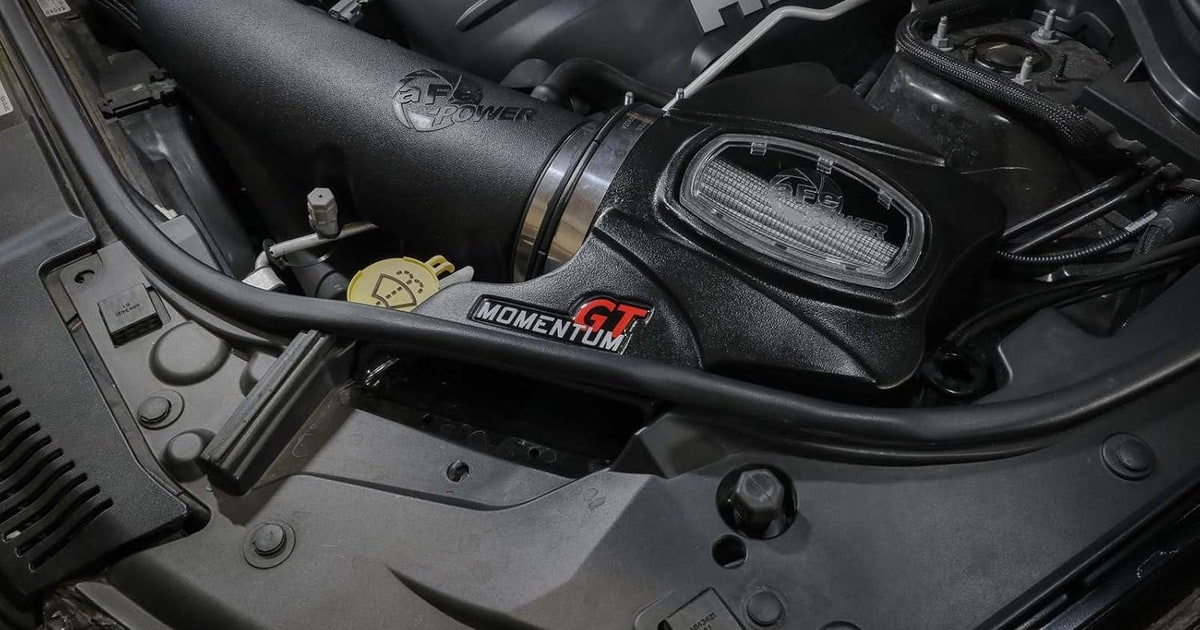
The aFe Momentum GT seals a huge Pro DRY S synthetic filter inside a roto-molded housing, so the engine draws almost nothing but outside air. It's 50-state legal under CARB EO# D-550-58 and it's the most expensive kit in this guide.
$428.01fromAmazonList priceThe fully sealed housing is what separates this from everything else. Instead of a shield that blocks part of the heat, aFe boxes the filter into a molded enclosure fed from outside the engine bay. That's why independent dyno reports on GM and Ram V8 trucks land so much higher than the rest of this group, with the torque showing up in the mid-range where towing and highway passing actually live.
The Pro DRY S filter never needs oil. No oil means no chance of residue reaching a MAF sensor, a turbo compressor wheel, or an intercooler core. If you're running boost, that peace of mind is worth more than the last few CFM an oiled filter might flow. aFe also sells other media in the same housing if you'd rather have the oiled version or extra dust protection for desert driving.
It's 50-state legal, which is rare at this power level. The listing carries CARB EO# D-550-58, so a smog technician's visual inspection won't flag it. Most kits that chase maximum airflow give up compliance to get there. This one doesn't, and that combination is the reason it earns the upgrade slot rather than just the loudest-number slot.
The build quality is the nicest in this group. Mandrel-bent aluminum tubing, patented housing design, and a sight window in the box so you can eyeball the filter's condition without pulling anything apart. That window sounds like a gimmick until it's the difference between checking your filter in ten seconds and putting it off for another month.
Flaws but not dealbreakers
That sealed box is big, and tight engine bays don't always take it. Measure before you commit. Owners on cramped applications report having to move or trim adjacent components to get clearance, which is not what you want on a Saturday afternoon.
The dry filter gets replaced, not washed forever. Pro DRY S media has a service life measured in tens of thousands of miles and then it's a new element, unlike the K&N cotton that keeps going as long as you clean it. Over a decade of ownership, that flips some of the math.
Fitment coverage is narrower and the install takes longer. aFe concentrates on GM, Ram and select import platforms, so your vehicle may simply not be in the catalog. And there are more steps and torque specs here than on the other kits — figure on a longer session with the instructions actually open in front of you.
Who this is for
Buy one of these if your vehicle has a restrictive factory airbox and you want a modest, reversible bump in throttle response and sound for about an hour of work. Truck and older domestic V8 owners see the most benefit, because that's where the stock intake path is most compromised. If you tow, the mid-range response is the part you'll feel. And if a tune is on your list, an intake is a sensible first step that gives the calibrator something to work with.
Skip it if you're expecting a transformation, if you regularly drive through standing water where a low-mounted filter could swallow it, or if you're in a smog-checked state and can't confirm an exemption number for your exact engine. This guide covers bolt-on cold air intakes for gasoline engines — kits that move the filter away from engine heat. We're not covering short ram intakes, which park the filter in the hot engine bay, and we're not covering forced-induction upgrades or replacement filter elements sold on their own.
How we picked
Airflow gains: we leaned on independent dyno results published by shops and reviewers over manufacturer claims, and expected a kit to prove itself on the platform it's built for. Filter media: we noted whether the element is oiled cotton or dry synthetic, how long it goes between services, and whether it carries any risk of fouling a MAF sensor. Heat shielding: a sealed housing keeps intake air close to ambient, while an open filter in a hot bay can give back much of the benefit, so we checked how enclosed each kit really is. Emissions: kits with CARB exemption numbers ranked higher, because a visual inspection can fail a non-compliant intake by itself. Install: we wanted bolt-on fitment with hand tools, no cutting, and a clean path back to stock.
Other cold air intakes worth considering
If you want the smoothest daily-driver manners: The Polished SP Series Cold Air Intake by ($378.98) — The Injen SP Series is tuned for the throttle openings you actually use. Injen's MR resonance design targets partial-throttle airflow instead of chasing peak numbers, so merging and city driving feel more immediate without any drone at cruise. The dry filter needs no oil, and the polished tube looks great under the hood. Injen rates it at up to 8 horsepower and 8 lb-ft, dyno proven, which is the lowest figure in this guide — you're trading peak power for refinement. Fitment is narrow, too: this part number is for the Hyundai Elantra and Kia Forte with the 2.0-liter four, and only for cars with a MAF sensor. Check Injen's compliance list if your state does visual smog inspections.
The competition
This is what our research turned up, not a census of the market. Cold air intakes are sold by dozens of brands in hundreds of vehicle-specific part numbers, and the right kit for you is as much about what fits your engine bay as about which company made it. We focused on the systems that come up repeatedly in published reviews and owner discussion, that publish real airflow or dyno data, and that can be installed and reversed without permanent modification. Every product we looked at for this guide ended up as a pick or an alternate above — none were weak enough to warrant a warning, but none of them fits every vehicle either, so start by confirming your exact year, make, model and engine before you shop by brand.
Installation notes
Plan on an hour with a socket set, a screwdriver and pliers. Disconnect the battery first, unplug the MAF sensor carefully by the connector rather than the wire, and never touch the sensor's hot wire with your fingers or a rag. Seat the silicone couplers fully before you snug the clamps, and stop when they're tight — overtightening deforms the coupler and creates a vacuum leak that'll drive you crazy later. After the install, expect a slightly rough idle for two or three drive cycles while the ECU relearns its fuel trims. That's normal. If you've got an oiled filter, clean and re-oil it on the brand's schedule and go light on the oil. And in heavy rain or deep water, remember the filter now sits lower than the factory box did.
Questions we get
How much horsepower does a cold air intake actually add?
On a naturally aspirated engine, figure roughly 5 to 15 horsepower from a well-designed kit, with the sealed aFe housing documented in the high teens to low twenties on big V8 trucks. The gains are largest where the factory airbox is most restrictive, which usually means trucks, SUVs and older domestic V8s. Turbocharged engines show smaller peak gains from an intake alone, but often respond with quicker spool and cooler compressor inlet temperatures.
Will an intake void my factory warranty?
No, not by itself. Under the federal Magnuson-Moss Warranty Act, a manufacturer can't void your warranty just because you installed an aftermarket part — they have to show that the part caused the failure they're refusing to cover. Emissions compliance is a separate issue, though: a non-compliant intake can fail a smog inspection regardless of any warranty question. A CARB-exempt kit gives you the strongest footing on both fronts.
What's the difference between a cold air intake and a short ram intake?
A cold air intake moves the filter away from engine heat — lower in the bay, behind the bumper or inside a fender — so it draws cooler, denser outside air. A short ram just replaces the tube between the throttle body and the airbox, leaving the filter sitting in the hot engine bay. Short rams are cheaper, simpler and louder, but they breathe warm air under sustained driving. Cold air kits win on both power and intake temperatures, at the cost of more exposure to water.
Do I need an ECU tune after installing one?
For a standalone intake on a modern car with closed-loop fuel management, no. The ECU adapts its long-term fuel trims within two or three complete drive cycles, and any rough idle in that window sorts itself out. If you're stacking the intake with headers, a camshaft or an exhaust, get a proper calibration to capture the combined gains safely. Turbocharged vehicles benefit most from a tune, since the calibrator can adjust boost and fueling around the improved inlet conditions.
Should I choose an oiled or a dry filter?
Oiled cotton flows a bit more air at peak and can be cleaned and reused essentially forever, which is the K&N and Spectre approach. Dry synthetic media — aFe's Pro DRY S, AEM's Dryflow, Injen's element — needs no oil at all, so there's zero chance of residue fouling your MAF sensor, but the element eventually gets replaced instead of washed. If you're running a turbo or supercharger, go dry. For a naturally aspirated daily driver, pick whichever maintenance routine you'll actually keep up with.
Can an intake improve my fuel economy?
Sometimes, by a small margin, and it depends entirely on how you drive. The engine works a little less to pull air past the stock restriction, and a crisper throttle can mean less pedal for the same acceleration — the Injen's partial-throttle tuning is the most deliberate attempt at this in the group. Owners who adapt their driving report modest highway gains. Owners who enjoy the new sound and get into the throttle more often report the opposite.
Why you should trust us
For this guide:
- We read the manufacturer spec sheets and listing details for every kit here, including filter media type, tubing material, heat shield design and CARB exemption status.
- We compared published dyno figures from independent shops and review sites against each brand's own claims, and gave more weight to the independent numbers.
- We reviewed owner feedback themes across these intakes for recurring complaints about fit, MAF sensor contamination and heat soak, and used those patterns to shape the flaws in each pick.
- We read owner reviews on every listing, weighted toward the critical ones, because that is where the recurring failures show up.
- We have a systematic way of automatically fetching the latest prices, so the numbers on this page stay current.
- This is a research-focused guide, so the team may not own every product listed — though we often do own the top winners, which gives us extra context for the recommendations.
- We don't accept free products, and the retailer commission never changes which product we recommend.
Sources
Best Cold Air Intakes 2026 — Motor Trend Tested, Motor Trend
Cold Air Intake Dyno Tests and Reviews — Car and Driver, Car and Driver
K&N Cold Air Intake Testing and Flow Data, K&N Engineering
aFe Power Momentum GT Dyno Results and Technical Data, aFe Power
AEM Induction Systems CARB Exemption Database, AEM Induction Systems
Cold Air Intake Buyer's Guide — Summit Racing, Summit Racing
Intake Air Temperature Effects on Engine Performance — SAE International, SAE International
Best Aftermarket Air Intakes: Independent Dyno Results — AutoAnything, AutoAnything
Amazon product listings and owner reviews for all 5 products
Manufacturer specification pages for each product
Some passages in this guide may be paraphrased with AI help. Prices are refreshed automatically.
More like this.
Continue exploring electronics reviews and recommendations.

The Best Cold and Flu Home Care Kits
A cold never schedules itself. It shows up on a Sunday night, and by Monday you're deciding whether you can get through a call without sounding like…

The Best Cold Therapy Knee Wraps
A knee that's just been operated on, twisted on a trail run, or flared up after a long day swells fast. Cold slows that down. But how you deliver the cold…

The Best Cold-Weather Dog Coats
Cold hits some dogs much harder than others. A husky can nap in the snow. A whippet starts shivering on a 40-degree sidewalk, and a 12-year-old terrier…

The Best Cold Water Surfing Wetsuits
Cold water finds every gap. A suit that feels fine in September can turn a February session into ten shivering minutes and a long walk back to the car.…

The Best Cold Plunge Tubs
Cold plunging is simple in theory and annoying in practice. You want water somewhere in the 50s, you want it there when you finally have ten free minutes,…

The Best Cold Press Juicers
A cold press juicer crushes produce slowly instead of shredding it at high speed. That means less foam, less heat, and juice that holds its color and…