The Best Knife Sets
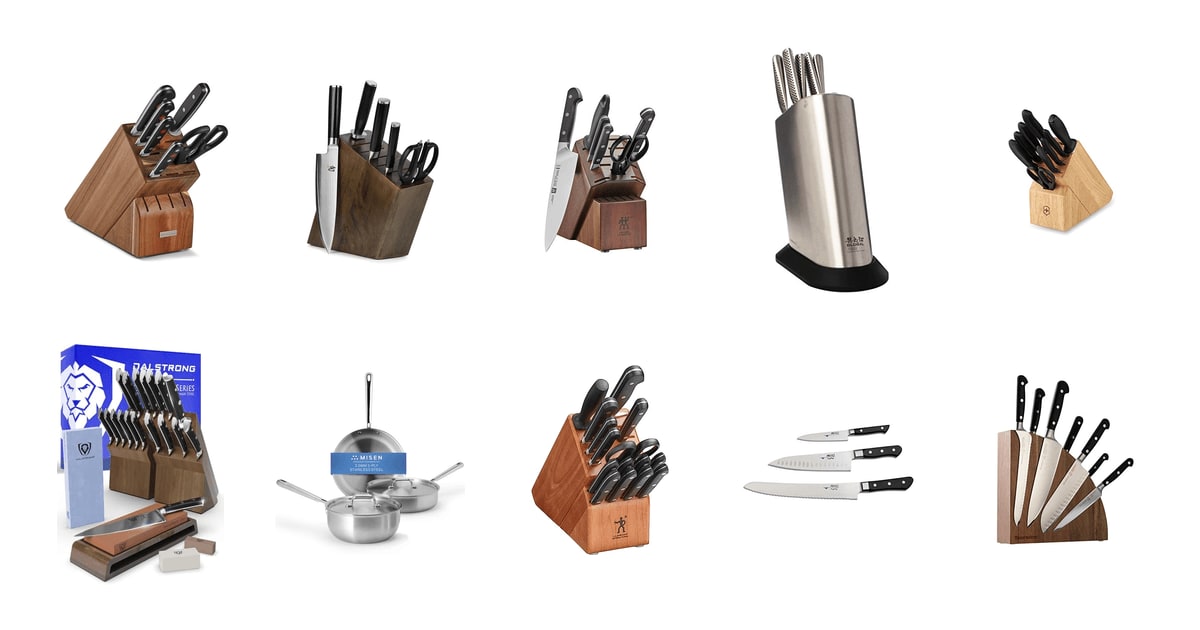
You touch your knives every time you cook. They're the difference between prep that moves and prep that drags. A sharp chef's knife walks through an onion in a few strokes; a dull one crushes it, stings your eyes, and skates off a tomato skin. Sets make sense because most kitchens need more than one blade — something big for breaking down produce, something small for coring strawberries, something serrated for a crusty loaf. Buy well once and you're set for a long time.
Here's the part no brand puts on the box: every knife in every set here goes dull. Steel wears, and no alloy, coating or grind stops it. So the real question isn't which set arrives sharpest, because they all arrive sharp. It's which one you'll keep sharp. Piece counts don't help either. Big sets pad the number with steak knives and specialty blades you'll rarely touch, and the three knives you reach for daily get whatever budget is left.
We read through spec sheets, published reviews and owner feedback, then sorted these sets by how they're built and what they actually cover. The short version: German steel forgives more, Japanese steel cuts finer and asks more of you, and a tight seven-piece set beats a padded fifteen nearly every time. We think that the WÜSTHOF Classic Seven Piece Knife Block Set is the best knife set for most people, and that the Victorinox Swiss Classic 10-Piece is the one to buy if you'd rather put your money into steel than into a showpiece block.
Everything we recommend

Forgiving German steel that sharpens easily and lasts decades

Nearly the same German steel, with a better grip at the bolster

Restaurant steel and easy sharpening, with plain-looking handles

A sharper, more delicate edge, if you'll learn the whetstone
At a glance




How we picked
Blade steel and hardness. We compared published hardness figures and alloy details across every set, because they predict how long an edge lasts and how easily it chips. German steel in the mid-to-high 50s HRC and Japanese steel at 60 and above represent two different bargains, and we wanted both represented.
Forged or stamped. We noted how each blade is made, since forging produces denser grain and better balance while stamping produces lighter, cheaper knives. Stamped construction wasn't disqualifying — from a maker like Victorinox or MAC it's excellent — but at similar prices from the same brand we favored forged.
Edge angle and upkeep. We looked at the grind angle and what it takes to maintain it at home. A set that needs specialized equipment had to justify that with a real cutting advantage.
Pieces you'll actually use. We counted core knives rather than total pieces, since a chef's knife, paring knife and bread knife handle the overwhelming majority of home cooking. Sets padded with steak knives lost ground against smaller, better-curated blocks.
Handles and storage. We weighed handle material for grip security and long-term stability, and checked that each block protects edges without swallowing the counter. Owner feedback about loose rivets, slippery grips and cracked handles carried real weight here.
Top pick
Forgiving German steel that sharpens easily and lasts decades
WÜSTHOF Classic Seven Piece Knife Block Set
This is the seven-knife lineup most kitchens actually need, forged in Solingen from a single piece of high-carbon stainless steel. It's tough enough for chicken joints and winter squash, simple to keep sharp at home, and backed by a limited lifetime warranty.
$435fromAmazonThe seven pieces here are the seven you'll use. You get a 3.5-inch paring knife, a 6-inch utility, an 8-inch bread knife, an 8-inch cook's knife, a 9-inch honing steel, kitchen shears and a wood block. That's the whole job. Nothing in this set exists to make the number on the box look bigger, and the block has empty slots if you later want a boning or carving knife.
Forged construction is why it feels balanced instead of just heavy. Each blade is precision-forged from one piece of steel, then set into a full-tang handle with three rivets. You feel it the moment you pinch the blade at the bolster — the knife sits where your hand wants it. That balance is what keeps your wrist from doing all the work through a big pile of onions.
The 20-degree edge forgives imperfect technique. It's less acute than a Japanese blade, which means it takes a bit more pressure through a ripe tomato. It also means you can hit a chicken joint or a dense sweet potato without worrying about chipping. If you cook the way most people cook — a little of everything, not much ceremony — that trade is worth making.
Keeping it sharp is genuinely easy. Thirty seconds on the honing steel before you start cooking realigns the edge and buys you weeks between real sharpenings. When it does need more, a 20-degree whetstone, a pull-through or a mail-in service all work. Japanese sets don't give you that many options.
It's built to still be here in twenty years. Synthetic handles don't crack or swell the way loose hardwood can, the rivets don't work free, and Wüsthof will repair or replace a knife with a manufacturing defect. Owners who've had these blocks for a decade or more describe the same knives doing the same work, just thinner from sharpening.
Flaws but not dealbreakers
It's a lot of money up front for knives. Several sets in this guide cost roughly half as much and will chop an onion just fine. What you're paying for is grain structure, balance and a warranty that outlives most kitchens — real things, but slow-burning ones. If you cook twice a week and mostly reheat, you won't feel the difference enough to justify it.
It won't give you paper-thin slices. The 20-degree grind is a durability choice, and it costs you acuity. If you break down whole fish, shave fennel for salads, or care about how thin you can get a cucumber, a Japanese set will do that better. This one just won't, no matter how well you sharpen it.
The block takes real counter space. It's a wide, deep footprint, and it's not slim or wall-mounted. In a small galley kitchen you'll notice it every day.
Wüsthof backs the Classic set with a limited lifetime warranty against manufacturing defects.
Runner-up
Nearly the same German steel, with a better grip at the bolster
ZWILLING J.A. Henckels 7-pc ZWILLING Pro Knife
Zwilling's Pro line is forged from a single piece of steel and ice-hardened, and its curved bolster is shaped around the pinch grip professionals use. It covers the same seven jobs as our top pick, usually for less, with a little less name recognition.
$369.95fromAmazonThe curved bolster is the reason to pick this over a conventional German set. Most bolsters are a straight vertical wall, which quietly fights the grip where you pinch the blade between thumb and forefinger. Zwilling curves it out of the way. Over a long prep session — a big batch of soup, a holiday side dish marathon — your hand stays where it should be instead of creeping back onto the handle.
SIGMAFORGED construction means there's nothing joined together to fail. Each blade starts as one piece of special-formula steel rather than a blade welded to a bolster. That's the same idea behind our top pick, and it produces the same result: consistent grain, predictable balance, and a knife that keeps its geometry through years of sharpening.
Friodur ice-hardening is a real process, not a label. Zwilling deep-freezes the steel during heat treatment, which improves hardness and corrosion resistance. In practice, you get blades that shrug off acidic prep — lemons, tomatoes, brined things — without the spotting that shows up on cheaper stainless.
The seven pieces cover a full kitchen with no filler. Full-tang, triple-riveted POM handles run through the set, and the block holds everything without leaving you a row of steak knives you'll never pull out. If you want German quality and you don't need the Wüsthof name on the block, this is the more sensible buy.
Flaws but not dealbreakers
The Amazon listing is a mess. It describes the material as aluminum, which is simply wrong — these are high-carbon steel blades — and the bullet list barely describes the product at all. That's a data entry problem rather than a manufacturing one, but it does mean you can't confirm much from the listing itself.
Sharpening all the way to the heel takes more attention. The bolster that helps your grip also crowds the back of the blade. On a whetstone you'll need to angle around it. If you use a pull-through or send knives out, this won't come up.
It doesn't read as a gift. Wüsthof and Shun carry weight with people who don't cook seriously. Zwilling Pro doesn't, which matters if you're buying this for someone else's wedding registry.
Budget pick
Restaurant steel and easy sharpening, with plain-looking handles
Victorinox Swiss Classic Knife Block - Kitchen
These are the Swiss-made, NSF-approved knives that turn up in culinary school kits and restaurant prep stations. You give up the heft and polish of a forged set, and you get ten genuinely useful pieces for a fraction of what the premium blocks cost.
$279.99fromAmazonProfessionals buy these with their own money, which tells you most of what you need to know. The Swiss Classic line is made in Switzerland to NSF food-service standards, the certification that governs knives in commercial kitchens. Nobody chooses them for looks. They get chosen because the steel takes an edge, holds it well enough, and costs little enough that a lost knife isn't a crisis.
The bolsterless heel makes sharpening genuinely simple. There's no metal collar blocking the back of the blade, so one stroke down a whetstone sharpens the whole edge, heel to tip. If you've ever fought to sharpen the last inch of a fully bolstered German knife, you'll appreciate this immediately. It also means you can use the entire cutting edge instead of most of it.
Ten pieces cover more ground than the premium sets do. You get straight and serrated 3.25-inch parers, a 4.5-inch serrated utility, a 6-inch utility, a 6-inch boning knife, an 8-inch chef's, an 8-inch bread knife, a steel, shears and a hardwood block. The boning knife alone saves you a separate purchase if you buy whole chickens.
Stamped blades are light, and that helps more than you'd think. These knives weigh noticeably less than forged German ones. Through an hour of dicing, that shows up as less fatigue in your forearm. The textured Fibrox handles stay grippy with wet hands, which is a safety feature disguised as a cheap-looking plastic grip.
Flaws but not dealbreakers
They feel like tools, not like objects. Stamped construction doesn't give you the heel-heavy balance of a forged knife, and the polymer handles have none of the tactile satisfaction of POM or PakkaWood. Set this block next to a Shun and it looks like what it is: workwear.
The edge needs more frequent attention. The steel is good Swiss high-carbon stainless, but it won't hold an edge as long as a harder Japanese blade. Plan on honing regularly and sharpening more often than you would with a premium set.
The listing says dishwasher safe. Don't. Detergent and heat will dull and pit these blades faster than hand washing, no matter what the box permits.
Victorinox covers the Swiss Classic set with a lifetime warranty against manufacturer defects.
Upgrade pick
A sharper, more delicate edge, if you'll learn the whetstone
Shun Classic 6-piece Slim Knife Block Set
Shun's Classic blades pair a hard VG-MAX core with 34 layers of Damascus cladding on each side and a hand-sharpened 16-degree edge. They cut vegetables and fish better than anything else here, and they punish careless use.
$529.95fromAmazonThe 16-degree edge changes how food behaves under the knife. At that angle the blade separates onion cells rather than crushing them, so you tear up less and the cut surface browns more slowly. Tomatoes give way under the weight of the blade alone. If you spend most of your prep time on produce, this is the upgrade you actually feel.
Harder steel means you sharpen less often. The VG-MAX core runs 60 to 61 on the Rockwell scale, well above the 56 to 58 typical of German blades. It's a higher-carbon, higher-cobalt alloy than standard VG-10. Practically, that means longer stretches between real sharpenings, as long as you keep the blade off bone and glass.
The six pieces are chosen, not padded. An 8-inch chef's knife, a 7-inch Santoku, a 3.5-inch paring knife, a combination honing steel, shears and a slim eight-slot block. The Santoku ends up being the knife most owners reach for, with a wider profile that's ideal for vegetables and fish.
The slim block is a real practical advantage. It takes up a fraction of the counter footprint of a standard block, which matters if your usable counter space is measured in feet rather than yards. The D-shaped PakkaWood handles are resin-stabilized hardwood — they resist moisture, don't swell, and look better than any other handle here.
Flaws but not dealbreakers
Hard steel is brittle steel. Crack a lobster shell, cut through a partially frozen chicken breast, or chop on a glass or ceramic board, and you can chip the edge. A chip on a blade like this isn't a two-second fix with a honing rod; it's a trip to a professional sharpener.
You need the right sharpening gear, and you need to use it. A standard European steel rod will damage the 16-degree bevel over time. Plan on a 1000/6000 grit whetstone or a ceramic system built for Japanese angles. If that sounds like a chore you'll skip, buy German instead — a well-maintained cheap knife beats a neglected expensive one.
There's no full-length utility knife in the six-piece configuration. For sandwich work and mid-size produce you'll be reaching for either the paring knife or the Santoku, neither of which is quite right.
Who this is for
Buy a set if you're equipping a kitchen from scratch, replacing a drawer full of mismatched blades, or upgrading from a starter block you've outgrown. Sets earn their keep when the per-knife cost undercuts buying the same knives individually and when the lineup is curated around blades you'll use. If you already own a chef's knife you love, you're better off buying the two or three pieces you're missing than starting over.
This guide covers block sets for home kitchens across the full range, from entry-level stamped steel to handcrafted Solingen forging. It doesn't cover single knives, sushi or specialty Japanese blades like yanagiba and deba, cleavers, or steak-knife-only sets. And if you cook once a week, don't stretch for a premium set — a mid-range block plus a decent whetstone will serve you better than expensive knives you never sharpen.
How we picked
Steel: we compared hardness ratings and alloy details, since they determine how long an edge lasts and how easily it chips. Construction: we tracked forged versus stamped blades, favoring forging at comparable prices from the same maker while recognizing that a good stamped knife beats a bad forged one. Edge angle: we checked the grind and what it demands of you at home, because a sharper bevel is only an advantage if you maintain it. Piece selection: we counted core knives instead of total pieces, so sets padded with steak knives lost ground to tighter blocks. Handles and storage: we weighed grip security, moisture resistance and long-term stability, and we leaned on owner feedback about loose rivets and slippery grips.
Other knife sets worth considering
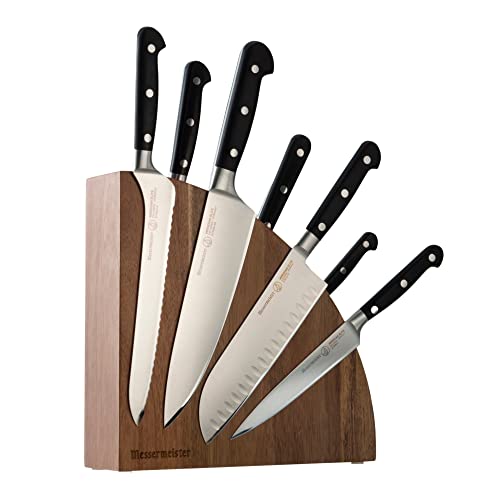
If you want the sharpest German edge you can buy: The Messermeister Meridian Elite 8-Piece Magnet Block Set ($899.95) — Messermeister handcrafts the Meridian Elite in Solingen using one-piece, hot-drop hammer forging, then grinds the blades to 15 degrees — sharper than any other German set here. The bolsterless heel means you can sharpen and use the entire edge, and the eight pieces include a Santoku, a Kullenschliff carving knife, a scalloped offset knife and a carving fork, which is a more ambitious lineup than our top pick's. The acacia magnet block displays everything without pressing blades into slots. What you give up is name recognition and money: this is the most expensive set in the guide by a wide margin, and few people outside serious kitchens will know what it is.
If you only want three knives and want them to be excellent: The MAC Knife set Professional series 3-piece PRO-31 ($395) — MAC's PRO-31 skips the block entirely and gives you the three blades that cover most cooking: the MTH-80 8-inch chef's knife with hollow-edge dimples, a 5-inch paring knife and a 10.5-inch bread and roast slicer. The chef's knife uses a sub-zero tempered alloy that holds an edge roughly 10 to 15 percent longer than MAC's standard molybdenum steel, and the half-bolster lets you sharpen all the way to the heel. Upswept PakkaWood handles give your knuckles clearance on the board. You'll need to buy storage separately, and three knives means no boning knife, no utility, no shears — but they're three very good knives.
If your hands get tired during long prep sessions: The Global G-835/WS-6 Knife Set with Block ($599.95) — Global's G-835 is one continuous piece of CROMOVA stainless steel from tip to handle end, with hollow handles weighted from the inside to hit the balance point. There's no handle scale to loosen, crack or harbor gunk, and the blades are face-ground with a long taper so the edge stays keen longer between sharpenings. Ice tempering to the mid-to-high 50s HRC gives it strong corrosion resistance. The catch is feel: the all-metal grip is a genuine acquired taste, and the dimpled surface can feel slick when your hands are wet or oily. Handle one before you commit.
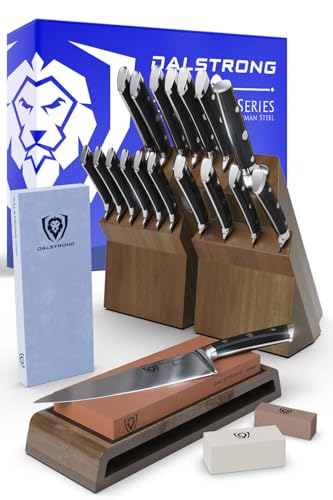
If you want the sharpening kit in the same box: The DALSTRONG 18-piece Gladiator Series Knife Block & ($440) — Dalstrong's 18-piece Gladiator set bundles a full knife complement, a handmade acacia block and a two-stone corundum whetstone kit, which is the most interesting part of the package — that's a separate purchase you won't have to make, and the stones are thick enough to last. The German high-carbon blades are NSF-certified and tempered past 56 HRC with a 16-to-18-degree hand-polished edge. That's a keener grind than most German sets, but it also needs consistent upkeep to stay that way. Owner reports on consistency vary more than they do for the established German brands, so buy from a seller with a straightforward return policy.
The competition
These are the sets our research turned up alongside the picks, not a survey of everything on the market. Each one is a real product that some people will be happy with. They lost to the picks on steel quality, on how the pieces are allocated, or on how well they hold up over years rather than months.
The HENCKELS Classic Razor-Sharp 16-Piece Knife Block Set ($254.94) — The HENCKELS Classic 16-piece block is the honest middle of the market: German-engineered design, satin-finished blades that arrive properly sharp, and a lineup that includes an 8-inch chef's, a serrated utility, a carving knife and fork, eight steak knives, a steel and shears. It's stamped rather than forged, so it lacks the balance and durability of the ZWILLING Pro set from the same parent company, and the lightweight handles feel hollow next to full-tang riveted ones. Owners generally report the edges dulling faster than they'd like. Still a reasonable choice if you need a complete block from a recognizable name and don't want to spend much.
The Cuisinart Stainless Steel Hollow Handle 15-Piece Cutlery ($89.59) — Cuisinart's 15-piece hollow-handle block is the classic first-apartment set: an 8-inch chef's, an 8-inch slicer, a 7-inch Santoku, a serrated utility, two paring knives, six steak knives, a steel, shears and a wood block. The precision-tapered blades cut acceptably out of the box and the stainless handles clean up easily. But the hollow handles feel insubstantial, the edges dull faster than forged German or Japanese steel, and it's covered only by a limited warranty. Think of it as a set that gets you cooking now and gets replaced later, not one you keep.
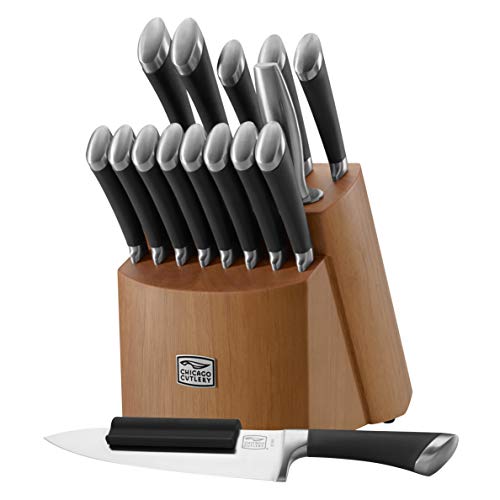
The Chicago Cutlery Fusion 17 Piece Kitchen Knife ($149.99) — The Chicago Cutlery Fusion set headlines with 17 pieces, but eight of those are steak knives — so the actual kitchen lineup is a 7.75-inch chef's, a serrated bread knife, two Santokus, a utility, a paring knife, a steel and a chop assist. The cushion-grip handles are genuinely non-slip, and the honey maple block looks better than the price suggests. The 26-degree taper grind is a blunt angle that needs frequent honing to stay useful. If you host dinner parties where those steak knives see real work, the math tilts in its favor; otherwise you're buying block space.
Care and sharpening
Keep every knife here out of the dishwasher, including the ones labeled dishwasher safe. Detergent is strongly alkaline and strips the protective layer off the steel, the drying cycle warps handles and works rivets loose, and blades knocking against other utensils roll the edge. Hand wash with warm soapy water, then dry right away — it takes about twenty seconds per knife. Hone before you cook, not after: half a minute on the steel realigns the edge without removing metal, and doing it consistently roughly doubles the interval between real sharpenings. Sharpen on a whetstone every few months, at 20 degrees for German blades and 15 to 16 for Japanese. Use wood or plastic boards, never glass or stone, and never store good knives loose in a drawer.
Questions we get
How many knives do I actually need?
Three cover roughly everything: an 8-inch chef's knife, a 3.5-inch paring knife and a serrated bread knife. Add a 6-inch utility knife and kitchen shears and you've got a complete setup for any style of cooking. Boning, fillet and carving knives handle jobs most home cooks manage fine with the chef's knife. Don't let piece count drive the decision — a good seven-piece set beats a mediocre fifteen-piece one in every knife you'll actually reach for.
Are sets worth it, or should I buy individual knives?
Sets make sense when you're starting from nothing, when the lineup is built around the five to seven knives you'll genuinely use, and when the per-knife cost undercuts buying them separately. They stop making sense when the piece count is padded to justify a shelf price. If you already know your preferences and want a Japanese chef's knife alongside a German bread knife, build your own collection — but for most people equipping or upgrading a kitchen, a curated set is the simpler path.
German or Japanese?
German blades sit around 56 to 58 HRC with a 20-degree edge — durable, chip-resistant and easy to maintain with a standard honing steel. Japanese blades run 60 and up with a 15 to 16-degree edge, so they cut finer and hold longer, but they're more brittle and need the right sharpening gear. If you break down whole chickens and cut dense root vegetables, go German. If you cook a lot of fish and fine vegetable work and will learn the whetstone, go Japanese. Unsure? German.
Does forged versus stamped matter for home cooking?
Forged knives are shaped from a heated billet under pressure, which gives them denser grain, better balance and a natural bolster. Stamped knives are cut from rolled sheet, then hardened and ground — lighter and cheaper to make. At the same price from the same brand, forged wins on balance and durability. But a well-made stamped knife from Victorinox or MAC will outcut a badly made forged one, and the lighter weight genuinely reduces fatigue on long prep days.
Can I put knives in the dishwasher?
No, not for any set in this guide. The detergent corrodes and pits the steel, the heat warps handles and loosens rivets, and the tumbling chips the edge. Even blades marked dishwasher safe degrade noticeably faster — the label means they won't fall apart, not that it's good for them. Hand wash and dry immediately.
How do I keep the edge sharp at home?
Two steps. Hone before each cooking session with a steel or ceramic rod, which realigns the edge without removing metal and takes about thirty seconds. Then sharpen on a whetstone every three to six months depending on how much you cook. A 1000/6000 grit combination stone handles both German and Japanese edges; just match the angle to the knife. Pull-through sharpeners are convenient but take off more metal and leave a coarser edge, so don't make one your primary method on good knives.
Why you should trust us
For this guide:
- We read the manufacturer specifications for every set here, including steel alloys, hardness ratings, grind angles and the exact piece breakdown behind each headline count.
- We compared published reviews from long-running kitchen publications and knife specialists against what the listings claim, and flagged the places where the two disagree.
- We read through owner feedback for each set, looking for repeated themes — chipped edges, loose rivets, slippery handles, edges that stop holding — rather than isolated complaints.
- We read owner reviews on every listing, weighted toward the critical ones, because that is where the recurring failures show up.
- We have a systematic way of automatically fetching the latest prices, so the numbers on this page stay current.
- This is a research-focused guide, so the team may not own every product listed — though we often do own the top winners, which gives us extra context for the recommendations.
- We don't accept free products, and the retailer commission never changes which product we recommend.
Sources
The Best Knife Sets of 2026 — Wirecutter, Wirecutter
Best Knife Sets Tested by Food Network Kitchen, Food Network
Best Chef's Knife Sets, According to Professional Chefs — Serious Eats, Serious Eats
Knife Set Reviews and Ratings — Cook's Illustrated, Cook's Illustrated
The Best Kitchen Knife Sets for Home Cooks — Bon Appétit, Bon Appétit
Amazon product listings and owner reviews for all 12 products
Manufacturer specification pages for each product
Some passages in this guide may be paraphrased with AI help. Prices are refreshed automatically.
More like this.
Continue exploring appliances reviews and recommendations.

The Best Kitchen Knife Sets
A sharp knife changes how cooking feels. You stop sawing at tomatoes, you stop crushing herbs into a bruised green paste, and dinner prep gets faster and…

The Best Knife Sharpeners and Honing Tools
A sharp knife does the work so your hands don't. It glides through tomato skin instead of skidding off it, and it takes most of the fight out of a…

The Best Knife Sharpeners
A dull knife is the most annoying tool in your kitchen, and the most dangerous one. It slides off a tomato skin instead of biting in. It crushes basil…

The Best Nonstick Cake Pans and Baking Sets
A cake pan does one job, and it's easy to take for granted until it fails you. The batter sticks to the bottom, the edges brown three shades darker than…

The Best Silicone Kitchen Utensil Sets
You touch these tools more than almost anything else in your kitchen. A turner that flexes just enough to slide under a fried egg, a spoon that won't…

The Best Cookware Sets
Cookware is the rare kitchen purchase you touch every single day. A good set heats evenly, so your onions brown instead of scorching in one spot while…