The Best Osprey Backpacks
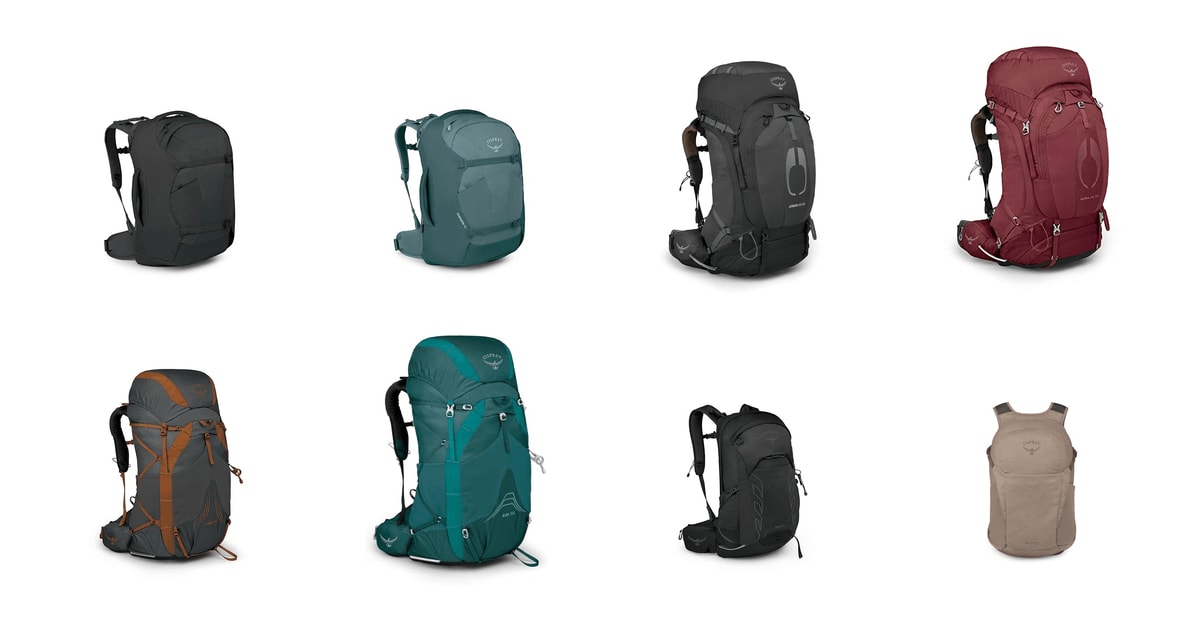
A backpack is one of the few things you buy that has to fit you, not just hold your stuff. Get the torso length wrong and a loaded pack digs into your shoulders by mile three. Get it right and 35 pounds of tent, food and water rides on your hips, where your legs can carry it. That's the whole game. Osprey has spent decades on suspension design, and it shows up in the small stuff too: hip belt pockets you can reach without stopping, a rain cover tucked in the lid, zippers that don't strip.
No single Osprey pack does everything, and the brand won't tell you that. The suspended-mesh packs that keep your back cool weigh close to four pounds empty, which is a real penalty if you're counting ounces. The ultralight models shed that weight but give up padding and pockets. Travel packs open like a suitcase and carry fine through an airport, but they're not built for a week on trail. And Osprey packs cost more than most rivals, so you're paying up front for a fit you may need to try on first.
We think the Farpoint 40 is the best Osprey backpack for most people, and that the Atmos AG 65 is the one to buy if you're heading out for several nights on trail with a heavy load.
Everything we recommend

Carry-on size, suitcase access, and a real hip belt

The most comfortable way to carry a heavy multi-day load
Nearly two pounds lighter, if you can live with fewer pockets

A day-hike pack light enough to forget you're wearing

Simple everyday carry that's built better than it needs to be
At a glance
| Product | Capacity | Weight | Price | |
|---|---|---|---|---|
| Osprey Farpoint 40L Men's Travel BackpackTop pick | 40L | — | $198.66 |
 | Osprey Fairview 40L Women's Travel BackpackAlso consider | 40L | — | $195.96On sale |
| Osprey Atmos AG 65L Men's Backpacking BackpackUpgrade pick | 65L | 4 lb | $276.81On sale |
 | Osprey Aura AG 65L Women's Backpacking BackpackAlso consider | 65L | 4.6 lb | $259.95On sale |
| Osprey Exos 58L Men's Ultralight Backpacking BackpackAlso great | 58L | 2.84 lb | $285 |
 | Osprey Eja 58L Women's Ultralight Backpacking BackpackAlso consider | 58L | 2.82 lb | $285 |
| Osprey Talon 22L Men's Lightweight Hiking BackpackBudget pick | 22L | 2.38 lb | $175 |
| Osprey Daylite Plus Driftshade Timber BeigeRunner-up | — | — | $85 |
How we picked
Suspension and load transfer. We compared Osprey's Anti-Gravity, Airspeed and AirScape back panels against published reviews from Switchback Travel and OutdoorGearLab. A pack had to move real weight onto the hips without pressure points at its rated load.
Weight versus support. Osprey's published spec sheets and CleverHiker's weight figures made it possible to compare packs at similar volumes. A pack earned a spot only if its weight made sense for the trips it's built for.
Fit and adjustability. We favored packs with adjustable torso length and multiple frame sizes, and we treated Osprey's women's-specific lines as genuinely different packs rather than smaller ones. Backpacker Magazine's reports on hip belt shaping informed this.
Real-world durability. We read owner feedback across each listing for recurring themes about fabric wear, zipper failure and stitching. Isolated complaints didn't disqualify a pack; patterns did.
Features that earn their weight. Rain covers, hydration sleeves and hip belt pockets counted only when they served the pack's purpose. We penalized organization that added bulk without a clear use.
Top pick
Carry-on size, suitcase access, and a real hip belt
Osprey Farpoint 40L Men's Travel Backpack
The Farpoint 40 opens flat like a suitcase, fits within most airline carry-on limits at 21.7 by 13.8 by 9.1 inches, and hides its harness behind a zip panel when you check it. For a week abroad with no baggage claim, it's hard to beat.
$198.66fromAmazonThis is the pack that lets you skip baggage claim. Its listed dimensions of 21.7 by 13.8 by 9.1 inches sit inside most major carry-on limits, and Wirecutter has named the Farpoint 40 a top pick across multiple travel backpack updates. The Points Guy measured the same footprint. You'll still want to check your airline's rules on a budget European carrier, but for the big carriers, you're fine.
The front panel unzips all the way around, so the pack lies open on a hostel bed and you can see everything at once. No digging down a top-loading tube to reach the shirt at the bottom. Dual internal compression straps hold your clothes flat, and the mesh lid pocket takes chargers and cables. There's a direct-zip 3-1-1 pocket up top for your liquids bag, which saves a real minute at security.
The harness and hip belt zip away behind a back panel. That matters more than it sounds. Loose straps are what gets a pack shredded on a conveyor belt, and stowing them turns the Farpoint into a duffel you can hand over at the gate. Deploy them again at the trailhead or the walk from the station, and you've got a load-lifting frame and an adjustable torso length doing the work.
Owners who travel with it for weeks at a stretch consistently report the fabric and stitching hold up through repeated airport handling. That's backed by Osprey's All Mighty Guarantee, which covers free repairs for the life of the pack with no receipt. If a buckle snaps in year six, you send it in.
Flaws but not dealbreakers
Forty liters is the stated volume, not the usable volume when you're wearing it. Several owners point out that once the pack is on your back and the compression straps are cinched, you're working with closer to 30 liters of practical space. Pack accordingly and don't count on the last five liters.
It's not a trail pack. The suspension is built for airport concourses and a mile of cobblestones, not for 35 pounds over a mountain pass. If your trip is mostly hiking with a flight on either end, look at the Atmos or the Exos instead.
The Farpoint 40 is covered by Osprey's All Mighty Guarantee, which repairs or replaces any Osprey pack for free, for life, with no receipt required.
Upgrade pickOn sale
The most comfortable way to carry a heavy multi-day load
Osprey Atmos AG 65L Men's Backpacking Backpack
The Atmos AG 65 uses a suspended-mesh back panel that curves away from your spine, so air moves behind you and the load rides on your hips. It weighs about four pounds empty, and it's the pack to take when you're out for four nights or more.
$276.81fromAmazonList priceThe Anti-Gravity back panel is a sheet of tensioned mesh that wraps from your shoulders to your hip belt with a gap behind it. Switchback Travel found it moves noticeably more air than framed competitors like the Gregory Baltoro. On a July climb with a full water carry, that gap is the difference between a damp shirt and a soaked one. It also spreads the load across a wider area, which is why owners describe heavy packs feeling lighter than they are.
Sixty-five liters is the right number for most multi-day trips. It swallows a bear canister, four days of food, a tent and a sleeping bag without you playing Tetris. The zippered sleeping bag compartment at the bottom has a removable divider, so you can run it as one big tube when you'd rather. Removable sleeping pad straps sit underneath. Curved side zips let you reach the middle of the pack without unpacking the top.
Fit-on-the-fly is the part that earns the money. The hip belt and shoulder harness adjust to your body, not to a size chart, and you can tweak them mid-hike when your hips start complaining. The pack ships in torso-length sizes on top of that. Owners who moved up from older internal-frame packs regularly say hip pain they'd assumed was normal simply stopped.
A rain cover comes tucked in the lid, made with PFAS-free DWR and bluesign approved materials. You're not buying one separately, and you're not stuffing a garbage bag into your pack liner at the trailhead.
Flaws but not dealbreakers
It weighs about four pounds empty, which is roughly a pound and a half more than the Exos 58. If your base weight matters to you — thru-hikers, mostly — that's a lot of ounces to spend on ventilation.
It's the most expensive pack here and the biggest. For overnight trips and weekend loops you'll be carrying volume and frame you don't need. A 65-liter pack tends to get filled to 65 liters.
The Atmos AG 65 is covered by Osprey's All Mighty Guarantee, with free lifetime repairs and no proof of purchase required.
Also great
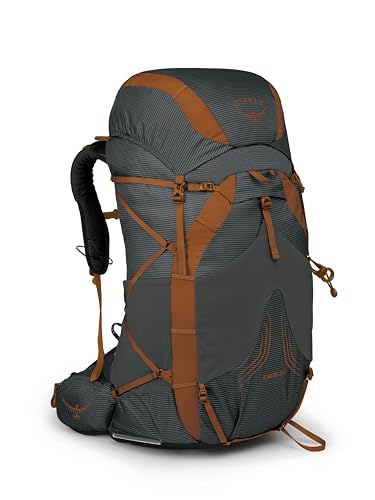
Nearly two pounds lighter, if you can live with fewer pockets
Osprey Exos 58L Men's Ultralight Backpacking Backpack
At about 2 pounds 13 ounces, the Exos 58 cuts serious weight off a comparable Anti-Gravity pack while keeping a frame that still carries a loaded pack well. It's the Osprey to look at if you're walking a long trail.
$285fromAmazonIf you're hiking a long trail, this is the Osprey to take. OutdoorGearLab has repeatedly rated the Exos and Eja series as offering the best weight-to-comfort ratio among ultralight backpacking packs, and CleverHiker puts the Exos 58 at roughly two pounds lighter than the Atmos AG 65. That's a meaningful chunk of your base weight, gone, without switching to a frameless pack that punishes you above 25 pounds.
The Airspeed suspension keeps a tensioned mesh panel between you and the pack, so you get most of the airflow benefit of the Atmos in a much lighter package. An injection-molded ladder system gives you four inches of torso adjustment, which is more range than most packs offer. Owners routinely report carrying 35 to 40 pounds in it comfortably, which is not something you can say about most ultralight packs.
You still get two hip belt pockets, an internal hydration sleeve with a center hose port, and a floating lid with pockets above and below. The lid comes off if you want to shed a few more ounces on a summer trip. That's a nice bit of flexibility that fully stripped-down packs don't give you.
Osprey beefed up the back panel mesh and main body fabrics on the current version. Ultralight packs earn a reputation for wearing through at stress points, and the extra durability is why this one shows up on long trails rather than in closets.
Flaws but not dealbreakers
The padding is thinner than on the Atmos, on both the hip belt and the shoulders. Owners notice it when the load creeps past 40 pounds. Under that it's fine; over it, you'll wish you had the Atmos belt.
Organization is spare by design. Several owners say they miss the extra zippers and pockets of a heavier pack, and that's the trade you're making. There's no side zip into the main compartment, so reaching the bottom means going through the top.
The Exos 58 carries Osprey's All Mighty Guarantee for free lifetime repairs, no receipt needed.
Budget pick
A day-hike pack light enough to forget you're wearing
Osprey Talon 22L Men's Lightweight Hiking Backpack
The Talon 22 weighs about 2 pounds 6 ounces and uses an AirScape foam back panel that keeps the pack close to your body while still letting air move. For full-day hikes, bike commutes and scrambles, it's the one to grab.
$175fromAmazonTwenty-two liters is the sweet spot for a day out. Lunch, a shell, a liter and a half of water, a first-aid kit, and you're set. GearJunkie clocks the Talon 22 at about 2 pounds 2 ounces for the version they looked at, and the AirScape back panel means it hugs your spine rather than swaying when you scramble. Stretch mesh side pockets hold bottles you can grab without taking the pack off.
The hip belt on this pack punches well above the category. Most 22-liter daypacks give you a webbing strap. The Talon has a BioStretch belt with dual zippered pockets, which moves real weight onto your hips and puts your phone and snacks where you can reach them. Owners doing 20-mile days over rough ground describe it as stable through bouldering, which is not a normal thing to say about a daypack.
It handles more than hiking. There's a LidLock helmet clip for bike rides, Stow-on-the-Go trekking pole attachments so you can stash poles without stopping, and a tuck-away ice axe loop. An internal hydration sleeve takes a reservoir, though you'll need to buy that separately. Plenty of owners use it as an airline personal item.
The adjustable sliding yoke lets you tune the torso length, which is unusual at this size and this price. If you're between sizes or you're buying for a growing teenager, that matters.
Flaws but not dealbreakers
The hydration sleeve placement confuses people. More than one owner has hunted for it, expecting it outside the main compartment. It's inside, and the reservoir isn't included.
The internal framesheet on the current version is a couple of inches longer than on older Talons. If you count on sliding your bag under the airplane seat in front of you, measure first.
The Talon 22 is covered by Osprey's All Mighty Guarantee, which repairs any pack for free, for life.
Runner-up
Simple everyday carry that's built better than it needs to be
Osprey Daylite Plus Driftshade Timber Beige
The Daylite Plus is a clean, compact everyday backpack with dual-zip panel access, a second organizer compartment and stretch side pockets that hold a 32-ounce bottle. It's the Osprey to buy for class, the office or a flight.
$85fromAmazonThis is the pack for commuting and campus, not the trail. It opens with a dual-zip panel into one roomy main compartment, and a second compartment up front handles pens, keys and a wallet with a built-in key clip. REI's buying guide singles out the Daylite Plus as one of the few budget daypacks with a padded sleeve for a laptop, which is the reason most students end up with one.
It carries small but holds more than it looks like it should. Owners consistently say the main compartment has noticeably more usable room than the profile suggests. Stretch mesh side pockets take a 32-ounce Hydro Flask, and a front shove-it pocket swallows a rain shell or a hoodie you peeled off between buildings. There's a front zip pocket for the little stuff.
The build quality is the surprise. This is Osprey's entry-level pack, and the stitching, straps and buckles are the same standard as their trail gear. Owners who already have three or four Osprey packs describe this one as holding its own. It's also the lightest and simplest thing in this lineup, which is exactly what you want when you're wearing it eight hours a day.
The Driftshade version has its own back panel and strap venting, with a wavy horizontal channel pattern rather than the cutouts on the standard Daylite Plus. Owners who've handled both notice the difference. Neither is better, but it's worth knowing you're not getting an identical pack in a new color.
Flaws but not dealbreakers
Organization is minimal. If you want dedicated slots for a tablet, a charger and a notebook, this pack asks you to bring your own pouches. Several owners flag it as the one thing they'd change.
There's no hip belt beyond a sternum strap, so weight sits on your shoulders. Fine for books and a laptop. Not fine if you're loading it up for a long day on foot — that's what the Talon is for.
The Daylite Plus is covered by Osprey's All Mighty Guarantee for free lifetime repairs.
Who this is for
This guide is for you if you've decided on Osprey and now need to pick the right one. That's a real question, because Osprey's lineup spans airport travel packs, ultralight thru-hiking packs, framed multi-day haulers and simple commuter bags, and the wrong choice is uncomfortable in a way that's hard to fix. If you're flying somewhere with one bag, start with the Farpoint or Fairview. If you're out for four nights with 35 pounds, start with the Atmos or Aura. If you're walking a long trail and counting ounces, the Exos or Eja. For day hikes, the Talon. For class and commuting, the Daylite Plus.
You should skip most of this if you're shopping purely on price — Osprey costs more than Gregory, Deuter or REI's house line at comparable volumes, and the lifetime guarantee is a big part of what you're paying for. We also cover only the packs confirmed in this lineup, so Osprey's rolling luggage, kids' packs, hydration vests and larger expedition models aren't here. And if fit is your main worry, nothing beats putting a loaded pack on in a store before you order a color online.
How we picked
Suspension: We compared how each back panel and frame moves weight onto the hips, leaning on published reviews from Switchback Travel and OutdoorGearLab plus Osprey's own spec sheets. Weight: We checked listed weights against comparable packs at the same volume, using CleverHiker's figures, and asked whether every ounce earned its place. Fit: We favored adjustable torso lengths and multiple frame sizes, and treated the women's-specific Fairview, Aura and Eja as separate designs rather than downsized versions. Durability: We read owner feedback for recurring patterns around zippers, stitching and fabric wear rather than one-off complaints. Features: Rain covers, hydration sleeves and hip belt pockets counted when they matched the pack's job, not when they just added bulk.
Other osprey backpacks worth considering
If you want the top pick in a women's-specific fit: The Osprey Fairview 40L Women's Travel Backpack ($195.96) — The Fairview 40 is the Farpoint's counterpart, same 21.7-by-13.8-by-9.1-inch carry-on footprint and same stowaway harness, built around a women's-specific fit with an adjustable torso length. The harness and hip belt are shaped differently, which is the whole point — this isn't a smaller Farpoint. Owners with petite frames report it fits without pinching. A few note the current version has slightly fewer organizational pockets than older Fairviews, so if you loved a previous one, expect a simpler layout inside.
If you want Anti-Gravity comfort in a women's-specific fit: The Osprey Aura AG 65L Women's Backpacking Backpack ($259.95) — The Aura AG 65 gives you the same suspended-mesh back panel as the Atmos with women's torso lengths and a differently angled hip belt. Backpacker Magazine reported that belt shaping reduced pressure points versus unisex packs on loaded multi-day carries. Owners hauling 35 pounds through the Grand Canyon describe it as the most comfortable pack they've used. It's heavier than the Atmos at 4.6 pounds, and a handful of owners still fight with hip belt fit, so try it loaded if you can.
If you want an ultralight pack cut for a woman's frame: The Osprey Eja 58L Women's Ultralight Backpacking Backpack ($285) — The Eja 58 is the Exos in women's-specific sizing, and Treeline Review calls it one of the few women's packs under three pounds still rated to comfortably carry over 30 pounds. It's a fixture on the Appalachian and Pacific Crest Trails for that reason. It uses the same Airspeed suspension with four inches of torso adjustment. Owner feedback on it is more mixed than on the Exos, with a few reports of stitching separating early, so inspect yours when it arrives.
More from Osprey
Osprey makes far more packs than the ones our research surfaced, and this guide covers only the models we could confirm. Every pack in that set fit a clear shopper — the travel packs, the multi-day haulers, the ultralight trail models and the everyday carry bag are all above, either as a pick or as an alternate fit. If none of them matches what you're after, Osprey's rolling luggage, kids' packs, hydration vests and larger expedition models are worth a look outside this guide.
Is Osprey worth it?
Osprey sits at the premium end of the pack market, above Gregory and Deuter on price at most volumes, and the reason people pay it comes down to two things. The first is suspension design. The Anti-Gravity and Airspeed systems are genuinely different from a standard framesheet-and-foam back panel, and reviewers at Switchback Travel and OutdoorGearLab consistently rate them at or near the top for ventilation and load transfer. The second is the All Mighty Guarantee. Osprey repairs or replaces any pack it has ever made, for free, for life, with no receipt required. That's not a marketing asterisk with a five-year window — it applies to a 20-year-old pack with a shredded hip belt. Owner feedback backs this up as a real service people actually use. Osprey also puts features into its cheaper packs that rivals leave out at the same tier: a rain cover in the lid, a hydration sleeve, a padded laptop pocket. The catch is fit. Osprey's sizing is specific, and a pack that's wrong for your torso is uncomfortable no matter whose logo it wears.
Not set on Osprey?
If you're open to Gregory, Deuter or REI's house line, this one compares multi-day packs across brands rather than within one. our full hiking backpack guide →
Worth a look if you only need something for day hikes and want to see how the Talon stacks up against the rest of the field. our hiking daypack guide →
Covers packs that stretch from a long day hike to a weekend overnight, if you'd rather buy one bag than two. our day-to-multi-day pack guide →
Fit and sizing
Torso length, not height, is what sizes a pack. Measure from the bony bump at the base of your neck down to the point level with the top of your hip bones — that number, in inches, maps to Osprey's small, medium and large frames. Once you've got the right size, load the pack with about 20 pounds before you adjust anything. Cinch the hip belt first, so it sits on your hip bones rather than your waist, then snug the shoulder straps, then pull the load lifters until they angle up at roughly 45 degrees. Most people wear the belt too high and the load lifters too tight. If your shoulders ache after an hour, the weight isn't reaching your hips. And when a buckle or zipper eventually fails, send it to Osprey — the All Mighty Guarantee covers the repair for free, whatever the pack's age.
Questions we get
What's the best Osprey backpack for international travel?
The Farpoint 40, or the Fairview 40 if you want a women's-specific fit. Both measure 21.7 by 13.8 by 9.1 inches, which fits within most major airline carry-on limits, and both open flat like a suitcase so you're not digging through a top-loading tube. Check your specific airline anyway — budget carriers set their own rules.
What's the difference between the Atmos AG and the Exos?
Weight and support. The Atmos AG 65 weighs about four pounds and uses a suspended-mesh Anti-Gravity panel with a thickly padded hip belt, built for heavy multi-day loads. The Exos 58 comes in around 2 pounds 13 ounces with thinner padding and fewer pockets. If you're carrying more than 40 pounds, take the Atmos. If you're counting base weight on a long trail, take the Exos.
How does Osprey's All Mighty Guarantee actually work?
Osprey repairs or replaces any pack it has made, for free, for the life of the pack. You don't need a receipt and there's no age cutoff. You send the pack in and they fix it, or replace it if it can't be repaired. It's a genuine reason to pay more for an Osprey than for a comparable pack from another brand.
Farpoint or Fairview — what's actually different?
The Fairview is built on a women's-specific fit: a shorter torso range, differently shaped shoulder straps and a hip belt angled for a woman's hips. Capacity, dimensions, materials and the stowaway harness are the same. If you're between the two, fit is the only thing that should decide it, so try both on if you can.
What size Osprey do I need for a three-day hike?
Something in the 40 to 58 liter range, depending on how bulky your gear is. The Exos 58 or Eja 58 handles three nights easily with room to spare. A 65-liter pack like the Atmos or Aura is more than you need for three days, and a pack that's too big tends to get filled anyway. If you're carrying a bear canister, size up.
Do Osprey backpacks come with a rain cover?
Some do, not all. The Atmos AG 65 and Aura AG 65 both include one tucked into the lid, made with PFAS-free DWR and bluesign approved materials. The Exos, Talon, Daylite Plus, Farpoint and Fairview don't list one, so you'll want to buy a cover separately or use a pack liner if you expect real weather.
Why you should trust us
For this guide:
- We read published reviews from Switchback Travel, OutdoorGearLab, CleverHiker, GearJunkie, Treeline Review, Backpacker Magazine, The Points Guy, REI's buying guide and Wirecutter alongside Osprey's own specifications for each pack.
- We compared listed weights, dimensions and suspension types across the lineup to see where each model's trade-offs actually fall.
- We read owner feedback on every listing here for recurring themes about fit, durability and organization, and weighted repeated patterns over one-off complaints.
- We read owner reviews on every listing, weighted toward the critical ones, because that is where the recurring failures show up.
- We have a systematic way of automatically fetching the latest prices, so the numbers on this page stay current.
- This is a research-focused guide, so the team may not own every product listed — though we often do own the top winners, which gives us extra context for the recommendations.
- We don't accept free products, and the retailer commission never changes which product we recommend.
Sources
The Best Travel Backpacks - Wirecutter, Wirecutter
Osprey Atmos AG 65 Review, Switchback Travel
Best Backpacking Backpacks of 2026, OutdoorGearLab
Osprey Exos 58 Review, CleverHiker
Osprey's Lifetime Warranty Explained, Osprey (manufacturer)
Best Daypacks for Hiking, GearJunkie
Best Backpacks for College Students, REI Co-op
Osprey Aura AG 65 Review, Backpacker Magazine
Carry-On Backpack Size Requirements by Airline, The Points Guy
Best Ultralight Backpacks, Treeline Review
Amazon product listings and owner reviews for all 8 products
Manufacturer specification pages for each product
Some passages in this guide may be paraphrased with AI help. Prices are refreshed automatically.
More like this.
Continue exploring lifestyle reviews and recommendations.

The Best Travel Backpacks for Carry-On
A good carry-on backpack ends the part of travel you dread. No baggage claim, no gate-check roulette, no wondering whether your bag made the connection.…

The Best Rolling Backpacks for Students and Commuters
A bag loaded with textbooks, a laptop and a water bottle can easily hit twenty pounds, and your shoulders feel every one of them by the third block.…

The Best Backpacking Tents for Families
A four-person backpacking tent is a strange piece of gear. It has to be light enough that two adults can split it and still carry food, water and a kid's…

The Best Disc Golf Bags and Backpacks
A disc golf bag is the one piece of gear you touch on every single hole. You'll sling it on and off two dozen times a round, dig through it for a putter…

The Best Laptop Backpacks for Commuters
A commuter backpack has one job that matters more than the rest: get your laptop to the office and home again without a scratch. But you feel the other…

The Best Sleeping Bags for Camping and Backpacking
A sleeping bag is the one piece of camping gear you notice at 3 a.m. When it's right, you don't think about it at all. When it's wrong, you spend the…