The Best Portable Concrete Mixers
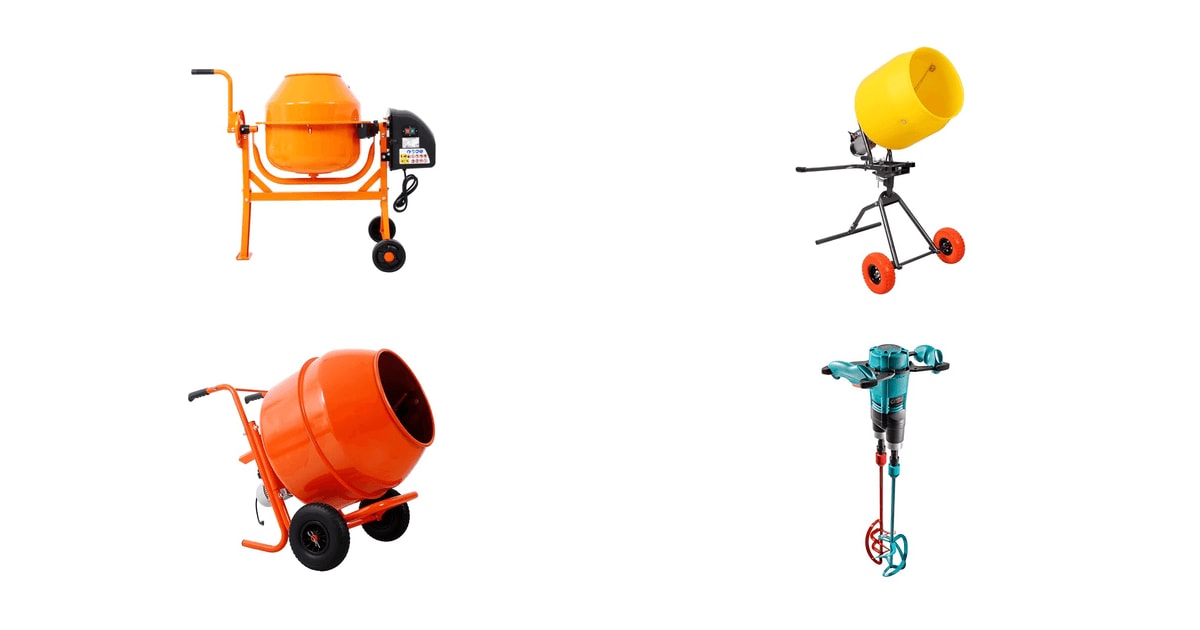
Concrete has a clock on it. Once water hits the bag, you've got maybe an hour to mix, place and finish before the batch goes stiff on you. That's why hand-mixing in a wheelbarrow falls apart past a bag or two — you're fighting a hoe while the mix sets. A portable mixer tumbles the load for you, keeps the water ratio consistent from batch to batch, and lets one person set a run of fence posts on a Saturday without help and without a rental reservation.
No portable mixer is pleasant to clean, and every one of them punishes you for waiting. Concrete that starts to set in a drum has to be chipped out, and chipping scars the interior so the next batch sticks worse. These machines are heavy, too — most run around a hundred pounds or more, and none of them fold flat. Motor specs are inconsistent across the category, and several brands don't publish drum speed at all, which matters more than it sounds like it should.
So think about how often you'll actually mix. One patio project and you should probably just rent. But if you've got five or more jobs on the horizon — posts, footings, steps, garden borders — a mixer of your own pays for itself in rental days you never book, and you stop working against someone else's return window. We think that the YARDMAX YM0146 is the best portable concrete mixer for most people, and that the Klutch Electric Cement Mixer is the one to buy if you're short on garage space and rarely mix more than one bag at a time.
Everything we recommend

More drum and more motor, with a setup you can finish alone

Nearly the same machine, in a footprint that fits a full garage

Bucket-scale mortar and stucco, as long as you skip the gravel

Driven paddles and an industrial motor, for people who mix weekly
At a glance
| Product | Drum Capacity | Motor Power | Price | |
|---|---|---|---|---|
| YARDMAX YM0146 5.0 cu. ft. Concrete MixerTop pick | 5.0 cu. ft. | 3/4 HP | $339 |
| Electric Concrete Mixer - 2100w 110v PortableBudget pick | — | 2100W | $33 |
| Klutch Electric Cement MixerRunner-up | 4.25 Cu. Ft. | — | $299.99 |
 | SPECRAFT 4.9 Cu.Ft. Electric Cement MixerAlso consider | 4.9 cu.ft | 375W | $329.99On sale |
| IMER Minuteman MixerUpgrade pick | 5 cu ft Drum | 1/2 HP | $809 |
 | Genuine OEM .75 HP Electric 115VAlso in lineup | 3 cf | .75 HP | $1,299.95 |
How we picked
Motor and drive. We compared published horsepower, wattage and drive type across every listing, since drive design is the best predictor of how long a mixer lasts. Machines that omit a motor rating entirely got marked down.
Drum size and material. We treated 4.0 to 5.0 cubic feet as the useful range for household pours, and we favored steel drums for anyone mixing gravel-aggregate concrete. Polyethylene earns its place on weight and rust immunity.
One-person operation. We looked for a locking tilt handle, a low pour lip and assembly that one person can finish without help. Owner feedback in this category is full of assembly complaints, so factory-assembled drives mattered.
Cleanout. Wide openings and smooth interiors cut washout time, and washout time is what decides whether a mixer gets cleaned or left to set. We read spec sheets and owner reports for both.
Parts and support. For any tool you expect to keep a decade, domestic parts availability beats a warranty term. Established construction brands scored better here than short-lived import listings.
Top pick
More drum and more motor, with a setup you can finish alone
YARDMAX YM0146 5.0 cu. ft. Concrete Mixer
The YM0146 pairs a 3/4-horsepower motor with a 5.0-cubic-foot steel drum, so it chews through gravel-heavy mixes that bog down lighter machines. The drive box arrives assembled, and one person can have it standing and ready in about half an hour.
$339fromAmazonThe motor is the reason to start here. Three-quarters of a horsepower is a full step up from the half-horse units common at this tier. That gap shows up most with stiff, low-slump mixes — the kind you want for a post or a footing. A weak motor slows as the drum loads, and slow tumbling leaves dry pockets in the batch. The extra torque is what keeps the drum turning at a steady speed after you dump the second bag in.
The drive box ships assembled, which spares you the worst part of setup. Plenty of drum mixers arrive as a box of loose drive parts, and seating that drive wrong is a good way to kill a motor early. YARDMAX puts it together at the factory. The company puts one-person assembly at under thirty minutes, and what's left is mostly bolting a frame together and standing it up.
Five cubic feet is the right amount of drum for household work. You can load two 80-pound bags with water in one go, which is roughly two fence-post holes' worth of concrete. Keep dry material under about two-thirds of drum volume, though, or the tumbling action stalls and the motor works too hard. Go bigger than this and the machine stops fitting in a pickup bed or a garage corner.
The locking handle lets you pour by yourself. An iron ring and safety lock hold the drum at whatever angle you set, so you're not bracing it with a hip while you aim the mix. The low frame helps too — the lip sits low enough to tip straight into a form or a wheelbarrow. If you mostly work alone, that's the feature you'll notice on every single batch.
Flaws but not dealbreakers
YARDMAX doesn't publish a drum speed. Concrete blends best somewhere around 25 to 28 revolutions per minute. Too slow and the aggregate never distributes evenly; too fast and the stone separates from the paste. Without a published number you're taking it on faith. If you're pouring anything structural, chalk-mark the drum and count revolutions against a timer before the first real batch.
It's heavy and it doesn't pack down. The steel drum and frame put it above the polyethylene machines here, so plan on a fixed spot in the garage rather than a shelf. Rolling it across loose gravel is a two-hand job. And if you're in an apartment or mixing on a roof deck, this isn't your tool — look at the handheld instead.
Runner-up
Nearly the same machine, in a footprint that fits a full garage
Klutch Electric Cement Mixer
The Klutch gives you the same factory-assembled drive and locking handle as our top pick, wrapped around a slightly smaller steel drum. It's the one to get if your storage space is tight or you rarely mix more than one bag at a time.
$299.99fromAmazonSteel is the right drum material if you mix with gravel. Aggregate works like coarse sandpaper against a drum wall, batch after batch. Plastic drums are lighter and rinse cleaner, but steel takes that abrasion far longer. If most of your work is bagged ready-mix with three-quarter-inch stone, the steel here should outlast a polyethylene drum by a wide margin.
You get the same conveniences as our top pick. The drive box arrives assembled, and the non-slip handle locks the drum at a pour angle so it doesn't drift while you aim. Seven-inch wheels and a triangular bracket keep it steady on a slab and movable when you're done. Practically speaking, you're choosing between two similar machines on drum size alone.
It's the easier one to live with in a small garage. At 97 pounds it's on the lighter side for a steel-drum mixer, and the shorter drum eats less floor. Nothing here folds, but you can tuck it against a wall behind a parked car. If your bay is already full of bikes and bins, that half-step down in size is worth more than the extra capacity.
Cleanup is quick as long as you don't wait. The smooth interior and open drum geometry rinse out with a few gallons of water and a minute of tumbling. Dump the slurry before it stiffens and you're done in the time it takes to coil the cord. Leave it overnight and you'll be chipping concrete out with a hammer, which scars the drum for good.
Flaws but not dealbreakers
The smaller drum costs you a batch on bigger pours. Four and a quarter cubic feet handles one 80-pound bag comfortably. Two bags is pushing it. On a run of fence posts or a footing, that's an extra load-mix-dump cycle every time, and those minutes stack up on a hot afternoon when your first batch is already going off.
Klutch doesn't list a motor rating. No horsepower figure and no drum speed means you can't compare torque against our top pick on paper. For mortar and thin mixes that hardly matters. For stiff structural concrete it's a real gap, and it's the main reason this one lands second.
Budget pick
Bucket-scale mortar and stucco, as long as you skip the gravel
Electric Concrete Mixer - 2100w 110v Portable
This is a high-torque paddle mixer rather than a drum machine — you sink it into a bucket, a trough or a wheelbarrow. For mortar, stucco, thinset and countertop mixes, it's quicker to set up and far easier to store than anything else here.
$33fromAmazonFor thin mixes, a paddle beats a tumbling drum. Mortar for a brick repair, stucco for a wall patch, thinset for a tile floor — none of that needs a rotating drum. You mix in the bucket you're already carrying, and there's no drum to hose out afterward. That's the whole argument for this thing, and for a lot of homeowners it's the right one.
Six speeds is more useful than it sounds. Start slow and the dry powder stays in the bucket instead of on your boots and your wall. Wind it up and a bag of thinset comes together in a couple of minutes. The trigger has a self-locking button, so your finger isn't holding pressure through a long batch.
It stores in a drawer. At a bit over eight pounds and about two and a half feet long, it lives on a shelf or in a tool bag between jobs. If your garage is already packed, or you're working in an apartment or on a roof deck, that's the difference between owning a mixer and renting something every time you need one.
The all-copper motor runs quieter than the cheap mixing drills. A vented housing helps it shed heat through long batches, and the galvanized rod and alloy gearing are built for repeat use rather than one weekend. It won't outlast a contractor's tool. But it's a clear step up from the throwaway paddle drills sold alongside it.
Flaws but not dealbreakers
It can't mix concrete with gravel. The paddle geometry simply can't move three-quarter-inch stone through a stiff mix, so bagged ready-mix is off the table. Push it and you'll bog the motor and end up with an uneven batch. If you're setting posts or pouring a footing, you need a drum — buy one of those and keep this for mortar work.
You're the mixer stand. Holding a 2100-watt paddle at depth in a five-gallon bucket takes real effort, and it fights back as the mix stiffens. Several buckets in a row is a workout. If you've got a bad shoulder or wrist, think hard about batch size before picking this over a drum machine.
Upgrade pick
Driven paddles and an industrial motor, for people who mix weekly
IMER Minuteman Mixer
The Minuteman drives paddles through the mix instead of relying on tumbling alone, which blends a batch faster and more completely. It's built for people who mix most weeks — homesteaders, hardscapers, part-time contractors — not a few times a year.
$809fromAmazonPaddles blend faster than gravity does. A plain drum mixer depends on concrete falling off internal fins, over and over. The Minuteman drives paddles through the material instead, so a standard batch comes together in a few minutes rather than the five to seven a passive drum needs. Save that on every batch across a full day of pours and it adds up to real time.
The motor is built for repeat duty. The half-horsepower industrial motor runs on ordinary 110-volt house current, and it holds drum speed in dense, low-slump mixes where lighter motors start to bog. That steadiness is what the money buys. A consumer mixer can handle a dozen batches a year for a decade; a dozen batches a month is a different job entirely.
IMER builds construction equipment, and parts are available here. That matters more than a warranty page on a tool you plan to keep for years. Established brands keep bearings, drive components and switches in the US supply chain, so a failure down the road is a repair instead of a replacement. Several budget mixers in this category have no parts story at all.
Flaws but not dealbreakers
A five-cubic-foot drum that yields three cubic feet is a low fill ratio. Sixty percent is less than you'd expect at this level, and it means more batch cycles on a large pour than our top pick or the wheelbarrow-style SPECRAFT need. The paddles have to have room to work, so that's the trade. Estimate your job on output, not on drum size.
It costs far more than the mid-range drum mixers, and it's heavy. For a homeowner mixing four batches a year, that premium buys longevity you'll never use up. It's also not something you'll move around casually — pick a mixing spot and leave it there. Buy this one for frequency, not for a single project.
Who this is for
This guide is for homeowners and weekend builders who mix their own concrete: fence posts, garden steps, small footings, walkway patches, retaining wall bases, the occasional countertop pour. If you've got five or more mixing sessions ahead over the next couple of years, buying beats renting, and you get the batch control that comes from working on your own schedule instead of the rental counter's. If you've got exactly one project, rent — you'll spend less and store nothing.
We're covering portable electric mixers you can run on a normal household circuit, plus one handheld paddle mixer for thin materials. Towable gas mixers, volumetric trucks and anything needing 240-volt service are out of scope. So is ready-mix delivery, which is the better answer once a pour gets past roughly a cubic yard. And if your work is exclusively mortar or stucco, skip the drum machines entirely and read the budget pick first.
How we picked
We built the shortlist around five things. Motor and drive: published horsepower or wattage, plus drive type, since direct and gear drives avoid the belt replacement that catches infrequent users off guard around the 50-to-80-hour mark. Drum size and material: 4.0 to 5.0 cubic feet suits most household pours, and steel resists gravel abrasion where polyethylene wins on weight and rust. One-person operation: a locking tilt handle, a low pour lip and a factory-assembled drive box. Cleanout: wide openings and smooth interiors, because a drum that's a chore to rinse doesn't get rinsed. Parts and support: brands with a real US service network beat listings with none.
Other portable concrete mixers worth considering
If you want to wheel the mixer to the pour: The SPECRAFT 4.9 Cu.Ft. Electric Cement Mixer ($329.99) — The SPECRAFT sits in a wheelbarrow-style frame, so you push the machine to the work instead of hauling buckets back and forth across a lot. On a big property or a farm, that's genuinely useful. The 140-liter steel drum holds 4.9 cubic feet, and the 22.4-inch opening makes dumping bags a lot less messy than the narrow-mouth drums. SPECRAFT also publishes its drum speed — 29.5 rpm, near the top of the useful window for concrete — which most brands here don't bother to do. What you give up is power. At 375 watts it's roughly half a horsepower, well under our top pick, and the frame is wide enough to be a nuisance in a crowded garage.
The competition
This is what our research surfaced, not a complete map of the market. Portable mixers turn over fast online, and near-identical drum machines ship under brand names that come and go within a season or two. We stuck to models with enough published specification and owner feedback behind them to say something useful.
The Genuine OEM .75 HP Electric 115V ($1,299.95) — The Multiquip MC3PEA is the contractor benchmark of this group: a 3/4-horsepower motor on standard 115-volt current, gears immersed in oil, and a thick polyethylene drum that can't rust or dent. It works as a wheelbarrow or on the included stand, and Multiquip units show up in rental fleets precisely because they survive job sites. Two things keep it out of our picks. It's the most expensive machine here by a wide margin, and its 3-cubic-foot drum is smaller than what our top pick gives you for far less. Polyethylene also wears faster than steel under coarse aggregate over many years. Still, if you're a small contractor who wants a rust-proof drum and a real parts network, it's a defensible buy.
Care and cleanup
Rinse the drum before you take your boots off. Concrete that starts to set inside becomes a chisel job, and chipping scars the interior so the next batch sticks worse than the last. Give yourself about twenty minutes from the final pour: dump in three to five gallons of water, run the drum a minute or two, then tip the slurry somewhere it won't matter. For crusted residue, toss a handful of pea gravel in with the water and run it a couple more minutes — the stone scrubs off soft buildup without gouging the wall. Keep the hose off the motor housing, drive box and bearing seals, and never point a pressure washer at any of them. Store it under cover, and grease the wheel bearings once a year.
Questions we get
What size concrete mixer do I need for DIY projects?
For fence posts, garden steps and small footings, a 4.0 to 5.0 cubic foot drum is the sweet spot. That handles one to two 80-pound bags of ready-mix per batch, which comes out to roughly 0.6 to 1.5 cubic feet of finished concrete. Only step past six cubic feet if you're pouring a patio or a long retaining wall. Anything bigger stops fitting in a truck bed or a garage corner.
Is it worth buying a mixer instead of renting one?
It depends entirely on how many pours you have coming. Rental costs stack up in day-rate chunks, so a mid-range drum mixer typically pays for itself somewhere around the fifth to eighth rental day. If you've got recurring work — fence lines, edging, porch repairs, homestead maintenance — buying wins, and you stop racing the return clock. For one project and no plans after that, rent.
What's the difference between a cement mixer and a concrete mixer?
Cement is an ingredient; concrete is the finished material. Portland cement is the powder binder that hardens with water, and concrete is cement, sand, gravel and water combined in a set ratio. In everyday use, both names describe the same drum machine. The distinction only matters at the supply counter, where you're choosing between bags of cement and bags of ready-mix.
What drum speed should I look for?
Around 25 to 28 revolutions per minute is the target for standard concrete. Below about 20 rpm the aggregate never distributes properly and you get weak spots in the pour; above 35 rpm the stone segregates from the paste and the mix goes inconsistent. Mortar and stucco tolerate a little more speed since there's no coarse aggregate to separate. If a manufacturer doesn't publish a number, chalk-mark the drum and count revolutions against a timer.
Do I need a special outlet or circuit?
No. Most 120-volt mixers pull 5 to 7 amps, which sits comfortably inside a standard 15-amp household circuit. Don't share that circuit with another high-draw tool while you're mixing. If you're running an extension cord past 25 feet, use 12-gauge wire at minimum so voltage drop doesn't starve the motor.
Can I mix mortar and stucco in a drum concrete mixer?
Yes. Any drum rated for concrete handles mortar and stucco easily, since both are thinner and much easier on the motor than gravel mixes. They also blend faster and rinse out with less effort. But if thin materials are all you ever mix, a handheld paddle in a bucket is simpler — there's no drum to clean afterward.
Why you should trust us
For this guide:
- We read the manufacturer specification sheets for every mixer here, comparing motor ratings, drum capacity, drive type and published rotation speed side by side.
- We weighed recurring themes in owner feedback — assembly headaches, drum cleanout, motors bogging in stiff mixes — against what each listing claims.
- We drew on published guidance about concrete mixing speed and batch sizing to set the thresholds we judged these machines against.
- We read owner reviews on every listing, weighted toward the critical ones, because that is where the recurring failures show up.
- We have a systematic way of automatically fetching the latest prices, so the numbers on this page stay current.
- This is a research-focused guide, so the team may not own every product listed — though we often do own the top winners, which gives us extra context for the recommendations.
- We don't accept free products, and the retailer commission never changes which product we recommend.
Sources
Best Cement Mixers Tested and Reviewed, Family Handyman
Best Concrete Mixers for DIY and Professional Use, Popular Mechanics
Best Cement Mixers Reviewed and Rated, This Old House
Best Cement Mixers for Contractors and DIYers, Pro Tool Reviews
Best Concrete Mixers Compared and Tested, The Spruce
Amazon product listings and owner reviews for all 6 products
Manufacturer specification pages for each product
Some passages in this guide may be paraphrased with AI help. Prices are refreshed automatically.
More like this.
Continue exploring home reviews and recommendations.

The Best Fence Post Setting Concrete
Setting a fence post is one of those jobs where the hard part isn't the post - it's the hole and what goes in it. You dig, you plumb, you brace, and then…

The Best Concrete Crack Repair Kits for Driveways
A crack in your driveway isn't just ugly. It's an open door for water, and water is what turns a hairline into a trench. Rain seeps in, freezes, expands,…

The Best Stand Mixer Attachments
Your stand mixer is a motor with a bowl bolted to it. That motor spends most of its life whipping cream and kneading bread, but the little hub on the…

The Best Stainless Steel Mixing Bowl Sets
A mixing bowl set is something you touch every day and think about almost never. You crack eggs into one, toss a salad in another, and stash leftovers in…

The Best Hand Mixers
A hand mixer is the small appliance you actually reach for. It whips cream for a last-minute dessert, creams butter and sugar for a batch of cookies, and…

The Best Stand Mixers for Baking
A stand mixer earns its counter space by doing the work your arms don't want to do. Creaming butter and sugar for cookies, whipping egg whites into stiff…