The Best Contractor and Jobsite Table Saws
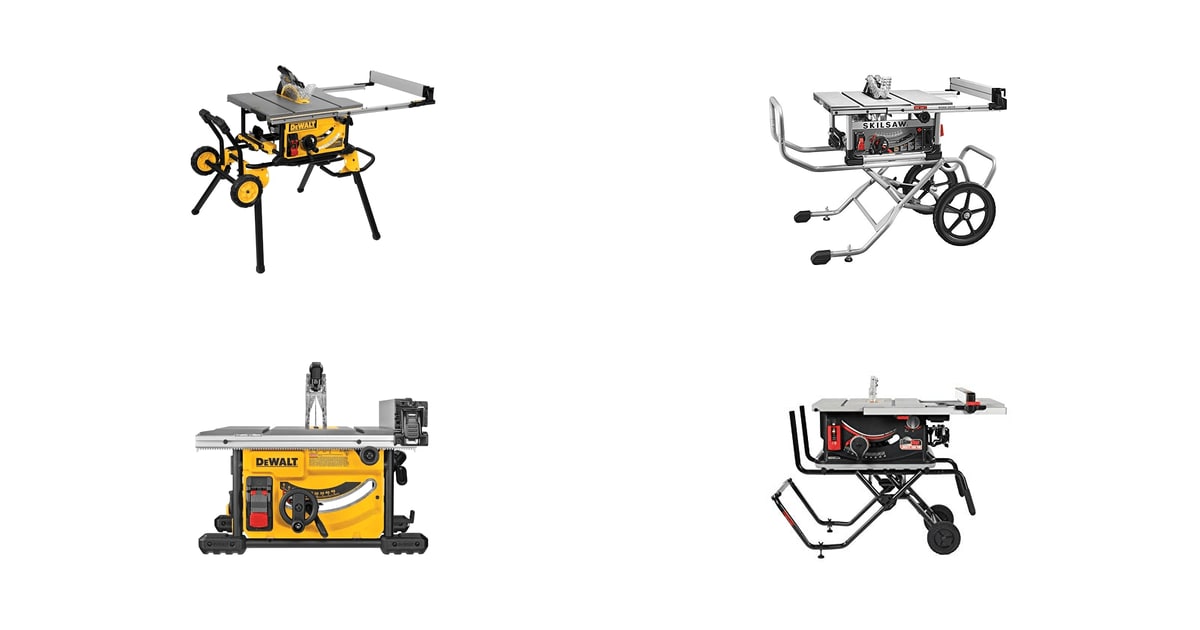
A jobsite table saw is the tool you drag out of the truck when a door needs trimming or a sheet of plywood needs breaking down. It lives outside, gets rained on, and takes a beating in a pickup bed. What you actually notice day to day is the fence — whether it locks parallel every single time — and the stand, because you're the one lifting it. Motor power matters too, but mostly when you're pushing thick hardwood through at full depth.
Here's the honest part: none of these is a cabinet saw. The tables are aluminum, not cast iron, so they flex a little and they ring. Dust collection is mediocre across the board — Wood Magazine's testing puts a single 2.5-inch port at roughly 60 to 65 percent capture of fine dust, and you need a shop vac and a second port to approach 85. The miter gauges are almost universally an afterthought. And every one of these runs a 15-amp motor that can trip a shared breaker on startup.
So buy for the work you actually do. If you break down sheet goods on site every week, rip capacity and a stand you can deploy alone matter more than horsepower on paper. If you're a hobbyist in a garage, safety tech may be worth more than any of it — the Consumer Product Safety Commission estimates table saws cause about 33,000 injuries a year in the U.S., roughly one in ten an amputation. We think that the DeWalt DWE7491RS is the best contractor and jobsite table saw for most people, and that the SKILSAW SPT99-11 is the one to buy if you rip dense hardwood all day.
Everything we recommend
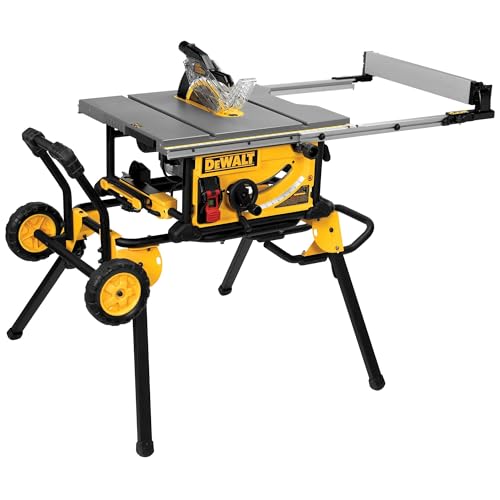
The fence and rip capacity most jobs actually need
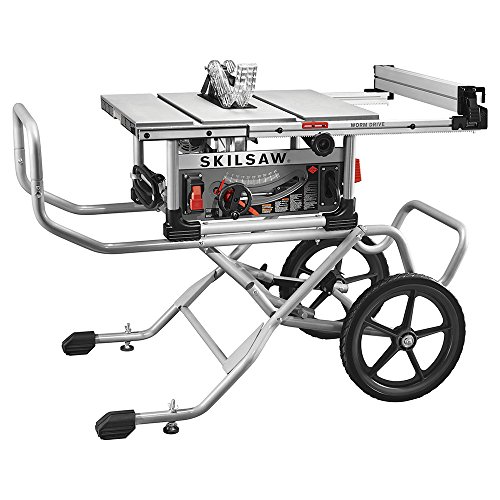
More torque for hardwood, and the best stand of the bunch

The one you can carry alone, with a smaller blade
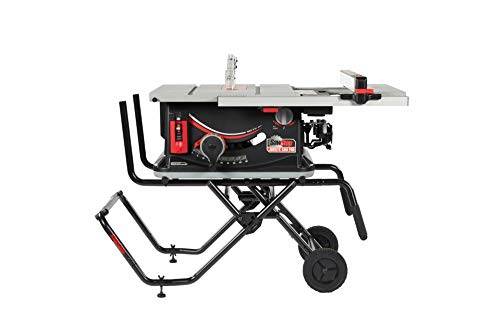
Flesh detection, if you'd rather not gamble your fingers
At a glance
| Product | Rip Capacity | Motor | Price | |
|---|---|---|---|---|
| DEWALT Table Saw 10 Inch with FoldableTop pick | 32-1/2 in | 15 Amp | $599On sale |
| SKIL 10 Inch Heavy Duty Worm DriveRunner-up | 30-1/2 in | Worm Drive | $648 |
| DEWALT 15 Amp 8-1/4 in. Compact PortableBudget pick | 24.5 in | 15 Amp | $429 |
| SawStop Jobsite Saw PRO with Mobile CartUpgrade pick | — | 1 1/2 HP | $1,899On sale |
How we picked
Fence accuracy. We weighted rack-and-pinion fences heavily, because published group testing shows they hold parallel within a few thousandths of an inch while lever-lock fences drift several times that. A fence you have to re-check every cut isn't a fence.
Rip capacity. We looked for at least 24 inches, the point at which you can split a full sheet of plywood without a secondary jig. More is better if you regularly cut shelving or cabinet parts.
Power and drivetrain. Every saw here runs a 15-amp motor, so we compared drivetrains instead. Worm-drive gearing gets credit for the torque advantage published testing found when ripping thick hardwood at full depth.
Stand and weight. We favored integrated stands that one person can deploy and roll over uneven ground, and we noted carry weight, since most 10-inch saws land between 60 and 90 pounds before the stand.
Safety hardware. Riving knives and modular guarding are table stakes. Flesh detection earns a place given how common table saw amputations are, and we weighed it against the cost of replacing a cartridge after a trip.
Top pickOn sale
The fence and rip capacity most jobs actually need
DEWALT Table Saw 10 Inch with Foldable
The DWE7491RS pairs a rack-and-pinion fence with 32-1/2 inches of rip capacity, so you can split a full sheet of plywood without building a jig first. The rolling stand folds flat, sets up alone, and the guard, wrenches and miter gauge all store on board.
$599fromAmazonList priceThe fence is the reason to buy this saw. Rack-and-pinion rails move both ends together, so the fence lands parallel instead of skewing as you clamp it. Fine Woodworking's group test found rack-and-pinion fences like DeWalt's held within about 0.005 inches of parallel across repeated settings, while lever-lock fences on budget saws drifted as much as 0.030 inches. That's the difference between a clean rip and a burned edge you have to sand.
You get 32-1/2 inches of rip capacity, well past the 24 to 28 inches typical of jobsite saws in this class. Practically, that means ripping a 4x8 sheet down the middle by yourself, on a stand, without a secondary cutting jig. If you hang cabinets or install shelving, you'll reach for that capacity constantly, and you'll stop dragging a track saw around as a backup.
Setup is a couple of minutes. The stand rolls on its wheels, tips up and locks, and the telescoping rails retract so the whole package fits through a doorway. Owners routinely mention that assembly took an evening and that the fence and blade were close to square out of the box, needing only small tweaks. Not every saw arrives that way, but it's the common thread in the feedback.
The 15-amp motor is sized right for the work this saw sees. Ripping 3/4-inch ply, cutting trim, breaking down 2x stock — it doesn't bog. Push 8/4 hardwood through at full depth and you'll hear it working harder than a worm-drive saw would. For framing and finish carpentry, that's a non-issue. For a shop that mostly cuts dense hardwood, read on to the SKILSAW.
Flaws but not dealbreakers
The miter gauge is the weak point, and that complaint follows nearly every saw in this category. It's stamped, it has play, and most owners end up building a crosscut sled or walking over to a miter saw when a cut has to be dead square.
Dust collection is average. There's a single port, and without a shop vac hooked to it you'll be sweeping up a pile. The saw and stand together are also a genuine load — heavy enough that getting it into a truck bed is easier with a second set of hands.
Runner-up
More torque for hardwood, and the best stand of the bunch
SKIL 10 Inch Heavy Duty Worm Drive
The SPT99-11 uses worm-drive gearing instead of a direct-drive motor, which puts more torque at the blade when you're ripping thick, dense stock. It also has a rack-and-pinion fence, 30-1/2 inches of rip capacity, and a rolling stand with 16-inch wheels that shrugs off rough ground.
$648fromAmazonWorm gearing is the whole pitch. The gear reduction trades some blade speed for torque, and Popular Mechanics reported noticeably less blade slowdown ripping 2-inch hard maple at full depth than same-amp direct-drive saws managed. If most of what you cut is framing lumber, you'll never feel the difference. If you rip 8/4 white oak or wet pressure-treated stock, you will.
The stand is genuinely better than everyone else's. Sixteen-inch wheels roll over gravel, curbs and extension cords instead of stopping dead at them. Anyone who has dragged a saw on four-inch casters across a muddy lot knows what that's worth on a Monday morning. Owners single out the stand and the all-metal build as the reasons they'd buy this one again.
You also get 3-5/8 inches of depth of cut, more than the usual 10-inch jobsite saw offers, and the rack-and-pinion fence tracks cleanly. Owners report the fence and bevel stops arriving close to accurate, with only minor tweaking needed. At roughly 94 pounds it's a heavy saw, but that mass is part of why it doesn't shift under a hard push.
Flaws but not dealbreakers
The miter gauge and push stick are throwaway parts. Owners say so bluntly, and you should plan on replacing both. Locking the fence also takes a firmer, clunkier motion than the DeWalt's, though the fence itself doesn't move when you do it.
It's big. Folded, it eats more floor space than the DeWalt, and at around 94 pounds it isn't a saw you carry up a flight of stairs alone. If your jobsite is a third-floor walk-up, this is the wrong tool.
Budget pick
The one you can carry alone, with a smaller blade
DEWALT 15 Amp 8-1/4 in. Compact Portable
The DWE7485 runs an 8-1/4-inch blade instead of a 10-inch one, which cuts the weight to around 50 pounds and shrinks the footprint. You still get the rack-and-pinion fence, 24-1/2 inches of rip capacity, and a metal roll cage that survives life in a truck.
$429fromAmazonIf you carry your saw more than you use it, buy this one. It's roughly 20 to 30 pounds lighter than most 10-inch jobsite saws, and it's the model contractors most often describe as a true one-person carry. Up a staircase, down into a basement, into the back of a hatchback — that weight difference decides whether the saw comes along at all or stays in the garage.
You keep the good fence. The same rack-and-pinion rails from the bigger DeWalt are here, and 24-1/2 inches of rip capacity is enough to split a 4x8 sheet if you plan the cut from the right edge. On-board storage holds the guard, wrenches and miter gauge, so nothing rattles loose in transit. Owners consistently report it arriving square and staying that way.
The trade is depth of cut. An 8-1/4-inch blade gives up about half an inch of maximum depth against a 10-inch saw, so a 4x4 in a single pass is off the table and thick hardwood gets fussy. For 3/4-inch sheet goods, trim and 2x lumber — most of what a remodel actually involves — it's plenty of saw.
Flaws but not dealbreakers
The 8-1/4-inch blade size is less common than 10-inch, so you'll find fewer options on a hardware store shelf and a thinner selection of specialty blades. Order a good one and keep a spare in the case.
Some owners find that a few adjustments aren't as accessible as they are on the larger DeWalt. Others got burned by versions sold without a stand, which look nearly identical in listings, so check what's actually in the box before you order.
Upgrade pickOn sale
Flesh detection, if you'd rather not gamble your fingers
SawStop Jobsite Saw PRO with Mobile Cart
The Jobsite Saw PRO carries SawStop's flesh-detection system, which stops and drops the blade in under 5 milliseconds when it senses skin. It's the heaviest and most expensive saw here, and it comes on a mobile cart that folds down for transport and storage.
$1,899fromAmazonList priceNothing else here can stop a blade before it takes a finger. SawStop's system senses skin contact and halts the blade in under 5 milliseconds. Human reaction time runs past 150 milliseconds, so you can't win that race on reflexes, no matter how careful you are. The CPSC puts table saw injuries at roughly 33,000 a year, about one in ten an amputation. That math is the entire argument for this saw.
The catch is what a trip costs you. The brake cartridge is single-use, and the blade generally doesn't survive the stop either, so one activation means replacing both and losing the rest of the afternoon. Damp or pressure-treated lumber can set the system off, too. If you cut wet stock daily, plan around that before you commit.
As a saw, it's good rather than exceptional. The 24-5/8-inch table depth gives you more support ahead of the blade than most jobsite saws, and the one-turn elevation crank makes height changes quick. Owners describe it as accurate out of the box and easy to move on its cart. Several also call it loud — the open-bottom base doesn't muffle much of anything.
It makes the most sense in a shared shop or a teaching space, where you can't control who's standing at the blade. It's also the saw people buy right after a close call. If you're framing and you're disciplined about push sticks, the DeWalt does nearly everything this does and costs considerably less — minus the safety net. That's the trade.
Flaws but not dealbreakers
It's heavy and bulky. Saw and cart together run well past 100 pounds, so it's a two-person lift into a truck and a saw you'd rather leave standing in a garage than haul between sites every day.
A few owners describe it as a construction saw rather than a precision machine, with a fence worth checking rather than trusting. Others flag the noise. And the safety system adds cost on top of a saw that's already the priciest option here.
Who this is for
This guide is for anyone who needs a saw that moves — contractors working out of a truck, remodelers cutting on site, and DIYers upgrading from a wobbly benchtop unit to something with a real fence. If you rip sheet goods, cut trim, or break down framing lumber somewhere other than a dedicated shop, these are the saws worth your attention. Finish carpenters and furniture makers will care most about fence repeatability, which is where the rack-and-pinion models separate themselves.
If your saw lives in one spot and never moves, you'll get more for your money from a stationary contractor or cabinet saw with a cast iron top — better vibration damping, better dust collection, better crosscut support. This guide doesn't cover those, and it doesn't cover benchtop saws without stands or cordless models. It also doesn't cover accessories like inserts and replacement parts, which show up in searches but aren't saws.
How we picked
We built the shortlist around a few things that actually change your day. Fence: rack-and-pinion rails that land parallel every time, since published group testing shows lever-lock fences drift several times as far. Rip capacity: at least 24 inches, so a full sheet of plywood doesn't require a jig. Drivetrain: 15 amps is the ceiling on a standard circuit, so gearing decides how much torque reaches the blade in dense stock. Stand: deployable by one person and rollable over gravel, with weight low enough to load solo. Safety: a riving knife and real guarding at minimum, with flesh detection weighed against cartridge replacement after a trip.
The competition
This is what our research turned up on Amazon for this category, not a survey of every jobsite saw on the market. Several well-regarded models — Bosch's REAXX and Gravity-Rise saws, Makita's contractor saw, and Ridgid's lifetime-warranty budget option among them — came up repeatedly in published reviews and owner discussion but weren't available as saws in this lineup. If one of those is on your list, the criteria above still apply: check the fence type, the rip capacity, and how the stand deploys before anything else.
Setup and jobsite care
Check the blade for square to the table and the fence for parallel to the blade before your first real cut, then re-check after any hard trip in the truck. Most of these saws arrive close, not perfect. Run the saw on a dedicated 20-amp circuit when you can — a 15-amp motor starting under load will trip a shared breaker, especially at the end of a long extension cord. Use the heaviest gauge cord you have and keep it short. Hook a shop vac to the dust port; a single port catches only a fraction of the fine dust on its own, and that matters most when you're cutting inside someone's house. Blow the motor housing out with compressed air regularly, keep the top waxed so stock slides instead of sticking, and stash the guard and riving knife in the on-board storage so they're there when you need them.
Questions we get
What's the difference between a contractor table saw and a jobsite table saw?
A jobsite saw is built to move: aluminum table, direct-drive or worm-drive motor, folding stand, and a weight one or two people can load. A classic contractor saw is a heavier stationary machine with a cast iron top and an open base, meant to live in a shop. In practice the terms get used interchangeably now, and everything in this guide is portable.
Is a worm-drive saw better than a direct-drive saw for hardwood?
For thick, dense stock, yes. The worm gear trades blade speed for torque, and Popular Mechanics reported less blade slowdown ripping 2-inch hard maple at full depth compared with same-amp direct-drive saws. For framing lumber, plywood and trim, you won't notice the difference, and direct-drive saws tend to be lighter and easier to haul.
Do I need flesh detection if I'm just a hobbyist?
You don't need it, but the case is stronger for hobbyists than most people assume. The CPSC estimates around 33,000 table saw injuries a year, and about a tenth are amputations — often to people who've been cutting for decades. If your shop is shared, or beginners use it, the brake is worth serious thought. Just know that a trip means replacing the cartridge and usually the blade.
What rip capacity do I need for full sheets of plywood?
About 24 inches gets you there, because you can rip a 4-foot-wide sheet down the middle. Anything less and you're building a jig or reaching for a track saw. Bigger capacity — the 30-inch-plus range — is what you want if you cut cabinet parts and shelving, where the offcut is the piece you're keeping.
Can I run a dado set in a jobsite table saw?
Often not. Many portable saws have arbors too short for a stacked dado set, and the manual will state plainly whether yours accepts one. Check before you buy the blades. If dadoes are central to your work, that's a strong argument for a stationary saw instead.
How heavy is too heavy to carry alone?
Around 50 pounds is the line most people can manage solo up stairs or into a truck bed. Most 10-inch jobsite saws sit between 60 and 90 pounds before the stand, which is why an integrated rolling stand with large wheels matters so much. If you're loading and unloading daily by yourself, weight should outrank almost every other spec.
Why you should trust us
For this guide:
- We read manufacturer specifications for every saw here alongside published testing from Fine Woodworking, Popular Mechanics, This Old House, Wood Magazine and Family Handyman.
- We compared fence systems, rip capacity, drivetrain type, stand design and weight across the lineup, and cross-referenced injury and dust-capture figures against Consumer Product Safety Commission and Wood Magazine data.
- We reviewed recurring themes in owner feedback — miter gauge quality, out-of-box accuracy, stand usability and noise — to identify flaws that specifications don't reveal.
- We read owner reviews on every listing, weighted toward the critical ones, because that is where the recurring failures show up.
- We have a systematic way of automatically fetching the latest prices, so the numbers on this page stay current.
- This is a research-focused guide, so the team may not own every product listed — though we often do own the top winners, which gives us extra context for the recommendations.
- We don't accept free products, and the retailer commission never changes which product we recommend.
Sources
Best Table Saws of 2026 — Popular Mechanics, Popular Mechanics
Best Jobsite Table Saw Reviews — This Old House, This Old House
Table Saw Buying Guide — Fine Woodworking, Fine Woodworking
Best Portable Table Saws — Bob Vila, Bob Vila
DeWalt DWE7491RS Review — Tool Reviews by Pros, Pro Tool Reviews
Contractor Table Saw Comparison Test — Wood Magazine, Wood Magazine
Table Saw Safety Statistics — U.S. Consumer Product Safety Commission, U.S. CPSC
Bosch REAXX vs. SawStop — Fine Homebuilding, Fine Homebuilding
Best Table Saws for the Money — Family Handyman, Family Handyman
Skilsaw SPT99-11 Worm Drive Table Saw Review — Tools in Action, Tools in Action
Portable Table Saw Group Test — Woodworkers Guild of America, Woodworkers Guild of America
Table Saw Injury Data & Power Tool Safety — National Safety Council, National Safety Council
Amazon product listings and owner reviews for all 4 products
Manufacturer specification pages for each product
Some passages in this guide may be paraphrased with AI help. Prices are refreshed automatically.
More like this.
Continue exploring home reviews and recommendations.

The Best Portable Jobsite Generators
A jobsite generator is the difference between a crew that works and a crew that stands around. You need enough running watts for every tool that's on at…

The Best Wet Tile Saws
Cutting tile is the part of a tile job that decides how the finished wall looks. Every outlet, every doorway, every corner needs a cut piece, and a…

The Best Miter Saws for Woodworking and Home Shops
A miter saw is the tool that decides whether your trim looks sharp or looks like it was cut with a butter knife. It crosscuts boards to length and slices…

The Best Pole Saws
Pruning overhead branches used to mean a ladder, a chainsaw, and a bad idea. A pole saw fixes that. You keep both feet on the ground, extend the shaft,…

The Best Ratcheting Wrench Sets
A ratcheting wrench earns its keep in the spots where a regular wrench can't move. You slip the box end over a bolt and swing the handle back without…

The Best Furniture Sliders and Mover Pads
Moving a loaded dresser across a room is one of those jobs that seems trivial until you're halfway through it. Bare furniture legs catch on carpet pile…