The Best Telescopes for Beginners
The hardest part of owning a telescope isn't the optics. It's finding anything in the dark. You step outside, point the tube at a patch of sky, look through the eyepiece, and see nothing but black. Star-hopping from a bright anchor star takes weeks to learn, and a discouraging first night is how most beginner telescopes end up in a closet. So the scope that matters is the one you'll actually carry outside and use, not the one with the biggest number on the box.
Here's the honest caveat: no telescope makes the sky look like a Hubble photo. Galaxies are grey smudges. Nebulae are faint and colorless to the eye, because your eye can't stack light the way a camera does. Every scope here is a compromise between aperture, portability and how much sky knowledge it demands from you. And the single biggest upgrade isn't a scope at all — it's driving away from city lights. Set your expectations there and you'll be delighted rather than let down.
We looked at five popular beginner telescopes across a wide range of sizes and budgets, from a compact app-guided refractor to an 8-inch collapsible Dobsonian. Each one suits a different kind of first-time observer, and the right pick depends mostly on whether you want the scope to find things for you or you'd rather learn the sky yourself. We think that the Celestron StarSense Explorer DX 130AZ is the best beginner telescope for most people, and that the Sky-Watcher Heritage 150 is the one to buy if you want the most aperture you can get and don't mind hunting for objects manually.
Everything we recommend
Your phone finds the target, so your first night isn't a bust

More light-gathering per dollar than anything else here

Eight inches of aperture, if you can lift it and store it

It finds and follows the target while you just look
At a glance
| Product | Aperture | Mount Type | Price | |
|---|---|---|---|---|
| Celestron StarSense Explorer DX 130AZ App-Enabled TelescopeTop pick | 130mm | Altazimuth | $499.95 |
| Sky-Watcher Heritage 150 Tabletop Dobsonian Telescope -Budget pick | 150mm | Dobsonian | $309On sale |
| Celestron NexStar 5SE Computerized TelescopeAlso great | 5-Inch | GoTo Mount | $899On sale |
| Sky-Watcher Flextube 200 Dobsonian 8-inch Collapsible LargeUpgrade pick | 8-inch | Dobsonian | $739On sale |
 | Celestron StarSense Explorer LT 80AZ App-Enabled TelescopeAlso consider | 80mm | Altazimuth | $229.99On sale |
How we picked
Aperture first. Aperture drives everything you'll actually see, so we set 80mm as the floor and favored scopes at 100mm and up for anyone who wants deep-sky views. We compared published mirror and lens specs directly rather than trusting the magnification claims on the box.
How you find things. We weighted object-finding heavily, because published reviews and owner feedback agree it's the reason most beginner scopes get abandoned. App-guided and computerized systems earned credit; so did manual scopes that pair a good finder with a wide, forgiving field.
Mount steadiness. A sharp mirror on a shaky mount is miserable to use, so we looked for slow-motion controls, friction adjustment and damping in spec sheets and reviews. Owner reports of vibration and drift counted against a scope.
Setup and storage. A scope that takes half an hour to deploy stays in the garage. We favored designs that go from storage to first view in under ten minutes and that fit in a normal home and car.
What's in the box. Two useful eyepieces and a real finder should be standard, not upgrades. We checked bundled accessories against what owners say they replaced first.
Top pick
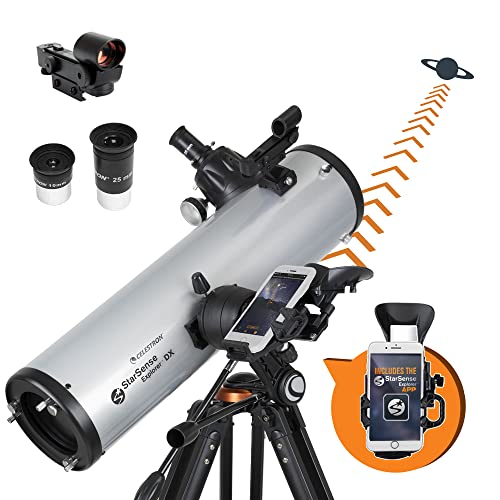
Your phone finds the target, so your first night isn't a bust
Celestron StarSense Explorer DX 130AZ App-Enabled Telescope
A 130mm reflector paired with an app that reads the actual star field through your phone's camera and tells you which way to nudge. It's the rare beginner scope where you can hand it to someone with zero astronomy background and they'll find Saturn on their own.
$499.95fromAmazonThe app solves the one problem that makes beginners quit. You clip your phone into the cradle, open the free StarSense Explorer app, and a mirror bounces the sky into your phone's camera. The app reads the star pattern and works out where the tube is aimed — no alignment routine, no typing in coordinates. On-screen arrows walk you to the target, and a bullseye turns green when you're there. Celestron says the catalog runs past 120,000 objects.
The 130mm mirror is enough aperture to make the classics look good. This is the size where Saturn stops being a dot with ears and starts showing the ring gap on a steady night. Jupiter's cloud bands show up, the Orion Nebula spreads out, and open clusters like the Pleiades fill the field. Two eyepieces come in the box — a 25mm for wide sweeping at 26x and a 10mm for planetary detail at 65x. That covers most of what a beginner wants to look at.
The mount is manual, and that's fine here. You get a straightforward alt-azimuth head with dual-axis slow-motion controls, so you're turning knobs rather than shoving the tube around. Nothing to charge, nothing to boot up, no alignment stars to center. Published reviews and owner feedback both point to smooth, well-damped motion that holds position between nudges — which matters a lot when you're at 65x and the target keeps drifting.
It works from a city backyard. The app builds a list of what's actually worth seeing from your location at that hour, so you're not chasing a galaxy that light pollution has erased. From a suburban street you'll get the Moon, planets, double stars and the brighter clusters. Drive out to darker sky and the same scope suddenly shows you a lot more. That's a nice arc to have with a first telescope.
Flaws but not dealbreakers
Your phone is a required part. No compatible smartphone, no navigation — you're back to a red-dot finder and a star chart. The app also wants an internet connection for full catalog access, which is awkward if your favorite dark site has no signal. Download what you need before you drive out.
It's not the biggest scope here. The 150mm and 203mm Dobsonians in this guide gather noticeably more light, and on faint galaxies and dim nebulae you'll see the difference. For the Moon, planets and bright deep-sky targets, the gap barely matters.
The tripod is adequate, not stiff. It holds the tube fine, but bump a leg at high magnification and the view shakes for a beat. Owners who upgrade anything usually start here. Setting up on grass rather than a deck helps more than you'd think.
The StarSense Explorer DX 130AZ comes with a two-year US warranty from Celestron.
Budget pickOn sale
More light-gathering per dollar than anything else here
Sky-Watcher Heritage 150 Tabletop Dobsonian Telescope -
A 150mm Dobsonian on a simple rocker box that collapses down small enough to carry in one hand. You get more aperture than the top pick for less money, but you'll be finding every object yourself with a chart or a phone app.
$309fromAmazonList priceYou're buying aperture, and that's the right thing to buy. Most inexpensive telescopes hand you a 60mm or 70mm refractor that shows dim, mushy planets. This one gives you a 150mm parabolic primary mirror instead — several times the light-gathering area. The practical result is that globular clusters start to look grainy rather than blank, and the Moon and planets carry real detail. If you only optimize one spec, make it this one.
The collapsible tube makes it genuinely portable. Sky-Watcher's strut design lets the tube slide down for storage and pop back up for use, and the company says it holds collimation through the process. Collapsed, it's small enough to sit on a shelf or ride in a footwell. That matters more than it sounds — the scope you can grab in thirty seconds is the scope you'll actually use on a Tuesday night.
Nothing about it can fail in the field. No batteries, no motors, no firmware, no app. You push the tube where you want it and it stays there. The rocker box rides on rubber feet that damp out the wobble you'd otherwise get from a tabletop, and there's a 1.25-inch helical focuser for fine adjustment. Fast f/5 optics at 750mm focal length give you wide, forgiving fields that make manual hunting easier.
It rewards learning the sky. There's no app holding your hand, so you'll use a printed chart or a free planetarium app and work your way over from a bright star. That's slower at first. But plenty of longtime observers say this is the part of the hobby they love most, and the skill transfers to every telescope you'll ever own.
Flaws but not dealbreakers
You need a table. There's no tripod in the box. A picnic table, a garden wall, a sturdy folding workbench or the roof of a car all work, but you have to think about it before dark. If you don't have a solid elevated surface, buy something else.
Finding things is entirely on you. No tracking, no GoTo, no app integration. At higher magnification you'll be nudging the tube every minute or so to keep an object in view. Gift buyers should think carefully — this can frustrate someone who just wants to look at Saturn without a lesson first.
The bundled eyepieces are basic. They work, but they're the obvious first upgrade, and they're a step below what comes with the pricier scopes here. A truss-style tube also collects more stray light than a closed one, so a simple shroud helps contrast under streetlights.
Upgrade pickOn sale
Eight inches of aperture, if you can lift it and store it
Sky-Watcher Flextube 200 Dobsonian 8-inch Collapsible Large
An 8-inch collapsible Dobsonian that collects roughly two and a half times the light of our top pick. It's the scope that turns galaxies from faint ovals into structures you can study, and it comes with better eyepieces and a proper finder than the rest of this list.
$739fromAmazonList priceThe jump to 203mm changes what's actually visible. This mirror collects about 2.4 times as much light as a 130mm and nearly twice as much as the 150mm. In practice that's the difference between M13 looking like a fuzzy ball and seeing individual stars break out around its edges, or between the Ring Nebula as a grey smudge and a clear smoke ring hanging in the field. Under dark sky, galaxy hunting stops being an exercise in faith.
The accessory bundle is the best here. You get two super wide-angle eyepieces at 25mm and 10mm, a 2-inch Crayford-style focuser with a 1.25-inch adapter, and an 8x50 right-angle finder scope. That finder matters — it's far easier to star-hop with than a red dot, and it saves you from craning your neck. Most beginner scopes make you buy your way up to this kit over a year or two.
The mount is smooth and completely mechanical. Teflon bearings handle the azimuth motion, and Sky-Watcher's tension-control handles let you adjust friction so the tube stays put without needing perfect balance. No tools, no power, no software. It's silent, it never needs an update, and it'll still work in twenty years.
It collapses, which is the whole point. A fixed 8-inch tube is roughly four feet long and genuinely awkward to store in an apartment. The strut design compresses it to about half that for transport, so it fits in most car boots and stands upright in a closet. Sky-Watcher says collimation survives the collapse, though a quick check before each session is good practice with any reflector.
Flaws but not dealbreakers
It's big and it's heavy. At 27 pounds for the assembled scope, this is the one you'll think twice about carrying downstairs. If you're in a walk-up apartment or don't have a car, be honest with yourself about how often it'll leave the house.
Collimation becomes part of your routine. Moving the truss around can shift the mirrors slightly, and at high magnification a misaligned reflector loses sharpness. It's a two-minute job once you've done it a few times, but it's real, and owners who skip it tend to blame the optics for a problem they created.
Everything is manual. No tracking means constant nudging, and no GoTo means you need to know roughly where you're going. Pair it with a planetarium app and it's manageable, but it's the most demanding scope here for a total newcomer.
Also greatOn sale
It finds and follows the target while you just look
Celestron NexStar 5SE Computerized Telescope
A computerized 5-inch Schmidt-Cassegrain that slews to any of 40,000-plus objects and then tracks them as the Earth turns. It's the most expensive scope here, and it's the one to get if you want a serious instrument you won't outgrow.
$899fromAmazonList priceTracking is the feature you don't appreciate until you have it. A manual scope needs a nudge every minute or two at high power. This one keeps the target centered on its own, which changes the experience completely. You can stare at Jupiter for ten unbroken minutes and let your eye pick out detail. At a star party, a line of people can each take a turn without anyone re-centering between them.
SkyAlign makes the setup approachable. Center any three bright stars or planets — you don't need to know their names — and the mount works out where it is. From there the NexStar+ hand control slews to anything in a 40,000-object database. It's a different philosophy than the StarSense scopes, which read the sky through your phone, but it lands in the same place: you spend the night observing instead of searching.
The folded optics buy you reach in a short tube. A Schmidt-Cassegrain bounces light between two mirrors inside a sealed tube, so the 5-inch aperture delivers a 1,250mm focal length in a tube roughly a foot long. High magnification comes easily with ordinary eyepieces — the included 25mm gives 50x, and a 10mm gets you to 125x, which is plenty for Jupiter's moons as small discs and Saturn's ring gap. The sealed tube also means no collimation chores.
It grows with you. There's a built-in wedge for polar aligning, which cuts field rotation and opens the door to entry-level long-exposure imaging. Celestron's accessory ecosystem covers wireless control and GPS modules. Most beginner telescopes are a stepping stone you resell in two years; this is one you keep.
Flaws but not dealbreakers
It costs far more than anything else here, and buys less aperture. The 8-inch Dobsonian in this guide gathers considerably more light for a fraction of the outlay. You're paying for automation and precision, not photons — which is a reasonable trade only if tracking is what you actually want.
Alignment takes time on every new site. Plan on ten to fifteen minutes before you see anything, and it's fussier if trees or buildings block your bright stars. On a night with a narrow clear window, that's a real cost.
Power is a live concern. It runs on eight AA batteries, and owners consistently report that they drain fast in cold weather, right when slewing draws the most current. An external AC or DC supply is the fix most people end up buying. The single-arm fork also isn't as rigid as a dual-arm mount, so it settles a bit after each slew.
The NexStar 5SE comes with a two-year US warranty from Celestron.
Who this is for
This guide is for someone buying a first real telescope — for themselves, for a kid, or for a household that wants to look at the sky together. If you've never owned one, you'll be happiest with a scope that helps you find things, because the finding is the hard part. If you already own a small refractor and know your way around a star chart, skip straight to the aperture picks; you don't need the hand-holding and you'll get more sky for your money.
We've stuck to complete beginner telescopes you can set up and use the same night. That means no astrophotography rigs, no equatorial mounts that need polar alignment, no smart telescopes that replace the eyepiece with a screen. It also means no department-store scopes with plastic mounts and 525x printed on the box — those numbers are marketing, and the real useful limit is roughly 50x per inch of aperture. If you want to photograph the sky seriously, that's a different guide and a different budget.
How we picked
We started with the specs that actually change what you see and ignored the ones printed on the box for show. Aperture: the single spec that matters most, so we set an 80mm floor and pushed toward 100mm and beyond wherever the budget allowed. Finding objects: app-guided plate-solving, computerized GoTo and quality finder scopes all got credit, because published reviews and owner feedback both point to frustrating object-hunting as the reason beginner scopes get shelved. Mount steadiness: slow-motion controls, adjustable friction and good damping, with owner reports of wobble counting against a pick. Setup and storage: ten minutes from storage to first view, and a footprint that fits a normal home. What's included: two usable eyepieces and a real finder, judged against what owners say they replaced first.
Other telescopes for beginners worth considering
If you want the app-guided experience in the lightest possible package: The Celestron StarSense Explorer LT 80AZ App-Enabled Telescope ($229.99) — The StarSense Explorer LT 80AZ runs the same navigation app as our top pick, but on an 80mm refractor that weighs about nine pounds all in. It sets up in a couple of minutes, comes with a floor-standing tripod so you're not hunting for a table, and never needs collimation — the lenses stay aligned for life. That makes it a genuinely good choice for a ten-year-old or for someone who wants a scope that lives in the car for camping trips. What you give up is light: 80mm gathers well under half of what the 130mm mirror does, so galaxies and faint nebulae look dim and low-contrast where the DX 130AZ shows something worth studying. Bright targets — the Moon, Saturn's rings, Jupiter's moons — still look sharp and satisfying. The lighter aluminum tripod also shivers in a breeze. If your budget can stretch to the DX 130AZ, stretch; if portability wins, this is the one. It carries the same two-year Celestron warranty.
The competition
Every telescope in this guide earned a spot, which is unusual — the beginner market is full of scopes we'd steer you away from, but this particular lineup is made up of designs that published reviews and owner feedback consistently rate well. What follows isn't the whole market. There are excellent scopes we didn't look at here, particularly larger fixed-tube Dobsonians and the newer smart telescopes that skip the eyepiece entirely. Treat this as a well-vetted shortlist rather than a survey of everything you could buy.
Setup and care
Give your eyes twenty minutes to adapt to the dark and don't check your phone with the screen at full brightness — one glance undoes it. Use red light instead. Let the scope sit outside for half an hour before you observe, because warm optics in cold air produce shimmering, mushy images until the temperature evens out. If you have a reflector or Dobsonian, learn to collimate; it's a two-minute routine with a collimation cap once you've done it a few times, and skipping it is why plenty of owners think their mirror is bad. Never clean a mirror or lens unless it's genuinely filthy, since dust costs you almost nothing and scratches are forever. Store the scope with caps on, indoors, somewhere dry. And start low — put the 25mm eyepiece in first, find the target, then swap up.
Questions we get
What's the best telescope for a complete beginner?
The Celestron StarSense Explorer DX 130AZ, because it removes the part that makes beginners quit. The app reads the actual star field through your phone's camera and walks you to your target with on-screen arrows, so you're observing on night one instead of hunting. The 130mm mirror is big enough for real detail on the Moon, planets and brighter deep-sky objects. If you'd rather learn the sky yourself and want more aperture, the Sky-Watcher Heritage 150 costs less and collects more light.
What magnification do I need to see Saturn's rings and Jupiter's moons?
Less than you'd think. Saturn's rings show up at around 25x, and Jupiter's four Galilean moons are visible as tiny points at about 20x — every scope in this guide clears that easily on any clear night. To split the Cassini Division in Saturn's rings you want roughly 100x on a steady night. Jupiter's cloud bands and the Great Red Spot need something like 75x to 150x through a 100mm or larger aperture.
Should I get a refractor or a reflector?
For most beginners, a reflector, because mirrors are far cheaper to make than lenses and you get much more aperture for the same money. The trade-off is collimation — every so often you'll realign the mirrors, which is a quick routine but a real chore. Refractors like the StarSense Explorer LT 80AZ never need it and are genuinely zero-maintenance, which makes them appealing for kids and casual use. If you want the most performance per dollar, go with a reflector or Dobsonian.
What's a Dobsonian, and is it good for a first telescope?
It's a Newtonian reflector sitting on a simple rocker-box mount that swings left-right and up-down. John Dobson designed it in the 1960s to get the most aperture for the least money and complexity, and it works — the Heritage 150 and the Flextube 200 here are both Dobsonians. They're mechanically simple, need no power, and the motion is smooth and intuitive. The catch is that they don't track, so you'll nudge the tube every minute or two at higher magnification.
Can I use a telescope in the city?
Yes, with realistic expectations. Light pollution wrecks faint galaxies and dim nebulae but barely touches bright targets, so the Moon, every planet, double stars and clusters like the Pleiades all look excellent from a suburban backyard. The Orion Nebula holds up too if you've got 100mm or more of aperture. Save your dark-sky trips for galaxy hunting — driving thirty or forty miles out changes what's visible more than any equipment upgrade you can buy.
Do I need a GoTo mount, or can I find things manually?
You don't need one, but it removes a lot of early frustration. Star-hopping is a genuine skill and many experienced observers prefer it, though it takes weeks or months to get comfortable — and a bad first session is how people quit the hobby. A computerized mount like the NexStar 5SE or an app-assisted scope like the StarSense Explorer DX 130AZ means every minute outside is spent looking, not searching. If you're buying a gift, lean toward guided. If you like a puzzle, a manual Dobsonian gives you more aperture for the money.
Why you should trust us
For this guide:
- We compared manufacturer specifications for every telescope here — aperture, focal ratio, mount type, bundled eyepieces and finder — rather than relying on the magnification figures printed on the packaging.
- We read published reviews from astronomy publications and equipment reviewers, and weighed them against recurring themes in owner feedback about setup time, mount steadiness, collimation and battery life.
- We did not observe through any of these telescopes ourselves; every judgment here comes from documented specifications, published reviews and owner-reported experience.
- We read owner reviews on every listing, weighted toward the critical ones, because that is where the recurring failures show up.
- We have a systematic way of automatically fetching the latest prices, so the numbers on this page stay current.
- This is a research-focused guide, so the team may not own every product listed — though we often do own the top winners, which gives us extra context for the recommendations.
- We don't accept free products, and the retailer commission never changes which product we recommend.
Sources
Best Telescopes for Beginners — Space.com, Space.com
Best Telescopes for Beginners — Wirecutter / The New York Times, Wirecutter / The New York Times
Buying a Telescope: Complete Buyer's Guide — Sky & Telescope, Sky & Telescope
Best Telescope for Beginners 2026 — BBC Sky at Night Magazine, BBC Sky at Night Magazine
Best Telescopes 2026: Tested by Experts — Tom's Guide, Tom's Guide
Telescope Buyer's Guide — Astronomy Magazine, Astronomy Magazine
Best Telescopes 2026 — Forbes Vetted, Forbes Vetted
StarSense Explorer Technology Overview — Celestron, Celestron
Amazon product listings and owner reviews for all 5 products
Manufacturer specification pages for each product
Some passages in this guide may be paraphrased with AI help. Prices are refreshed automatically.
More like this.
Continue exploring lifestyle reviews and recommendations.

The Best Cookbooks for Kids and Beginner Cooks
A kids' cookbook has one job: get a child cooking something they're proud of, without you hovering over every step. The good ones explain why you fold…

The Best Fishing Rod and Reel Combos for Beginners
Your first fishing combo has one job: get you to the water without a fight. That means a reel that doesn't tangle when your cast goes sideways, a rod that…

The Best Inflatable Paddle Boards for Beginners
Your first hour on a paddle board is mostly about not falling in. That's why width matters more than length when you're starting out, and why a 32-inch…

A Beginner's Guide to POP MART: Everything You Need to Know About Blind Box Toys (2026)
Discover the captivating world of POP MART blind box collectibles. From understanding the thrill of the chase to choosing your first series, this complete guide helps newcomers navigate the exciting hobby of art toy collecting.

The Best Cookbooks for Beginner Home Cooks
A first cookbook has one job: get you cooking dinner without panic. That sounds simple, but most cookbooks aren't built for someone who has never sweated…

The Best Foam Surfboards for Beginners
A foam surfboard is the closest thing surfing has to an insurance policy. The deck is soft, the rails are soft, and when the board comes back at you in…