The Best Cast Iron Skillets
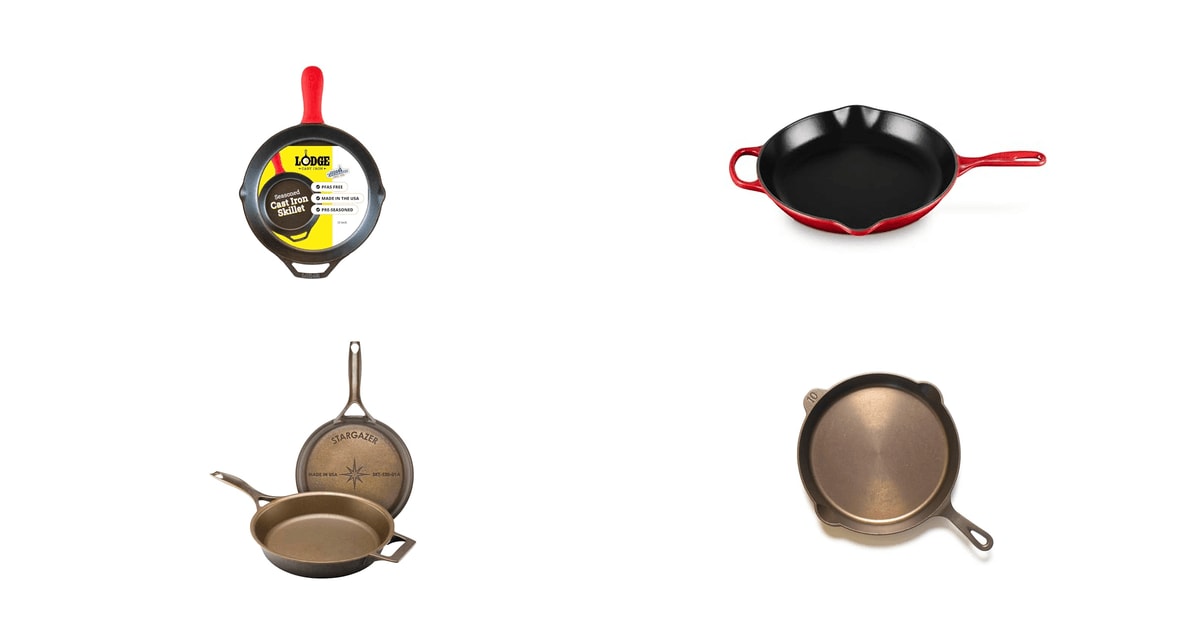
A cast iron skillet is the rare pan you buy once. It doesn't peel, it doesn't warp under a hot burner, and it doesn't need replacing every three years like a nonstick. What it does is hold heat. Drop a cold steak into a properly preheated cast iron pan and the surface temperature barely dips, which is exactly why the crust comes out dark and even. The same mass that makes it good at searing also makes it good at cornbread, roasted chicken thighs, and a deep-dish pizza you finish under the broiler.
Here's the honest part. Every bare cast iron skillet asks something of you. You have to dry it, oil it now and then, and accept that eggs will stick until the seasoning builds up. None of these pans are nonstick out of the box, no matter what the packaging says. They're all heavy enough that lifting a loaded one from a hot oven takes two hands and real attention. And a bare pan doesn't love acidic food — a long tomato braise will strip seasoning off any of them. Enameled cast iron sidesteps that, but trades away campfires and very high heat.
So the right pan depends on how much fuss you'll tolerate and how much you want to spend. Someone who cooks eggs every morning wants a smooth surface. Someone who sears steak on weekends wants thickness. Someone with wrist trouble wants the lightest pan that still works. We think that the Lodge Seasoned Cast Iron Skillet is the best cast iron skillet for most people, and that the Stargazer 12-Inch Cast Iron Skillet is the one to buy if you cook in cast iron daily and want a smoother surface from the start.
Everything we recommend

Heavy, rough, and better than anything near its price

A smoother surface and a helper handle, for real money

Much lighter and better seasoned, in a smaller size

Cast iron heat with none of the seasoning homework
At a glance
| Product | Diameter | Weight | Price | |
|---|---|---|---|---|
| Lodge Seasoned Cast Iron Skillet - QualityTop pick | 12 inch | 7.5 lbs | $34.90 |
| Le Creuset Enameled Cast Iron Signature IronAlso great | 11.75 in | 6.8 lbs | $274.95 |
| Stargazer 12-Inch Cast Iron SkilletUpgrade pick | 12 inch | 6.5 lbs | $175 |
 | Lancaster Cast Iron No. 10 Skillet -Also consider | 11-5/8 inch | 6 lbs | $225 |
| Lodge Blacklock 10.25" Triple Seasoned Cast IronAlso great | 10.25 in | 4.2 lbs | $59.95 |
How we picked
Heat retention. We compared casting thickness and listed weights against published reviews of searing performance. A pan needs enough mass to hold temperature when cold food hits it, which is the whole reason to own cast iron.
Cooking surface. We looked at whether the interior is sand-cast, machined, hand-polished, or enameled, and read owner feedback on how quickly food release improved. Smoother surfaces shorten the frustrating early period.
Weight and handling. We compared manufacturer weights and read owner reports about lifting loaded pans, and gave credit for helper handles and cooler-running grips. Weight is the most common reason a cast iron skillet stops getting used.
Maintenance load. We weighed how much seasoning work each pan demands out of the box and over time, based on factory seasoning claims and owner experience. Enameled pans got credit for needing none.
Warranty and support. We checked stated warranty terms and how reachable each maker is, since these are pans people expect to keep for decades. Every brand here offers long-term or lifetime coverage.
Top pick
Heavy, rough, and better than anything near its price
Lodge Seasoned Cast Iron Skillet - Quality
This is the 12-inch pan most people should start with. It sears as well as skillets costing several times more, it's sold nearly everywhere, and it comes with a silicone handle sleeve so you don't burn yourself on day one.
$34.90fromAmazonThe Lodge does the one thing cast iron is for, and does it as well as anything here. Its walls are thick, so it stores a lot of heat. Put a cold ribeye in it and the pan holds its temperature instead of stalling out. Owner feedback comes back to searing again and again — steaks, burgers, smash-fried anything. That thermal mass is the whole point, and Lodge gives you more of it per dollar than any other pan on this list.
It also happens to be the most forgiving pan to own. You can rust it, scrub it back with steel wool, re-season it, and carry on. You can take it camping and set it directly in coals. It's induction-safe, oven-safe to 500°F, and it works on gas, electric, and glass-top. If you've never cooked in cast iron, this is the pan to make your mistakes in.
The surface is the catch, and it's worth being clear about. Lodge sand-casts and then applies a vegetable-oil pre-seasoning, so the cooking surface stays pebbly compared with a machined pan. Food release starts mediocre. It gets better as you cook bacon, sausage, and burgers in it, because fat fills in the low spots and polymerizes. Most people notice a real change after a couple of weeks of regular use.
Lodge includes a red silicone handle holder in the box, which is more useful than it sounds. The handle on a bare cast iron skillet gets ferociously hot on the stovetop, and the sleeve means you're not hunting for a towel with one hand while the pan smokes. It slides off before the pan goes in the oven.
Flaws but not dealbreakers
It's heavy — about 7.5 pounds empty, and noticeably more with food in it. That's the most common complaint from owners by a wide margin. If you have wrist or grip issues, or you're lifting it out of a low oven, this is a genuine problem rather than a quibble.
There's no helper handle on the standard 12-inch model. Moving a full pan means gripping the long handle with a mitt and steadying the rim with your other hand, which is awkward at best. Several pans further down this list fix that, and it's the single upgrade most Lodge owners end up wanting.
You'll need to keep up with it. Dry it fully, wipe a little oil in it, and don't leave it wet in the sink. Skip that for a few weeks in a humid kitchen and you'll find orange spots.
Upgrade pick
A smoother surface and a helper handle, for real money
Stargazer 12-Inch Cast Iron Skillet
Stargazer machines its cooking surface smooth instead of leaving it sand-cast, so food releases better early on. It also adds a helper handle and a flared rim that pours cleanly, which are the two things Lodge owners most often wish for.
$175fromAmazonThe machined surface is the reason to buy this pan. A smooth interior gives proteins and starches fewer places to grab, so eggs and fish behave much earlier in the pan's life. Owners who came from a Lodge describe the difference as immediate rather than gradual. You still want to season it and cook fatty things in it, but you're not starting from a coarse surface and waiting it out.
It's also better balanced than a standard skillet. Stargazer casts it lighter than the Lodge 12-inch, adds a helper handle opposite the main one, and shapes the long handle so it stays cooler for longer. Pulling a loaded 12-inch pan from a 450°F oven goes from a two-hand balancing act to something you can just do. If you cook in cast iron several times a week, that's the difference you'll feel most.
The flared rim is a small, smart touch. There are no pour spouts, because the whole lip is a spout — you can tip pan sauce or bacon fat out from any angle without the dribble down the side that every straight-walled skillet gives you. It costs you a sliver of flat cooking area, which is a fair trade.
Stargazer makes these in the United States and backs them with a warranty that doesn't expire. That matters more than it sounds for a pan you're paying up for. It's a small company without much shelf presence, so you're mostly buying online rather than picking one up at a store.
Flaws but not dealbreakers
It costs several times what the Lodge does, and the cooking it does is not several times better. The upgrade is in daily handling and early food release, not in how a steak comes out. Plenty of people are happier keeping the Lodge and spending the difference elsewhere.
There's a scattering of owner reports of a warped base — a pan that rocks or spins on a flat cooktop. It's not the common experience, but it's the one failure that ruins a skillet on a glass-top or induction surface, and it's worth checking the pan sits flat as soon as it arrives.
Machined doesn't mean nonstick. The surface still wants several seasoning cycles and regular use before eggs slide reliably, and a few owners are surprised by that.
Stargazer covers this skillet with a lifetime warranty that has no expiration for defects or failure during proper use.
Also great
Much lighter and better seasoned, in a smaller size
Lodge Blacklock 10.25" Triple Seasoned Cast Iron
Lodge's Blacklock line is cast thinner and seasoned three times at the factory, which makes it far easier to lift and quicker to get slick. At 10.25 inches it's a two-person pan rather than a family one.
$59.95fromAmazonWeight is the headline. The Blacklock comes in around 4.2 pounds, roughly 25 percent lighter than comparable traditional cast iron, and you feel it the moment you pick it up. For anyone cooking with arthritis, a bad wrist, or just a general reluctance to wrestle cookware at 7 a.m., that's not a marginal spec — it's the difference between a pan you use and a pan that lives in a cabinet.
The triple seasoning gives it a real head start. Lodge bakes on three coats at the foundry rather than one, and owners consistently report usable food release from the first few cooks, which is not how a standard Lodge behaves. It's still seasoning, so it keeps improving, but you skip most of the frustrating opening chapter.
The handle is the other quiet improvement. It's longer and raised away from the pan body, so it stays cool enough to grab for longer than the flat handle on a standard Lodge. Combined with the lower weight, it makes one-handed stovetop work — a quick shake, a tilt to pool butter — actually plausible.
Thinner walls change how it cooks, mostly for the better on a weeknight. It heats faster and reacts more quickly when you turn the burner down, which suits eggs, vegetables, and fish. What it gives up is thermal mass, so it's the wrong pan for searing four steaks back to back.
Flaws but not dealbreakers
At 10.25 inches it's meaningfully smaller than the 12-inch pans here. Two chicken breasts and some vegetables fit; a family-sized batch of anything doesn't. Check that against how many people you cook for before you buy.
The factory seasoning is good on average but not consistently. A minority of owners have received pans with patchy, poorly bonded seasoning that had to be stripped and redone — annoying on a pan positioned as the easy one.
It costs well more than a standard Lodge of similar size, and less thermal mass is a real trade for that money. You're paying for lighter weight and better factory prep, not better searing.
Also great
Cast iron heat with none of the seasoning homework
Le Creuset Enameled Cast Iron Signature Iron
Le Creuset's enameled skillet browns nearly as well as bare iron and never needs seasoning. It's also the only pan here you can cook a tomato sauce in without worrying, and it cleans with soap and water.
$274.95fromAmazonIf seasoning is the reason you've avoided cast iron, this pan removes the entire problem. The interior is black satin porcelain enamel, formulated for higher surface temperatures, and it's chemically inert. You don't oil it after washing. You don't worry about rust. You wash it, dry it, put it away — and the surface it has on day one is the surface it has in twenty years.
It's the only skillet here that's genuinely happy with acid. Wine reductions, lemon, vinegar, long tomato braises — all of that slowly eats the polymerized seasoning off a bare pan and can leave a faintly metallic edge on the food. In the Le Creuset, none of it registers. That alone makes it the right pan for anyone who cooks a lot of braises and pan sauces.
Browning is close enough to bare iron that most cooks won't feel shortchanged. The dark interior sears meat well and shows fond clearly, and the enamel spreads heat evenly across the 11.75-inch surface. It's oven-safe to 500°F and works on every cooktop, including induction.
It's also the one pan here that goes to the table without looking like equipment. That sounds frivolous until you've served a skillet of roasted vegetables out of an enameled pan in Cerise and not had to transfer anything to a serving dish.
Flaws but not dealbreakers
Enamel is glass, and glass chips. Drop it on a tile floor or bang it against another pan in the sink and you can take a piece out of the rim. Rapid temperature swings can craze it too, which is why it shouldn't go over a campfire or sit on a screaming-hot outdoor burner.
It's not a high-heat searing pan, and some owners buy it expecting one. Le Creuset caps it well below where bare iron is comfortable, so if you want every-night steaks and smash burgers at maximum heat, this isn't the pan for that job.
It costs several times what a bare Lodge does. You're paying for the enamel, the finish, and the warranty rather than for better heat retention.
Le Creuset backs the Signature skillet with a lifetime warranty.
Who this is for
Buy a cast iron skillet if you want one pan that sears steak, bakes cornbread, roasts a chicken, and goes from burner to oven without thinking about it. It's also the right call if you're tired of replacing nonstick pans every couple of years. This guide covers 10- to 12-inch skillets, which is the size range that handles most home cooking — a 12-inch pan fits a family dinner in one layer, and a 10-inch is plenty for one or two people.
Skip it if you mostly cook delicate fish and scrambled eggs and don't want to build seasoning to get there, or if lifting six or seven pounds with one hand is a problem — in that case start with the lightest pan here and size down. We don't cover Dutch ovens, griddles, grill pans, or woks, and we don't cover the very large 15-inch skillets, which are too heavy and too big for most home ovens.
How we picked
Heat retention: we favored pans with enough casting thickness to hold their temperature when cold food lands, since that's what separates cast iron from everything else. Cooking surface: we noted whether the interior is sand-cast, machined, polished, or enameled, and read owner accounts of how long food release took to get good. Weight and handling: we compared listed weights and gave credit for helper handles and grips that stay cooler, because a pan that's a chore to lift stops getting used. Maintenance: we weighed how much seasoning each pan needs out of the box and how it behaves with acidic food. Warranty: we checked stated coverage, since these are pans people expect to hand down.
Other cast iron skillets worth considering
If you want the closest thing to a restored vintage skillet: The Lancaster Cast Iron No. 10 Skillet - ($225) — The Lancaster No. 10 is machined to a near-mirror interior and cast lighter than most modern cast iron, around six pounds for an 11-5/8-inch pan. Owners who've cooked on old Griswolds say it's a fair substitute, which is high praise in this corner of cookware. It has a helper handle and traditional pour spouts, and it arrives well seasoned enough that food release is good early. Two things hold it back from a pick: it's among the priciest bare pans here, and production runs are small enough that the size you want may not be in stock. The thinner casting also gives up a little thermal mass against a heavy Lodge, which matters only if hard searing is your main use.
The competition
Cast iron is a crowded category, and this is what our research surfaced rather than a survey of everything for sale. Smithey, Field, Finex, Butter Pat, and a long tail of vintage Griswold and Wagner pans all have real followings, and any of them can be the right answer for a particular cook. What follows is where the pans in this guide landed relative to the picks.
Care and seasoning
For bare cast iron, the routine is short: rinse with hot water while the pan's still warm, scrub with a stiff brush or chainmail, dry it completely on the stove, then wipe a nearly invisible film of oil across the interior. Skip the soak — iron starts oxidizing within minutes of sitting in water. To season from scratch, wipe on a very thin coat of a high-polyunsaturated oil like grapeseed or flaxseed, buff off almost all of it, and bake the pan upside down at 450–500°F for an hour with a sheet pan underneath. Repeat three or four times. After that, cooking bacon and other fatty foods does more for the surface than any oven session. Enameled pans need none of this — soap, water, dry, done.
Questions we get
Which cast iron skillet should a beginner buy?
Start with the 12-inch Lodge. It's cheap enough that mistakes don't sting, it comes pre-seasoned and ready to cook, and it's nearly impossible to ruin — even bad rust comes off with steel wool and a re-seasoning. You'll also learn heat management and seasoning technique that transfers to any other cast iron pan you buy later.
What's the difference between enameled and bare cast iron?
Bare cast iron needs seasoning — thin layers of baked-on oil that give it food release and keep rust away. Enameled cast iron has a fused porcelain surface instead, so it never needs seasoning and handles tomatoes, wine, and citrus without complaint. The trade-off is that enamel can chip, shouldn't go over a campfire, and costs considerably more.
Should I get a 10-inch or a 12-inch skillet?
Get 12 inches if you're cooking for a household. It holds chicken thighs in one layer, fits a big steak, and matches the size most recipe writers assume. Go with 10 inches if you're cooking for one or two, if oven space is tight, or if weight is a concern — the smaller pan is usually a pound and a half to two pounds lighter.
Does cast iron work on induction and glass-top stoves?
Every pan here works on induction, since cast iron is ferrous. Glass-top stoves are fine too, with one rule: lift the pan straight up, never slide it. A cast iron base will scratch ceramic glass permanently. Also check that the pan sits flat before you commit to it, because a warped base rocks and heats unevenly.
How do I get a cast iron skillet to stop sticking?
Preheat it properly — three to five minutes over medium heat, not thirty seconds — and use enough fat for the job. Then leave the food alone. Protein releases on its own once a crust forms, and pulling at it early tears the crust and leaves residue behind. If you want good release sooner, a machined pan like the Stargazer or Lancaster gets there faster than a sand-cast one.
Can I cook tomato sauce in cast iron?
In a bare pan, not for long. Acid slowly dissolves the seasoning and can leave a faint metallic taste, and a new pan with thin seasoning is especially vulnerable. A quick deglaze with wine or a splash of lemon at the end is fine once the seasoning is well established. For anything that simmers, use the enameled Le Creuset instead.
Why you should trust us
For this guide:
- We read manufacturer specifications and listing details for every skillet here, including casting weights, surface finishes, oven ratings, and stated warranty terms.
- We compared published reviews and long-running recommendations from major cookware review outlets to see where the consensus held and where it didn't.
- We read owner feedback across all five pans to find the failure modes people actually run into, like warped bases, uneven factory seasoning, and pans that simply proved too heavy to use.
- We read owner reviews on every listing, weighted toward the critical ones, because that is where the recurring failures show up.
- We have a systematic way of automatically fetching the latest prices, so the numbers on this page stay current.
- This is a research-focused guide, so the team may not own every product listed — though we often do own the top winners, which gives us extra context for the recommendations.
- We don't accept free products, and the retailer commission never changes which product we recommend.
Sources
The Best Cast Iron Skillet — Wirecutter / NYT Cooking, Wirecutter / NYT Cooking
Best Cast Iron Skillets of 2026 — Serious Eats, Serious Eats
Best Cast Iron Skillet Reviews 2026 — Good Housekeeping, Good Housekeeping
Cast Iron Skillet Reviews — Cook's Illustrated, Cook's Illustrated
Best Cast Iron Cookware 2025–2026 — Food & Wine, Food & Wine
Best Cast Iron Skillets — Bon Appétit, Bon Appétit
Cast Iron Pan Tests and Rankings — America's Test Kitchen, America's Test Kitchen
The Science of Cast Iron Seasoning — Serious Eats / J. Kenji López-Alt, Serious Eats
Amazon product listings and owner reviews for all 5 products
Manufacturer specification pages for each product
Some passages in this guide may be paraphrased with AI help. Prices are refreshed automatically.
More like this.
Continue exploring appliances reviews and recommendations.

The Best Electric Skillets for Large Families
An electric skillet earns its counter space the moment you're cooking for more than four people. It gives you a second, temperature-controlled surface…

The Best Hair Straighteners and Flat Irons
A flat iron is one of the few beauty tools you press directly against your hair, at temperature, over and over. So the things that matter are boring ones.…

The Best Ironing Boards
An ironing board is one of those things you don't think about until you're fighting one. The legs skate on tile. The cover slides as you push into a…

The Best Curling Irons
A curling iron sits on your bathroom counter and gets maybe eight minutes of your morning. In that time it has to heat up, hold a steady temperature, and…

The Best Roasting Pans
A roasting pan comes out of the cupboard a few times a year for most people, and then it has to do something no sheet pan can: hold a heavy bird, catch a…

The Best Kitchen Knife Sets
A sharp knife changes how cooking feels. You stop sawing at tomatoes, you stop crushing herbs into a bruised green paste, and dinner prep gets faster and…