The Best Dishwashers
A dishwasher is one of the few appliances you run almost every day and barely think about. That's the point. You want it to get baked-on mac and cheese off a casserole dish, dry the kids' plastic cups so you're not toweling them off, and stay quiet enough that you can still hear the TV. What separates a good one from a mediocre one usually isn't the cycle list. It's the rack layout, the drying method, and how loud the thing is when you're standing three feet away in an open kitchen.
Here's the honest part: no dishwasher dries plastics the way it dries glass. Plastic doesn't hold heat, so water beads up and just sits there, and you'll still shake out a few sippy cups. Quiet, efficient machines also run long. A normal cycle on a modern unit often runs well over an hour, because low noise and low water use both depend on time. If you want dishes done in forty minutes, you'll give something up — usually quiet, usually drying, sometimes both.
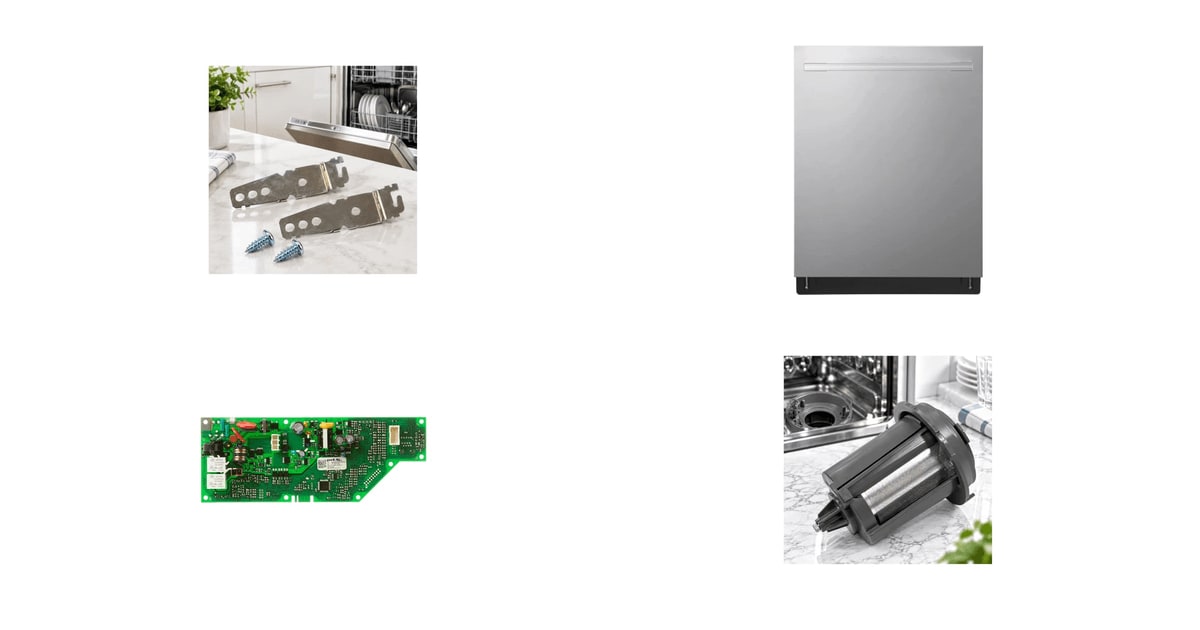
One note about scope. Of the listings we could confirm, exactly one is a built-in dishwasher; the rest are repair parts and detergent. So this is a close look at one machine, plus the parts that keep an older one alive. The LG sits right where most people shop: a 24-inch cutout, a third rack, Wi-Fi and heated dry. We think that the LG QuadWash Pro LDTH555NS is the best dishwasher for most people, and that the Whirlpool fine-mesh filter cup is the one to buy if your machine is only leaving grit on clean dishes.
Everything we recommend
Third rack and heated dry, if a long cycle doesn't bother you

A new filter first, before you replace the whole machine

Hands-off dosing, if your machine takes AutoDos discs
At a glance
| Product | Third rack | Drying | Price | |
|---|---|---|---|---|
 | 2Pcs Dishwasher Bracket for KitchenAid KDTM404KPS 2022-2026Also in lineup | — | — | $20.99 |
| LG 24 in. Top Control Smart Wi-FiTop pick | 3rd Rack | Dynamic Heat Dry | $699.97 |
 | GE Appliances WD21X24900 Dishwasher Electronic Control BoardAlso in lineup | — | — | $139.76 |
| GJRGEG1Y Dishwasher Filter Cup for Whirlpool WDT750SAKZBudget pick | — | — | $123.99 |
| Miele PowerDisk Dish Detergent for Auto DispensingAlso great | — | — | $79.90On sale |
How we picked
Cleaning and soil sensing. We looked for spray coverage and soil-sensing cycles that manufacturer specs and published reviews actually describe, not just a long menu of cycle names. Consumer Reports treats cleaning as the first dimension of a dishwasher score, and so did we.
Drying, especially plastics. Heated or fan-assisted drying is the single biggest predictor of whether you'll be toweling off containers. Condensation-only drying works on glass and ceramic and struggles with everything else.
Noise in an open kitchen. Under about 45 dBA is the threshold where a dishwasher stops intruding on a room you're living in. We give extra credit to brands that publish a number, and we cross-check against RTINGS.com, which measures noise itself.
Rack layout. A third rack plus adjustable tines usually decides whether a messy load fits in one run or two. We checked listing photos and spec sheets for rack count and tine adjustability.
Efficiency and repairability. ENERGY STAR certification is the floor, since certified units use about 12% less energy and 30% less water than the federal minimum. We also weighed how easy it is to find parts, because a control board or a filter costs far less than a new machine.
Top pick
Third rack and heated dry, if a long cycle doesn't bother you
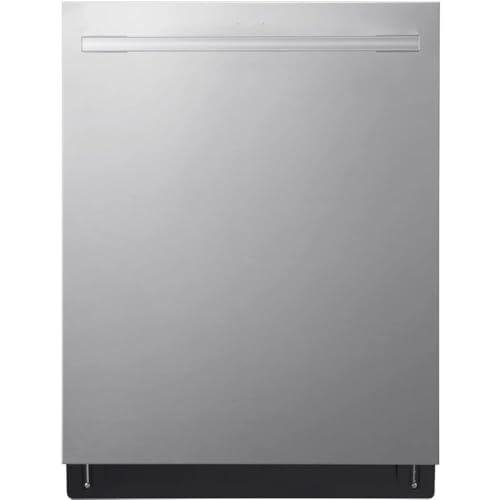
LG 24 in. Top Control Smart Wi-Fi
This is a standard 24-inch built-in with a third rack, LG's QuadWash Pro spray system and a Dynamic Heat Dry option, all behind a PrintProof stainless front that shrugs off fingerprints. It's the only confirmed dishwasher in this lineup, and it happens to be the setup most households actually want.
$699.97fromAmazonThe third rack is the feature you'll notice every single day. Flatware moves up top, which frees the bottom rack for pots and the middle rack for bowls. If you've ever given up on a load because the cutlery basket was eating half your lower rack, you know the difference. It's also where long spatulas, measuring spoons and the lids that never fit anywhere else finally go. On a weeknight with a full sink, that's one less load to run.
Drying is where cheap dishwashers fall apart, and LG's answer here is Dynamic Heat Dry rather than a condensation-only system. Heat helps most with plastics, which don't hold enough warmth on their own to evaporate the water sitting on them. You'll still find a few damp lids. But a heated option means you can shut the door, walk away and put things away later, instead of propping it open for an hour and coming back.
Running a dishwasher is cheaper than washing by hand, and not by a little. ENERGY STAR says a certified machine can save thousands of gallons of water a year compared with doing dishes in the sink, and certified models use about 12% less energy and 30% less water than the federal minimum. That minimum caps a standard-size dishwasher at roughly five gallons per cycle, per the Department of Energy. Whichever machine you buy, look for the label.
It's a 24-inch top-control model, which matters for two reasons. The controls sit on the top edge of the door, so the front is a clean panel with nothing to smudge — and the PrintProof finish handles the fingerprints that do land. More practically, 24 inches is the standard cutout in nearly every American kitchen. If you're swapping out a dying unit, this should drop into the hole you already have.
Flaws but not dealbreakers
The listing is thin, and that's a real problem on an appliance you'll keep for a decade. There's no dBA figure anywhere in it, so you can't tell whether this is a machine you'd forget about in an open kitchen or one you'd hear from the couch. For comparison, Bosch publishes about 42 dBA for its 800 Series, quieter than a normal conversation. LG doesn't give a number here, so pull the spec sheet before you commit.
PrintProof Stainless Steel describes the outside, not the tub. The listing never says what the interior is made of, and that matters, because stainless tubs generally dry better than plastic ones — the metal holds residual heat and helps the last of the water evaporate. Most machines at this level use stainless inside. You still shouldn't have to guess, so ask the retailer or check the manufacturer spec before you buy.
And the usual modern-dishwasher tax applies. Quiet, water-stingy cycles take time, so if you're used to an old unit that banged through a load in an hour, this will feel slow. Wi-Fi is genuinely handy for a cycle-finished alert on your phone. It won't wash anything better.
Budget pick
A new filter first, before you replace the whole machine
GJRGEG1Y Dishwasher Filter Cup for Whirlpool WDT750SAKZ
This is a replacement fine-mesh filter cup for Whirlpool dishwashers, the cylinder that twists out of the tub floor. If your dishes have started coming out gritty after years of service, a clogged or torn filter is the likeliest cause, and swapping it takes about a minute.
$123.99fromAmazonA failing filter mimics a failing dishwasher. Grit on glasses, film on plates, food redeposited on the top rack — those all look like a dying pump, and often they're just a mesh screen that's clogged or split. Before you shop for a new machine, pull the filter and hold it up to the light. If you can see a tear, you've found your problem.
Installation is as simple as appliance repair gets. You open the door, reach into the bottom of the tub, twist the old cylinder counterclockwise and lift it out. The new one drops in and twists to lock. No tools, no water shutoff, no pulling the machine out from under the counter. Owners who've never repaired anything handle this one.
Check the part number against your model before you order. Whirlpool builds dishwashers under several badges, and filter assemblies differ between generations even within one brand. Your model number is on a sticker along the edge of the door or on the tub rim. Owner feedback on parts like this one splits almost entirely along fit lines: right part, easy win; wrong part, wasted week.
There's a maintenance habit worth building here too. Rinse the filter every few weeks and it'll outlast several years of daily loads. Coffee grounds, rice and soggy label scraps are what kill it, and they build up faster than you'd think. If you scrape plates instead of rinsing them, which helps the soil sensor do its job, the filter does more of the work.
Flaws but not dealbreakers
It's a part, not an upgrade. A fresh filter restores a machine to how it washed when it was healthy; it won't make an old unit quieter, dry plastics better or add a rack. If your dishwasher is loud, slow and leaking, this won't save it.
And compatibility is on you. The listing covers specific Whirlpool-family models, so a near-match can arrive and still not seat properly in the tub floor. Confirm your model number first, and keep the packaging until you've run a load.
Also greatOn sale
Hands-off dosing, if your machine takes AutoDos discs
Miele PowerDisk Dish Detergent for Auto Dispensing
The PowerDisk is Miele's detergent cartridge for AutoDos dishwashers, which meter out powder automatically based on the cycle you pick. You load one disc, close the drawer and forget about detergent for weeks instead of dropping a pod in every night.
$79.90fromAmazonList priceHere's the appeal: you stop thinking about detergent. The machine measures what each cycle needs from the disc, so a light load gets less and a pots-and-pans cycle gets more. If you've ever dropped a pod into a half-full dishwasher and then found residue on the glasses, you've seen the problem that automatic dosing is meant to solve.
It only makes sense if you already own the right machine. AutoDos is a Miele feature, and the disc fits the drawer built for it. On any other dishwasher there's nowhere to put it. That's the whole buying decision here, and it's worth stating plainly before you add one to a cart.
Miele also builds its dishwashers for an unusually long life — the company designs them for roughly 20 years of use, a claim based on 7,500 hours of operation. If you bought into that, consumables are part of the deal. You'll keep buying discs the way you'd keep buying filters, and the convenience compounds over a machine that sticks around.
Flaws but not dealbreakers
You're locked in. A disc only works in an AutoDos machine, which means you're buying detergent from one manufacturer for as long as you own the dishwasher, and ordinary pods or powder cost less per load. Some owners keep pods around anyway, because the drawer doses conservatively and a heavily soiled load sometimes wants more.
And it does nothing about the hardest part of running a dishwasher, which is drying. Detergent affects film and spotting, not whether your storage lids come out damp. That's a function of heat and tub material.
Who this is for
Buy now if you're replacing a dying unit in a standard 24-inch cutout and you want the modern conveniences — a third rack, heated dry, a phone alert when the load's done — without stepping up to a premium European brand. It also suits a household that runs the dishwasher daily and loads it badly, because a flexible third rack forgives a lot of sloppy stacking.
Skip it if quiet is your top priority and you can't verify a noise rating first. This guide covers full-size built-in dishwashers, plus the repair parts and detergent our research confirmed alongside them. We're not looking at compact 18-inch models, portables, countertop units, drawer dishwashers or commercial machines. And if your current dishwasher simply won't start, price out a repair before you replace it — a control board or a filter is a small fraction of a new appliance, and plenty of owners handle that swap themselves.
How we picked
Cleaning: we wanted soil-sensing cycles and spray coverage that spec sheets and published reviews back up, not a long list of cycle names. Drying: heated or fan-assisted drying matters more than anything else for plastics, so we weighted it heavily. Noise: under about 45 dBA is the bar for an open-plan kitchen, and we prefer brands that publish a figure you can check against RTINGS.com. Loading: a third rack and adjustable tines decide whether a full sink becomes one load or two. Efficiency: ENERGY STAR certification is the floor, since certified machines use about 12% less energy and 30% less water than the federal minimum. Repairability: parts availability outlasts any smart feature.
The competition
This is what our research surfaced for this category, not everything on the market. The search turned up one built-in dishwasher and a cluster of repair parts and consumables, so there's no brand-versus-brand shootout here. Plenty of strong machines from the major brands belong in a fuller version of this guide. We only write about listings we can confirm, and these are the two that didn't earn a spot above.
The GE Appliances WD21X24900 Dishwasher Electronic Control Board ($139.76) — This is a replacement electronic control board for GE dishwashers — the brain that runs the cycle. It's a real fix for a real failure: a machine that won't start, won't advance through cycles, or lights up the panel and then does nothing. It lost to the filter cup because a board swap means pulling the door panel apart and handling connectors, and because a dead board is a rarer failure than a clogged screen. If a tech has already diagnosed yours, fitting the board yourself costs a fraction of a new appliance.
The 2Pcs Dishwasher Bracket for KitchenAid KDTM404KPS 2022-2026 ($20.99) — A metal mounting bracket for KitchenAid dishwashers, the kind that secures the unit to the countertop or cabinet. These snap or corrode, and a dishwasher that tips forward when you pull out the lower rack usually needs one. It's genuinely useful and also the narrowest item here — nobody shops for a bracket until something specific breaks. Grab it if your machine has started rocking in its cutout; otherwise there's nothing to decide.
Care and maintenance
Pull the filter every few weeks. On most modern dishwashers it's a cylinder in the floor of the tub that twists right out, and it fills up with whatever your plates leave behind — coffee grounds, rice, bits of soggy label from jars. A clogged filter is the most common reason a machine suddenly starts leaving grit on clean glasses. Rinse it under the tap, scrub the mesh with an old toothbrush, twist it back in. While you're down there, wipe the door gasket, which collects grease and eventually smells. If you have hard water, run an empty hot cycle with a dishwasher cleaner now and then. And scrape your plates instead of rinsing them — the soil sensor needs something to detect.
Questions we get
What is the quietest dishwasher you can buy?
The quietest full-size machines sit in the high 30s to low 40s dBA. Bosch lists its 800 Series at about 42 dBA, which is quieter than a normal conversation. Manufacturer numbers aren't always measured the same way, so RTINGS.com publishes its own decibel readings, and those are the better cross-brand comparison. Anything under 45 dBA fades into the background of an open kitchen.
Is a stainless steel tub better than a plastic tub?
Usually, yes, and the reason is drying. Stainless holds residual heat after the final rinse, which helps the last of the water evaporate instead of pooling on your plastic containers. Stainless also resists staining and odors better over years of use. Plastic tubs aren't a dealbreaker on a budget machine, but you'll notice the difference on a load full of storage lids.
Is a third rack worth it?
For most households, yes. Moving flatware to a shallow top rack frees up the lower rack for pots and pans, which is usually the bottleneck. It's also the only sane home for long utensils, measuring spoons and small lids. If you run the dishwasher daily or cook for a family, it can turn two loads into one.
How much water does a modern dishwasher use compared with hand washing?
Far less. The federal standard caps a standard-size dishwasher at about five gallons per cycle, per the Department of Energy, and ENERGY STAR-certified models use roughly 30% less water than that minimum. ENERGY STAR says a certified machine can save thousands of gallons a year compared with washing by hand. A running tap beats five gallons in a couple of minutes.
How long do dishwashers typically last?
Ten years is the common expectation for a mainstream machine, and a lot of that depends on water hardness and how often you clean the filter. Miele designs its dishwashers for roughly 20 years of use, a manufacturer claim based on 7,500 hours of operation. Parts availability matters as much as build quality here. Owners of GE and Whirlpool machines routinely find control boards and filters online and swap them themselves rather than buying new.
Why you should trust us
For this guide:
- We read the manufacturer specifications and full listing details for every product in this lineup, then checked them against the dimensions Consumer Reports uses to rate dishwashers: cleaning, drying, noise, energy and water use.
- We compared published noise figures from RTINGS.com against manufacturer dBA claims, because the two aren't always measured the same way.
- We read owner feedback themes on these listings, which clustered around parts fit and do-it-yourself repairs rather than wash quality.
- We read owner reviews on every listing, weighted toward the critical ones, because that is where the recurring failures show up.
- We have a systematic way of automatically fetching the latest prices, so the numbers on this page stay current.
- This is a research-focused guide, so the team may not own every product listed — though we often do own the top winners, which gives us extra context for the recommendations.
- We don't accept free products, and the retailer commission never changes which product we recommend.
Sources
Dishwasher Ratings and Reviews - Consumer Reports, Consumer Reports
Best Dishwashers - Wirecutter, Wirecutter
Dishwasher Reviews - RTINGS.com, RTINGS.com
ENERGY STAR Certified Residential Dishwashers, ENERGY STAR
Dishwasher Buying Guide - Good Housekeeping Institute, Good Housekeeping Institute
Dishwasher Reviews - Reviewed, Reviewed (USA Today)
Dishwasher Product Pages and Specs, Bosch (manufacturer)
Dishwasher Product Pages and Specs, Miele (manufacturer)
Dishwashers - Appliance Standards Program, U.S. Department of Energy
Amazon product listings and owner reviews for all 5 products
Manufacturer specification pages for each product
Some passages in this guide may be paraphrased with AI help. Prices are refreshed automatically.
More like this.
Continue exploring appliances reviews and recommendations.

The Best Countertop Dishwashers
A countertop dishwasher solves a specific problem: you have dishes, you have a sink, and you have no room for a real dishwasher. These units sit next to…

The Best Food Dehydrators
A dehydrator is a slow appliance that quietly saves you money. It pulls 80 to 95 percent of the moisture out of food, which drops water activity below the…

The Best Robot Vacuums for Pet Hair
If you live with a shedding dog or a long-haired cat, you already know the problem isn't dirt. It's hair. It drifts into corners, mats into the edge of…

The Best Bread Machines
Fresh bread from a machine is really about mornings. You load flour, water, salt and yeast the night before, set the timer, and wake up to a warm loaf and…

The Best Electric Spice Grinders
Pre-ground spice is convenient, and it's also a slow leak. The oils that make cumin smell like cumin start escaping the moment the seed breaks open, so a…

The Best Personal Blenders
A personal blender earns its counter space by being fast. You drop in frozen berries, yogurt and a scoop of protein powder, twist on the cup, press once,…