The Best Protein Powders
Most people don't buy protein powder because they love shakes. You buy it because hitting a daily protein target with chicken and eggs alone takes more cooking than you have time for. So the powder that works is the one you'll actually drink: it mixes in a shaker bottle without clumps, it doesn't wreck your stomach, and it tastes fine with cold water when you're out of milk. Everything else — the branding, the amino acid charts, the promises about lean muscle — matters far less than that.
Here's the honest part. Supplements aren't regulated the way food and drugs are, and independent lab work has repeatedly turned up powders that miss their label claims or carry traces of heavy metals. Third-party certification narrows that risk, but it's a screen, not a guarantee. Taste is a coin flip too. No powder tastes like a milkshake without the calories of one, and flavors shift from run to run. Buy the smallest size of a new flavor first, and don't stockpile something you haven't tried.
The good news is that the top of this category is genuinely competent, and the real differences come down to sweeteners, how fast the protein absorbs, and how much verification you want behind the tub. Choose based on your stomach and your grocery budget, not on marketing. We think that the Optimum Nutrition Gold Standard 100% Whey is the best protein powder for most people, and that the Dymatize ISO100 is the one to buy if dairy bothers you or you're counting every gram of carbs and fat.
Everything we recommend

Artificial sweeteners, but the easiest whey to live with
Leaner macros and easier digestion, at a real premium

A short, stevia-sweetened label, if the taste suits you
At a glance
| Product | Protein Per Serving | Servings | Price | |
|---|---|---|---|---|
| Optimum Nutrition Gold Standard 100% Whey ProteinTop pick | 24g | — | $45.32On sale |
| Dymatize ISO100 Hydrolyzed Protein PowderRunner-up | 25g | 42 Servings | $92.49On sale |
| Transparent Labs Grass-Fed Whey Protein Isolate -Upgrade pick | 28g | 30 Servings | $64.99 |
 | Garden of Life Sport Organic Plant-Based EnergyAlso in lineup | — | 40 Servings | $29.37On sale |
 | Momentous Essential Grass-Fed Whey Protein Powder -Also consider | 20g | 25 Servings | $59.99 |
How we picked
Protein by weight. We divided grams of protein by scoop weight on every label and looked for at least 70 to 80 percent. Much below that usually means fillers are doing the heavy lifting.
Third-party certification. We gave weight to NSF Certified for Sport and Informed Sport, since both require testing actual production lots rather than reviewing a factory's paperwork. Uncertified powders carry documented contamination risk.
Mixing and texture. Published reviews and owner feedback line up closely on this, so we favored instantized powders that dissolve in cold water in a shaker bottle without grit, clumps or film.
Sweeteners and additives. We noted exactly which sweeteners each label uses. Sucralose and stevia both have committed detractors, and that single choice drives most taste complaints.
Cost per gram. We compared protein per serving against container size rather than sticker price, which is the only fair way to line up tubs of different weights and scoop sizes.
Top pickOn sale
Artificial sweeteners, but the easiest whey to live with
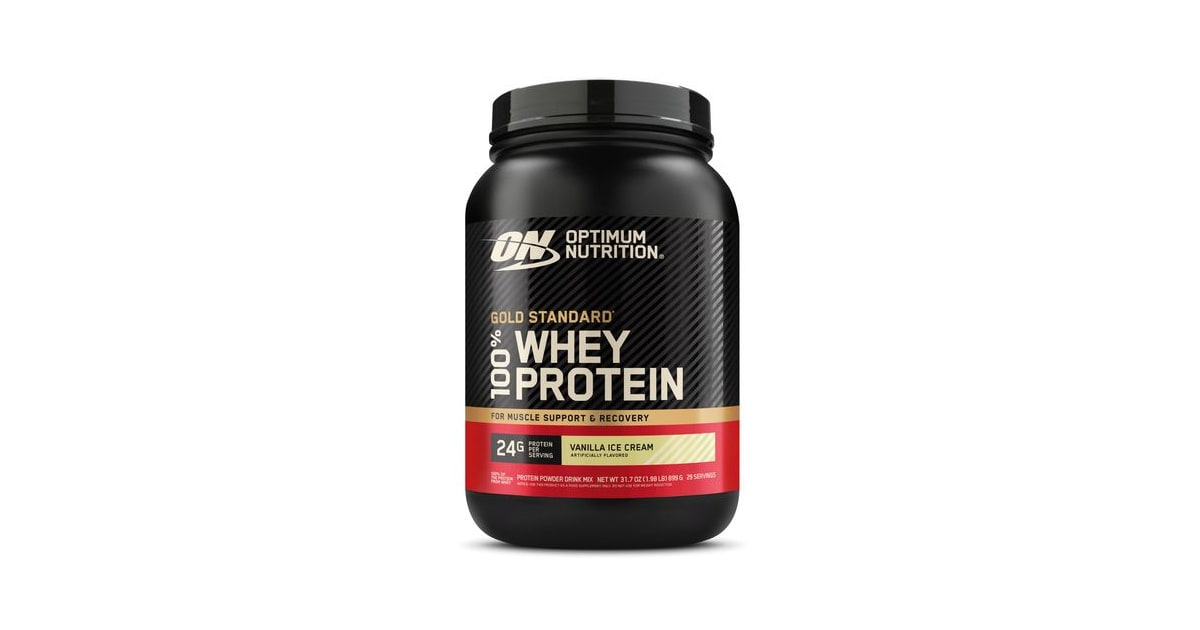
Optimum Nutrition Gold Standard 100% Whey Protein
Gold Standard blends whey isolate, concentrate and peptides to put 24 grams of protein in a 31-gram scoop. It dissolves in cold water in about 15 seconds, it comes in more than 30 flavors, and it's the easiest powder here to find on an actual store shelf.
$45.32fromAmazonList priceThe blend is a design choice, not a cost-cutting move. Each 31-gram scoop gives you 24 grams of protein from whey isolate, concentrate and peptides. The isolate absorbs quickly and carries little lactose or fat. The concentrate rounds out the texture and flavor, so your shake doesn't taste like watered-down chalk. You also get 5.5 grams of naturally occurring BCAAs and 11 grams of EAAs, leucine included, which is the part that actually drives muscle repair.
It mixes in a shaker bottle, and that matters more than you'd think. The powder is instantized, so it disperses in cold water after about 15 seconds of shaking. No blender, no clumps welded to the lid, no gritty sludge left at the bottom of the glass. If your shake gets made at a gym sink or in the car, that's the difference between a daily habit and a tub you quietly stop opening.
The safety paperwork is batch-level, not a one-time audit. Gold Standard carries Informed Sport certification, which means each production lot is screened at an accredited lab for more than 250 substances banned in competitive sport. Independent programs that buy supplements at retail and analyze them have graded it well for label accuracy, too. For a powder sold at this scale, that kind of consistency is the real achievement.
You can buy it almost anywhere, in almost any flavor. There are more than 30 flavors, and the tubs sit on shelves at warehouse clubs, big-box stores and pharmacies as well as online. That sounds mundane until your usual flavor sells out. With a boutique brand, you wait for restock. With this one, you grab a different tub and get on with your week.
Flaws but not dealbreakers
The sweeteners are artificial, and that's a dealbreaker for some people. Gold Standard uses sucralose and acesulfame potassium. Both are approved and fine for most people, but if you avoid artificial sweeteners on principle, or they leave your stomach unhappy, nothing about the rest of the formula changes that. The Transparent Labs isolate is the stevia-sweetened alternative, and you'll pay a good deal more for the swap.
The whey concentrate brings lactose with it. Concentrate is what makes the texture pleasant, and it's also why people with real dairy sensitivity sometimes feel bloated an hour later. A pure isolate filters most of that out. If milk generally disagrees with you, start with ISO100 instead of hoping this one goes down easy.
Flavor quality isn't perfectly even from batch to batch. Owners report that some runs of the darker chocolate flavors come out thinner or sweeter than the last tub. It's an annoyance rather than a defect. Still, it's a good reason to buy a small container of a new flavor before you commit to the big one.
Runner-upOn sale
Leaner macros and easier digestion, at a real premium
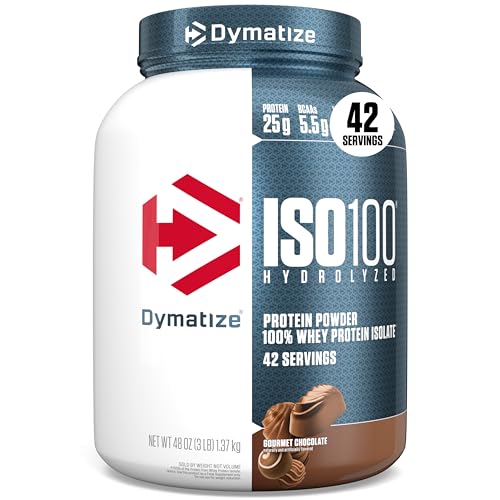
Dymatize ISO100 Hydrolyzed Protein Powder
ISO100 is hydrolyzed whey isolate: 25 grams of protein with about a gram each of fat and sugar, and the excess lactose filtered out. Reach for it if dairy usually leaves you bloated, or if you're tracking macros down to the gram during a cut.
$92.49fromAmazonList priceHydrolyzed whey really is pre-digested. Enzymes chop the protein chains into short peptides before the powder ever reaches your glass, so your gut has less work to do. Blood amino acid levels rise sooner than they do with a standard isolate. In practice that's a modest edge, and it matters most in the hour after a hard session, when your muscles are primed to use whatever shows up.
The macros are about as lean as whey gets. You get 25 grams of protein with roughly a gram of fat, a gram of sugar and under 120 calories per serving. That works out to about 86% protein by weight. If you're eating in a deficit, your shake shouldn't be competing with dinner for calories, and this one doesn't ask you to make that trade.
It's the friendliest pick here for a touchy stomach. The whey is filtered to strip out excess lactose, carbs and fat, and it's gluten free. People who bloat on concentrate-based powders generally do fine on a hydrolyzed isolate like this one. Comfort is most of the reason to pay up, and for a lot of people that's reason enough.
The label holds up under outside scrutiny. ISO100 is Informed Sport certified, so lots are screened for banned substances at an accredited lab. Independent groups that purchase supplements at retail and analyze them have ranked it at the very top for label accuracy and purity. If you compete in a drug-tested sport, that documented trail is worth more than any flavor.
Flaws but not dealbreakers
You pay a lot more per gram of protein. Against Gold Standard, ISO100 runs close to double for the same gram of protein, and the extra processing is why. For someone lifting a few times a week, that premium is hard to justify. Buy it for the digestion and the macros, not because faster absorption will change how you look in the mirror.
Hydrolysis leaves a faint bitter edge. It's most noticeable in unflavored and lighter versions, where there's nothing to hide behind. Chocolate covers it well. If you drink your shakes with plain water rather than milk, start with a darker flavor.
It's lean to a fault if you're trying to gain. Fewer than 120 calories a scoop is exactly what you want in a deficit and close to useless in a surplus. Hard gainers will end up adding oats, nut butter or whole milk anyway, at which point a cheaper concentrate blend would have done the same job.
Upgrade pick
A short, stevia-sweetened label, if the taste suits you
Transparent Labs Grass-Fed Whey Protein Isolate -
Transparent Labs puts 28 grams of protein in a scoop of grass-fed whey isolate, with stevia instead of sucralose and a published lab report tied to every batch. You're paying for sourcing and proof here, not for protein you couldn't get elsewhere.
$64.99fromAmazonThe batch reports are the feature you're paying for. Enter the lot number from your tub on the company's site and you can pull the actual lab report: protein content, heavy metal levels, microbiological results. Most brands stop at the phrase third-party tested and leave you to take it on faith. Being able to check the specific container in your kitchen is a genuinely higher standard.
It's the most protein-dense powder in this guide. Each serving delivers 28 grams of protein at roughly 87% protein by weight, with all nine essential amino acids and very little sugar or fat. If you're chasing a high daily target, that means fewer scoops and fewer shakes to get there. The math is quietly the best argument for it.
The ingredient list is short enough to read out loud. No artificial sweeteners, no dyes, no gluten, no preservatives. The whey comes from grass-fed, hormone-free American dairy cattle, and stevia leaf extract does the sweetening. If you're the kind of shopper who reads a label and puts the tub back on the shelf, this is the one that survives.
Grass-fed is a sourcing decision, not a physique decision. Pasture-raised milk carries somewhat more omega-3s and conjugated linoleic acid, but the protein itself is chemically identical, and nobody builds more muscle because of it. Buy this for the transparency and the farming standards you're supporting. Expect the same results you'd get from any good isolate.
Flaws but not dealbreakers
Stevia divides people, and there's no hiding it here. The finish is herbal and it lingers, which some people never stop noticing — vanilla and unflavored are the worst offenders. Chocolate masks it best. If you've disliked stevia in soda or yogurt, you'll dislike it in your shake.
It's the most expensive whey in this guide. Per serving, nothing else here is close, and the protein you get isn't meaningfully better than a certified mainstream isolate. What you're actually buying is sourcing and verification, which is a fair thing to want, as long as you know that's the trade.
It's thicker in plain water and harder to find in a store. Mixed with water alone, the texture is denser than ISO100's, so milk or a blender helps. It's also largely sold direct and online, so you can't grab a replacement tub on the drive home when you run out.
Who this is for
Buy a protein powder if you're consistently short of your daily protein target. Active adults generally do well on roughly 1.4 to 2.0 grams per kilogram of body weight, and older adults working to hold onto muscle often need the top of that range. Getting there on whole food alone means a lot of chicken, eggs, yogurt and cottage cheese. If you already eat that way and feel fine, you don't need a tub of anything. Powder is a convenience, not a requirement.
This guide covers whey powders meant for everyday use — post-workout, between meals, stirred into oats. Every pick is dairy-based. If you're vegan or allergic to milk protein, none of these will work for you, and you'll want a multi-source plant blend instead. We also aren't covering mass gainers, ready-to-drink bottles, collagen powders or pre-workout mixes, which solve different problems.
How we picked
We built the shortlist from spec sheets, published reviews and owner feedback, then held each powder to the same handful of standards. Protein by weight: grams of protein divided by scoop weight, with 70 to 80 percent as the floor. Certification: NSF Certified for Sport and Informed Sport count for more than a vague claim, because both require testing real production lots. Mixing: it should dissolve in cold water in a shaker bottle, with no grit and no film in the glass. Sweeteners: we tracked exactly what does the sweetening, since that drives most complaints. Cost per gram: protein per serving against container size, not the number on the shelf tag.
Other protein powders worth considering
If you need airtight anti-doping paperwork: The Momentous Essential Grass-Fed Whey Protein Powder - ($59.99) — Momentous Essential is NSF Certified for Sport, which means every batch goes to an independent lab to be screened for hundreds of banned substances, masking agents and contaminants. The whey is cold-processed isolate from grass-fed European dairy, with a ProHydrolase enzyme blend added to ease digestion, and the ingredient list stays clean. The catch is the dose: 20 grams a serving is the smallest here, so anyone over about 200 pounds will be scooping one and a half or two servings to hit a full protein feeding. That pushes it to the highest cost per gram in this guide, and flavor choices are thin. For a professional athlete or a service member whose eligibility rides on a clean test, none of that registers as a downside. For everyone else, Gold Standard is also batch-certified and goes much further per tub.
The competition
This is what our research surfaced, not a census of everything sold. We concentrated on powders whose primary job is delivering protein, and on brands with a verifiable testing program behind the label, which rules out a large tier of uncertified budget tubs. Independent lab work keeps finding label inaccuracies and heavy metal traces in that tier, so we'd rather point you to fewer options that publish real results. If a powder you're considering doesn't appear here, check whether the manufacturer will show you lot-specific test data before you buy it.
Mixing and storage
Liquid first, powder second. Pour 8 to 10 ounces of cold water or milk into the bottle, add the scoop, drop in the whisk ball and shake hard for 15 to 20 seconds — reversing that order is how you get a paste stuck to the bottom. Cold liquid mixes cleaner than room temperature. If a powder stays thick or earthy in plain water, blend it with frozen fruit or oat milk instead. Keep the scoop buried in the powder dry, since a wet scoop turns the whole tub clumpy, and store the container sealed in a cool cupboard rather than a hot car or gym bag. Drink a mixed shake within a couple of hours or refrigerate it, and rinse the bottle right away.
Questions we get
Which protein powder is best for building muscle?
For most people, Optimum Nutrition Gold Standard 100% Whey is the right call. It gives you 24 grams of protein per scoop with enough leucine to reliably trigger muscle protein synthesis, and it costs far less per gram than the premium options. But the brand on the tub matters much less than consistency — hitting roughly 1.6 to 2.2 grams of protein per kilogram of body weight every day is what actually builds muscle.
Can I use these if I'm lactose intolerant?
Usually, yes, if you pick the right one. Whey isolate and hydrolyzed whey contain very little lactose, and ISO100 is filtered specifically to remove it, which makes it the easiest of these to digest. Gold Standard includes whey concentrate, so it carries more lactose and is more likely to cause bloating. A true milk protein allergy is different — in that case you should skip all four of these and use a plant-based blend.
What's the difference between concentrate, isolate and hydrolyzed whey?
Concentrate is the least processed form, at about 70 to 80 percent protein by weight, and it keeps some fat and lactose along with the richest flavor. Isolate goes through extra filtration to hit 90 percent or more protein, mixes cleaner and sits easier on sensitive stomachs. Hydrolyzed whey takes it one step further by breaking the protein into short peptides that absorb faster. For daily use, a good isolate or a blend gives you the best mix of cost, taste and tolerance.
What does Informed Sport or NSF Certified for Sport actually mean?
Both certifications require that individual production lots be sent to an independent, accredited laboratory and screened for hundreds of substances banned in competitive sport. That's the key difference from generic quality seals, which typically evaluate a factory's processes rather than the product in your hand. If you're subject to drug testing through a league, the NCAA or the military, you should only use powders carrying one of these two marks.
How much should I take in a day?
Use powder to close the gap between what you eat and your daily target of roughly 1.6 to 2.2 grams per kilogram of body weight. For most people that's one or two scoops. Try not to take in much more than 40 grams of protein at once, since your body's ability to use a single dose is limited. If you're having two scoops, split them — one after training and one later in the day works well.
Should I worry about heavy metals in protein powder?
It's a real and documented risk, not a scare story. Independent investigations have found arsenic, cadmium, lead and mercury in popular powders, with plant-based and chocolate-flavored products showing up most often. Don't rely on a brand saying it tests internally. Choose a powder with published, lot-specific results from an accredited outside lab — Transparent Labs makes those reports easiest to check.
Why you should trust us
For this guide:
- We read the label panel and spec sheet for every powder here and compared grams of protein against scoop weight rather than trusting the number on the front.
- We reviewed published independent lab reporting on label accuracy and heavy metal contamination in protein supplements, plus the sports nutrition literature on protein dose, leucine thresholds and absorption speed.
- We weighed recurring owner feedback about mixability, aftertaste and digestion, and treated those themes as the most reliable guide to what a powder is actually like to drink.
- We read owner reviews on every listing, weighted toward the critical ones, because that is where the recurring failures show up.
- We have a systematic way of automatically fetching the latest prices, so the numbers on this page stay current.
- This is a research-focused guide, so the team may not own every product listed — though we often do own the top winners, which gives us extra context for the recommendations.
- We don't accept free products, and the retailer commission never changes which product we recommend.
Sources
Best Protein Powders — Wirecutter (The New York Times), Wirecutter / The New York Times
Whey Protein: Research, Benefits, Dosage — Examine.com, Examine.com
Protein Powder Rankings and Lab Test Results — Labdoor, Labdoor
ISSN Position Stand: Protein and Exercise (Stokes et al., 2018) — Journal of the International Society of Sports Nutrition, Journal of the International Society of Sports Nutrition
Protein Powder and Supplement Reviews — ConsumerLab.com, ConsumerLab.com
Heavy Metals in Protein Drinks Investigation — Consumer Reports, Consumer Reports
NSF Certified for Sport: What It Tests and Why It Matters — NSF International, NSF International
Informed Sport Certification: Batch Testing for Banned Substances — Informed Sport, Informed Sport
Amazon product listings and owner reviews for all 5 products
Manufacturer specification pages for each product
Some passages in this guide may be paraphrased with AI help. Prices are refreshed automatically.
More like this.
Continue exploring health reviews and recommendations.

The Best Vegan Protein Powders
Plant protein is something you drink almost every day, so the small stuff matters more than the marketing does. Does it dissolve in a shaker bottle, or…

The Best Protein Powders for Muscle Building
Protein powder is a convenience food, not a magic one. If you're lifting three or four times a week, you need somewhere between 1.6 and 2.2 grams of…

The Best Collagen Peptides Powders
Collagen powder is one of the few supplements you'll actually notice in your routine, because you have to stir it into something every single morning.…

The Best Aquarium Protein Skimmers
A protein skimmer does one job. It pulls dissolved organic waste out of your water before it breaks down into nitrate and phosphate. Fish waste, uneaten…

The Best Blenders for Smoothies and Protein Shakes
A blender for smoothies has one job, and it's a harder job than it looks. Frozen mango, a fistful of kale, a scoop of whey and some oat milk all resist a…

The Best Knee Scooters for Foot Injuries
A broken foot changes your whole day. Crutches sound simple until you've used them for a week, and then your armpits ache, your wrists throb, and you…