The Best RV Accessories and Camper Upgrades
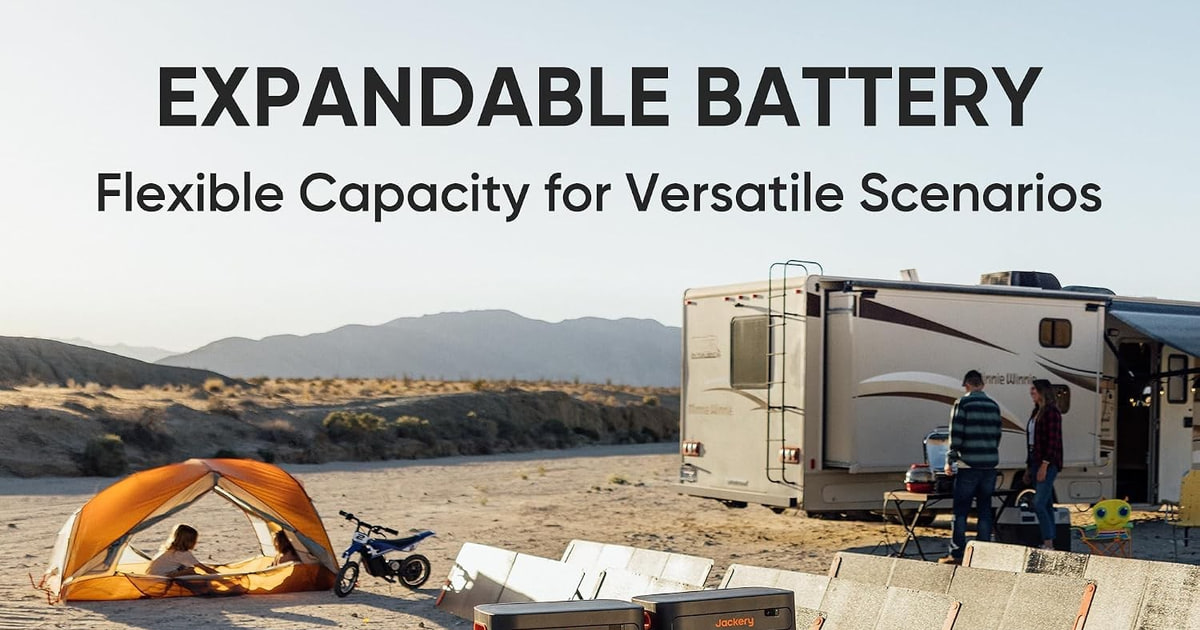
An RV is a house that shakes at 65 miles an hour, and most of the parts that make it livable didn't come from the factory. You add them. Power that lasts through a hot night without a generator. Water that doesn't taste like the campground's pipes. A camera so you're not guessing where the back bumper is. The upgrades worth buying are the ones you stop thinking about after a week — they just work, every trip, in the rain, in the dark, at a site you've never seen before.
No single accessory fixes off-grid living, and anyone who tells you otherwise is selling something. Power stations run out. Solar takes a full sunny day to refill a big battery, and a 400-watt roof kit won't run air conditioning. Cell boosters amplify what's already there, so a true dead zone stays dead. Surge protectors can't repair a pedestal that's wired wrong — they just refuse to pass the power through. Every product here asks you to adjust your expectations a little.
Money works oddly in this category. The small items often change your trips the most, while the big-ticket ones change what kind of trips you can take at all. A water filter is a minor purchase and improves every glass you drink. Two kilowatt-hours of battery decides whether you can park somewhere with no hookups. Buy the small stuff first, then the expensive thing you'll actually use. We think that the Jackery Explorer 2000 Plus is the best RV power upgrade for most people, and that the Progressive Industries EMS-HW50C is the one to buy if you spend most nights plugged into campground pedestals.
Everything we recommend

Enough quiet power for a weekend off-grid, if you can lift it

A hose-end filter that fixes campground water taste

A complete roof kit that keeps the house batteries topped up
Wiring protection that stays bolted inside your rig
Prices as of Oct 24, 6:27 AM PT · Details
At a glance
| Product | Accessory Category | Standout Spec | Price | |
|---|---|---|---|---|
| Jackery Explorer 2000 v2 Portable Power StationTop pick | Lawn & Patio | 3000W AC Output | $899 |
| Renogy 400Watt Premium Solar Kit with 40AUpgrade pick | Lawn & Patio | 40A MPPT Charge | $585.99 |
 | weBoost Drive Reach RV II- Cell PhoneAlso consider | Wireless | Boosts 4G LTE & 5G | $549.99 |
| Progressive Industries EMS-HW50C Heavy Duty RV SurgeAlso great | Automotive Parts | 12,000 W capacity | $170.15 |
 | Garmin RV 1095Also in lineup | Wireless | Custom RV Routing | $819.99 |
 | Haloview MC7109 7'' 720P HD Digital WirelessAlso consider | Wireless | 720P HD Digital | $299.99 |
| Camco 40013 TastePURE KDF/Carbon Water FilterBudget pick | Automotive Parts | KDF/Carbon Water | $38.97 |
Prices as of Oct 24, 6:27 AM PT · Details
How we picked
Real usable power. For batteries and solar, we compared rated watt-hours, inverter output and charge times against the loads RVers actually run. Anything that couldn't keep a fridge going overnight didn't make sense as a primary power upgrade.
Install you can survive. We separated plug-and-play items from those that need drilling, sealing or panel-side wiring, and read owner accounts of how each install really went. Where a job is harder than the listing suggests, we say so.
Weather and vibration. Anything mounted outside has to survive rain, road grit and constant shaking, so we looked for stated IP ratings, vibration specs and outdoor-rated enclosures rather than vague durability claims.
Fit across RV types. We favored products that work on travel trailers, fifth-wheels and motorhomes alike, and noted the amperage, voltage and mounting limits that rule a product out for your rig.
Support you can reach. Electrical gear generates questions, so we weighted owner feedback about U.S.-based phone and email support and how brands handle failures within the first season.
Top pick
Enough quiet power for a weekend off-grid, if you can lift it
Jackery Explorer 2000 v2 Portable Power Station
With 2,042 watt-hours and a 3,000-watt inverter, this is enough battery to run an RV fridge for days or a rooftop air conditioner for a short stretch. It's heavy at 62 pounds, but it refills from solar or a wall outlet in about two hours and makes no noise doing it.
$899fromAmazonPrices as of Oct 24, 6:27 AM PT · Details
It's the rare battery that's big enough to matter. At 2,042 watt-hours, the Explorer 2000 Plus covers the loads that make a hot night bearable — a fridge running straight through, a CPAP, fans, laptops, a coffee maker in the morning. The 3,000-watt inverter means you're not doing arithmetic before you plug something in. Owners living full-time in triple-digit heat describe using it for air conditioning in short bursts, which is about the ceiling at this size.
Charging is where it pulls away from older power stations. Jackery rates a full refill at roughly two hours from a wall outlet, or the same from six of its 200-watt solar panels. In practice that means you can top it off during a lunch stop instead of planning a whole day around the sun. Once you're moving every couple of days, refill speed matters more than raw capacity.
The cells are LiFePO4, and that's a big part of why we'd choose this over older lithium-ion units. It tolerates heat better and handles far more charge cycles, and Jackery rates the pack for up to ten years of use. Owners who cycle theirs daily rather than a few weekends a year are consistently positive about how well it holds a charge over the long haul.
You can grow it instead of replacing it. The 2000 Plus accepts up to five add-on battery packs, and two units run in parallel, so a weekend backup setup can become a real off-grid system later without throwing anything away. The app handles the boring part over Wi-Fi or Bluetooth: checking the state of charge from bed, changing settings, seeing what's actually drawing power.
Flaws but not dealbreakers
It weighs 62 pounds, and that's a genuine problem rather than a spec-sheet quibble. Moving it down RV steps or into a basement bay is a two-hand, watch-your-footing job, and plenty of owners say it's more than they want to handle alone. It's also the most expensive thing on this list by a wide margin. Once it's in place, you'll leave it there.
There's a battery-saving mode that limits how deeply the unit charges and discharges, and owners have asked for a clearer way to switch it off. It's minor, but if you bought this expecting every last watt-hour on demand, the usable number sits a little below the number on the box.
Budget pick
A hose-end filter that fixes campground water taste
Camco 40013 TastePURE KDF/Carbon Water Filter
This inline filter threads onto your fresh water hose and pulls out chlorine, sediment and the metallic edge that comes with a lot of campground spigots. Camco rates it for 200 gallons, which works out to roughly 10 to 15 fills of a typical travel trailer tank.
$38.97fromAmazonPrices as of Oct 24, 6:27 AM PT · Details
Campground water is a lottery. Some sites run clean municipal supply; some run well water through pipe that's been in the ground a very long time, and you find out which after the tank is already full. A KDF and carbon filter handles the two problems you'll actually notice — chlorine taste and fine sediment. Owners report clear ice cubes and drinkable tap water at sites where neither was true before.
Installing it takes about ten seconds. It screws in between the spigot and your hose, and that's the whole job. No tools, no permanent plumbing, nothing left behind when you break camp. If flow drops or the taste comes back, you unscrew it and put on a new one. That reversibility is why we'd point a first-time owner here before anything else on this list.
The 200-gallon rating covers about a season of weekend camping for most people, less if you're full-time or filling a big tank. Owners who camp constantly swap it once or twice a year and treat it as a consumable, which is the right way to think about it. Camco also suggests running the spigot only half open, and going by owner feedback, that meaningfully improves the result.
Flaws but not dealbreakers
This is a taste-and-sediment filter, not a purifier. It won't handle bacteria, viruses or heavy metals, so if you're filling from a source you don't trust, you still need to boil, treat, or run a proper multi-stage setup. Owners drawing from already-clean municipal water often notice very little difference, which is fair — it removes what's there rather than improving what isn't.
Flow drops off as the cartridge loads up, and nothing tells you when. You go by taste and water pressure, which means most people run one a bit longer than they should.
Upgrade pick
A complete roof kit that keeps the house batteries topped up
Renogy 400Watt Premium Solar Kit with 40A
This kit pairs 400 watts of monocrystalline panels with a 40-amp MPPT charge controller and the cabling to connect them, so you're not sourcing matched parts from four sellers. It's enough to keep a 12-volt system charged indefinitely for lights, fans, the water pump and a fridge.
$585.99fromAmazonPrices as of Oct 24, 6:27 AM PT · Details
The appeal of a kit is that the parts match. Renogy ships the panels, the MPPT controller, the branch connectors and the cable in one box, all sized for each other. If you've ever tried to spec a controller against a panel string yourself, you know how much time that saves. Owners who've built several systems tend to describe this as the one they'd hand a first-timer.
The MPPT controller is the part that earns its keep. A 40-amp MPPT unit pulls noticeably more usable current out of the same panels than the simpler PWM controllers bundled into entry-level kits, especially in cold weather and partial shade. Renogy rates its monocrystalline panels at up to 23% conversion efficiency against 15 to 17% for polycrystalline, so you need roughly a quarter less roof for the same output.
Four hundred watts sounds like plenty until you do the math on air conditioning. It isn't close. What it does cover is the everyday load — lights, fans, a 12-volt fridge, phones and laptops — which for most boondockers is the difference between moving every two days and staying a week. Pair it with a decent battery bank and the generator becomes a backup you rarely start.
Installation is the real cost here. Mounting brackets aren't included, the panels weigh 56 pounds together and run about three and a half feet long each, and several owners report the factory panel leads are too short for the recommended series-parallel layout. Plan on extension cables and an inline fuse before you ever climb on the roof.
Flaws but not dealbreakers
This is a project, not a purchase. You're drilling into a roof, sealing the penetrations and running cable through a wall, and if any of that makes you uneasy, you should budget for an installer — which changes the math considerably. The controller tops out at 32 volts on the battery side, so it suits 12- and 24-volt systems and nothing above them.
The included wiring works but is the piece owners most often supplement or replace. A few also note the documentation assumes more electrical knowledge than a genuine beginner has, so expect to spend an evening reading before you spend an afternoon building.
Also great
Wiring protection that stays bolted inside your rig
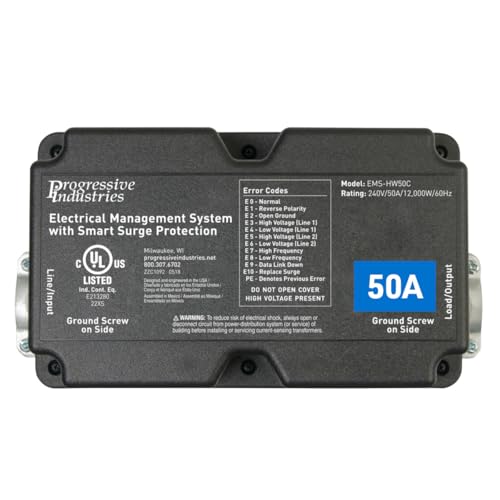
Progressive Industries EMS-HW50C Heavy Duty RV Surge
This hardwired electrical management system watches the pedestal for open grounds, reversed polarity, high or low voltage and miswired 240-volt feeds, then disconnects before any of it reaches your rig. Because it lives inside, there's nothing to plug in at each site and nothing to steal.
$170.15fromAmazonPrices as of Oct 24, 6:27 AM PT · Details
Campground power is worse than you'd guess. RVtravel.com's field surveys found pedestals delivering out-of-spec voltage — below 104 volts or above 132 — about 30% of the time. Low voltage is what kills air conditioner compressors, and an open neutral can put 240 volts across your 120-volt circuits in an instant. The EMS-HW50C watches for both, plus reverse polarity, open ground and AC frequency faults, and cuts power before your converter ever finds out.
A hardwired unit solves the annoyance that makes people stop using plug-in protectors. Nothing hangs off the pedestal in the rain, nothing needs unlocking, and there's nothing to forget when you're breaking camp early. The remote display mounts inside and cycles through both legs of a 50-amp service, so you can check voltage and current draw from the couch instead of standing outside with a flashlight.
It's rated for 50 amps at 120/240 volts, absorbs surges up to 3,580 joules, and is made in the U.S. Owner feedback on Progressive's phone and email support is unusually warm for this category — people with wiring questions get real answers. RV technicians recommend it constantly, and that consistency across years of owners is most of the reason it's here.
Flaws but not dealbreakers
The install is the hard part, and it varies enormously by rig. Some owners wire it in an hour. Others lose a weekend because the only correct mounting point — after the transfer switch, before the panel — sits buried in a basement bay behind a water heater. You'll probably need wire, connectors and conduit that don't come in the box, and Progressive doesn't warn you clearly enough about that up front.
It also protects by refusing to pass power. When a pedestal is bad, you get nothing until you fix it or move, which is exactly right and still maddening when you pull in after dark. There's a bypass, but using it gives up the whole point of owning one.
Who this is for
This guide is for anyone outfitting an RV, camper van or travel trailer with the things that didn't come from the dealer — power, water, electrical protection, connectivity and visibility. If you're a first-time owner, start at the small end: a water filter and pedestal protection cost a fraction of a battery bank and prevent the two most common ways a trip goes sideways. If you're already boondocking regularly, the solar and battery picks are where the money changes what you can do.
It isn't a guide to structural or drivetrain work, and it isn't for you if you camp exclusively at full-hookup resorts a weekend or two a year — a filter and a surge protector cover you, and the rest is optional comfort. We also can't cover every accessory that exists. This is what the research surfaced across power, water, connectivity and safety, not a complete map of the aftermarket.
How we picked
We built the shortlist around five things. Usable power: rated watt-hours, inverter wattage and charge speed measured against the loads people actually run overnight. Installation: whether it's plug-and-play, a wiring job, or something you should hand to a shop, judged against owner accounts rather than the listing copy. Weather resistance: stated IP ratings, outdoor-rated enclosures and vibration specs for anything living on a roof or bumper. Fit: the amperage, voltage and mounting limits that decide whether a product suits a 50-amp Class A or a 30-amp trailer. Support: how reachable the manufacturer is when something goes wrong, since almost everything here touches your electrical system.
Other rv accessories and camper upgrades worth considering
If you want to work from campgrounds with weak signal: The weBoost Drive Reach RV II- Cell Phone — The weBoost Drive Reach RV II amplifies 4G LTE and 5G for every major U.S. carrier at once, with an omnidirectional roof antenna, a 25-foot cable and a directional panel antenna inside that you can aim at your desk. weBoost says it extends reach up to three times the distance from the nearest tower and cuts dropped calls by up to 90%. Owner feedback is more measured, and worth taking seriously: a booster amplifies what already exists, so expect one or two bars of improvement rather than signal from nothing, and expect the indoor coverage area to be small — a few feet around the inside antenna, not the whole rig. People who mount the outside antenna high and place the inside one thoughtfully report it turning an unusable hotspot into a working one. People in true dead zones report nothing at all. A KOA camping report found 65% of RV campers now weigh cell service when choosing a site, up from 48% a few years earlier, so this category matters more than it used to.
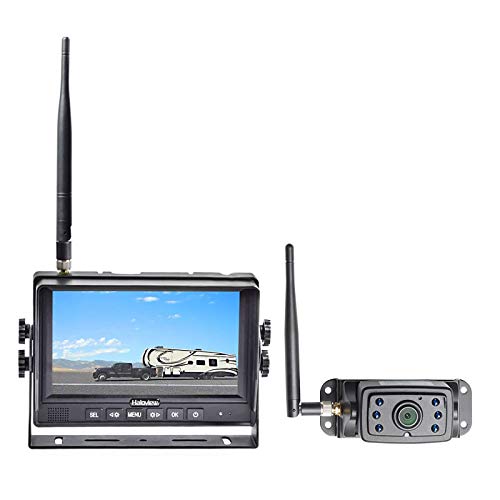
If you want to see behind a long trailer: The Haloview MC7109 7'' 720P HD Digital Wireless — The Haloview MC7109 pairs a 7-inch monitor with a wireless 720p camera rated to IP69K — the toughest waterproof rating on the scale — with a 5.9G vibration rating and night vision. The wireless line-of-sight range runs up to 984 feet, which covers a fifth-wheel and tow vehicle with room to spare, and the monitor takes up to four cameras if you later add side or rear-marker views. A bracket adapter is included for RVs prewired for a factory camera, and owners with those mounts describe genuinely plug-and-play installs. The compromises are real but small: it's 720p rather than 1080p, the monitor's interface looks dated next to a phone screen, and a few owners had to add an antenna extender to stop intermittent dropouts. Most say the picture is sharp enough to read a license plate behind the trailer, which is the only resolution test that matters here.
The competition
These are the other products the research turned up, not a survey of everything sold for RVs. A product landing here didn't necessarily fail; in some cases it's simply narrower than our picks, or it asks more of you than the alternatives do.
The Garmin RV 1095 — The Garmin RV 1095 is a 10-inch navigator built around custom routing for your rig's height, weight and length, with road warnings for steep grades, sharp curves and weight limits, plus a preloaded directory of RV parks pulling in Tripadvisor ratings, Ultimate Public Campgrounds, KOA and national park listings. Satellite imagery helps at arrival, when you're trying to figure out which way a site actually faces. It's a genuinely useful device, and phone navigation still routes big rigs under low bridges. But owner feedback is more mixed than the rest of this list: the suction mount doesn't hold on textured dash surfaces, the interface takes real time to learn, initial map updates can run for hours, and some owners report occasional detours that add miles for no clear reason. If you drive a 40-foot Class A and want a dedicated screen that knows your dimensions, it's still the obvious choice — just plan on a solid mounting spot and a shakedown trip before you trust it completely.
Installation notes
Two rules save most of the headaches here. First, everything that goes through the roof or the exterior wall needs proper sealant and a yearly look, because a solar mount or an antenna cable entry is a new hole in a structure that flexes constantly. Self-leveling lap sealant on the seam, checked each spring, is cheap insurance against a leak you'll find much later. Second, anything touching the electrical panel deserves a licensed hand if you're unsure. A hardwired EMS has to sit after the transfer switch and before the distribution panel, and getting that order wrong means the unit protects nothing. Buy the wire and connectors before you start, not halfway through. And label what you install — future you, lying on your back in a basement bay with a flashlight, will be grateful.
Questions we get
Do I really need a surge protector for my RV, or is it optional?
It's close to essential. RVtravel.com's field surveys found campground pedestals delivering out-of-spec voltage roughly 30% of the time, and low voltage quietly destroys air conditioner compressors while an open neutral can fry electronics instantly. A protector costs a fraction of the converter, fridge board and air conditioner it guards. Treat it as the first purchase, not the last.
What's the difference between a surge protector and an EMS?
A basic surge protector absorbs voltage spikes, mostly from lightning and switching events. An electrical management system does that and also monitors the incoming power continuously, disconnecting for low or high voltage, open ground, open neutral, reversed polarity, miswired pedestals and frequency problems. Spikes are rare; bad wiring and sagging voltage are common. That's why an EMS is the better buy.
How many watts of solar do I need to run my RV air conditioner off-grid?
More than a roof kit like the 400-watt Renogy provides. Air conditioning is the single biggest load in an RV, and running one off-grid generally means a large battery bank plus roughly 1,000 watts or more of panel, with real limits in cloudy weather. A 2,000 watt-hour power station like the Jackery can run a rooftop unit for a couple of hours, not all afternoon. For sustained cooling off-grid, most people still use a generator or shore power.
How do I boost cell signal when camping in remote areas?
A booster like the weBoost Drive Reach RV II amplifies whatever signal reaches your roof antenna, so mounting that antenna as high as possible and away from metal matters more than anything else. Then position the inside antenna near where you work, since indoor coverage is only a few feet. Realistically, expect a weak signal to become usable — not a dead zone to become live. Boosters can't create coverage that isn't there.
What are the most essential accessories for a first-time RV owner?
Start with pedestal protection and a water filter. Those two guard your electrical system and make campground water drinkable for a small fraction of what the bigger upgrades cost. After that, add a backup camera if you tow something long, then look at power. Buying in that order means each purchase solves a problem you've already noticed.
What's the best portable power station for boondocking without a generator?
For most people it's the Jackery Explorer 2000 Plus. Its 2,042 watt-hours and 3,000-watt output cover a fridge, fans, laptops and a coffee maker across several days, and it's silent and emission-free, so you can run it inside. An OutdoorGearLab survey found 71% of RVers and van-lifers under 45 now use solar and battery as their primary power, with generators kept only as backup. Pair it with roof solar and you rarely need one.
Why you should trust us
For this guide:
- We read manufacturer specification sheets for every product here, comparing rated capacity, output, waterproofing and voltage limits against the claims in each listing.
- We reviewed published industry research from the RV Industry Association, KOA, OutdoorGearLab and RVtravel.com to understand how RVers are actually powering and connecting their rigs.
- We read through owner feedback for each product, looking for the complaints that repeat across many buyers rather than one-off failures.
- We read owner reviews on every listing, weighted toward the critical ones, because that is where the recurring failures show up.
- We have a systematic way of automatically fetching the latest prices, so the numbers on this page stay current.
- This is a research-focused guide, so the team may not own every product listed — though we often do own the top winners, which gives us extra context for the recommendations.
- We don't accept free products, and the retailer commission never changes which product we recommend.
Sources
Best RV Surge Protectors & EMS Units — RVtravel.com, RVtravel.com — notes that campground power pedestals deliver out-of-spec voltage (below 104V or above 132V) an estimated 30% of the time based on field surveys
Best Portable Power Stations for Camping — OutdoorGearLab, OutdoorGearLab — 2024 survey found 71% of van-lifers and RVers under 45 now use battery + solar exclusively, replacing gas generators
North American Camping Report 2025 — KOA, KOA — 65% of RV campers prioritize cell/Wi-Fi connectivity when choosing a campsite, up from 48% in 2021
RVIA Annual Industry Statistics — RV Industry Association, RVIA — reported 600,240 RV shipments in 2024, with towables representing 92%+ of all units, sustaining strong aftermarket accessories demand
Best Solar Panels for RVs — CNET, CNET — notes monocrystalline panels now achieve up to 23% efficiency vs. 15–17% for polycrystalline, yielding more power per square foot of roof
WeBoost Drive Reach RV Product Specs — Wilson Electronics, WeBoost — the Drive Reach RV delivers up to 32 dB of signal gain, theoretically pulling usable LTE signal from towers up to 26 miles away under ideal conditions
Garmin RV 1095 Product Page — Garmin, Garmin — RV 1095 includes 1,500+ campground directory with hookup type and amenity details, plus routing filters for height, weight, length, and propane restrictions
Lippert Ground Control 3.0 Leveling System — Lippert Components, Lippert — Ground Control 3.0 achieves full leveling in under 2 minutes via one-touch operation or smartphone app
RV Resources & Ownership Cost Data — FMCA, FMCA (Family Motor Coach Association) — average RVer spends $1,200–$2,500 annually on accessories, with power management and connectivity as the fastest-growing categories since 2022
Full-Time RV Solar Setup Guide — Mortons on the Move, Mortons on the Move — practical real-world solar sizing guide from a couple living full-time in an RV; widely cited by the boondocking community
Best RV Accessories — Wirecutter / NYT, Wirecutter — editorially independent picks with long-term durability testing notes
Best RV Backup Cameras — Truck Camper Magazine, Truck Camper Magazine — compares wireless vs. wired systems and real-world range claims against measured performance
Amazon product listings and owner reviews for all 7 products
Manufacturer specification pages for each product
Some passages in this guide may be paraphrased with AI help.
Product prices and availability are accurate as of the date/time indicated and are subject to change. Any price and availability information displayed on Amazon.com at the time of purchase will apply to the purchase of this product.
More like this.
Continue exploring lifestyle reviews and recommendations.

The Best E-Bike Accessories and Upgrades
An e-bike changes what you ask of your gear. The bike is heavier, faster, and worth more than the commuter you probably owned before, and that shifts what…

The Best RV Leveling Blocks
Pull into a campsite and the pad is never flat. One tire sits low, the trailer leans, and by dinner your soup slides to one side of the pot. Leveling…

The Best Work-From-Home Upgrades
Most home offices got built in a hurry. A dining chair, a laptop propped on a stack of cookbooks, and whatever light happened to come through the window.…

The Best RV Surge Protectors
Shore power at a campground isn't the same thing as power at home. A pedestal sits outside for years, gets plugged and unplugged thousands of times, and…

The Best Family Camping Tents
A family tent is the one piece of camping gear everybody in your family has to live inside. It's where a toddler naps at two in the afternoon, where five…

The Best Sleeping Bags for Camping and Backpacking
A sleeping bag is the one piece of camping gear you notice at 3 a.m. When it's right, you don't think about it at all. When it's wrong, you spend the…