The Best Swimming Goggles
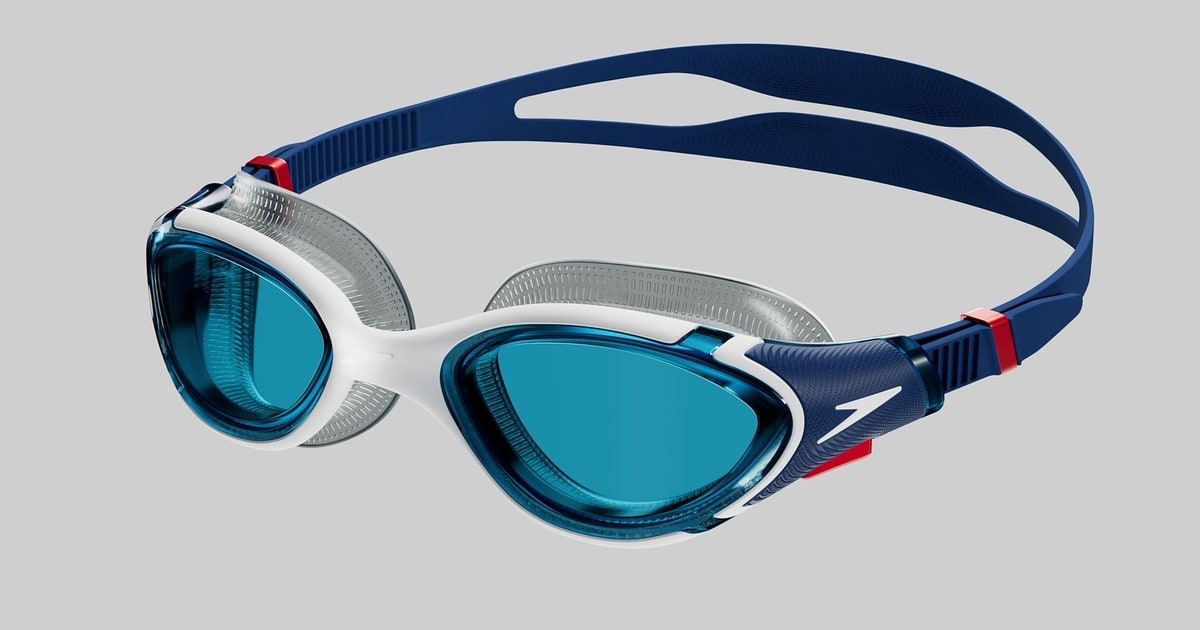
A pair of goggles is the difference between a swim you enjoy and one you cut short. When the seal works, you stop thinking about your face entirely and just swim. When it doesn't, you're stopping every four laps to dump water out of one eye, and the lens fogs until the lane line turns into a smear. The gear itself is simple — silicone, polycarbonate, a strap. What separates a good pair from a bad one is whether the gasket happens to match the shape of your face.
Here's the honest part: no goggle fits everyone, and no brand can promise yours will seal. Face geometry varies more than gasket designs do, so the pair your training partner swears by may leak on you within a lap. Anti-fog is the other universal weak point. Almost every factory coating wears off eventually, usually in a few months of daily swimming, and once it's gone you can't really bring it back. Interchangeable nose bridges help, but they don't solve everything.
So we approached this the way you'd approach it yourself if you had time: reading published reviews, comparing manufacturer specs, and looking for the complaints that show up again and again in owner feedback. The picks below cover lap swimming, open water, triathlon and racing, because those need genuinely different goggles. We think that the Speedo Biofuse 2.0 is the best swimming goggle for most people, and that the TYR Special Ops 3.0 is the one to buy if you swim outdoors in bright sun.
Everything we recommend
A soft, forgiving seal that fits most faces without pinching

Wide sightlines and glare control for swimming outdoors

Anti-fog you can refresh, in a low-drag racing shape

Wide, distortion-free vision in a soft, easygoing frame
At a glance
| Product | Lens Type | Anti-Fog | Price | |
|---|---|---|---|---|
| Blue Biofuse 2.0 Goggles by SpeedoTop pick | — | Fog-Resistant | $29.99 |
| TYR Special Ops 3.0 Non-polarized Adult FitAlso great | Non-Polarized | Anti-Fog | $33.75On sale |
| Aqua Sphere Kaiman Swim Goggles with ClearRunner-up | Clear Lens | Anti-Fog | $25.52On sale |
| ARENA Unisex Cobra Ultra Swipe Racing SwimUpgrade pick | Mirrored | Swipe Anti-Fog | $79.97 |
 | Speedo Fastskin Pure Focus Mirror GoggleAlso in lineup | — | — | $82.94 |
How we picked
Seal and comfort. We looked for gasket designs that spread pressure rather than concentrating it, and we weighted owner feedback about pressure marks and headaches heavily. A goggle that leaves rings after an hour didn't make the picks unless it's explicitly a racing model.
Fog resistance. We compared what manufacturers claim about their anti-fog systems against the pattern in owner reports, which is that most factory coatings fade within a few months of daily use. Systems you can refresh scored higher than ones you can't.
Field of view. For open water and triathlon picks we required a genuinely wide lens — roughly 180 degrees — since sighting is where most outdoor swims are won or lost. Pool goggles were judged on whether the narrower view still let you read a pace clock.
Fit adjustability. Interchangeable nose bridges and one-handed strap adjustment came up constantly in reviews as the difference between a leaking goggle and a sealed one. We favored models that include multiple bridge sizes in the box.
Durability in water. We checked spec sheets for silicone rather than foam gaskets and for UV-stable lens coatings, since saltwater and sun degrade cheap materials fast. Owner complaints about seals going brittle after a season were disqualifying.
Top pick
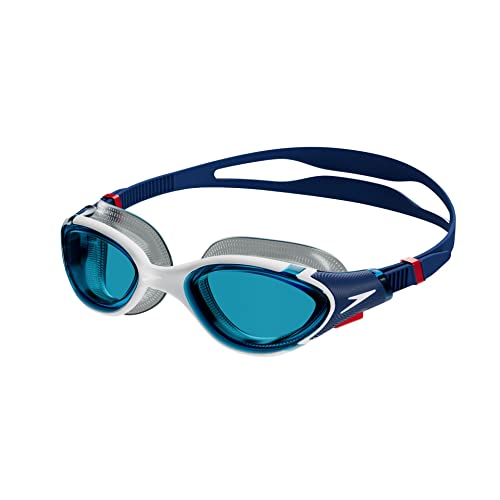
A soft, forgiving seal that fits most faces without pinching
Blue Biofuse 2.0 Goggles by Speedo
The Biofuse 2.0 is a comfortable everyday training goggle with molded seals that spread pressure across your face instead of digging into your eye sockets. It's fog-resistant, blocks UV, and adjusts with a push-button strap you can work one-handed on the wall.
$29.99fromAmazonThe seal is the whole reason to buy these. Speedo molds a soft gasket that conforms to your face rather than forcing your face to conform to it. That matters most after the first half hour, when a firmer racing gasket starts to ache. If you've ever finished a swim with red rings around your eyes and a low headache, this is the fix. Reviewers and owners describe the fit as plush and forgiving across a wide range of face shapes.
You can adjust the strap without stopping your set. The push-button system on each side lets you tighten or loosen with one hand, so a quick fix at the wall takes a second or two rather than a fumble behind your head. The divided strap sits above and below the crown of your skull, which keeps the goggle from sliding up when you push off. It's a small thing that you'll appreciate every single swim.
UV protection makes these usable outdoors, not just in a chlorinated box. Full UV coverage means you can take the same pair to a lido, a lake, or an outdoor 50-meter pool in July without squinting your way through the set. Water bounces sunlight back into your eyes from below as well as above, so the exposure adds up faster than you'd think. Most training goggles at this level skip it.
These are built for how often you actually swim. Latex-free silicone holds up to chlorine, and the frame is light enough that you forget it's there. For three to five swims a week — the pattern most lap swimmers settle into — that's the right balance. You're not paying for race-day drag reduction you'll never use, and you're not settling for a foam gasket that falls apart by spring.
Flaws but not dealbreakers
The gasket sits higher than a racing goggle, and you can feel it at speed. The same cushioning that makes these comfortable adds a bit of bulk in the water. If you're doing sprint work off the blocks or racing at meets, that's a real if small penalty. For everyone else it's irrelevant — you won't notice it on a steady aerobic set.
The fog resistance won't last forever. Like almost every factory coating, it fades with daily use, generally within a few months. Rinsing in cold water and never touching the inside of the lens buys you more time. But plan on replacing these once persistent fogging sets in rather than trying to revive them.
Also greatOn sale
Wide sightlines and glare control for swimming outdoors
TYR Special Ops 3.0 Non-polarized Adult Fit
The Special Ops 3.0 is built for open water, with a wide peripheral view that helps you spot buoys and other swimmers without craning your neck. The silicone gaskets hold up to repeated saltwater and sun exposure better than the foam seals found on cheaper outdoor goggles.
$33.75fromAmazonList priceYou can see sideways, which is the whole point in open water. The lens shape gives you a wide peripheral range, so you catch a buoy or a swimmer drifting into your lane line without lifting your head into a full sighting stroke. Every sighting stroke costs you a little rhythm and a little energy. Over a long lake swim or a triathlon leg, spending fewer of them adds up to a meaningfully easier swim.
The gaskets are made for salt and sun, not just chlorine. TYR uses hypoallergenic Durafit silicone that sits close to the eye and seals without much pressure. Silicone resists saltwater and UV far better than the foam seals you'll find on budget open water goggles, which go crumbly after a season of ocean swims. If you swim in the sea regularly, that's the difference between one pair a year and one pair every few years.
The strap adjusts fast, which matters when your hands are cold. A secure release button handles the strap tension, so you can fix a slipping goggle in a few seconds while treading water. Anyone who has tried to work a small buckle with numb fingers in a lake in spring will understand why this is worth mentioning. It's also useful in a triathlon transition when your arms are tired.
This is a genuine outdoor specialist, and TYR treats it that way. The Special Ops line is designed around triathlon and open water use rather than adapted from a pool goggle. The polarized version of this goggle is the one to get for bright, glare-heavy days on open water; the non-polarized version here is the better call for overcast conditions or when you're mixing in pool sessions.
Flaws but not dealbreakers
These aren't a great pool goggle. The wide frame is heavier and bulkier than a low-profile lap goggle, and the tinted lens makes the pace clock harder to read under indoor lighting. If most of your swimming happens in a pool, buy something smaller and keep these for outdoor days.
The nose bridge doesn't swap out. There's no set of interchangeable bridges here, so the fit is what it is. If you have a particularly narrow or particularly broad face, the seal may not land where you need it, and there's no adjustment to fall back on.
Upgrade pick
Anti-fog you can refresh, in a low-drag racing shape
ARENA Unisex Cobra Ultra Swipe Racing Swim
The Cobra Ultra Swipe solves the problem every other goggle here eventually loses to: fogging. You restore the coating by swiping the inside of the lens with a fingertip in the water, and it's built in Arena's lowest-profile racing shape with five nose bridges included.
$79.97fromAmazonThe anti-fog is rechargeable, which nothing else here can claim. Instead of a coating that slowly washes away, Arena seals a protective film into the lens that you reactivate by swiping the inner surface five times with a fingertip while the goggles are in the water. When fog starts creeping in, you swipe and keep going. For a swimmer training most days of the week, that changes the replacement cycle from a few months to a season or more.
Five nose bridges is an unusually generous fit kit. Most goggles ship with two or three, if any. Five gives you a real chance of dialing in a leak-free seal, which matters more on a racing goggle because the gasket is firmer and less forgiving of a mismatch. Work through the sizes patiently before you decide these don't fit you — the difference between the right bridge and the wrong one is dramatic.
The profile is low and the temples are long, so it stays put off the blocks. Arena calls this its lowest-profile goggle, with a lens shape tuned for glide rather than comfort. Long molded side temples brace the goggle against your head, which is what keeps it from being knocked loose on a dive entry or a hard flip turn. If you've ever surfaced from a start half-blind, you know why that's the feature people care about.
The polycarbonate mirrored lens takes abuse. Hard polycarbonate scratches less easily than softer lens materials, and the mirror finish cuts the glare from the banks of overhead lights that competition pools tend to use. It also keeps your eyes hidden from the swimmer in the next lane, which some racers genuinely value.
Flaws but not dealbreakers
The firm gasket gets uncomfortable on long swims. This is a racing goggle, and racing goggles trade cushioning for a tight, low seal. Owners report that past the hour mark it starts to press. If your typical swim is a long steady aerobic effort rather than intervals, the Biofuse 2.0 will treat your face better.
The view sideways is narrow. The low-profile lens is close to your eye and doesn't give you much peripheral vision, which is fine in a lane and a real problem in open water. Don't buy these for a triathlon swim leg.
The swipe technique isn't obvious. You have to swipe the lens in the water, several times, gently — not scrub at it dry. Owners who fog up and blame the goggle have often skipped the instructions. Read them once and you'll be fine.
Runner-upOn sale
Wide, distortion-free vision in a soft, easygoing frame
Aqua Sphere Kaiman Swim Goggles with Clear
The Kaiman has been a triathlon and open water staple for years, built around a curved lens that gives you a 180-degree view without warping what you see. The soft frame conforms to most faces, and the clear lens version works indoors as well as on grey days outside.
$25.52fromAmazonList priceThe curved lens gives you width without distortion. Aqua Sphere bends the Plexisol lens into an arc rather than using two flat panes, which opens up roughly 180 degrees of vision while keeping the image straight. In open water that means you can track a buoy line and the swimmers on either side of you with barely a head turn. In a pool it just makes the whole swim feel less like looking through a letterbox.
The frame is soft enough for genuinely long swims. The flexible frame material spreads pressure across your face instead of concentrating it around the orbital bone, and owners consistently describe finishing long swims without deep marks. If you're doing a two-hour open water session or a slow build toward a distance event, that comfort is what determines whether you finish thinking about your stroke or your face.
The clear lens is the versatile choice, and that's underrated. Clear Plexisol transmits natural light, so it's the right pick for indoor pools, early mornings, and overcast days. A lot of open water goggles force you into a dark tint that's useless the moment the sun goes behind a cloud. Aqua Sphere also sells the Kaiman in tinted and UV-rated versions if bright conditions are your normal.
It carries full UVA and UVB protection with a scratch-resistant anti-fog coating. That combination is what makes a goggle survive outdoor use. The scratch resistance matters more than people expect, since most lens damage comes from tossing goggles loose in a bag rather than from swimming.
Flaws but not dealbreakers
The frame is bulky by racing standards. It sits higher off your face than a low-profile goggle, and that costs you a little at speed. For open water and training it's a fair trade; for a 50 free at a meet it isn't.
The seal can be finicky on narrower faces. Published reviews and owner feedback both note that the Kaiman seals beautifully on broad and average faces but can let water creep in at the inner corners on narrow ones. There's no set of interchangeable bridges to fix it. If your face is on the narrow side, the Biofuse 2.0 is the safer buy.
Who this is for
This guide is for anyone who swims regularly enough to care — a few times a week in a pool, a season of open water, or a triathlon on the calendar. If you swim twice a summer at a hotel pool, buy the least expensive thing that fits and skip the rest of this. But if you're logging real yardage, the right pair pays you back in swims you don't have to interrupt.
We're covering adult goggles for lap swimming, open water, triathlon and competitive racing. We're not covering children's goggles, swim masks, prescription lenses, or smart goggles with heads-up displays — those are different products with different buying logic. And a warning worth repeating: fit is personal. If a pair leaks on you across every nose bridge size, it isn't defective, it just doesn't match your face, and the fix is a different model rather than a tighter strap.
How we picked
We weighed five things. Seal and comfort: we prioritized gaskets that spread pressure across the face over ones that dig into the eye socket, using owner reports of marks and headaches as the tell. Fog resistance: most factory coatings fade in a few months of daily use, so systems you can refresh scored highest. Field of view: open water and triathlon picks needed roughly 180 degrees of vision for sighting, while pool goggles just needed enough to read a clock. Fit adjustability: multiple nose bridges and one-handed strap adjustment repeatedly separate a sealed goggle from a leaking one. Durability in water: silicone gaskets and UV-stable coatings survive salt and sun; foam doesn't.
The competition
This is what our research surfaced across the major swim brands, not a survey of everything sold. The goggle market is enormous and heavily seasonal, and there are competent models from smaller brands we didn't look at. The one below is a specialist that most swimmers don't need, but for the swimmers who do need it, nothing else quite substitutes.
The Speedo Fastskin Pure Focus Mirror Goggle ($82.94) — The Speedo Fastskin Pure Focus Mirror is a pure racing instrument, and it's the most expensive goggle here. The rigid precision-molded frame is built to hold its shape and its seal when you hit the water off the blocks, and the mirror lens cuts glare from overhead competition lighting while hiding your eyes from the swimmer beside you. It's approved for sanctioned meets, so if you race at the national level it clears the regulatory bar. But there's almost no cushioning in the gasket, and published reviews and owner feedback agree that it turns uncomfortable well before the hour mark. It also runs narrow, so if you have a broad face it's a gamble unless you can try it on. Buy it if you race regularly and want the lowest-drag option available. If you train hard but don't compete, the Arena Cobra Ultra Swipe gives you a similar low profile with anti-fog you can actually maintain.
Care and maintenance
The fastest way to ruin a pair of goggles is to touch the inside of the lens. Skin oil strips anti-fog coatings faster than chlorine ever will, so resist the urge to wipe them clear mid-swim — a quick dunk in the pool works better anyway. After every swim, rinse in cold fresh water, not warm, and let them air dry out of direct sun. Salt is especially punishing, so rinse thoroughly after ocean swims. Store them in a hard case rather than loose in a mesh bag, where the lenses get scratched by everything else in there. Skip anti-fog drops on a factory-coated lens unless the manufacturer says otherwise, since some formulas strip the coating you're trying to save. And when fogging turns persistent, replace them — a dead coating doesn't come back.
Questions we get
What's the difference between open water goggles and pool goggles?
Open water goggles have wider lenses for sighting buoys, darker or polarized tints for surface glare, and tougher silicone gaskets that survive salt and sun. Pool goggles are lower-profile for less drag, clearer for reading pace clocks under artificial light, and often more cushioned for long sets. Using one in the other's environment mostly works, but you give something up: sightlines outdoors, or drag and clock visibility indoors.
Do I need polarized lenses for open water?
They help a lot on bright days but aren't mandatory. Polarized filters block the horizontal glare that bounces off a flat water surface, which standard tints only partly reduce, and that cuts eye strain on long sunny swims. On overcast days or in shaded water, a plain dark tint is fine. Don't use polarized lenses indoors — they dim things enough to make pace clocks and lane markings genuinely hard to read.
How do I stop my goggles from leaking?
Nearly every leak is a fit problem, not a defect. Start with the nose bridge: if your goggles came with multiple sizes, work through them, because the wrong bridge opens a gap at the inner corners of the seal. Press the lenses onto your face without the strap and let go — if they suction in place for a couple of seconds, the gasket shape is right and you just need to tune strap tension. Over-tightening makes leaks worse, not better, because it distorts the gasket.
How long does anti-fog last?
For a factory coating, expect one to three months if you swim daily and up to six if you swim a couple of times a week. Never touching the inside of the lens is the single biggest thing you can do to extend it, followed by rinsing in cold water and drying in the shade. Arena's Swipe system is the exception, since you reactivate the film yourself before each swim rather than waiting for it to wear away.
Which goggles work best for a wide face?
Look for a wide gasket frame and the largest nose bridge you can get. The Speedo Biofuse 2.0 is the most forgiving option here — its soft molded seals spread across broader facial structures instead of pinching. The Aqua Sphere Kaiman is a good second choice thanks to its flexible frame. Precision racing goggles like the Fastskin Pure Focus are engineered around narrower profiles, so try before you buy.
Is UV400 protection worth it?
If you swim outdoors at all, yes. UV400 means the lens blocks essentially all UVA and UVB up to 400 nanometers, and swimming is a high-exposure activity because water reflects sunlight straight back up into your eyes. That doubles the angles you're catching rays from compared with, say, running. For strictly indoor swimming it's a nice bonus rather than a requirement.
Why you should trust us
For this guide:
- We read manufacturer specifications and published reviews for every goggle here, and compared how each brand describes its gasket material, lens geometry and anti-fog system.
- We looked for the complaints that recur across owner feedback — leaking on narrow faces, coatings fading, gaskets pressing on long swims — and let those shape the flaws we describe.
- We did not swim in any of these goggles, so every claim above traces back to a specification, a published review, or a pattern in what owners report.
- We read owner reviews on every listing, weighted toward the critical ones, because that is where the recurring failures show up.
- We have a systematic way of automatically fetching the latest prices, so the numbers on this page stay current.
- This is a research-focused guide, so the team may not own every product listed — though we often do own the top winners, which gives us extra context for the recommendations.
- We don't accept free products, and the retailer commission never changes which product we recommend.
Sources
Best Swimming Goggles 2026, Wirecutter / The New York Times
Best Swimming Goggles Tested by Swimmers, Runner's World / Hearst
Best Triathlon Swim Goggles, Triathlete Magazine
How to Choose Swimming Goggles — Buyer's Guide, SwimOutlet
The Best Open Water Swimming Goggles, OutdoorSwimmer Magazine
FORM Smart Swim 2 Goggles In-Depth Review, DC Rainmaker
Review: Arena Cobra Ultra Swipe Goggles, SwimSwam
Themagic5 Custom Swim Goggles Review, GearJunkie
Amazon product listings and owner reviews for all 5 products
Manufacturer specification pages for each product
Some passages in this guide may be paraphrased with AI help. Prices are refreshed automatically.
More like this.
Continue exploring health reviews and recommendations.

The Best Swimming Gear and Pool Accessories
Most swim gear does exactly one job. Goggles keep water out of your eyes and let you find the wall. A kickboard floats. Fins make your legs work harder…

The Best Blue Light Blocking Glasses
If you spend your workday staring at a screen, you've probably had that late-afternoon feeling: gritty eyes, a dull ache behind your forehead, and the…

The Best Running Shoes for Men and Women
A running shoe is the only piece of gear that touches you on every single stride. Over an hour-long run that's thousands of landings, and a shoe that's…

The Best Grounding Mats
Most of us spend our days on floors that don't conduct anything. The EPA puts the average American's indoor time at roughly 90 percent, which means bare…

The Best Battle Ropes
A battle rope is one of the few pieces of home gym equipment that earns its floor space twice over. It's cardio and upper-body work at the same time, and…

The Best Compression Clothing for Workout Recovery
Compression gear is one of the few pieces of workout equipment you wear when you're not working out. The idea is simple: snug fabric squeezes your legs,…