The Best Rice Cookers for Home Use
Rice is the one thing you cook that nobody thanks you for until it goes wrong. Undercooked grains crunch, overcooked ones turn to paste, and the pot boils over onto the burner while you're chopping vegetables. A good rice cooker takes all of that off your plate. You add rice and water, press a button, and walk away. The better machines go further: they hold that rice hot and edible for hours, so dinner at six and leftovers at nine both taste right.
Here's the honest catch. No rice cooker is fast. A full cycle on most of these runs 35 to 50 minutes, and brown rice can push past an hour and a half — the smarter the machine, the longer it often takes, because soaking and resting are part of how it gets the texture right. Quick-cook modes shave time but cost you some quality. And every one of these takes up real counter space in a kitchen that probably doesn't have much to spare.
We also want to be upfront that the gap between a basic cooker and a premium one is real but not infinite. A cheap machine makes perfectly good white rice on a Tuesday. You notice the difference most with brown rice, sushi rice, and rice you're reheating the next day. We think that the Zojirushi NS-ZCC10 Neuro Fuzzy is the best rice cooker for most people, and that the Aroma ARC-150SB is the one to buy if you want big-batch capacity without spending much.
Everything we recommend
Smart enough to fix your mistakes, small enough to store
Big batches and simple controls for a fraction of the money

Even heat and better texture, if you're serious about rice
Pressure cooking for fluffier grains and faster cycles

Japanese microcomputer cooking without the premium tag
At a glance
| Product | Capacity (Cups) | Cook Modes | Price | |
|---|---|---|---|---|
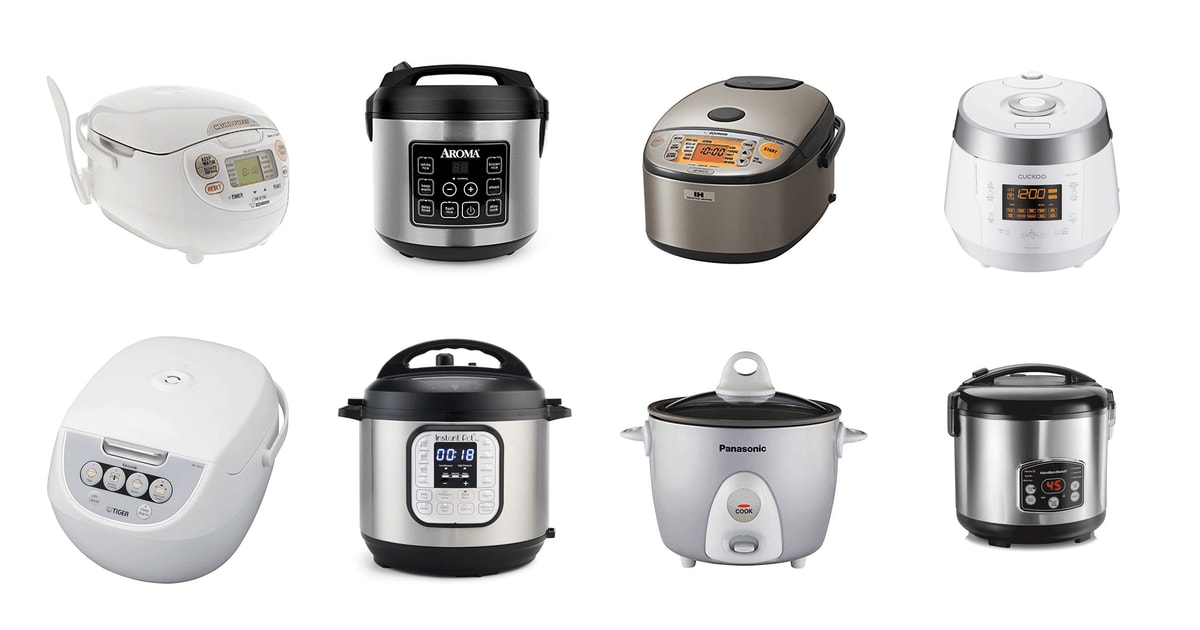
| Zojirushi Ns ZCC10 Neuro Fuzzy Rice CookerTop pick | 5.5 Cups Uncooked | 8 Menu Settings | $242.60 |
| Aroma Housewares 20 Cup CookedBudget pick | 10 Cups Uncooked | 5 Presets | $40.99 |
| Zojirushi NP-HCC10XH Induction Heating System Rice CookerUpgrade pick | 5.5 Cups Uncooked | Multi-Menu | $334On sale |
| CUCKOO High Pressure Rice CookerAlso great | 10 Cups Uncooked | 13 Modes | $279.99 |
| Tiger Jbv A10u 5.5 Cup Micom RiceRunner-up | 5.5 Cups Uncooked | 4 Cook Settings | $109.99 |
 | Instant Pot Duo 7-in-1 Electric Pressure CookerAlso consider | 8 Quarts | 7 Functions | $123.49 |
 | Panasonic Rice CookerAlso in lineup | 3 Cups Uncooked | One-Step Auto | $69.99 |
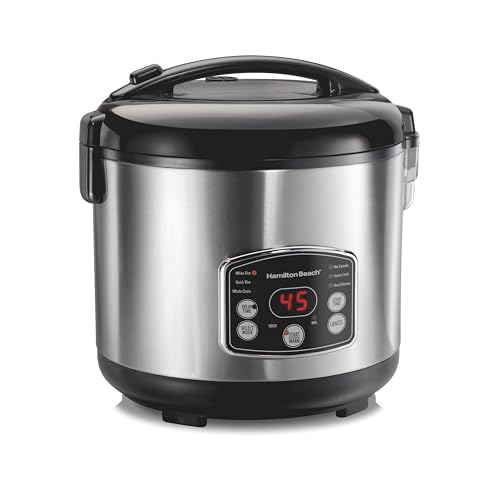 | Hamilton Beach Digital Programmable Rice Cooker &Also consider | 7 Cups Uncooked | 6 Settings | $66.95 |
How we picked
Cooking technology. We compared spec sheets to sort each cooker into basic thermostat, fuzzy logic microcomputer, induction, or pressure. Published testing from America's Test Kitchen and Serious Eats consistently shows a texture gap between the first tier and the rest, so we weighted anything above basic heavily.
Capacity that fits. We looked for a spread from small households to large ones, since buying the wrong size is the most common mistake. Underfilling a microcomputer cooker below its minimum line degrades results, so a too-big machine is a real problem, not just wasted counter space.
Keep-warm quality. We read manufacturer specifications for hold temperature and duration, and cross-checked against owner feedback about rice drying out. Premium models hold rice well past 12 hours; basic ones start degrading within two or three.
Pot durability. Good Housekeeping Institute testing found budget nonstick coatings showing wear within two to three years of daily use. We favored models where owner reports describe pots surviving several years, and flagged the ones where scratching comes up repeatedly.
Grain range. We checked which machines have dedicated programs for brown rice, sushi rice, porridge, mixed grains, and GABA. Brown rice in particular needs sustained heat above the boiling point that basic cookers frequently miss.
Top pick
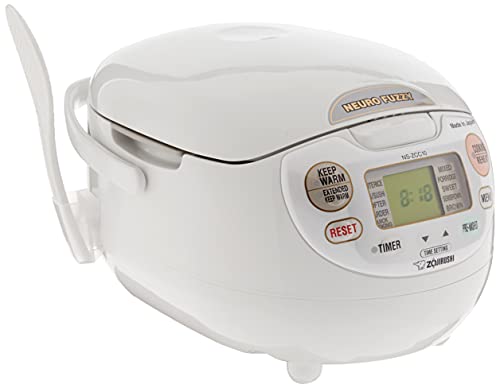
Smart enough to fix your mistakes, small enough to store
Zojirushi Ns ZCC10 Neuro Fuzzy Rice Cooker
The Neuro Fuzzy reads what's happening inside the pot and adjusts heat and time as it goes, so brown rice, sushi rice, and porridge all come out right. Its keep-warm holds rice for hours without drying it into a crust.
$242.60fromAmazonThis is the machine that stops rice from being a skill. A basic cooker applies heat until a thermostat trips, then quits. The Neuro Fuzzy's microcomputer watches temperature through the cycle and adjusts as it goes. So if you were a little heavy with the water, or the rice was older and drier than last bag, it compensates. America's Test Kitchen's blind tasters have rated rice from premium fuzzy logic cookers as excellent, against merely acceptable for the same rice in basic on/off models.
The menu covers more than you'd expect from a machine this size: white with softer and harder options, sushi, mixed grains, porridge, sweet rice, semi-brown, brown, rinse-free, and quick cooking. Brown rice is where you'll feel it most. Getting the bran layer to soften properly needs sustained high heat after the water boils off, and cheap cookers tend to give up right at that point. This one keeps going.
The delay timer runs up to 24 hours, which sounds like a gimmick until you use it. Load it before bed and there's hot rice waiting at breakfast. Or set it in the morning and walk in the door to dinner half-made. Owners who eat rice several times a week describe this as the feature that changed their routine, more than the texture did.
Keep-warm is the other quiet win. Zojirushi's specs put the extended keep-warm at roughly 140 to 149°F for up to 12 hours — above the food-safe line, and gentle enough that rice stays fluffy instead of turning into a yellow ring at the bottom. Basic thermostat cookers start drying rice out within two or three hours. If your household eats in shifts, this matters more than any menu setting.
It's also the smallest premium cooker here at around three pounds, with a retractable cord and a wall-mountable body. That's genuinely useful in an apartment kitchen. Consumer Reports owner surveys found more than 85% of Zojirushi and Tiger owners still had working units after seven-plus years, versus roughly 60% for budget brands — so counter space aside, you're probably not shopping again soon.
Flaws but not dealbreakers
The nonstick inner pan is the weak point, and owners say so. It scratches if you're careless, and metal utensils or aggressive scrubbing will shorten its life. Use the included plastic spoon and wash it by hand. Good Housekeeping Institute testing found nonstick coatings on rice cookers showing visible wear after two to three years of daily use, and this pan isn't magic.
It's slow. A full white rice cycle runs roughly 35 to 45 minutes, and quick cook still takes about 25. Brown rice takes considerably longer. If you're the kind of cook who decides on rice fifteen minutes before dinner, you'll be annoyed regularly.
The manual is long and repetitive, and you actually have to read it. The measuring cup that comes in the box is not a US cup, and using a standard measuring cup instead is the single most common way people get bad results out of an otherwise excellent machine.
The NS-ZCC10 comes with a one-year limited warranty.
Budget pick
Big batches and simple controls for a fraction of the money
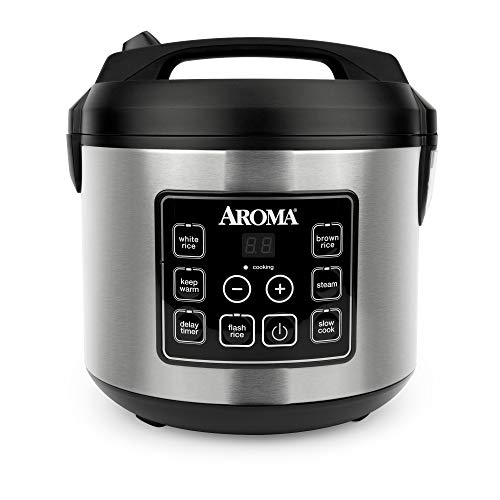
Aroma Housewares 20 Cup Cooked
The ARC-150SB cooks up to 20 cups of finished rice, steams vegetables on a tray above it, and slow-cooks a stew — all for a small share of what a Zojirushi costs. Texture isn't as refined, but for weeknight white rice it's more than fine.
$40.99fromAmazonMost people don't need a microcomputer to make good white rice, and this is the machine that proves it. Aroma's Sensor Logic adjusts internal temperature through the cycle, which puts it a clear step above a single-switch cooker. Jasmine and long-grain white rice come out fluffy and separate. It's one of the best-selling rice cookers on Amazon, and the owner feedback is remarkably consistent about that one core job.
The capacity is the real reason to buy it. Twenty cups cooked is a lot of rice — enough for a dinner party, a week of meal prep, or a household that goes through rice the way other households go through bread. Nothing else in this guide at anywhere near this price cooks this much. If you're feeding six people or batching for the freezer, this is a straightforward answer.
It's a genuine multi-cooker, too. There's a slow-cook setting, a steam tray that sits above the rice so vegetables or fish cook in the rising steam, and preset programs for white, brown, and flash rice. Brown rice takes about 45 minutes to an hour for a couple of cups, which is quick for the category. For a small kitchen that can only fit one appliance, that versatility counts.
Longevity is better than the price suggests. Owners report running these several times a week for the better part of a decade before the nonstick finally gives out and they replace it with the same model. That's not Zojirushi territory, but it's a long way from disposable.
Flaws but not dealbreakers
It's a big, tall machine — over 11 inches in every direction — and it weighs more than six pounds. On a small counter it's an imposing block. If you're cooking for one or two, you're buying capacity you'll never use, and underfilling below the minimum line hurts results.
Texture is good, not exceptional. Sushi rice and delicate short-grain varieties come out fine rather than distinctive, and there's no dedicated setting for them. Keep-warm works but doesn't hold rice as gracefully for many hours as the premium models do.
As with the Zojirushi, you must use the cup that ships in the box and the water lines molded into the pot. Owners who get bad results almost always turn out to have used a standard US measuring cup.
Upgrade pickOn sale
Even heat and better texture, if you're serious about rice
Zojirushi NP-HCC10XH Induction Heating System Rice Cooker
Induction heating warms the whole inner pot with an electromagnetic field instead of a plate under the bottom. That means fewer scorched grains at the edges and more consistent texture — plus GABA and germinated brown rice settings you won't find lower down.
$334fromAmazonList priceInduction is the meaningful upgrade over fuzzy logic, not just a more expensive version of it. A standard cooker heats from a plate underneath, so the bottom runs hotter than the top. IH turns the pot itself into the heating element. Serious Eats found this produces measurably more even temperature distribution and fewer scorched or undercooked grains. In practice, you get a pot of rice that tastes the same at the edge as it does in the middle.
The healthy-grain menu is where this pulls furthest ahead. Brown rice, GABA brown rice, and germinated brown rice each get their own program — GABA involves holding the rice at a specific warm temperature for a couple of hours to sprout it before cooking, which a basic cooker simply cannot do. If whole grains are the point of your rice cooker, this is the one.
It's rated at 1,230 watts against the Neuro Fuzzy's 680, and that extra power shows up as faster, more forceful heating. Owners who moved from a conventional Zojirushi describe the jump in texture as real but incremental — better, not transformative. Set expectations accordingly. You're paying a lot more for the last increment of quality.
Durability reports are strong. Owners running these several times a week for four or more years describe them as operating like new. Good Housekeeping Institute testing found the pots in premium models showed minimal degradation after five-plus years, against visible wear at two to three years on budget cookers — which shifts the long-term math in this machine's favor more than the sticker suggests.
Flaws but not dealbreakers
It's heavy — around nine pounds — and it takes a wide footprint at roughly 14 inches deep. This is a machine that lives on the counter permanently, not one you tuck into a cabinet between uses.
It's the most expensive dedicated rice cooker in this guide by a wide margin, and the improvement over the Neuro Fuzzy is a refinement rather than a revelation. If you mostly cook plain white rice, you will probably not be able to justify it.
Cleaning takes a bit more care than it looks. The inner lid and steam valve need regular attention, and owners recommend hand-washing the bowl and draining the valve after each use to keep smells from building up.
Also great
Pressure cooking for fluffier grains and faster cycles
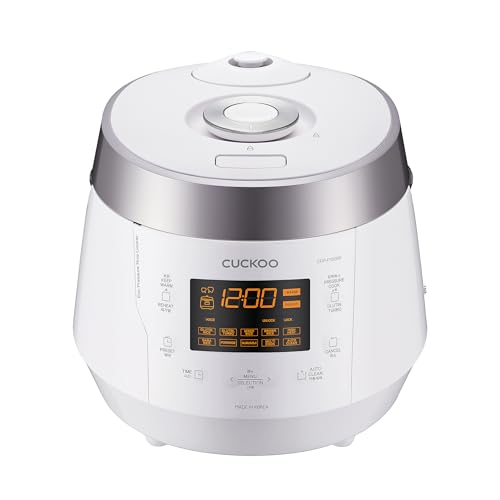
CUCKOO High Pressure Rice Cooker
Cuckoo's pressure-based system cooks rice above boiling point, which softens tough grains and cuts cycle time noticeably. It handles mixed grains, GABA, and even nurungji — the crisped rice crust — across 13 modes.
$279.99fromAmazonPressure changes what's possible with rice. Cooking above 212°F drives water into the grain faster and softer, which is exactly what stubborn brown rice and multigrain blends need. Cuckoo built its reputation on this: the company holds roughly half the rice cooker market in South Korea and supplies the Korean presidential residence. That's a long track record in a market that takes rice seriously.
Speed is the everyday benefit you'll actually notice. Pressure cycles run meaningfully shorter than conventional ones, which is a real quality-of-life change if rice is a weeknight staple rather than a weekend project. Owners who've switched from conventional Japanese cookers consistently name faster cooking as the thing they didn't expect to care about and now won't give up.
The mode list goes deeper than most Western kitchens will need — GABA and brown rice, glutinous and white rice, nurungji for the toasted crust at the bottom, multi-cook — and the steam release is designed to vent softly rather than hiss like a stovetop pressure cooker. Twenty cups cooked makes it a plausible pick for a large household as well.
Texture is the payoff. Rice comes out notably fluffy and evenly hydrated, and mixed-grain blends that turn out gritty in a conventional cooker cook through properly here. If your rice bowl regularly includes barley, millet, or beans, that's the difference.
Flaws but not dealbreakers
The voice prompts and some menu labeling lean Korean, and owners regularly flag this. If you don't read Korean or don't want a machine talking to you, it's a mild ongoing annoyance rather than a barrier.
It's the heaviest and bulkiest thing in this guide at 16 pounds and more than 15 inches deep. It also needs periodic maintenance — owners run the clean cycle with water and vinegar every week or two to keep odors from building up in the pressure seal and gasket.
Owner sentiment is a bit more mixed than for the Zojirushi models, with more reports of units failing after a few years. It's a more complex machine with more parts that can go wrong.
Runner-up
Japanese microcomputer cooking without the premium tag
Tiger Jbv A10u 5.5 Cup Micom Rice
The Tiger JBV-A10U uses microcomputer control to adjust heat mid-cycle, which is the core advantage of a smart cooker. It also cooks a main dish in a tray above the rice, so dinner finishes in one appliance.
$109.99fromAmazonThis is the compromise pick, and it's a good one. Tiger's Micom system senses temperature inside the pot in real time and adjusts heat output as the cycle runs — the same fundamental advantage the Zojirushi has over a basic cooker. You give up menu breadth and the finer keep-warm, not the underlying technology. For a lot of households that's exactly the right trade.
The tacook tray is a genuinely clever piece of design. A BPA-free tray sits above the rice and uses the same steam to cook vegetables or chicken, and Tiger tuned the cycle so the flavors don't cross. Owners cooking for one or two describe it as the thing that turned the machine from a rice cooker into a dinner appliance.
Reliability is where Tiger earns its place. Consumer Reports owner surveys put Tiger alongside Zojirushi, with more than 85% of owners reporting working units after seven-plus years — roughly 60% for budget brands at the same point. Several owners here describe years of steady use without trouble. That's a long time for a machine costing what this one does.
Settings are deliberately simple: plain rice, brown rice, slow cook, and steam. If you make white rice most nights and brown rice sometimes, four buttons is not a limitation. It's one fewer thing to think about.
Flaws but not dealbreakers
Brown rice is slow — owners report cycles running well past an hour. It works, but plan ahead rather than starting it when you're already hungry.
The inner pot is 1mm aluminum with a fluorine coating rather than the thicker spherical pan in the Zojirushi, and it's built in China rather than Japan. Owners who've handled both notice the difference in feel and finish. It cooks well; it just doesn't feel like the premium machines.
Unrinsed rice, particularly basmati, tends to leave starch residue around the lid area. Rinsing first solves it, but it's an extra step the pricier cookers handle more gracefully.
Who this is for
Buy one of these if you eat rice more than once or twice a week and you're tired of watching a pot. That's the threshold where a dedicated cooker pays off — not in money saved, but in attention you get back. It's also the right call if you cook brown rice, sushi rice, or mixed grains regularly, because that's exactly where stovetop cooking and cheap cookers fall apart. Households that eat at different times get a second benefit from a good keep-warm, which turns rice from a thing you time into a thing that's just there.
Skip it if rice shows up on your table a few times a year. A pot with a lid handles that fine, and a rice cooker is a large object to store for occasional use. This guide covers countertop electric rice cookers for home kitchens, plus one multi-cooker that does rice among other things. We're not covering commercial units, stovetop donabe, or the very large restaurant-scale machines, and we've deliberately kept the range wide — from a machine that costs about as much as a couple of takeout dinners to one that costs many times that.
How we picked
We started from a simple question: what actually separates a great rice cooker from a passable one? Cooking technology: whether the machine senses and adjusts temperature during the cycle, or just heats until a thermostat trips — published blind testing shows a clear texture gap between the two. Capacity: enough spread to cover a solo apartment and a family of six, since both buying too small and buying too big cause real problems. Keep-warm: how long rice stays fluffy and food-safe rather than crusting over, per manufacturer specs and owner reports. Pot durability: whether the nonstick or stainless inner pot survives daily use for years, not months. Grain range: dedicated programs for brown rice, sushi rice, porridge, and mixed grains, because those are the varieties that expose a weak machine.
Other rice cookers for home use worth considering
If you want a programmable cooker for very little money: The Hamilton Beach Digital Programmable Rice Cooker & ($66.95) — The Hamilton Beach 37548 does more than its price suggests. You get six preset programs — white rice, quick rice, whole grain, heat/simmer, steam cook, and hot cereal — plus an 11-hour delay start, which is the feature people usually have to spend much more to get. The steam basket doubles as a rinse basket, a small touch that saves a colander. Its ceramic nonstick pot is PFAS-free and removable. What you give up is refinement: texture is decent rather than excellent, and the keep-warm won't hold rice gracefully all afternoon. For a dorm room, a first apartment, or a household testing whether it wants a rice cooker at all, that's an easy trade.
If you want one appliance instead of three: The Instant Pot Duo 7-in-1 Electric Pressure Cooker ($123.49) — The Instant Pot Duo pressure cooks, slow cooks, steams, sautés, makes yogurt, and yes, cooks rice — seven functions in an 8-quart stainless pot that's genuinely good at most of them. More than 30 million have sold globally, and the owner base is fiercely loyal for good reason. But rice is one of the things it does least well. Without dedicated grain sensing, delicate short-grain and sushi rice come out inconsistent, and there's no keep-warm tuned to hold rice for hours. If you'd cook rice a few times a month and braise short ribs the rest of the time, the trade makes sense. If rice is the main event, it doesn't.
The competition
These are the machines the research surfaced alongside our picks — not a survey of everything on the market. Rice cookers are a crowded category, and plenty of capable models from Toshiba, Yum Asia, and others didn't come up in the reviews and owner feedback we worked from. What follows is what we can speak to.
The Panasonic Rice Cooker ($69.99) — The Panasonic SR-G06FGL is a small, simple, one-button cooker that makes 6 cups of finished rice — right for one person or a couple. Owners describe running these for years, sometimes decades, before the nonstick coating finally forces a replacement, and Panasonic's basic cookers have a genuinely long reputation. But it's a basic thermostat machine with a glass lid and no programs, no delay timer, and no real keep-warm strategy. Against the Hamilton Beach, which costs less and offers six programs plus a delay start, it's hard to argue for. Choose it if you want the fewest possible controls and a compact footprint, and you don't care about brown rice or timers.
Care and maintenance
The inner pot is the part that fails first, so treat it gently. Use the plastic or wooden spoon that came with the cooker, never metal, and wash by hand with a soft sponge — dishwashers and abrasive pads are what turn a five-year pot into a two-year pot. Soak stuck-on rice rather than scraping it. The inner lid and steam vent need attention too: rinse them after each use, because starchy residue builds up there and eventually smells. If your machine has a removable inner lid, take it off and wash it properly at least weekly. Pressure models like the Cuckoo benefit from a periodic clean cycle with water and a splash of vinegar to keep the gasket fresh. And always measure with the cup that shipped in the box, not a standard US measuring cup — the two are different sizes, and mismatching them is the most common cause of bad rice.
Questions we get
Is an expensive Zojirushi actually worth it over a basic model?
It depends on what you cook. For plain white rice a few times a week, a good budget cooker gets you most of the way there. The premium models pull ahead on brown rice, sushi rice, and long keep-warm — and Consumer Reports surveys found over 85% of Zojirushi and Tiger owners still running their units after seven-plus years, versus around 60% for budget brands. Spread across that lifespan, the gap narrows a lot.
What is the difference between fuzzy logic and induction heating?
Fuzzy logic describes the brain: a microcomputer that senses temperature during the cycle and adjusts heat and timing instead of running a fixed program. Induction heating describes the heat source: an electromagnetic field that warms the entire inner pot rather than a plate under the bottom. Serious Eats found induction produces more even temperature distribution and fewer scorched grains. Most induction cookers also use fuzzy logic — induction is the upgrade layered on top.
What size rice cooker do I need for a family of four?
A 5.5-cup uncooked model is the standard answer, and it's a good one. That yields roughly 10 to 11 cups of cooked rice, or about five to seven servings. Both the Zojirushi models and the Tiger sit at this size. Go bigger only if you regularly host or batch-cook, since underfilling below the minimum line actually degrades results in microcomputer-controlled cookers.
Are Korean pressure cookers like Cuckoo better than Japanese brands?
Different, not strictly better. Pressure cooking above the boiling point softens tough grains and cuts cycle time, which makes Cuckoo excellent for brown rice, multigrain blends, and GABA. Japanese induction models tend to win on plain white and sushi rice texture and on long-term reliability reports. Pick pressure if you eat a lot of whole and mixed grains, or want faster cycles.
Can a rice cooker make oatmeal, quinoa, and congee?
Yes, and most people underuse this. The Zojirushi has a dedicated porridge setting that handles congee and steel-cut oats well. The Hamilton Beach has a hot cereal program, and the Aroma slow-cooks. Quinoa generally works on a white rice setting with slightly less water. Grains with very different water ratios may need a round or two of adjusting before you land on your numbers.
How long should a good rice cooker last?
A premium Japanese or Korean model should run seven to ten years or more with regular use — Consumer Reports found over 85% of Zojirushi and Tiger owners still had working units past seven years. Budget models more commonly land in the three-to-six-year range, and the nonstick pot usually gives out before the electronics do. Hand-washing the pot and avoiding metal utensils is the single biggest thing you control.
Why you should trust us
For this guide:
- We read published evaluations from Wirecutter, America's Test Kitchen, Serious Eats, Good Housekeeping Institute, and Bon Appétit, along with Consumer Reports owner satisfaction data on long-term reliability.
- We compared manufacturer specifications for every model here — capacity, wattage, menu programs, keep-warm temperature and duration, inner pot material, and warranty terms.
- We read through owner feedback for each product looking for repeated themes about pot coating wear, cycle times, cleaning hassles, and how rice holds up on keep-warm.
- We read owner reviews on every listing, weighted toward the critical ones, because that is where the recurring failures show up.
- We have a systematic way of automatically fetching the latest prices, so the numbers on this page stay current.
- This is a research-focused guide, so the team may not own every product listed — though we often do own the top winners, which gives us extra context for the recommendations.
- We don't accept free products, and the retailer commission never changes which product we recommend.
Sources
The Best Rice Cookers — Wirecutter (New York Times), Wirecutter
Rice Cooker Equipment Reviews — America's Test Kitchen, America's Test Kitchen
Best Rice Cookers — Serious Eats, Serious Eats
Best Rice Cookers — Consumer Reports, Consumer Reports
Best Rice Cookers of 2026 — CNET, CNET
Best Rice Cookers — Good Housekeeping Institute, Good Housekeeping
Best Rice Cookers — The Spruce Eats, The Spruce Eats
Best Rice Cooker Picks — Bon Appétit, Bon Appétit
Best Rice Cookers Tested — Reviewed (USA Today), Reviewed (USA Today)
Best Rice Cookers — The Kitchn, The Kitchn
Global Rice Cooker Market Size & Forecast — Statista, Statista
Amazon product listings and owner reviews for all 8 products
Manufacturer specification pages for each product
Some passages in this guide may be paraphrased with AI help. Prices are refreshed automatically.
More like this.
Continue exploring home reviews and recommendations.

The Best Fuzzy Logic Rice Cookers
Rice is easy to cook badly. A cheap on/off cooker heats until a thermostat trips, which works fine for plain white rice on a good day and leaves you with…

The Best Professional Hair Dryers for Home Use
A hair dryer is one of the few tools you might hold in your hand for 20 minutes a day, several days a week, for years. That changes what matters. Weight…

The Best Dehumidifiers for Home Use
Damp air is easy to ignore until it isn't. You smell it first - that flat, earthy basement smell that gets into stored boxes and winter coats. Then you…

The Best Red Light Therapy Devices for Home Use
Red light therapy sounds exotic, but the routine is dull in the best way. You sit or stand in front of a panel for 10 to 20 minutes, a few times a week,…

The Best Pizza Ovens for Home Use
A home oven tops out around 500°F. That's the whole problem. At that heat the dough dries out before the top browns, and you get a cracker with toppings…

The Best Heated Cat Beds for Outdoor Winter Use
When the temperature drops below freezing, an outdoor cat's night gets genuinely dangerous. Veterinary guidance puts hypothermia risk on the table once…